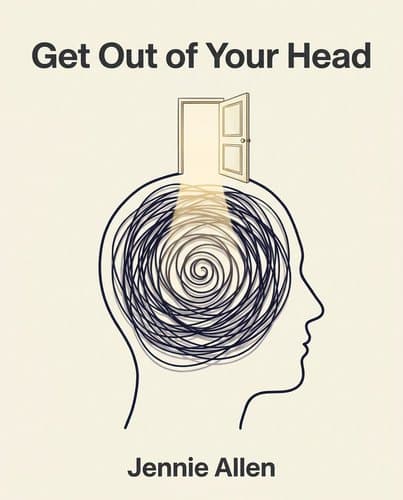
52780142_get-out-of-your-head
by Jennie Allen
Every spiral traces back to one of three lies—"I'm helpless," "I'm worthless," or "I'm unlovable"—and learning to name the lie the moment it starts is the…
In Brief
Get Out of Your Head (Janu) maps the mechanics of mental spirals — tracing how a single thought cascades into emotion, belief, and lifestyle — and delivers a precise intervention framework rooted in Christian theology and neuroscience.
Key Ideas
Trace spirals to their source thought
When a spiral starts, locate the thought feeding the emotion — not the emotion itself. The chain runs: thought → assumption → emotion → belief → action → habit → lifestyle. You cannot fix downstream symptoms by treating downstream symptoms. Go upstream.
Name the three core lies
Every toxic thought eventually collapses into one of three lies: 'I'm helpless,' 'I'm worthless,' or 'I'm unlovable.' When you feel the spiral, name which lie is running. Naming it is the first move.
Choice as spiritual interruption
Keep one interrupting thought ready: 'I have a choice.' Use it the moment you recognize a spiral beginning. It works not as positive thinking but as a theological statement — a reminder of what the Spirit's presence in you actually means about your capacity to choose.
Replace what-ifs with God promises
Convert every anxious 'What if?' into 'Because God' — then fill in the specific scriptural promise that answers the specific fear. Research suggests 97% of what you worry about never happens; truth aimed precisely at the lie is the counter-weapon, not comfort.
Speak the last two percent aloud
Say the last 2 percent out loud to someone you trust — the thing you haven't told anyone. The 'last 2 percent' holds more power in silence than it will in the light. One woman in the book reports that speaking a secret attraction out loud ended the attraction immediately.
Mission breaks the chains first
Don't wait to feel spiritually ready before serving others. Hebrews 12 runs in the opposite order from what you assume: you run the race, and as you run with eyes on Jesus, sin loses its grip. The mission breaks the chains — the chains don't break before the mission.
Thoughts build neural highways through repetition
The seven thought shifts (noise→stillness, isolation→community, anxiety→trust, cynicism→worship, self-importance→humility, victimhood→gratitude, complacency→service) are training to repeat, not feelings to achieve. Neuroscience confirms: one thought rewires the brain in ten minutes. Repeated thoughts build highways.
Who Should Read This
People working on personal growth in Christianity and Mental Health, especially those tired of generic motivational advice.
Get Out of Your Head
By Jennie Allen
9 min read
Why does it matter? Because your anxiety, your dark moods, and your worst spirals are all following the same script — and the exit is one thought away.
Most attempts to fix anxiety start in the wrong place. We go after the feelings — trying to manufacture more peace, more faith, more whatever we're told we need — while the actual problem runs a layer deeper. Jennie Allen spent eighteen months waking at 3am in panic, trapped in a spiral she couldn't break, before she understood: what she was fighting wasn't primarily emotional. It was cognitive. Emotions, it turns out, are downstream. They're output, not input. And once she could trace how a thought becomes an emotion, she could locate the precise place to break it. Not through willpower. Not through feeling your way to freedom. Through one interrupting thought that functions as a door into an entirely different operating system.
The Spiral Isn't Random — It Follows a Chain You Can Break
One morning Jennie Allen woke up intending to write. First, she thought, she'd spend time with God. So she picked up her phone. A critical email caught her eye. Then Instagram pulled her in, and within minutes she was measuring her unfinished work against other people's polished wins. By the time her husband Zac walked in, cheerful from actually spending time with God, she had already decided she was an inadequate writer, that her whole career was a waste, that she had nothing to say. She snapped at him. The whole collapse took under an hour.
You probably know some version of that sequence. What's less obvious is the mechanics underneath it. Allen traces what happened: the email triggered unease, the unease produced a thought (I don't measure up), that thought drove a decision — keep scrolling — which shaped a behavior, which poisoned the nearest relationship, which fed the original feeling. Around and around, each loop pulling tighter.
The conventional move when you're trapped in that loop is to work on the feelings. Allen says that's the wrong target. Scripture's command isn't to manage your mood; it's to "be transformed by the renewal of your mind," because the chain starts there. Feelings are a by-product of thought, not the source. The email didn't wreck her morning; the thought it seeded did. And unlike a raw feeling, a thought is something you can actually work with.
That repositions the whole problem. The entry point isn't the anxiety or the sadness. It's upstream, at the thought that generated them. Which means the spiral, for all its force, has a seam, and the seam is earlier than most people think to look.
Your Biggest Threat Doesn't Announce Itself — It Numbs You
The most dangerous attack on your mind will never feel like an attack.
At a Baptist church in Little Rock, Jennie Allen experienced spiritual warfare in its most obvious form. She'd just delivered a bold talk warning several thousand women about a real enemy. Afterward, alone in the foyer, a stranger approached — warm-looking, until she wasn't. The woman's face changed. She leaned in close and whispered: Allen needed to stop speaking about them. They were coming. Minutes later, screaming erupted in the hallway. Then every light went out: the sound system, the giant screens, everything dark at once. Sunny afternoon, heavily staffed, megachurch with redundant backup systems. The pastor said afterward it had never happened before.
Allen left that day burning with certainty. The experience was unambiguous: God was real, the enemy was real, she was in the right fight. Then the 18 months that followed nearly erased all of it. Each night around 3 a.m., she'd wake to a thought that seemed small at first — Is God real? — and lie there as it quietly expanded. No screaming, no power failures. Just a question that grew heavier each night until doubt had hollowed out something she'd spent decades building. By the bottom of the spiral, nothing felt like it mattered at all.
That's the actual strategy. Allen writes that the enemy rarely needs the dramatic assault — he more often works by numbing, seducing with comfort and small distractions until the person can no longer locate what they've lost. The foyer encounter required effort. The 3 a.m. erosion ran itself.
A therapist friend named Christina sharpens the mechanism: every lie a person believes about themselves, all three hundred on a bad day, collapses into one of three. I'm helpless. I'm worthless. I'm unlovable. That's all the erosion needs. The lies don't arrive announced; they accumulate, quietly confirming each other, until they've built the whole story. She knew the mechanism. She hadn't yet found the break.
God Sent the Same Verse Twice — 10,000 Miles Apart
The room was small, un-air-conditioned, and sitting in a remote corner of Uganda. Jennie Allen had flown there with two close friends, Ann and Esther, to visit refugee camps. She had told neither of them about the 18 months of 3 a.m. panic, the doubt, the daily erosion of everything she'd built her life on. She had been carrying it alone.
Then a local official opened their pre-meeting devotionals and began to read. In a thick accent, he chose — out of every psalm and letter and prophecy in Scripture — Psalm 139, the psalm about God's presence even in the darkest places. The exact words Allen had been whispering in the dark every sleepless night for a year and a half. Where shall I go from your Spirit? If I make my bed in the grave, you are there. Hearing them land in that sweltering room, spoken by a man whose first language wasn't English, ten thousand miles from her bedroom, she couldn't hold it. She excused herself, fell apart, and finally told them everything.
Ann heard her out. Then she said something almost too simple: "Jennie, this isn't who you are. I know your faith. This is the enemy."
Allen connects what happened next to a moment in Acts. After Paul's blinding encounter with Jesus on the road to Damascus, he sat in darkness for three days, eating nothing, seeing nothing. Then a disciple named Ananias arrived and spoke a word of restoration. Paul's sight returned. Something physical had broken free. Allen says Ann did the same thing for her. Lies survive in isolation because no one is there to name them false. A person who knows you well and refuses the story the darkness has been writing about you is the antidote. Ann had no strategy or technique. She simply named what was true when Allen had lost the ability to see it.
Two things finally broke it: a verse that found Allen twice, once in her bedroom and once in Uganda spoken by a stranger, and a friend who refused to let the lie stand. The pattern holds: the lie needs isolation to survive; truth needs a witness to land.
Allen learned it the hard way. If you've been trying to think your way out alone, that's the piece that's missing.
You Don't Have to Catch 30,000 Thoughts — Just One
You don't have to capture every thought — you just have to capture one.
That reframe matters because the math is brutal. Thirty thousand thoughts across sixteen waking hours works out to roughly thirty-one per minute. No spiritual discipline handles that load. Allen uses the arithmetic not to discourage but to expose a wrong assumption: Paul's command to "take every thought captive" was never a call to patrol all thirty-one. It was a call to find the one thought capable of interrupting the chain, the master thought that redirects everything downstream.
That thought is three words: I have a choice.
Not a mantra. A theological statement. If you have the Spirit of God, the same power that raised Jesus from the dead, then you are no longer subject to your emotions, your genes, your circumstances, or your thoughts. You possess a God-given, God-empowered ability to choose where your mind goes next. The thought "I have a choice" doesn't generate willpower; it recognizes what the Spirit has already made possible. Allen is direct about what this cost her to learn: for eighteen months, she felt like a victim of her own doubts. For years before that, her eating disorder ruled her. What broke each spiral wasn't a technique — it was realizing she had been given authority over her own mind and had never used it.
Neuroscience supplies the mechanism. Dan Siegel found that inside each of the brain's eighty-six billion neurons, tiny structures called microtubules constantly build and dismantle scaffolding in response to every thought. From the moment you think something to the moment it has physiologically altered your brain: ten minutes. Which cuts both ways. Years of negative thinking have been rewiring your brain, but the reversal begins within ten minutes of thinking something different. What felt permanent, Siegel found, isn't. Mental effort physically rewires the scaffolding.
The spiral isn't a verdict. Every time you catch yourself in one, the interrupting thought is the same: I have a choice. And that choice, the moment you make it, is already rebuilding something.
Self-Help Can Improve You. Only Something Outside You Can Replace You.
Allen built a simple practice: name the emotion, take it to God, look for the thought underneath. On the surface, very little separates it from any other self-help program.
Allen's argument isn't that self-help doesn't work. It's that it works on the wrong thing — behavior rather than source. The best it can do with a spiraling thought is tell you to stop. Reject it. Declare today different. Which is exactly how willpower fails by noon. The thought gets suppressed, not transformed.
Her framework catches the thought the same way any self-help program does. But then it does something no program can: submit that thought to something outside. Not a better narrative. Not a more optimistic reframe. An outside force that doesn't improve you so much as replace what's dying. Allen's image for this is botanical: you don't go from a wilting spruce to a healthier spruce. You become a pear tree. The species changes. That's not modification — that's new creation. And no amount of journaling produces it alone.
Anxiety Runs on Two Words — and So Does the Cure
Think of anxiety as a machine with a single starter motor. The worries look different — your marriage, your health, your career, your kids making poor decisions — but underneath each one, the same two words are spinning the ignition: What if? What if it falls apart? What if I'm not enough? What if the worst happens? Allen's insight is that because every anxiety runs the same engine, every anxiety has the same kill switch.
The counter is also two words: Because God. Because God clothes the grass and feeds birds that don't file taxes, you don't need to spin out about tomorrow. Because God has already poured his love into your heart, your hope won't collapse under pressure. Because God chose the method of your salvation, you can stand in whatever the day brings. The formula redirects: it moves the question from an imagined future to an established fact.
Allen cites a figure: 97 percent of what you worry about never actually materializes. Anxiety is mostly fiction, a vivid story your brain tells about a future that doesn't exist yet. Allen draws on John 8, where Jesus describes the enemy as a liar with no truth in him at all. If the source of anxious thoughts is constitutionally incapable of truth, then the precise weapon isn't reassurance or distraction — it's truth, aimed directly at the specific lie.
Allen builds a list from that logic. Name the fear out loud (I'm afraid of being found out) and counter it with what's actually true: God knows every thought you've ever had and loves you anyway. Six specific pairings cover the fears most people carry silently: failure, abandonment, inadequacy, rejection, people-pleasing, public disgrace. The work isn't finding the right emotion about each fear. It's identifying the lie the fear is running on and replacing it with something real enough to stand on.
'I Trusted My Training': Freedom Is a Discipline, Not a Destination
Shane Kimbrough used to be afraid of heights. Then, on the morning of a space launch, strapped into a capsule atop rockets about to blast to 17,500 miles per hour, he fell asleep. His colleagues had to shake him awake. The man who once flinched at ladders had trained himself so thoroughly that his nervous system treated "about to be launched into orbit" as an ordinary Tuesday.
The real test came months later. Already four months into a mission — separated from his family, sleeping in a soundproofed booth the size of a phone box, losing bone mass at one percent per month — he learned the mission was being extended. Not by days. By two months. His wife was waiting. The crew ached to go home. They were not going home.
When Allen asked how he coped, Kimbrough gave her four words: "I trusted my training."
That's Allen's closing argument for the entire book. Everything before it — choosing stillness over distraction, community over isolation, gratitude over victimhood, service over complacency — was never meant to be inspiration. It was meant to be practice. You don't decide to trust your training in the middle of a crisis. You trust it because you built it before the crisis arrived.
Allen maps the progression explicitly. A newly learned mind redirect starts as possible — you have to consciously interrupt the spiral, remember you have a choice, force the turn. Do it enough and it becomes probable, then predictable, then entirely instinctive. The Uganda moment — the verse that found her twice, the friend who named the lie — didn't end the work. It started the construction.
Allen's final instructions aren't about feeling differently. They're operational: get into Scripture before you get on your phone, start mornings on your knees, invest in relationships you'll actually call when the spiral begins. Not because any single practice is magic, but because the trained mind under pressure defaults to what it rehearsed. Kimbrough called his wife, finished his task, and returned home two months late without losing himself.
Not someone who never feels the wind — someone who has practiced looking somewhere else long enough that the wind no longer decides where they go.
What a Freed Mind Does Next
The freed mind doesn't stay with the person who freed it. That's what Allen saves for last — not comfort, but weight. She writes at 3 a.m. now without the old terror, and offers her own mind as evidence the ground can actually shift. None of it begins with dramatic change — it begins with one person, across seven domains, building the reflex to choose differently: stillness over noise, community over isolation, trust over anxiety, worship over cynicism, humility over self-importance, gratitude over bitterness, service over complacency. The practice is yours. But the outcome was never only yours. The question underneath everything: who is watching you closely enough right now to catch the freedom in what you're becoming?
Notable Quotes
“take every thought captive to obey Christ.”
“Help. Tell me what to do!”
“I don't want to live anxious,”
Frequently Asked Questions
- What is "Get Out of Your Head" about?
- "Get Out of Your Head" by Jennie Allen "maps the mechanics of mental spirals — tracing how a single thought cascades into emotion, belief, and lifestyle." The book combines Christian theology and neuroscience to equip readers to "identify the three core lies driving anxiety, interrupt spirals at the source, and build new thought patterns through repeatable practice." The core principle: "You cannot fix downstream symptoms by treating downstream symptoms. Go upstream." This upstream approach targets the original thought feeding the entire cascade rather than treating downstream effects.
- What are the three core lies in "Get Out of Your Head"?
- Every toxic thought in "Get Out of Your Head" eventually collapses into one of three lies: 'I'm helpless,' 'I'm worthless,' or 'I'm unlovable.' The book states: "When you feel the spiral, name which lie is running. Naming it is the first move." Recognizing which core lie underlies your anxiety allows you to target your response precisely. This naming practice interrupts the spiral at the thought level, before it cascades into emotion, belief, and lifestyle patterns. Identifying the specific lie is the first upstream intervention in the chain.
- How does the "I have a choice" technique work in "Get Out of Your Head"?
- Keep one interrupting thought ready: 'I have a choice'—use it the moment you recognize a spiral beginning. The book states: "It works not as positive thinking but as a theological statement — a reminder of what the Spirit's presence in you actually means about your capacity to choose." When anxiety or negative thoughts spiral, this phrase interrupts the automatic cascade from thought to emotion to belief. It functions as a reset button grounded in Christian theology, enabling you to exercise agency and step out of automatic mental patterns immediately.
- What are the seven thought shifts in "Get Out of Your Head"?
- The seven thought shifts are noise→stillness, isolation→community, anxiety→trust, cynicism→worship, self-importance→humility, victimhood→gratitude, and complacency→service. According to Allen, these are "training to repeat, not feelings to achieve." The book emphasizes that "one thought rewires the brain in ten minutes. Repeated thoughts build highways." Rather than waiting to feel spiritually ready before acting, practicing these shifts gradually transforms mental patterns. Neuroscience confirms that intentional, repeating thought practice creates lasting neural and behavioral change.
Related Book Summaries



Read the full summary of 52780142_get-out-of-your-head on InShort