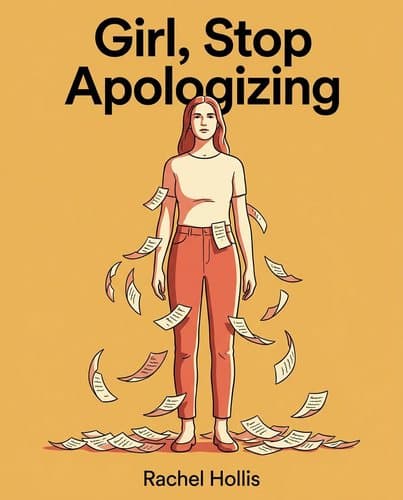
40591267_girl-stop-apologizing
by Rachel Hollis
Women are conditioned to shrink their ambitions to fit other people's comfort—Rachel Hollis shows exactly how to unlearn that programming and build the habits…
In Brief
Girl, Stop Apologizing (Marc) challenges women to identify and discard the cultural conditioning that teaches them to subordinate their ambitions to others' approval. Rachel Hollis delivers a practical framework for goal-setting, backward planning, and habit-building — giving readers concrete tools to pursue their own ambitions clearly and without guilt.
Key Ideas
Trace limiting beliefs to their source
Before accepting any excuse as true, ask: 'Did I choose this belief, or was it handed to me?' Childhood attention-seeking patterns and gendered social conditioning create the feeling of personal limitation — recognizing the source is the first move toward dismantling it.
Yet unlocks your growth trajectory
Add 'yet' to every limiting self-description: 'I'm not a goal-oriented person yet' converts a fixed identity into a trajectory. The word 'yet' is your potential, your promise, your next step.
Write dreams in present tense daily
Write your ten dreams in the present tense daily — 'I have X,' not 'I'm going to have X.' Your subconscious solves for present-tense outcomes; future-tense language turns goals into to-do items your brain ignores.
Choose one goal, not five
Pick one goal, not five. Surrounding your real dream with a buffer of lesser possibilities is an exit strategy disguised as ambition. The question isn't 'which goals do I have?' — it's 'which one will move me toward my ten-year vision fastest?'
Build plans backward from finish line
Build your plan backward from the finish line: identify three guideposts (major milestones without which the goal is impossible), then nest mile markers under each. Avoid 'wildflowers' — tasks that feel productive but don't advance any guidepost.
Name your help, don't hide it
Catalog your actual help honestly, then ask for more. The gap between the assistance you use and the 'I figured it out alone' story you tell is where other women get hurt. Naming your help isn't weakness — performing its absence is.
Preparation disarms guilt and doubt
When the people closest to you are unsupportive, prepare before you see them: know your why, anticipate the specific comments, have responses ready. Guilt is the mechanism of sabotage, not the naysayers themselves — preparation reduces guilt's leverage before it strikes.
Who Should Read This
People working on personal growth in Goal Setting and Self-Improvement, especially those tired of generic motivational advice.
Girl, Stop Apologizing
By Rachel Hollis
11 min read
Why does it matter? Because the excuses keeping you small weren't your idea in the first place.
Here's what you've been telling yourself: you don't follow through because something is slightly off about you — not enough drive, not enough discipline, maybe just not the kind of person who does hard things. That story feels true because it's been in your head so long it sounds like your voice. But it isn't yours. It was installed, piece by piece, from the moment you learned that the fastest way to get love was to shrink, comply, and make everyone around you comfortable. The excuses keeping you stuck (no time, not enough, too scared of what they'll think) aren't character flaws. They're the predictable output of a system that trained you to earn your place by making yourself useful to others. Rachel Hollis names that system with the specificity of someone who lived inside it for years — and then clawed her way out, loudly and imperfectly (she spent five years hiding her real life online before a Facebook comment section tore the whole thing open).
Your Excuses Were Installed, Not Chosen
In Hollis's house, love came through accomplishment. Do the thing, earn the approval. She didn't choose that wiring — she ran a toddler's experiment and never stopped.
Hollis argues that's exactly what happens with ambition. The guilt women feel when they pursue something for themselves, the shrinking, the "who am I to want this," didn't come from their character. It was built in before they were old enough to notice. Blaming yourself for it is like blaming yourself for not speaking a language no one ever taught you.
The mechanism: as toddlers, we all discovered that attention equals love, then figured out what strategy got us more of it. Affection got you comfort. Making people laugh got you noticed. Achievement got you praise. Illness got you your mother's undivided care. Rage, at least, got you something other than being ignored. Each child ran the experiment and kept doing what worked. The strategies hardened into habits, and habits no one interrupts become the unconscious software running the adult. The overachiever who cannot rest. The woman perpetually in crisis. None of them chose this.
The childhood patterns explain half the cage. The other half is gendered. Layered on top is a social script: your value is entirely relational. A good mother means her children are happy. A good wife means her husband is thriving. Nobody stands outside church on Sunday and says, There goes Becca — she's devoted to self-care. What a good mama. The score is kept entirely in other people's contentment.
Stack those two things on top of each other — childhood patterns that made you desperate for approval, and a culture that defined female goodness as the approval of others — and you don't get a personal flaw. You get a cage that was built around you while you were sleeping.
Hiding Your Ambition Doesn't Protect You — It Convinces You You're Wrong
When a reader asked Hollis in a Facebook comment how she managed to "do it all," she typed back an honest answer: her husband stayed very involved, and they had a nanny who helped with the kids while she worked. Simple. She didn't think twice.
What followed was immediate and vicious. "What kind of mother lets someone else raise her children?" "Only a selfish bitch would choose work over family." The attacks came from strangers in comment threads, yet they hollowed her out — because the girl who had spent her childhood desperate to belong was still in there, and she could not stand the idea of being cast out by her own audience.
So she went quiet. Not just about the nanny — about everything. Her company with five full-time employees. Her sixty-plus-hour weeks. Her business trips and her housekeeper and the fact that her "little blog," as she described it to people, was reaching millions of readers every month and pulling in six-figure revenue. She had built something real, and she buried all of it.
She thought she was protecting herself. She was doing something far worse.
Brené Brown draws a line between guilt and shame that cuts here. Guilt: I made a mistake. A behavior you can change. Shame: I am a mistake. An identity you have to hide. Every time Hollis waved off her company as a hobby, she wasn't just managing how she appeared to strangers. She was casting a private vote: what I'm concealing must be wrong. Do that often enough, over five years, and the hiding stops feeling like a strategic choice. It starts feeling like the honest account.
That's the trap concealment sets. You don't start out ashamed of your ambition — you start out afraid of other people's reactions, which feels like a manageable, external problem. Just don't hand them anything to react to. But the secrecy you think of as strategy gradually trains you to see yourself through the critics' eyes. Hollis kept producing meticulous parenting content and Pinterest-perfect recipes not because that was who she was, but to prove to an invisible jury that she hadn't abandoned who they needed her to be. She wasn't living her own life. She was defending herself against a verdict she'd already half-accepted.
Five years of it came with constant anxiety attacks. That's what it costs to run a six-figure company while pretending it's a hobby.
She didn't start hiding because she was ashamed. She became ashamed because she was hiding. You cannot spend five years treating your own life like a secret without eventually concluding, somewhere you don't quite examine, that your life deserves to be one.
Society Raised Boys to Chase What They Want and Girls to Chase the Boys
She was eleven years old, standing in a cramped dining room with stained carpet and a secondhand table, looking at a birthday cake baked from a box in an old Pyrex dish. Her parents had separated again — her siblings had stayed with her father in the family home, and she'd moved into a run-down apartment with her mother. No decorations. A handful of school friends stood around. The whole scene announced one thing clearly: this is what not having money looks like.
Rachel Hollis made a vow in that room. Not the soft, wistful kind you make and forget. She stood there and promised herself, with a ferocity she'd carry for years, that she would be wealthy — that she would never live this way once the choice was hers to make.
The world had a response ready for girls who said things like that out loud.
When she started her company in her twenties, people saluted her drive. When she got pregnant, those same people immediately asked when she'd be quitting. The business had just been a hobby, they'd collectively decided — something to fill the time before her real purpose arrived. When her husband's income made it clear she didn't financially need to work, the passive comments sharpened into open disapproval.
Hollis describes what happened to her under that sustained pressure with an image that sticks: sea glass. A jagged piece thrown into the ocean, worn smooth by years of waves and sand until all its edges are gone and nothing about it looks like what it used to be. She thought that process was the world improving her. Later she understood it was the world erasing her.
The message that ambition is somehow wrong, or at least unseemly, in a woman isn't a truth about ambition. It's a rule that was installed, and like all installed rules, it's most effective when the person wearing it stops noticing the fit. Society raises boys to pursue what they want and girls to pursue the boys. That's a design, not a fact of nature. None of the women worth admiring spent their energy making sure their ambition was politely sized.
Hollis claims the word now. She calls herself a mogul. No joke, no disclaimer. The word fits, and she's done softening it. She's ambitious. She wants to build, to earn, to be recognized for what she creates. Saying so isn't a confession. It's just a fact she stopped apologizing for.
There is a difference between gratitude and acceptance. You can be grateful for your life and still refuse to accept its limits.
The Dream You Keep Circling Is the Real One — Everything Else Is an Escape Hatch
The list of things you "might want to do someday" isn't evidence of an open mind. It's a trapdoor. Every great idea you stack on top of your real dream gives you a place to land when that dream gets hard enough to quit.
Hollis is direct about the mechanism: when she asks women to describe their ambitions, they reliably produce catalogs: write a book, launch a podcast, get a real estate license, rescue shelter animals, maybe start a nonprofit. She asks the same question every time: if you could only pursue one of those for the next decade, which would it be? They always have an answer. Always. Which means the list isn't about genuine uncertainty. It's about protection. If there's a plan B, quitting plan A doesn't feel like quitting. It feels like pivoting.
The fix she offers is a framework she calls 10, 10, 1. Start by imagining the best version of yourself ten years from now, specific enough to describe how you speak to the people you love and what your week actually looks like. From that vision, extract ten dreams that, if achieved, would make it real. Then pick the single one that moves you toward that future the fastest.
Those ten dreams get written in a notebook every morning, phrased as current facts rather than future intentions. The reasoning is mechanical: telling your brain "I'm going to save $5,000" parks the goal in the future, which is where the brain leaves it. Writing "I have $5,000 saved" gives the subconscious a present-tense problem to solve. The difference sounds like a grammar lesson. The outcome is different.
Her own list included "I only fly first class" — not for the wine or the early boarding, but for the seat space so she could write with a laptop on her knees without a stranger reading over her shoulder. She wrote that sentence every morning for six months before having what she describes as an embarrassingly obvious realization: she could simply tell speaking clients that first-class travel was part of her fee. She did. No one objected. The subconscious had been working on the problem for half a year; the solution was sitting right there.
Once you have the one goal, her planning method runs in reverse. Start at the finish line, work backward to three major milestones, which she calls guideposts, then fill in the smaller steps beneath each one. Three, not thirty, because the constraint forces you to identify what actually matters. The danger she names is what she calls wildflowers: tasks that feel productive but don't advance the guidepost. Creating a mood board. Attending a conference. Talking about it with friends. These are ways of moving without going anywhere.
Nobody Does This Alone, and Pretending Otherwise Hurts the Next Woman
A woman appears on the Today Show: beautiful, polished, promoting a new product line. She has young kids at home, a husband with a career as demanding as her own, and a lifestyle brand that millions of women follow. Someone asks her the question every ambitious mother gets asked eventually: how do you do it all?
She looks at the interviewer and says she's just super organized.
Hollis watched this and wanted to cry. Not at the woman (she genuinely likes her) but at the waste of it. She's spent enough time in that world to know this woman almost certainly employs a housekeeper, at least one nanny, an assistant, and possibly a house manager and a personal chef. She doesn't begrudge any of it. She just knows that thousands of women were watching that morning, exhausted and stretched thin, unable to get dinner on the table even on days they'd been home all day, and they heard "super organized" and quietly concluded they were the problem.
That's the move Hollis unpacks here. The silence isn't neutral. When someone with a massive platform performs solo achievement, she's not just protecting her reputation. She's warping everyone else's self-assessment. The myth doesn't disappear when you refuse to challenge it. It compounds.
So Hollis goes the other direction entirely, listing her own support in deliberate, almost defiant detail: three full-time nannies over the years — Martha, Jojo, and now Angie — since her oldest was three months old, because she's never had family living nearby. A full-time housekeeper she and her husband Dave spent years saving toward. A company team, a work assistant, stylists for red-carpet events, hair and makeup for television. Once, a woman who arrived at her house with a pop-up tent and gave her a spray tan in her own bathroom.
She presents the inventory not as boasting but as proof of concept. This is what it takes. Women running ambitious lives, at any level, need some version of the same thing: a partner who picks up more, a sibling who takes the kids on weekends, a neighbor who swaps babysitting. The shape of the help changes. The need doesn't.
Asking for help isn't a confession that you can't manage. It's a description of how anything real gets built.
The Author's Belief in You Was Never Going to Be Enough
Hollis opens her conclusion in full cheerleader mode — I believe in you, I'm fired up on your behalf, somewhere in Texas there's an enthusiastic mom of four who cannot wait to see what you do next. She builds this up: the trusted voice, the community that's been reading along. Then she cuts it off.
It doesn't matter, she says, if she believes in you.
She won't be there tomorrow to drag you out of bed. Won't be there when your shift gets cut and rent comes due. Won't be there when your family mocks the weight loss attempt, when you fall off the wagon, when things genuinely collapse, when you quit on yourself. Each line takes away another place you'd been counting on someone else to show up. By the end, only one person is left in the room, and it's you.
You're the one who will be there every single day. So you'd better believe your life is worth fighting for.
She built a whole book on being the voice that says you can do it. Here she argues the opposite: external encouragement has a structural problem. It isn't present for the moments that actually decide things. It's not there at eleven at night when you're close to quitting. It's not in the room when your sister makes the comment that lands exactly where it hurts. It's not in the car when you're trying to talk yourself into turning toward the gym instead of home.
What survives those moments is what you've already decided about yourself. Which means the work Hollis has been describing throughout — examining the excuses, naming the behaviors, building the skills — was never really about motivation. Motivation gets you started. Belief keeps you going when motivation has long since packed up and left.
The book ends where it has to: not with Hollis, but with you. The dream your soul keeps pulling you toward, the "what if" that surfaces whenever you imagine something more: that restlessness isn't random. It's the truest thing about you. And no one else can answer it.
What She Wrote on the Tape Before She Wrote a Single Word
Somewhere in Rachel Hollis's kitchen, for nearly a decade, a bottle of Dom Pérignon sat in a beer fridge next to whatever was actually getting drunk. She'd labeled it for a goal she couldn't yet see how to reach. She kept it anyway — not as a reminder that she was special, but as a bet that the person she was becoming would eventually show up to collect. That gap, between the label and the moment you pop the cork, isn't a sign you started too soon. It's the whole point. Hollis spends her final pages dismantling the scaffolding she spent the book building — the encouragement, the community, the belief she holds for you. None of it travels to the hard moments. Only you do. The question isn't whether she thinks you're capable. It's whether you think your life is worth fighting for. That's always been the only question.
Notable Quotes
“It didn't even occur to me to lie.”
“Only a selfish bitch would choose work over family!”
“Must be nice to lay around all day while some other woman raises your kids.”
Frequently Asked Questions
- What is Girl, Stop Apologizing about?
- Girl, Stop Apologizing challenges women to identify and discard the cultural conditioning that teaches them to subordinate their ambitions to others' approval. Rachel Hollis delivers a practical framework for goal-setting, backward planning, and habit-building to help readers pursue their own ambitions clearly and without guilt. The book addresses how childhood attention-seeking patterns and gendered social conditioning create feelings of personal limitation, providing concrete tools to overcome these barriers. Readers learn to recognize the source of these limiting beliefs as the first step toward dismantling them and achieving their goals with confidence.
- What is the 'yet' concept in Girl, Stop Apologizing?
- The 'yet' concept transforms limiting self-descriptions from fixed identities into trajectories of growth. Rachel Hollis teaches readers to add 'yet' to every limiting self-description: 'I'm not a goal-oriented person yet' converts a fixed identity into a trajectory. The word 'yet' is your potential, your promise, your next step. By reframing statements this way, you shift from a fixed mindset to one of continuous development. This simple linguistic tool helps readers recognize that their current limitations are not permanent, empowering them to pursue growth and change with confidence and hope for the future.
- How should you set goals according to Girl, Stop Apologizing?
- Rachel Hollis emphasizes picking one goal, not five, as the foundation of effective goal-setting. Surrounding your real dream with a buffer of lesser possibilities is an exit strategy disguised as ambition. The question isn't 'which goals do I have?' — it's 'which one will move me toward my ten-year vision fastest?' Once you've identified your primary goal, build your plan backward from the finish line by identifying three guideposts (major milestones without which the goal is impossible), then nesting mile markers under each. This structure ensures you avoid 'wildflowers' — tasks that feel productive but don't advance any guidepost.
- How does Girl, Stop Apologizing teach you to handle unsupportive people?
- When the people closest to you are unsupportive, preparation is your best defense. Know your why, anticipate the specific comments you'll hear, and have responses ready beforehand. Guilt is the mechanism of sabotage, not the naysayers themselves — preparation reduces guilt's leverage before it strikes. Additionally, Rachel Hollis advises cataloging your actual help honestly, then asking for more. The gap between the assistance you use and the 'I figured it out alone' story you tell is where other women get hurt. Naming your help isn't weakness — performing its absence is.
Related Book Summaries

Read the full summary of 40591267_girl-stop-apologizing on InShort