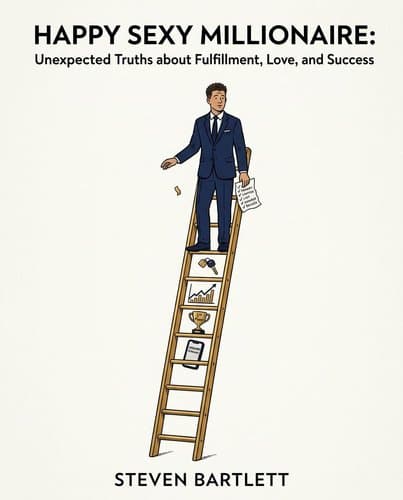
52255414_happy-sexy-millionaire
by Steven Bartlett
The goals society sells you—wealth, status, beauty—are painkillers for a wound they can never heal. Steven Bartlett exposes the trap of chasing external…
In Brief
The goals society sells you—wealth, status, beauty—are painkillers for a wound they can never heal. Steven Bartlett exposes the trap of chasing external validation and reveals why abandoning that chase is the only path to real fulfillment, and ironically, genuine success.
Key Ideas
Intrinsic Goals Drive Fulfillment Beyond External Validation
Before pursuing any major goal, ask whether it's extrinsic (money, status, or validation as a substitute for something else) or intrinsic (genuinely yours, independent of what others think). Extrinsic goals can be fully achieved and still feel hollow — because they were never aimed at the right wound.
Compare Yourself Only to Yesterday's Version
The only comparison that produces genuine motivation is you yesterday versus you today. Audit your social media follows and mute or remove every account that triggers upward comparison rather than genuine curiosity or learning.
Daily Gratitude Activates Measurable Brain Chemistry
Start a 20-second daily gratitude practice: one thing you're grateful for before you sleep, one when you wake. Write it in your phone's notes app. The dopamine response is chemically real and doesn't require any external change in your circumstances to trigger.
Five Conditions Trump Passion for Career Fit
When evaluating career options, skip the passion question and check against five conditions instead: Do I have real autonomy over how I work? Are tasks clear with defined endpoints? Is there variety? Do I get honest feedback? Does the work benefit others in some direct way?
Unique Skill Stack Beats Peak Mastery
Build your skill stack by identifying what the top performers in your field typically lack, not what they typically have. Being in the top 10% in six complementary skills makes you statistically unique — and that combination is more valuable than top-1% mastery of any single one.
Small Integrity Choices Compound Into Reputation
Your reputation is compounding for or against you right now through actions you don't think anyone is noticing. The small negative choices — the integrity slip, the unreturned message, how you treat people when nothing is at stake — are more decisive than the absence of big positive ones.
Aspirational Hourly Rate Protects Irreversible Time
Set an aspirational hourly rate that feels uncomfortably high, and filter every discretionary hour against it. If something can be outsourced for less than that rate, outsource it. The goal isn't efficiency — it's protecting irreversible chips for the things you actually value.
Psychological Needs Require Structural Non-Negotiables
Identify the psychological needs your current schedule systematically eliminates — meaningful in-person connection, physical movement, time in nature, genuine rest — and treat them as structural non-negotiables, not rewards to be earned after enough work has been done.
Who Should Read This
People working on personal growth in Self-Improvement and Happiness, especially those tired of generic motivational advice.
Happy Sexy Millionaire: Unexpected Truths about Fulfillment, Love, and Success
By Steven Bartlett
10 min read
Why does it matter? Because the version of you that finally achieves the goal feels exactly like the version that was still chasing it.
The assumption you're running on right now — that reaching the thing will finally change the thing — is the most expensive lie you'll ever believe. Steven Bartlett knows, because he ran the experiment to completion. The company went public at a quarter billion pounds. The car. The millions. The body. Every goal he'd written into a diary at eighteen, achieved ahead of schedule, in full. And then came the moment that made this book necessary: the complete absence of anything resembling arrival. Not disappointment. Not relief. Nothing. The version of him that had everything felt identical to the version that was stealing food to survive. This book is his attempt to explain why, and to hand you the evidence before you spend another decade finding out the hard way.
The Confetti Never Came: Achieving Every Goal Changed Nothing
Steven Bartlett was 25 when he came across a battered diary, the one a friend had given him three weeks after he'd dropped out of university, having made it through exactly one lecture. On the first page, in his own handwriting: become a "technical millionaire" by 25; make a Range Rover the first car; hold a long-term relationship; work on the body. Four goals. He worked through the list.
Ticked. Ticked. Ticked. Ticked.
His company had just listed on the stock exchange for around $200 million. He had millions in the bank, millions of followers, a life in New York, first-class travel, the best hotels. Everything 18-year-old Steve had aimed at, 25-year-old Steve had arrived at — ahead of schedule. So he waited for the feeling. The euphoria those four goals had promised was on its way. The shift that all those movies and Instagram feeds and celebrity profiles had guaranteed would be waiting on the other side.
The confetti didn't come.
Nothing had moved inside him. He was exactly the same person who had been stealing pizzas from takeaways in a boarded-up house in the roughest part of Manchester, hungry enough that petty theft felt reasonable. Same inner weather, different backdrop. The bottom and the top felt identical.
The belief underneath those four goals, shared by nearly everyone who sets them, is that once you get there, you'll feel different. Feel arrived. Feel whole in a way you currently don't. The experiment was complete. Result: the goals were empty containers. The internal state you're actually after was never locked inside them.
If you're structuring your life around a future version of yourself who finally has the thing, you already know what this book is about. You're just still waiting to find out.
Your Brain Cannot Measure Absolute Value — Only Relative Value
Think about the last phone you owned that felt like a miracle. Whatever it was, it's probably embarrassing now, not because it got worse, but because better phones appeared around it. The phone is identical. Its perceived value collapsed because the context changed.
This is how your brain processes almost everything. There's no system in the unconscious for measuring absolute value, only relative value. Bartlett calls the mechanism a "lazy CEO": the subconscious makes decisions at lightning speed using one variable, relativity, because it was built for a world where hesitation got you eaten. You'll drive 10 minutes to save £10 on a £20 jacket but not on a £200 one, even though £10 is £10 in both cases. The CEO doesn't calculate; it contrasts, automatically, without asking permission.
The machinery is embarrassing enough when it distorts how you value objects. It's devastating when it distorts how you value yourself.
Bartlett grew up poor in a middle-class English neighbourhood. His lazy CEO ran the comparison, found him lacking, and handed down a verdict: not enough. His entire decade of building companies and stacking money was a response to that verdict, proof he wasn't the inferior one after all. But here's what he buried until late in the chapter: he was born in a small village in Botswana — his family moved to England when he was a child — where average life expectancy was 49. Had they stayed, his family would have ranked near the top of the social ladder. Same Bartlett. Entirely different verdict from the same machinery, because the comparison inputs would have been different. No inferiority. No decade-long chase. No problem to solve.
That's the thing about feelings of inadequacy: they feel like evidence. They feel like a read-out on reality. They're not. They're an artifact of whichever comparison frame your brain happened to load, and you never chose that frame. The same Bartlett, running the same machinery in a different country against a different ladder, would have had no verdict to fight.
Social Media Is a Zero-Sum Status War — and You're Volunteering for It
Social media is not entertainment with a side effect. It's a status war, and the war only works if you lose.
The mechanics are simple. Post a selfie in bed eating instant noodles and the algorithm buries it. Post yourself on a Maldives yacht in a designer bikini and the algorithm amplifies it to millions, because that photo sends one signal: "I have more than you." Status is zero-sum. You gain only by taking from someone else. Every aspirational post you scroll past is a transfer: a little of your sense of adequacy moves to whoever posted it. You didn't agree to the transaction. You just opened the app.
Kylie Jenner is the case study, because she sits at both ends simultaneously. Three hundred million followers watch her on yachts in designer swimwear, and the comparison machinery in every one of those brains runs the same automatic calculation — the lazy CEO doesn't ask permission. At 21, Kylie was reportedly a billionaire. She also got the word "sanity" tattooed on her hip because, in her own words, she felt like she was going insane. She now runs from candid photographs, not from critics but from the gap between her real self and the version she's posted 300 million times. The trap closed on her the same way it closes on anyone who plays the game long enough.
That's what "finding it inspiring" costs. The brain you're scrolling with was never designed to distinguish a curated highlight reel from reality. Feed it a diet of highlight reels and the verdict it hands down will feel indistinguishable from fact.
The £13.40 That Felt Better Than a $200 Million IPO
In a five-star hotel in London, Bartlett is eating a gourmet breakfast when a message arrives: his company just listed on the stock market at $200 million. He's 26, worth eight figures by the time he puts his fork down.
He feels nothing.
He calls his business partner Dominic, hoping to catch someone else's excitement. Dominic is flatlined too — numb, weirdly unbothered. Two people who should be on the phone screaming, sitting in silence.
The same comparison machine that kept Bartlett miserable on the way up was running the same calculation upward. For years, as he climbed, his reference group climbed with him. Each new level brought richer people into view, and the lazy CEO tallied the gap: still behind. By the time the IPO landed, his brain had already priced it in against people far wealthier still. The $200 million was noise.
What broke through wasn't a decision. It was a song. Walking to the office, Kendrick Lamar's "Money Trees" came on, the track he'd listened to every morning at 19 on the two-hour walk from a run-down room above a Chinese takeaway to the call centre where he worked nights. The song pulled him backward. He was 19 again on those streets, making promises about what one day would look like — the same kid who, a year earlier, had scavenged £13.40 in loose change from the seat cushions in his room and felt like he'd won something, because it meant eating properly for a week. By the end of the track he was crying on the pavement.
He recorded a voice note for Dominic and walked him through the kitchen floors they'd slept on, the morning the business was hours from folding. Within minutes Dominic went from numb to fired up.
That's the mechanism. Gratitude is a direction of comparison. The brain runs comparisons constantly; the only variable is which way it looks. The IPO failed because the comparison ran upward, toward richer people. The song worked because it forced a comparison downward, toward a version of himself who would have wept at this news.
Bartlett's practice after that morning: one thing in his phone's notes before sleep and on waking. Sometimes a single word. Twenty seconds. The dopamine the $200 million couldn't produce, available daily, because the direction flipped.
'Find Your Passion' Is a Structurally Invalid Question — Here's What to Actually Build
Have you found your passion yet? The question sounds reasonable until you notice what it assumes — that somewhere inside you there's a fixed, singular thing waiting to be discovered, and that once found, it will announce itself clearly enough for a yes or no. Bartlett's analogy cuts right to it: the question has the same structure as "What color is four?" You can ask it. That doesn't make it answerable.
The research backs this up: people who believe they have a predetermined passion show reduced motivation for everything outside it and are more likely to quit when difficulty arrives than people who hold a fluid view of their interests. The fixed-passion belief makes you fragile, not focused.
What actually produces career satisfaction? Not income, and not passion. One factor kept coming up in the research that nobody talks about: work structure. What matters isn't the industry or the title but the second-by-second experience of the work itself. Work that pulls you in has autonomy over how it's done, clear tasks with defined endpoints, variety, and feedback. Computer games are designed around exactly these four things, which is why an hour of gaming feels like nothing and an hour of spreadsheets feels like geological time. The texture of the hours is everything.
That's the daily experience. The separate question is how you build something nobody else can replicate — and there, the math is worth sitting with. In a city of a million people, being in the top 10% of six complementary skills means 1,000,000 × 10% × 10% × 10% × 10% × 10% × 10% = 1. You're statistically the only person in your city with that combination. The key is that the skills must be rare together — not reinforcing what everyone in your field already has.
Steve Jobs took a calligraphy class at Reed College that he was certain would never matter. A decade later he built that understanding of typography directly into the first Macintosh, and since Windows copied the Mac, every personal computer eventually inherited it. He was never the world's best calligrapher, designer, technologist, or salesperson. He was unusually good at all of them together, and the combination was rare enough to be unreplicable.
You don't have to find your passion. You have to build a stack.
Your Invisible Reputation Is Compounding Right Now, Whether You Know It or Not
A text arrives on Bartlett's phone in his New York office. A colleague in London passes along a small piece of office news: Steph from the design team just ran out to the nearest shop, unprompted, to get a plaster for a coworker who'd cut her finger. That's it.
Steph had no idea anyone was tracking this. Bartlett was 5,500 miles away. But something filed itself in his mind, not a decision, more like a first entry in a document that would keep updating. When the team sat down months later to discuss promotions, that moment surfaced almost automatically.
He calls it Invisible PR. Your reputation isn't the sum of your biggest achievements — it's a collection of small stories living in other people's minds, written without your knowledge, consulted without warning. You don't see the file. You don't know when you're adding to it or subtracting from it. But every path forward is guarded by other people, and they're making decisions based on that file.
Running a team of more than 700, Bartlett saw this clearly: the small negative actions, not the absence of large positive ones, most reliably blocked advancement. Talented salespeople who should have been climbing couldn't, because innocuous moments had left entries that stuck — a sigh when asked to cover for a colleague, an eye roll in the wrong meeting. Buffett calls compound interest the Eighth Wonder of the World for the same reason: invisible, slow, then suddenly decisive. The file doesn't weigh heroic acts more heavily than careless small ones.
You can't audit your Invisible PR or see what's been written. What you can control is your integrity, how you treat people when nothing seems to be at stake, whether your word holds. Those are the deposits. They're always being counted.
The Hidden Cost of Hustle Culture Is Your Psychological Foundation
At 3am on a Tuesday, Bartlett hears something smash downstairs. He's 24, living in a six-bedroom country mansion behind an electric gate — the kind of place two young men buy to prove something. He grabs a mop handle, heads down in his underwear, switches on the lights, and finds his business partner Dominic alone in the dark, drunk, halfway through his second bottle of wine.
He doesn't know yet what this actually is. Dom has been a functioning alcoholic for some time. He's gained weight, developed anxiety he can't shake, and been quietly thinking about stepping in front of a train. He never said any of it — because Bartlett appeared invincible, and invincible people don't make it safe to be fragile. So Dom performed toughness until the pretense cracked.
And he's careful to say: the problem was never the hard work. He worked crushingly hard and doesn't regret it. The problem was what the hard work required them to sacrifice: meaningful relationships, time with family, emotional honesty, any rest that wasn't strategic. Physical needs denied produce unmistakable signals: hunger, thirst, pain. Psychological needs denied produce loneliness, anxiety, depression — quieter signals, easy to reclassify as weakness and push through. So they pushed through. And the debt accrued silently until it couldn't.
A study researchers came to call Rat Park makes this concrete. Rats in small bare cages, offered a choice between plain water and heroin-laced water, chose the heroin compulsively. Rats given companions, exercise wheels, and room to move chose plain water overwhelmingly. Dom wasn't choosing alcohol out of weakness. He was medicating a deprivation he had no language for.
After a real conversation, the first one apparently, Dom rebuilt completely. Fifty pounds gone, marathons run, alcohol abandoned for good. What it opened up was this: Dom had been holding it together in front of someone who was also holding it together. Bartlett's invincibility was a performance too, and neither of them had known it. Bartlett's conclusion: it wasn't until he met sober Dom that he realized he'd never actually known him.
You Have Roughly 500,000 Waking Hours. Each One Is an Irreversible Bet.
Imagine a roulette table with one rule: you must place one chip every hour, and once placed, you never get it back. Eighty years of life works out to roughly 700,000 hours total; subtract the third spent unconscious and you're left with around 500,000 active chips. That's the game.
Bartlett didn't just think about this. He bought sand timers for his desk, his mantelpiece, and his bedside table, and periodically flips them and watches the grains fall. Not as a motivational exercise. Time is invisible; the sand timer makes it briefly visible. The loss is happening right now, as you read this, but without the visual you don't feel it. If you could watch your remaining hours drain in real time, would you still spend them the way you currently do?
After building Social Chain over roughly five years (around 40,000 hours) for approximately £200 million, the math came out to about £5,000 of value per hour. His speaking fee eventually reached £10,000 to £20,000 an hour. At that point, paying someone to clean a carpet wasn't extravagance — it was arithmetic. Naval Ravikant put the same logic plainly: set an hourly rate that feels absurdly high and make every decision against it, because no one will value your time more than you do.
The comparison traps, the false goals, the hustle debt, the reputation built in quiet moments — all of it comes back to where you placed your chips. And here's what Bartlett eventually understood: the hours he spent proving his worth to a world that wasn't watching were the most expensive chips of all. Time doesn't care what the chase was for. You were already enough before it started. Knowing that, finally, is what makes the remaining chips worth something.
The Paradox at the Bottom of the Chase
Here's what actually happened at 25, underneath the IPO and the Range Rover and the ticked boxes: Bartlett got everything on the list and discovered the list had been written by someone in pain, for someone in pain, as an answer to a pain that no external achievement has ever touched. The goals weren't the problem. The wound underneath them was. And here's the part nobody tells you — the wound doesn't close when the goal arrives. It just finds a new goal to aim at.
The version of you that finally feels enough isn't the one who stops wanting things. It's the one who notices the wanting is already answered somewhere underneath the chase — it was already answered the morning Bartlett sat on the pavement and cried, before the goals were gone. Aim from that place, and ambition stops being a flight from something and starts being a move toward something real. That's the only version of success that doesn't evaporate the moment you arrive.
Notable Quotes
“What is the chance of X or Y occurring — 10, 50, 80 per cent?”
Frequently Asked Questions
- What is Happy Sexy Millionaire about?
- Happy Sexy Millionaire challenges the assumption that chasing money, status, and validation leads to a good life. Steven Bartlett argues that these are extrinsic goals—responses to a deeper wound of inadequacy—and that they structurally cannot heal it. Even when fully achieved, these goals can feel hollow because they were never aimed at the right wound. The book provides practical frameworks for identifying intrinsic goals aligned with genuine values, building sustainable habits, and designing a life oriented toward authentic fulfillment rather than external validation or constant social comparison.
- What is the difference between extrinsic and intrinsic goals in Happy Sexy Millionaire?
- Extrinsic goals are pursued for external rewards—money, status, or validation—as substitutes for addressing deeper wounds. Intrinsic goals are genuinely yours and independent of others' opinions. The key insight: extrinsic goals can be fully achieved and still feel hollow because they were never aimed at the right wound. Before pursuing any major goal, ask whether it's extrinsic (seeking external validation as a proxy for self-worth) or intrinsic (aligned with authentic values). This fundamental distinction separates a treadmill of endless striving from a life genuinely oriented toward fulfillment.
- What practical tools does Happy Sexy Millionaire provide for building fulfillment?
- Happy Sexy Millionaire offers several concrete daily practices. Start a 20-second daily gratitude practice: write one thing you're grateful for before sleep and one when you wake in your phone's notes app. The dopamine response is chemically real and doesn't require external circumstances to change. Also audit your social media follows and remove accounts that trigger upward comparison. For time management, set an aspirational hourly rate that feels uncomfortably high and filter every discretionary hour against it. If something can be outsourced for less than that rate, outsource it. The goal isn't efficiency—it's protecting your most valuable time for things you actually value.
- What career strategy does Happy Sexy Millionaire recommend?
- Rather than asking about passion, Happy Sexy Millionaire recommends evaluating career options against five conditions: Do I have real autonomy over how I work? Are tasks clear with defined endpoints? Is there variety? Do I get honest feedback? Does the work benefit others in some direct way? Additionally, build a skill stack by identifying what top performers in your field typically lack, not what they have. Being in the top 10% in six complementary skills makes you statistically unique—and more valuable than top-1% mastery of one skill. Your reputation is compounding for or against you through small choices—the integrity slip, the unreturned message—that others might not notice.
Related Book Summaries
Read the full summary of 52255414_happy-sexy-millionaire on InShort