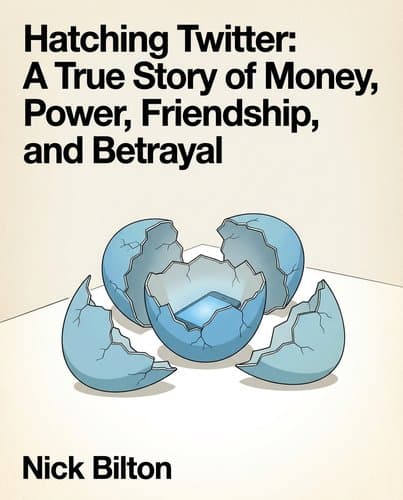
18656827_hatching-twitter
by Nick Bilton
Four friends built a platform that connected 300 million voices—then spent years backstabbing each other over who deserved credit for inventing it.
In Brief
Four friends built a platform that connected 300 million voices—then spent years backstabbing each other over who deserved credit for inventing it. Hatching Twitter reveals how the same obsessive need for recognition that sparked Twitter's creation systematically destroyed every relationship that made it possible.
Key Ideas
Messy accidents birth transformative products
The origin of a transformative product is almost never a single eureka moment — Twitter emerged from a drunk conversation in a car, a crush on a girl who texted, and a dying podcast company; the messy, accidental truth is always more instructive than the polished myth
Exceptional traits become dangerous in founders
The psychological trait that makes a founder exceptional — intense personal need, fear of invisibility, obsessive drive for control — is also the trait that makes them dangerous to anyone who trusts them; recognizing this pattern in yourself or your co-founders is more valuable than any organizational chart
Gifted power triggers strategic vulnerability
Power given voluntarily (Noah handing Ev the CEO role for $200k, Ev giving Jack a 'silent chairman' seat out of mercy) carries more strategic risk than power taken by force — the person who receives a gift of power has no moral debt and no restraint on using it
Loudest storyteller claims all credit
Credit in a collaborative invention is not a fixed resource to be divided — it is a story to be told, and whoever tells it first and loudest wins; the founders who stayed quiet (Noah, Biz) lost the narrative to the ones who cultivated it relentlessly (Jack)
Founding culture encodes permanent organizational dysfunction
A company's founding culture encodes its later dysfunction: Twitter's 'anything-goes' ethos and refusal to resolve the 'status vs. news' debate weren't oversights — they were the product, and the boardroom chaos was the same philosophy applied to governance
Who Should Read This
Business operators, founders, and managers interested in Startups and Business Strategy who want frameworks they can apply this week.
Hatching Twitter: A True Story of Money, Power, Friendship, and Betrayal
By Nick Bilton
8 min read
Why does it matter? Because the startup origin story you've been told is a myth — and the real one is more human, and more heartbreaking.
We tell startup stories as founder myths — one genius, one garage, one eureka moment that changed everything. Twitter gets told that way too. Jack Dorsey invented it. Or maybe Ev Williams. Depends who's doing the telling, and that's exactly the problem. The actual story is messier and more human: four chronically lonely outsiders — a Nebraska daydreamer, a manic idealist, an invisible programmer, and a jester who used jokes to survive his childhood — stumbled into building a tool that would let the entire planet feel less alone. They succeeded completely. They failed each other catastrophically. Bilton reconstructs it as a long, slow detonation — each act of betrayal foreshadowed by the previous one, every friendship weaponized the moment the stakes got high enough. What they built connected the world. What they did to each other is the real story.
The Technology Was Born From Loneliness, Not Genius
It's almost 2 a.m. on a rain-soaked San Francisco street in February 2006, and Noah Glass is idling his car on Valencia while his marriage quietly disintegrates around him. In the passenger seat is Jack Dorsey — contract programmer, aspiring fashion designer, a man who communicates in syllables — telling Noah he's thinking about quitting tech entirely. The rain hammers the windows like static. Both of them smell like vodka.
Jack mentions, almost as an aside, an old idea he'd been nursing since 2000: a website where people could post a single-line status update. What are you doing right now? Where are you? What are you listening to? He'd prototyped a crude version once, alone in a decaying Oakland warehouse he called the Biscuit Factory, inspired by the away messages teenagers were typing into AOL Instant Messenger. To Jack, it was a technical feature — clean, minimal, clinical.
Noah heard something else entirely. Sitting in that car, thinking about his estranged wife, about the friendships at their failing podcast startup that were already beginning to fray, he felt the idea click into a different shape. This wasn't about metadata. It was about the specific ache of being separated from the people you love and wanting them to know you're still out there. He thought about Ev Williams, who had built Blogger alone in his apartment with no friends, connecting to strangers through a keyboard. About Biz Stone blogging from his mother's basement. About Jack, spending evenings in St. Louis coffee shops talking to people he'd never meet. Every single person who would eventually build Twitter had grown up treating a computer screen as a substitute for human warmth. The status idea wasn't a product — it was, Noah suddenly understood, a cure for the thing they all had.
That realization is the actual origin of Twitter. Not a whiteboard strategy session. Not a founder's vision document. A drunk man in a parked car who missed his wife and suddenly understood that loneliness was the market.
About six weeks later, Jack typed
The People Who Built It Were Solving Their Own Problem
Ev Williams, the night the Pyra Labs team walked out on him, was sitting alone in his San Francisco apartment surrounded by pizza boxes and empty Snapple bottles, writing code for fourteen to sixteen hours a day. No salary, no employees, no girlfriend — he'd lost all of them inside a few months. And yet he wasn't in collapse. He was logging onto Blogger each evening, writing about the music he'd been listening to, reading dispatches from strangers across the country who were using the platform he'd built, signing off to a community of people who had no idea he was eating cereal for dinner in a one-room apartment. The blog wasn't a product feature to Ev. It was the only social life he had.
Noah Glass was arrested in Bakersfield in his late teens for erratic behavior. The police, certain he was on methamphetamines, booked him and tested him for every substance they knew. Got back nothing. He spent the night in a cell and the next morning was acting exactly the same way — because that was just how Noah's mind worked, moving too fast and too loud for the world to accommodate.
Jack Dorsey grew up with a speech impediment so severe he couldn't say his own last name. He spent his childhood on St. Louis city buses in silence, making friends with an IBM computer his parents brought home when he was eight.
Biz Stone grew up on food stamps in one of the wealthiest suburbs in Massachusetts, his mother incrementally selling and downsizing their home so her kids could stay in the good school district. Then he walked away from two million dollars in unvested Google stock to follow Ev to a South of Market office where homeless people slept in the stairwell.
Four people, four versions of the same wound — and one section from now, that sameness will be exactly what tears them apart.
The Same Wounds That Built Twitter Made It Impossible to Share
Why did the man who named Twitter get pushed out of it within months of writing that name down? The obvious answer — he was erratic, volatile, difficult to work with — is true but incomplete. The real answer is that the psychological engine driving Noah Glass was identical to the one driving every other person in that building, and none of them had enough of what they were building to go around.
The moment that makes this visible isn't the blowup over Dennis Crowley's account, or Noah's midnight guitar sessions in an empty office. It's something quieter. The morning after that rainy car ride on Valencia Street, Noah brought the status idea to Ev and Biz with the fervor of a man who'd finally found solid ground. Ev listened, said he liked it — and then, the moment Noah left the room to take a phone call, leaned across the table and told Jack and Biz to start developing it in secret. Specifically: don't let Noah get too involved. This was the idea Noah had championed. The emotional framing that made it feel worth building — the loneliness argument, the 'cure for feeling alone' — that was Noah's. Ev's first move was to wall him out of it.
Then Noah found the name. He spent four days skipping lunch and paging through a dictionary, looking for a word that could carry the emotional weight he'd placed on the concept. It came to him when his phone buzzed silently on his apartment table — he traced the physical sensation through the tw- words until he landed on a definition about bird chirps, tremulous speech, and agitation. He emailed Ev: what do you think about 'twitter'? A whole new level of connection. Or something like that. The name stuck. His fingerprints were on everything.
And then Jack, the man Noah considered his closest friend, the one who had floated the original idea in that rain-soaked car, walked into a private meeting with Ev and issued an ultimatum. Either Noah goes, or I do. He did not tell Noah this had happened. That same night, the two of them went out drinking together, and Noah spent the evening believing Jack was on his side.
Every Betrayal Follows the Same Script — And No One Notices Until It's Too Late
Think of it as a stage play where the actors keep rotating but the blocking never changes. One character stands at the center. A trusted friend circles quietly to the outside. The friend finds an investor, a board member, someone with the power to pull the lever. Then the center character is walked to a park bench, or a hotel breakfast, or a law office, and told it's over. The exiled character rages, or weeps, or calls their mother. And then, months or years later, they take the position just vacated — and the blocking starts again from the top.
The cleanest place to see the mechanism is the boardroom at Fenwick & West, October 1, 2010. Seven people around a table: investors, lawyers, founders. Ev Williams — who had built Blogger, who had bought Odeo, who had shepherded Twitter from side project to global platform — says fifteen words: 'I resign as CEO.' The lawyers ask for someone to make a motion confirming the resignation. Fred Wilson raises his hand first. Then a pause. And then, slowly, Jack Dorsey raises his hand and seconds it.
Ev had given Jack that seat. Two years earlier, when Jack was walked out of the Clift Hotel with a bowl of untouched yogurt and a stack of legal documents stripping him of his voting rights, Ev had offered him a consolation: a silent chairman role, no power, but a seat at the table. No law required it. No contract demanded it. Ev did it because he thought it was the decent thing. The judgment is almost clinical: that act of mercy was to be Ev's demise. The one vote Jack needed to cast against him, Ev had placed in Jack's hands himself.
Twitter ran this play three times in four years. Jack issued the ultimatum that erased Noah, then got erased over eggs he didn't order. Ev took the lever from Jack and used it to consolidate control, then found the same lever in Jack's hands. Each of them understood, from the inside, exactly what it felt like to be the one sitting across the table. None of that understanding transferred. The script ran on loyalty the way a fire runs on oxygen — consuming it entirely in the process.
The Invisible Founder: What Gets Erased When One Person Claims the Story
Noah Glass stood in a crowd at the SXSW after-party, arm extended toward Jack Dorsey, mouth open to offer congratulations — and Jack never turned around. Biz Stone had swooped in, looped an arm around Jack, pivoted him toward a camera. By the time the shutter clicked, Noah was shaking hands with empty air. He lowered his arm and walked out into the rain alone while the rest of them went to a diner to celebrate the award Twitter had just won.
That outstretched hand is the whole story in miniature. Noah had named the thing — four days of skipped lunches and dictionary pages to find a word that matched the emotional weight he'd placed on the idea. And then, at the moment of public recognition, he was edited out in real time, mid-gesture, by the very people who had watched him build it.
Two years later, Noah watched Ev appear on The Oprah Winfrey Show and tweeted the only thing left to say: that he had become invisible, absent from the frame, leaving no fingerprints at all. The platform he had named and emotionally architected had become the medium through which he announced his own erasure.
What happened next was more systematic. Jack, holding a silent chairman title and a personal email inbox that still received press inquiries, began granting interviews. In those conversations, he narrated a version of Twitter's origin that contracted around a single figure: himself. No mention of Noah, who had named it. No mention of the brainstorming sessions, the hack days, the room full of people who shaped what the original status idea became. The story Jack told reporters was clean and heroic — a lone inventor, a pure insight, a product that emerged fully formed from one man's vision. He was, in his own account, the kind of founder Silicon Valley likes: solitary, prophetic, uncrowded by collaborators.
The solo-founder myth isn't something better journalism could have corrected. It was the last move available to someone who lost the internal power struggle but still controlled the external narrative. Jack understood that in the age of Twitter, history belongs to whoever speaks loudest and earliest. Noah had cared most about what the platform meant. That's exactly why he lost the argument about who built it.
The Tool That Connected the World Left Its Creators More Alone
Twitter succeeded beyond anything its creators imagined. By 2013 it was carrying the voices of presidents, popes, and astronauts — a real-time nervous system for a planet of seven billion people, used to organize revolutions and share photographs of Earth from orbit. The four men who built it ended up more isolated than when they started.
The sharpest proof of this sits behind a wooden gate in one of San Francisco's most expensive neighborhoods. Jack Dorsey, worth roughly a billion dollars, paid twelve million for a house on a cliff overlooking the bay. The rooms are nearly empty. In the living room he keeps the same Le Corbusier furniture Steve Jobs once owned — not a coincidence, but a statement, another layer of the identity he'd been curating for years. On the balcony some nights he can hear waves slamming the rocks below. When the loneliness gets dense enough, he goes back inside, pulls out his phone, taps the little blue bird, and talks to Twitter. The man who helped invent a platform to make people feel less alone uses that platform the way you'd use a night-light — not for connection, exactly, but to take the edge off the dark.
Ev spent his last forty-seven minutes as CEO on his knees over a trash can, retching. The blog post already sitting in a publicist's browser described his departure as a voluntary, forward-looking decision he'd made himself. One story was happening in a bathroom. The other was being published to the world.
Noah had his fingerprints wiped from the whole story. Except Noah is also the only one who found what the platform promised. In a San Francisco ultrasound room, holding his partner Delphine's hand while a machine translated a heartbeat into sound, he felt the connection he'd been engineering toward for years — not through code, but through another person. He'd made the least money of anyone in that building. He ended up, by any human measure, the least alone.
The Question the Blue Bird Can't Answer
Every person in that building was trying to solve, with code, a problem that has never once responded to code. The loneliness was real. The cure they built was real. And yet the builders ended up more isolated than when they started — because the platform could carry a voice across a billion screens but couldn't teach the people who built it how to stay in the same room together. That gap between what a tool does and what its makers needed it to do haunts every page. Noah Glass still gets stopped in bars by strangers who ask if he's ever heard of Twitter. He has to decide, every time, how to answer. That question — and his hesitation before answering it — might be the most honest thing the whole story produced.
Notable Quotes
“Do you want to be CEO?”
“Well, I’ve been thinking about things,”
“You’re not answering the question. You have to tell me if you want to be CEO. I don’t want to leave this table without knowing your intent; I do not want to work under a cloud.”
Frequently Asked Questions
- What was Twitter's real founding story according to Hatching Twitter?
- Hatching Twitter reveals that Twitter emerged not from a eureka moment but from accident—a drunk conversation in a car, a founder's crush on a girl who texted, and a dying podcast company. Bilton stresses that 'the messy, accidental truth is always more instructive than the polished myth.' This challenges the sanitized founder narratives typically celebrated in business. Understanding Twitter's actual chaotic origins provides more valuable lessons for co-founders than the polished mythology typically presented. The book demonstrates that building something meaningful often involves far more luck and serendipity than strategic genius.
- What does Hatching Twitter reveal about founder psychology and danger?
- The book reveals that the psychological traits enabling founder success—intense personal need, fear of invisibility, and obsessive drive for control—are the same traits making founders dangerous to collaborators. Bilton emphasizes that 'recognizing this pattern in yourself or your co-founders is more valuable than any organizational chart.' This insight challenges the romanticized founder archetype, showing how the ambition that drives transformative products simultaneously undermines stability. For co-founders and teams, this suggests that structural governance—not faith in founder character—is essential protection. The paradox matters because understanding founder psychology enables more honest collaboration.
- Why is voluntarily given power riskier than seized power in startups?
- Hatching Twitter demonstrates that power given voluntarily carries more strategic risk than power taken by force. When Noah handed Evan the CEO role for $200,000, and when Evan later gave Jack a 'silent chairman' seat out of mercy, neither recipient felt moral obligation to their benefactor. This absence of debt enabled them to act aggressively without guilt or restraint. Bilton shows how gifts of power, unlike seized power, create no psychological bond. For co-founders and investors, this lesson is critical: generosity without formal governance structures can be weaponized. Legal frameworks matter more than personal trust.
- How did narrative control decide who got credit in Twitter's founding?
- Hatching Twitter shows that credit is not divided equally among founders—it's determined by whoever tells the founding story first and loudest. The book states: 'credit in a collaborative invention is not a fixed resource to be divided — it is a story to be told, and whoever tells it first and loudest wins.' The quiet founders like Noah and Biz lost the narrative to Jack, who cultivated it relentlessly. This reveals that success depends not just on innovation but on storytelling power. For co-founders, this warns that documenting contributions and shaping the public record matters as much as doing the work itself.
Related Book Summaries
Read the full summary of 18656827_hatching-twitter on InShort