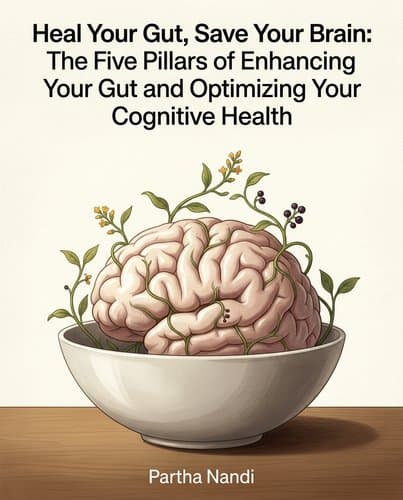
204193271_heal-your-gut-save-your-brain
by Partha Nandi
Your gut produces 90% of your serotonin and sends inflammation signals that literally punch holes in your blood-brain barrier—discover how fixing constipation…
In Brief
Your gut produces 90% of your serotonin and sends inflammation signals that literally punch holes in your blood-brain barrier—discover how fixing constipation, feeding the right bacteria, and moving your body can slash dementia risk by 60% using five science-backed pillars.
Key Ideas
Gut microbiome produces majority of serotonin
The gut-brain axis runs on the vagus nerve and chemical messengers — 90–95% of your serotonin is made in your gut, meaning mood, sleep, and appetite problems often need gut solutions, not just brain ones.
Fiber deficiency initiates neurodegenerative cascade
The path from gut to neurodegeneration is traceable: low fiber → less butyrate → leaky gut → LPS in the bloodstream → inflamed blood-brain barrier → plaques, tangles, or Lewy bodies. Each step is an intervention point.
Constipation precedes Parkinson's by decades
Constipation is not a minor inconvenience — it is the most common early symptom of Parkinson's, sometimes appearing decades before motor tremors, and should be treated as a neurological warning signal.
Black pepper multiplies turmeric absorption dramatically
Adding black pepper to turmeric increases curcumin's bioavailability by 2,000%. Eat turmeric with healthy fat and black pepper — a free, immediate upgrade to one of the most researched anti-inflammatory compounds available.
Exercise prevents dementia more than diet
Exercise is the single most powerful pillar for dementia prevention: a 35-year Welsh study found it reduced dementia risk by up to 60%, outperforming diet and smoking cessation. Low-intensity movement (walking, yoga, cycling) also increases butyrate-producing bacteria after several weeks.
Intermittent fasting clears brain plaques
Intermittent fasting (16:8 method) activates lysosomal function — the cellular cleanup system that clears beta-amyloid plaques — and reduces inflammation, making it one of the most evidence-backed dietary interventions specifically for Alzheimer's risk.
Purpose shields brain from cognitive decline
Purpose measurably protects the brain: Rush University research found that having a sense of purpose reduced cognitive decline by 50%. Beverly's IBS resolved when she joined a church tutoring program — social and purposeful engagement are gut medicine.
Stroke dysbiosis lasts at least 28 days
After a stroke, the microbiome remains dysbiotic for at least 28 days, with gut tissue appearing 'scrambled' under a microscope. Post-stroke care should include probiotic support (especially Bifidobacterium breve and longum) alongside standard neurological treatment.
Peppers cut Parkinson's disease risk significantly
Eating peppers twice or more per week is associated with a 30% reduced risk of developing Parkinson's. Red cabbage anthocyanins have been shown to protect and repair the blood-brain barrier. Specific foods have specific neurological targets — this is not generic healthy eating advice.
Raw honey loses benefits above 95 degrees
Raw honey is a prebiotic — but only if unheated. Above 95°F its prebiotic properties are destroyed. Small preparation details determine whether a food reaches the microbiome intact.
Who Should Read This
People working on personal growth in Nutrition and Neuroscience, especially those tired of generic motivational advice.
Heal Your Gut, Save Your Brain: The Five Pillars of Enhancing Your Gut and Optimizing Your Cognitive Health
By Partha Nandi
10 min read
Why does it matter? Because the brain disease you fear most may have started in your gut decades ago.
Most people assume neurodegeneration is a matter of bad luck or worse genes — the slow-motion inheritance of a disease that arrives, eventually, whether you prepared or not. That assumption is comfortable. It also happens to be wrong. The most powerful driver of Alzheimer's, Parkinson's, and stroke isn't sitting in your chromosomes. It's a living ecosystem of roughly five hundred microbial species that you've been shaping with every meal, every night of poor sleep, and every skipped walk for decades. What Nandi discovered, after watching his father's brilliant mind dissolve following a stroke, is that the gut and brain are locked in constant biochemical conversation, and when the gut starts sending the wrong signals, the brain eventually pays the price. This book explains exactly how that happens — and more importantly, how to stop it.
A Brilliant Man Nobody Suspected Was Already Losing His Brain
On an ordinary spring evening, Dr. Uma Nandi — a polymer chemist who invented the reflective road markers you follow home on dark nights — sat with his family debating politics, then excused himself to bed. Within the hour, the left side of his body was paralyzed. His son, a gastroenterologist named Partha Nandi, had seen him just ninety minutes earlier looking perfectly healthy.
The shock of that night shapes everything in this book. But the harder truth, the one Dr. Nandi only understood years later, is that his father's brain had already been sending signals for months or years before the stroke — and everyone missed them. Uma had a long history of gastric ulcers. He'd learned to avoid certain spicy and acidic foods. What nobody registered at the time was that a gut chronically in distress is a communication from a system that runs directly into the brain. Then came the subtler warnings. A man once capable of rapid, complex calculations started slowing down. His memory grew patchy. Most tellingly, he got lost on a familiar drive and couldn't find his way home — then dismissed it so convincingly that his doctors filed it under normal aging. That moment was a diagnostic window, and it closed without anyone walking through it.
Neurodegeneration rarely ambushes you. It narrates its arrival through symptoms we're trained to dismiss — mild bloating that comes and goes, brain fog after meals, an uncharacteristic irritability, a sudden difficulty following a conversation you would once have tracked easily. None of these feel like a brain emergency. They feel like Tuesday.
Uma Nandi's peptic ulcers, in hindsight, were waving a flag. The tragedy isn't that the stroke was unpreventable — it's that the warning was legible, and nobody had been taught to read it yet.
90% of Your Serotonin Is Made in Your Gut — So Who's Really Running Your Brain?
The gut makes 90 to 95 percent of your body's serotonin. Not the brain — the gut. Serotonin regulates your mood, governs your sleep, and controls your appetite, and almost all of it originates in your intestinal lining. If you've ever been prescribed an antidepressant that works by keeping serotonin available to the brain, and you wondered why it also affected your digestion, now you know: you were adjusting the chemistry of a system whose headquarters is in your abdomen.
The channel through which this signal travels is the vagus nerve, the body's longest cranial nerve, running from the base of the brain all the way down into the intestines. It's a physical wire, not a metaphor, and the traffic along it is heavily one-directional: the gut sends far more signals upward to the brain than the brain sends down. The organ you've been thinking of as the control center is, in biological reality, more of a recipient.
That infrastructure has ancient roots. The gut's own nervous system, the Enteric Nervous System, predates the brain by roughly 600 million years — it developed in organisms that had no brain at all. The central nervous system arrived later and plugged into a communication network the gut had already built.
Here is the practical consequence: when your microbiome is disrupted — say, by a diet low in fiber that starves the bacteria responsible for fermenting nutrients — the serotonin signal degrades. The vagus nerve still carries the message, but the message is corrupted. What arrives at the brain looks like depression, poor sleep, or an inability to feel full. Your doctor treats it as a brain problem. The source is in your gut. Understanding that geography is the first step toward treating the right organ.
The Slow Collapse: How a Leaky Gut Becomes a Damaged Brain
Think of your gut lining the way a medieval city wall works: it holds because it's constantly maintained, and it fails the moment the maintenance stops. That's the exact mechanism linking a low-fiber diet to a damaged brain, and it runs in four steps you can trace like dominoes.
It starts with what you eat. When your diet is low in fiber, the beneficial bacteria in your gut have nothing to ferment. Fermentation is how they produce butyrate, a short-chain fatty acid that fuels the cells lining your gastrointestinal barrier. Without butyrate, that lining begins to thin and loosen. The wall stops holding. Molecules that were supposed to stay inside the gut — particularly a bacterial fragment called lipopolysaccharide, or LPS — slip through the gaps and enter the bloodstream. Your immune system reads it like an invading army and launches an inflammatory response. That inflammation doesn't stay local. It circulates. And eventually, it reaches the blood-brain barrier, a cellular wall designed to keep the brain sealed from precisely this kind of chemical chaos. Under sustained inflammatory pressure, that barrier weakens too. Now LPS and rogue immune cells are reaching brain tissue. They degrade neurons — the cells the body largely stopped producing after infancy. The damage, unlike a bruise, doesn't heal.
Animal research from West Virginia University found something that should change how we think about stroke recovery: intestinal tissue that had looked normal before an induced stroke appeared disorganized under a microscope 28 days later — villi compressed, nutrient absorption impaired. More alarming, the ratio of harmful Firmicutes bacteria to beneficial Bacteroidetes bacteria was six times higher in the stroke animals than in healthy controls. The gut didn't just contribute to the stroke; the stroke scrambled the gut in return, creating a feedback loop that actively undermined recovery.
The whole cascade begins somewhere unremarkable: a diet short on vegetables and fiber, sustained over months or years. By the time symptoms appear in the brain, the erosion has been underway for a long time.
Alzheimer's Is Not Inevitable — It's Downstream of a Gut Problem That Started Decades Earlier
What if the gene everyone fears most — the one family members scan their own behavior for after watching a parent decline — turns out to be less a death sentence than a marker for something correctable? That question sits at the center of the most disorienting finding in recent Alzheimer's research, and the answer begins in your intestines, not your skull.
The causality runs in a direction that should alarm anyone who assumed this was purely a brain disease. A 2022 King's College London study analyzed stool samples from people with Alzheimer's and found distinctly elevated inflammatory markers compared to healthy controls. Then came the harder evidence: rats implanted with fecal matter from Alzheimer's patients generated fewer new nerve cells than animals in the control group. The gut contents alone — transferred into a healthy organism — disrupted neurological growth. The inflammation the gut generates doesn't stop at the gut wall. It shows up inside the skull, in the same environment where beta-amyloid plaques accumulate and tau proteins tangle into knots that strangle neuronal communication.
Carriers of the APOE ε4 variant carry the highest genetic risk for late-onset Alzheimer's. But when researchers examined their gut microbiomes, they found something specific: a significant depletion of butyrate-producing bacteria. Butyrate is the short-chain fatty acid that feeds the gut lining and keeps it sealed. Without it, the barrier thins, harmful bacterial fragments like LPS enter the bloodstream, and the resulting inflammation travels — including into the brain. The ε4 variant also disrupts how brain cells process fats, and researchers now believe losing those butyrate-producing bacteria is what drives that metabolic breakdown. The gene and the gut deficiency arrive together, so reliably that it raises an uncomfortable question: is the variant the risk, or is it a flag for a microbial pattern we could actually do something about?
The disease that feels like it arrives without warning at sixty-eight or seventy-two has typically been building its infrastructure for decades — quietly, in the gut, through the same cascade described earlier. The brain is the last address on a very long chain of mail.
Parkinson's May Have Begun in Your Bowel — Not Your Brain
A nurse examining Jimmy for a life insurance policy — not a neurologist, not even in a clinical context — was the one who suspected Parkinson's. She asked him whether his handwriting had gotten smaller, whether people told him he spoke too softly, whether he stopped swinging one arm when he walked, whether constipation troubled him. He said yes to all of it. He was twenty-seven. The detail that makes this scene so unsettling isn't the diagnosis — it's the questions. Handwriting. Arm swing. Constipation. These aren't the symptoms of a brain disease anyone pictures. They're the symptoms of a body that has already been broadcasting distress for years through its gut, its posture, its voice, before a single tremor appears.
The gut-first hypothesis of Parkinson's starts with a protein called alpha-synuclein, which normally helps regulate how neurons communicate. In Parkinson's patients, it begins to misfold and clump in the enteric nervous system — the dense web of neurons lining your intestines — long before it reaches the brain. When the gut's barrier is compromised, these toxic clusters travel upward via the vagus nerve to the substantia nigra, where they destroy the dopamine-producing cells whose loss eventually produces the tremors, the rigid muscles, the shuffling walk most people recognize as Parkinson's. By the time those motor symptoms appear, the process has typically been underway for a decade or more. Constipation, which affects well over half of all Parkinson's patients, isn't a side effect of the disease. It's an early chapter of the same story, written in the gut first.
The microbiome research makes this concrete. An analysis of nearly five hundred Parkinson's patients found that thirty percent of the polymicrobial species in their guts were unique to the disease — a pattern so consistent that researchers described the Parkinson's microbiome as an ecosystem that actively promotes neurodegeneration and obstructs recovery. Constipation, bloating, dysbiosis — these aren't inconveniences to manage around a brain disease. If constipation has been a companion for years, that's the gut's nervous system asking to be taken seriously before the brain has to.
The Microbiome Is Reprogrammable — Here's What the Evidence Actually Says to Do
The gut-brain axis carries disease in both directions — but the traffic is reprogrammable, and the interventions that do it are more specific than anyone raised on generic wellness advice has been told.
Start with what you eat, and start with precision. Turmeric has been consumed across South Asian cooking for centuries and correlates with some of the lowest Alzheimer's rates ever recorded — fewer than one percent of people over fifty-five in northern India showed signs of the disease in studies conducted before Western fast food became prevalent there. The active compound, curcumin, repairs intestinal barrier function, reduces the inflammatory load that travels to the brain, and is gut-protective in ways that ibuprofen and aspirin are not. But here's the detail that makes this actionable rather than theoretical: curcumin is fat-soluble and poorly absorbed on its own. Add a small amount of black pepper to the same meal, and the piperine in the pepper increases curcumin's bioavailability by 2,000 percent. That's not a rounding error — it's the difference between a spice and a medicine. The mechanism is specific, the intervention costs nothing, and it captures in miniature what this entire book argues: precise, layered choices compound in ways that blunt lifestyle advice never does. Fermented foods work through a parallel mechanism, seeding the gut with beneficial bacteria that produce short-chain fatty acids, which reduce inflammation and feed the gut lining. Cut the fermented foods clause here — the postbiotics link to stroke recovery and Parkinson's motor decline is real, but the evidence chain needs more room than this section can give it.
Food alone doesn't close the loop. A Welsh longitudinal study that followed over two thousand men for thirty-five years found that exercise reduced dementia risk by up to sixty percent — a larger effect than diet improvement or stopping smoking produced on their own. Jimmy, diagnosed with Parkinson's at twenty-seven, began by walking around his block. Within a few years he had completed fifteen marathons and over a hundred half marathons and appeared on American Ninja Warrior. That arc isn't motivational decoration. Exercise raises butyrate levels, increases microbial diversity, and reduces the inflammatory markers that drive neurodegeneration — through the same gut-brain axis the disease used to build its damage. The channel runs both ways. You can deliberately flood it with signals that repair rather than destroy, but only if you start moving before the symptoms make movement feel impossible.
Nandi's Five Pillars — nutrition, movement, purpose, community, and spirituality — interact rather than stack. Having a reason to get up in the morning is independently associated with lower dementia risk; the gut responds to psychological state, not just physical inputs. Chronic loneliness drives cortisol up, and sustained high cortisol shifts the microbiome toward inflammatory bacterial populations — the kind that feed the very signaling your body is trying to quiet. Eating with other people builds dietary consistency and guards against the low-diversity meals that quietly erode the microbiome of people living alone. Each pillar feeds the others. The gut that carried the disease signal upstream can, with enough deliberate pressure applied across all five domains, begin carrying something different — more butyrate, more microbial diversity, less inflammation. Start with the turmeric and the walk. The biology takes it from there.
The Kitchen Is the Laboratory — And the Table Is Where Prevention Actually Happens
Uma Nandi—polymer chemist, poet, world-class cook—used to build curries the way he built scientific formulas: with precision, intention, and the conviction that getting the inputs right was everything. His son watched him in that kitchen for decades. Then Uma had a stroke, spent his last years in decline, and died before Partha understood what the gut-brain research now makes plain. The recipes in this book's final section are, in one sense, Uma's recipes. They are also, in another sense, an act of reckoning—grief converted into the only form of action he knew how to take: a protocol.
The protocol happens to look like dinner. A butternut squash tikka masala whose turmeric contains curcumin shown to delay stroke onset. A berry and spinach salad where the basil carries a compound called fenchol, linked to reduced damage in Alzheimer's-affected brains, and the blue cheese delivers the fermented bacteria the gut-brain axis needs to hold the line against dementia. Even the smoothie carries its logic: raw honey loses its prebiotic properties if heated above 95 degrees Fahrenheit, so the recipe specifies raw, unfiltered, added cold.
But Nandi's deeper argument isn't about any single ingredient. It's that the act of cooking together—children, parents, spouses at the same stove—is itself a biological intervention. Cortisol drops when you're not isolated. Dietary diversity improves when meals are social. The microbiome responds to the conditions under which food is eaten, not just what the food contains. Community isn't the warm feeling you get after the meal. It is part of the medicine.
He writes, simply, that if he had known then what he knows now, his father's last decade might have been different. That sentence is the book's real conclusion. The science is the vehicle. The kitchen is where you actually go.
The Grief That Became a Prescription
The science in this book exists because a son watched his father get lost on a familiar road and couldn't explain why until it was too late. That weight is behind every mechanism described here — the butyrate pathways, the leaky barriers, the plaques assembling quietly for decades while everyone called it aging. Nandi arrived at the biochemistry through grief, but he's handing you something different: time. Your gut isn't fixed. It is being written right now, by what you ate this morning, by whether you walked yesterday, by who was sitting across from you at dinner. The tools that could have changed his father's last decade are in your kitchen — turmeric and black pepper, a walk around the block, dinner with someone you love and enough time at the table to actually talk.
Notable Quotes
“Listen, they’re all the same. It is politics.”
“There’s also less space between the villi [projections from membranes, like those in the inner lining of the small intestine] to allow nutrients to move around.”
“Big picture: seeing a persistent, chronic change 28 days after a stroke associated with this increase in some of the negative bacteria means that this could negatively affect brain function and behavior. Ultimately, this could slow or prevent post-stroke recovery,”
Frequently Asked Questions
- What is the gut-brain axis and how does it affect cognitive health?
- The gut-brain axis runs on the vagus nerve and chemical messengers, creating a direct link between digestive and neurological health. Remarkably, 90–95% of your serotonin is made in your gut, meaning mood, sleep, and appetite problems often need gut solutions, not just brain ones. The pathway from gut dysfunction to neurodegeneration follows a traceable sequence: low fiber → less butyrate → leaky gut → LPS in the bloodstream → inflamed blood-brain barrier → plaques, tangles, or Lewy bodies. Each step represents an intervention point where dietary and lifestyle changes can interrupt progression toward cognitive decline and neurodegenerative disease.
- What are the five pillars for enhancing gut and cognitive health?
- Heal Your Gut, Save Your Brain identifies five core pillars: diet, exercise, fasting, purpose, and microbiome care. Diet includes specific food combinations and understanding how preparation methods preserve prebiotic properties. Exercise is described as the single most powerful pillar for dementia prevention—a 35-year Welsh study found it reduced dementia risk by up to 60%. Intermittent fasting activates cellular cleanup systems that clear beta-amyloid plaques. Purpose measurably protects the brain; Rush University research found that having a sense of purpose reduced cognitive decline by 50%. Microbiome care involves targeted probiotic support and understanding how individual foods affect specific neurological targets.
- Is constipation related to neurodegeneration and Parkinson's?
- Yes—constipation is a critical neurological warning signal, not a minor inconvenience. It is the most common early symptom of Parkinson's, sometimes appearing decades before motor tremors. This makes it one of the earliest detectable markers of potential neurodegeneration and should trigger preventive interventions. Constipation indicates reduced fiber intake and butyrate production, which compromises the intestinal barrier. When the barrier becomes leaky, lipopolysaccharides enter the bloodstream, cross the blood-brain barrier, and trigger neuroinflammation. Understanding constipation as a neurological symptom changes how patients and clinicians approach prevention and early intervention for Parkinson's and cognitive decline.
- What specific foods protect against Parkinson's disease?
- The book identifies multiple foods with documented neurological benefits. Eating peppers twice or more per week is associated with a 30% reduced risk of developing Parkinson's. Red cabbage anthocyanins have been shown to protect and repair the blood-brain barrier. Turmeric is one of the most researched anti-inflammatory compounds; adding black pepper increases curcumin's bioavailability by 2,000%, making this an effective, inexpensive upgrade. Raw honey acts as a prebiotic but only if unheated—above 95°F its prebiotic properties are destroyed. These examples reflect a core principle: specific foods have specific neurological targets, moving beyond generic healthy eating advice toward precision nutrition.
Related Book Summaries


Read the full summary of 204193271_heal-your-gut-save-your-brain on InShort