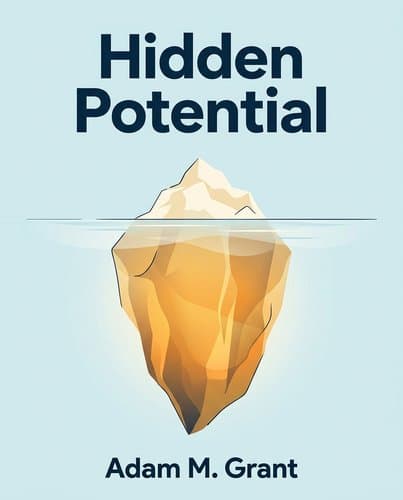
157095669_hidden-potential
by Adam M. Grant
Potential isn't a fixed trait you're born with—it's a distance you can travel using learnable character skills and smarter systems.
In Brief
Potential isn't a fixed trait you're born with—it's a distance you can travel using learnable character skills and smarter systems. Grant reveals counterintuitive strategies like budgeting for mistakes, seeking advice over feedback, and measuring growth trajectories to unlock hidden capacity in yourself and others.
Key Ideas
Embrace mistakes to reduce rumination
Set a 'mistake budget': aim for a minimum number of errors per day or week. When you expect to stumble, you ruminate less and improve faster — Benny Lewis's 200 mistakes a day is the model.
Ask for advice not feedback
Ask for advice, not feedback. Feedback is backward-looking and triggers defensiveness or vague praise. 'What's one thing I can do better next time?' shifts the conversation from evaluation to coaching.
Take detours to refuel progress
When you hit a plateau, look for a detour before you push harder. A side pursuit that builds mastery in a different domain can refuel your primary one — R. A. Dickey's Kilimanjaro climb preceded his Cy Young season.
Brainwrite anonymously for better ideas
Replace brainstorming with brainwriting: generate ideas individually first, share them anonymously, then evaluate. You'll get more ideas and better ones — especially from junior, introverted, or underrepresented voices.
Evaluate improvement trajectory not snapshots
Measure candidates and direct reports by grade point trajectory — improvement over time — not starting GPA. The 'rise over run' predicts future performance far better than a snapshot of where someone began.
Obstacles overcome reveal true ability
When selecting or promoting people, ask what obstacles they've navigated, not just what they've achieved. The absence of early accomplishments often indicates the presence of adversity, not the absence of ability.
Advise others to build confidence
To build confidence in someone who is struggling, ask them to give advice to others in a similar situation — not receive it. The shift from 'I am incapable' to 'I have something to offer' changes motivation more than encouragement does.
Who Should Read This
People working on personal growth in Self-Improvement and Skill Acquisition, especially those tired of generic motivational advice.
Hidden Potential
By Adam M. Grant
13 min read
Why does it matter? Because the people you've been overlooking — including yourself — aren't lacking talent. They're lacking a fair measure.
We've been measuring potential backwards. The signals we trust most — early talent, high test scores, elite pedigrees — turn out to be remarkably poor predictors of who actually goes on to do something extraordinary. Meanwhile, the people who quietly become exceptional are often the ones we overlooked, discouraged, or dismissed along the way. Adam Grant's Hidden Potential argues — with evidence that should unsettle anyone who's ever been sorted, ranked, or written off — that what looks like raw ability is usually just a head start, and that the real indicators of growth — a hunger for discomfort, a relentless appetite for feedback, the stubborn refusal to stay stuck — are skills anyone can build. The question isn't whether you have potential. It's whether the people around you, and the systems above you, are designed to see it.
The Prodigy Myth Is Costing Us — and Here's the Evidence
Detroit, spring 1991. Eight students from a Harlem public school shuffle into a hotel ballroom for the National Junior High Chess Championships. They are B students. Most learned the game two years ago. One of them practiced in a park with a drug dealer. Their opponents include Dalton, an elite Manhattan prep school that had won three consecutive national titles and funneled child prodigies through years of intensive training since kindergarten.
The Raging Rooks, as the Harlem team called themselves, had no insurance policy — every score counted, with no games to throw out. Their opponents could absorb losses. They could not. And yet, round by round, they dismounted kings they had no business defeating. By the final round, the leading teams had faltered, and the kids from JHS 43 tied for first place.
The obvious question is how. The interesting answer is why it happened — and it has nothing to do with hidden genius. Coach Maurice Ashley had spotted no chess prodigies. He was deliberately growing something different: what researchers would later confirm as the real engine of achievement.
Around the same time those students were learning chess, economist Raj Chetty was mining data from a Tennessee experiment that had randomly assigned over 11,000 students to different kindergarten classrooms. Decades later, the students taught by more experienced kindergarten teachers were earning meaningfully more money as adults. The obvious explanation — that better teachers built stronger cognitive skills — collapsed under scrutiny: any early math and reading advantage had fully evaporated by fourth grade.
What hadn't faded were four behaviors: taking initiative, working well with others, staying focused, and persisting through obstacles. When researchers used fourth-grade ratings of these behaviors to forecast adult income, they outweighed standardized test scores by more than two to one.
Those behaviors aren't personality traits you're born with. They're skills you learn.
The prodigy story is almost always told backward. We watch someone succeed spectacularly and reach for an origin myth — the innate gift, the early spark. What the evidence keeps finding instead is something quieter and far more useful: specific, trainable skills of character that compound over time.
The Comfort Zone Is Where Potential Goes to Die
The most effective way to learn something is usually the method you least want to use. That's not a motivational cliché — it's what the research keeps finding, and it should unsettle anyone who has built a learning routine around what feels natural.
Consider the myth of learning styles, which roughly nine in ten teachers worldwide accept as settled fact. The theory goes like this: auditory learners absorb information through sound, visual learners through images, verbal learners through text, and tailoring instruction to each student's preference unlocks their potential. When researchers actually tested this idea across decades of controlled experiments, the evidence simply wasn't there. Students didn't perform better when lessons matched their preferred style. Some performed worse when they leaned into their comfort zone — the extra friction of working in an unfamiliar mode turned out to be part of the learning itself.
The implication is harder to swallow than the myth. Your preference tells you what's comfortable, not what works. And discomfort, far from being a signal to stop, is often a signal to keep going.
Benny Lewis understood this the hard way. He spent eleven years studying Irish and five studying German without ever holding a real conversation in either language. After six months living in Spain, he still couldn't speak Spanish. His explanation was familiar: he simply lacked the language gene. What he lacked, it turned out, was the willingness to make mistakes in public. When he finally committed to speaking from day one in a new country — before fluency, before confidence, before he felt remotely ready — he reoriented his entire measure of progress. His goal became making at least 200 mistakes a day. Not fewer errors over time. More of them, faster, as a sign that he was actually trying.
That reframe matters because it makes discomfort something you pursue rather than endure. When effort itself becomes the metric, the sting of stumbling loses its power to stop you — and 200 mistakes a day stops feeling like failure and starts feeling like the job.
Perfectionism Isn't a High Standard — It's a Hiding Strategy
Picture a sixteen-year-old standing at the end of a diving board, walking back and forth for forty-five minutes without making a single attempt. That was Adam Grant — not paralyzed by fear exactly, but by the conviction that conditions had to be exactly right before he could jump. Too far forward. Wrong rhythm. Leaning slightly left. He was Goldilocks on a springboard, and while he stood there waiting for perfection, he learned nothing.
That image is worth holding onto, because it captures what perfectionism actually is: not a high standard, but a hiding strategy. You tell yourself you're being rigorous. You're actually avoiding the one thing that produces growth — attempting something before you're certain it will go well.
The research backs this up in an uncomfortable way. Across meta-analyses, the average correlation between perfectionism and job performance is zero. Not small. Zero. Perfectionists tend to make three specific errors: they fixate on trivial details while missing the larger problems worth solving, they retreat from unfamiliar tasks where failure is possible, and when they do stumble, they shame themselves instead of learning from the mistake. The result is a narrowing loop — increasingly refined skills applied to an increasingly small range of challenges.
What broke Grant's loop wasn't a pep talk. It was a redefinition. His coach pointed out that in Olympic diving, a score of ten doesn't mean the dive was flawless — it means it was excellent. That single distinction changed Grant's calculus on the board. A five on a difficult dive beats a zero for not trying. He stopped waiting for the perfect approach and started going on the first one that was good enough.
That's the move this chapter is asking you to make. Raise your tolerance for the right imperfections — not all of them, just the ones that don't actually matter. A slightly awkward entry on a difficult dive still earns points. A first draft with clunky sentences still gets the idea onto the page, where it can be improved. The skill isn't eliminating every flaw; it's knowing which flaws are acceptable and which aren't. You develop that skill by attempting things before you're ready, not by standing at the end of the board waiting for everything to feel just right.
What Actually Separates the People Who Keep Growing
Think of two athletes with identical physical gifts, identical training hours, identical desire to win. Why does one plateau while the other keeps climbing? The obvious answer is talent or discipline — but those are already equal in this thought experiment. The real differentiator turns out to be something subtler: what each athlete actually does with information.
Julius Yego grew up in rural Kenya with no electricity, no training facility, and no coach. His rival, Egyptian javelin thrower Ihab Abdelrahman, had the physique of someone designed for the sport — six foot four, naturally powerful, and eventually the beneficiary of professional coaching in Finland, the global capital of javelin throwing. At the 2010 African Championships, Ihab won gold and his worst throw that day flew farther than Julius's best. On paper, this was already decided.
Then Julius found an internet café and started watching YouTube videos of the world's best javelin throwers. He wasn't just watching — he was studying mechanics, dissecting technique, and rebuilding his own form from what he absorbed. Six years later, he won the world championship with a throw of nearly 93 meters, one of the longest in fourteen years. The unconventional release that coaches might have corrected out of him — falling forward like a break-dancer mid-throw — he kept, because it worked for his body. He had absorbed what applied and discarded what didn't.
Ihab, by contrast, was excellent when guidance arrived but passive when it didn't. When funding for his Finland trips dried up, he stopped training entirely for five months. He was coachable the way clay is moldable — responsive to whoever picked him up and shaped him, but not self-directing.
Julius was doing something specific that Ihab wasn't. He was hunting for the gap between his form and the best form in the world, then closing it. That's different from being open to feedback when it arrives. Most people who think of themselves as learners are actually clay: genuinely receptive, but waiting. A smaller group runs on ego-protection — either bouncing criticism away entirely or filtering it so that nothing uncomfortable sticks. The rarest type is the sponge: proactively seeking information with the explicit purpose of getting better. That's the one who keeps improving after the coaching stops, after the structured feedback ends, after the obvious resources run out.
Not drive alone. Not talent. The habit of hunting for what you don't yet know, and using it.
Why Suffering Through Practice Is Overrated
What if the grinding, joyless repetition you've been told is the price of mastery is actually slowing you down?
Evelyn Glennie became the world's first full-time percussion soloist despite being profoundly deaf — and despite being rejected by one of Britain's most prestigious music academies on the grounds that she'd never amount to anything as a professional musician. What made the difference wasn't brute force drilling. It was her teacher Ron Forbes, who declined to put her through conventional practice routines and instead built something more like a sensory puzzle. He had Glennie press her hands against the wall while he played the timpani, helping her map different pitches to different parts of her body — higher notes vibrating near her face, lower ones through her legs and feet. She practiced barefoot to feel more. Then, as she got better, Forbes narrowed the pitch intervals, forcing finer and finer distinctions, leveling up the difficulty the way a game does. When one challenge clicked, he'd introduce a completely different one: could she play a Bach piece on a snare drum? Her description of this period: no distinction between fun and hard work. She was a sponge.
Grant calls this deliberate play — structuring skill development as a game rather than a gauntlet. Not gamification, which is just a leaderboard bolted onto a task you still hate. Deliberate play redesigns the task itself. The goal shifts from logging hours to tracking improvement. You're not competing against a benchmark someone else set; you're competing against your own past performance.
The distinction matters because the research keeps exposing a flaw in the grinding model. Psychologist Robert Vallerand's team synthesized data from 45,000 people across 127 groups and found that persistence only converts to performance when passion is present. And the kind of passion that sustains long-term growth isn't the compulsive, white-knuckled variety — it's what Vallerand calls harmonious passion, the pull of genuine interest rather than the pressure of obligation. Concert pianists who achieved international fame before forty mostly practiced an hour a day in their early years, driven by curiosity rather than compulsion.
Enjoyment, it turns out, isn't a sign you're not working hard enough. It's what makes the work stick.
Getting Unstuck Means Going Backwards First
When you're stuck, the instinct is to push harder along the same path. That instinct is almost always wrong.
R. A. Dickey spent fourteen years as a mediocre minor-league pitcher before winning the Cy Young Award at 37. The turnaround wasn't grit applied in the same direction — it was a complete dismantling. At 31, with his fastball going nowhere and his managers telling him he was going nowhere, Dickey's pitching coaches pointed him toward the knuckleball, a pitch so rare and strange that virtually no one in baseball understood how to teach it. To throw it properly, he had to unlearn everything: the wrist rotation, the spin, the mechanics drilled into him since childhood. He described it as tearing down to ground zero. Then he threw 30,000 practice pitches against cinder blocks and brick walls before the mechanics became reliable. Progress moved in circles for years before it moved upward.
Two things made the difference besides the sheer repetition. The first was finding the right guides — not the most eminent ones. A Northwestern University study tracking over 15,000 students found that those taught introductory courses by tenured professors actually performed worse in follow-up classes than students taught by lecturers. The deeper the expertise, the harder it is to narrate what confusion felt like at the start. Dickey faced the same problem: the few active knuckleball pitchers had no more ability to explain the pitch than a native speaker has to explain grammar. So he sought out retired specialists instead, collecting what Adam Grant calls "pins" — key turning points from their own climbs — and built a personal guidebook from fragments none of them could have assembled alone.
The second thing was a detour. When Dickey stalled again in his mid-thirties, he climbed Mount Kilimanjaro — against his team's legal objections — to raise money for a charity rescuing trafficking victims. He returned and posted a 2.73 ERA, the best of his career, on his way to the Cy Young. What the mountain gave him wasn't fitness. It gave him a fresh source of forward motion when his main road had stalled. Completing something hard in a different arena restored the fuel to keep going on the harder thing.
Breakthroughs rarely announce themselves as progress while they're happening. What they feel like is circles.
The Fastest Way to Master Something Is to Teach It to Someone Else
January 1944, outside Chicago: sixteen Black men arrive at a Navy training facility expecting to be failed. Their instructors say as much out loud. The curriculum — a full semester of navigation, gunnery, naval law, Morse code, seamanship — has been compressed into ten weeks. In a standard officer class, one in four candidates washes out.
All sixteen passed. When Washington suspected cheating, they retook the exams and scored higher. Their collective GPA was 3.89 — the highest in Navy history.
The standard explanation would be determination or resilience. The actual explanation is stranger and more useful. Every night after lights-out, the men crammed into a bathroom with flashlights, sheets hung over the windows. But they weren't cramming individually. They had divided the curriculum by expertise: whoever shouted 'that's mine' owned that subject and taught it to the rest. Jesse Arbor handled Morse code. William White, a lawyer with no military background, learned Navy regulations by explaining them to his peers — often just a lecture or two ahead of the men he was teaching. He probably grew most confident in the subject precisely because of that: psychologist Lauren Eskreis-Winkler has found that people struggling to save money, lose weight, or find jobs become more motivated after giving advice to others in the same situation than after receiving it from experts. When you're being coached, you're the one who lacks something. When you're coaching, you're the one who has something to offer. White wasn't just learning Navy regulations. He was becoming someone who knew Navy regulations.
This is the tutor effect. Teaching demands a different kind of understanding than absorbing, because explaining something to someone else forces you to find the gaps in your own grasp — you can follow a demonstration passively, but narrating a process out loud is how you discover you didn't fully understand it, and the act of retrieval itself strengthens what you've just had to reconstruct. The Golden Thirteen weren't dividing the work. They were multiplying the learning. Every man who taught something came out of that bathroom knowing it more deeply than he went in.
They were working in conditions designed to defeat them — racist instructors, impossible timelines, no support from above. What they built instead was scaffolding from within the group. The self-made story is almost always a collective one with the collaborators written out. When you're facing a ceiling, the fastest way up is to hand someone else a foothold.
Your Organization Is Probably Hiring for the Wrong Thing
How confident are you that your organization's selection process is actually finding the people who will grow the most?
NASA spent years rejecting José Hernandez before finally sending him to space in 2009. From the agency's perspective, his early applications were unremarkable — middling grades, limited operational experience, nothing that made him stand out. What they couldn't see was the context behind those numbers. Hernandez had grown up in a migrant farmworker family, crossing seasonally between Mexico and California, missing months of school each year, and working weekends in the fields to help cover his family's costs. He entered kindergarten in California without a word of English. By the time he earned his engineering degree, he was doing it on graveyard-shift wages from a cannery, arriving at class after a full night of work and fighting to stay awake. Those early Cs in calculus and programming didn't reflect missing ability. They reflected the weight of what he was carrying while everyone else slept.
The selection system had no mechanism to register that weight. The federal application asked about work experience and honors, not what it cost you to get there. Hernandez stayed quiet about his background, assuming it would hurt more than help. So NASA saw a flat record and moved on. What they were optimizing for was past achievement, and what they were missing was the trajectory that achievement represented.
Economist George Bulman tracked every Florida high school graduate from 1999 to 2002 and found that freshman-year grades predicted nothing about future income or the odds of finishing college. What did predict those outcomes was improvement over time — the rate at which a student climbed from where they started. Students whose grades rose from ninth to eleventh grade were dramatically more likely to graduate than those whose grades declined over the same period. Colleges, sorting applicants by cumulative GPA, were averaging away the one signal that actually mattered.
The fix isn't complicated, but it requires a change in what we treat as evidence. Cumulative performance tells you where someone ended up. Trajectory tells you how fast they were moving and from how far back. The goal of any honest selection process shouldn't be to favor people who've already had tailwinds. It should be to stop penalizing the people who've been running into headwinds the whole time.
Impostor Syndrome Might Be Evidence You're Exactly Where You Should Be
A smoke detector doesn't go off because something is wrong with you — it goes off because something real is happening that hasn't fully revealed itself yet.
Impostor syndrome works the same way. Grant failed Harvard's mandatory writing exam on his first attempt, was told by the writing center that skipping remedial class would almost certainly land him a C, and registered for the regular seminar anyway — less because he was confident and more because he couldn't reconcile the verdict with what his alumni interviewer had seen in him. John Gierak had watched a nervous kid pull a deck of cards from his jacket pocket mid-interview and teach himself a new performance on the spot, with someone else's deck. That detail — the initiative, the willingness to improvise under pressure — was what Gierak had flagged in his report to Harvard. Grant couldn't see what Gierak saw. He just trusted that the mismatch meant something — that Gierak's read on him might be more accurate than his own. By semester's end, he'd earned the only A in the class.
The reframe Grant offers is almost too clean to believe, but the logic holds: if you doubt your abilities, apply that same skepticism to your low opinion of yourself. Impostor syndrome is a paradox — others believe in you, you don't believe in yourself, yet you trust your self-assessment over theirs. When multiple credible people see capacity you can't locate, the more rational move is to update toward them.
The stakes of updating are larger than they appear. A study tracking thousands of people from birth to age 55 found that the aspirations they formed as teenagers — independent of IQ, family income, and parental education — uniquely predicted how far they went in school and how high they climbed at work. Not ambition, in the sense of wanting outcomes. Aspiration: who you were reaching toward becoming. If you hold an aspiration, you're already reaching beyond where you are — and the gap between that reach and your current position is exactly what impostor syndrome measures. It's not a deficit. It's evidence you're aiming at the right thing. The smoke detector was picking up something real all along.
What You Owe the People Nobody's Measuring
Right now, somewhere, a person is filling out a form that has no field for headwinds. A hiring committee is averaging grades that should be read as a slope. A manager is overlooking a struggling employee who would flourish if asked to advise rather than receive. The systems we've built measure altitude. They were never designed to measure climb.
That's not an accident you inherited. It's a design flaw you can actually do something about — and the book's final section maps forty specific ways to do it: how to restructure an interview question, how to reframe a performance review, how to spot the José Hernandez in a room full of people who look, on paper, like they've already peaked. None of it requires dismantling anything. It requires a different ruler. Start by finding one person in your life — a report, a student, a kid, a candidate — whose story you know well enough to read as a slope rather than a snapshot. Then evaluate them that way, out loud, in the next conversation that matters. Distance traveled is data. Most of us just never learned to collect it.
Notable Quotes
“What’s one thing I can do better next time?”
“The award should be given to the brave owner who is living and surviving in this environment.”
“See this piece by Bach? Do you think you can play it on a snare drum?”
Frequently Asked Questions
- What is the main argument of Hidden Potential?
- Hidden Potential challenges the idea that achievement is determined by innate talent, arguing instead that how far you travel matters more than where you start. The book draws on research and case studies to demonstrate that strategic development and progress matter more than initial talent assessments. Grant provides concrete strategies for readers to unlock more of their own potential and help others do the same. This core argument suggests that potential is not fixed at birth but rather grows through deliberate effort and proper development approaches.
- What is a 'mistake budget' and how does it improve performance?
- A mistake budget is setting a minimum number of errors you aim for per day or week. When you expect to stumble, you ruminate less and improve faster—Benny Lewis's 200 mistakes a day is the model. This reframes errors from failures to be avoided into data points to learn from, reducing the psychological resistance that slows improvement. By normalizing mistakes as part of the learning process, you remove the shame and fear that prevent people from taking intellectual risks necessary for growth and skill development.
- How should organizations evaluate employee potential according to Hidden Potential?
- Organizations should measure candidates and direct reports by grade point trajectory — improvement over time — not starting GPA. The 'rise over run' predicts future performance far better than a snapshot of where someone began. This approach recognizes that potential isn't fixed at an initial assessment but demonstrated through growth patterns. Additionally, when selecting or promoting people, ask what obstacles they've navigated rather than just achievements. The absence of early accomplishments often indicates the presence of adversity, not the absence of ability.
- What is the difference between asking for feedback versus advice?
- Ask for advice, not feedback, because feedback is backward-looking and triggers defensiveness or vague praise. 'What's one thing I can do better next time?' shifts the conversation from evaluation to coaching. Advice-seeking reframes the dynamic from judgment to partnership, inviting specific, actionable suggestions rather than general comments. This approach makes people feel less scrutinized and more supported, encouraging them to actually implement suggestions. The shift encourages people to remain open to improvement rather than becoming defensive.
Related Book Summaries

Read the full summary of 157095669_hidden-potential on InShort