50088631_hidden-valley-road
by Robert Kolker
Six of twelve Galvin brothers developed schizophrenia — but the most devastating damage fell on the sisters no one was watching. A true story about what…
In Brief
Six of twelve Galvin brothers developed schizophrenia — but the most devastating damage fell on the sisters no one was watching. A true story about what families sacrifice, hide, and destroy in the desperate attempt to survive a disease science couldn't explain.
Key Ideas
Healthy family members bear hidden burden
Mental illness in a family is never contained to the diagnosed members — the psychological burden falls hardest on the undiagnosed people living alongside them, especially children, who absorb violence and terror while their own needs disappear. Identifying and supporting 'well' family members is as important as treating the sick ones.
Mother-blame pseudoscience delayed psychiatric care
The 'schizophrenogenic mother' theory — which blamed cold, controlling mothers for causing schizophrenia — dominated psychiatry from the 1940s through the 1980s with no empirical basis. Its primary real-world effect was to make families hide their sick children from doctors, dramatically worsening outcomes for everyone involved.
Gene pathways unlock prevention strategies
Schizophrenia is genetic but not simply heritable: mutations in genes like SHANK2 and CHRNA7 affect brain pathways rather than directly causing the disease. The same logic that led to statins for heart disease (a rare family mutation exposed the cholesterol pathway that helped millions) now points toward specific prevention strategies for schizophrenia.
Prenatal choline prevents schizophrenia risk
Choline supplementation during pregnancy shows genuine promise for preventing schizophrenia in genetically at-risk families — a nutritional intervention as potentially routine as folic acid for spina bifida. Robert Freedman's trials show 76% of supplemented at-risk babies pass auditory gating tests vs. 43% in controls.
Antipsychotic cardiac risks demand monitoring
Antipsychotic medications that stabilize schizophrenia patients can produce fatal cardiac side effects — both Jim and Joe Galvin likely died of neuroleptic malignant syndrome caused by the drugs prescribed to treat them. Patients on long-term antipsychotics need active cardiovascular monitoring, and complaints of chest pain from mentally ill patients often go ignored.
Early intervention prevents chronic progression
Early, intensive therapeutic intervention before a first psychotic break — wilderness programs, family therapy, supported housing — may prevent the progression to chronic schizophrenia. The longer a person goes untreated or with the wrong treatment, the more 'brittle' they become; each psychotic break causes measurable gray matter loss. These interventions exist, but only for families with resources to access them.
Who Should Read This
Curious readers interested in Mental Health and Neuroscience and the science of how the mind actually works.
Hidden Valley Road
By Robert Kolker
10 min read
Why does it matter? Because you've been thinking about mental illness as the sick person's problem — and this book shows exactly who else it destroys.
You assume it's a book about schizophrenia. Six brothers diagnosed out of twelve children — the disease must be the point. But the disease is just the pressure; this book is about everything it crushes. Hidden Valley Road is about two girls growing up at the bottom of that weight, absorbing what their parents couldn't acknowledge and their brothers couldn't help doing. It's about a century of psychiatric theory that blamed mothers, protected reputations, and handed families like this one a practical script for silence. And it's about the strange cruelty of scientific progress — how the research that finally began to explain this illness was built on the suffering of people who never benefited from its findings. The answers came. Just not for them.
When Schizophrenia Enters a Family, It Doesn't Stay With the Sick
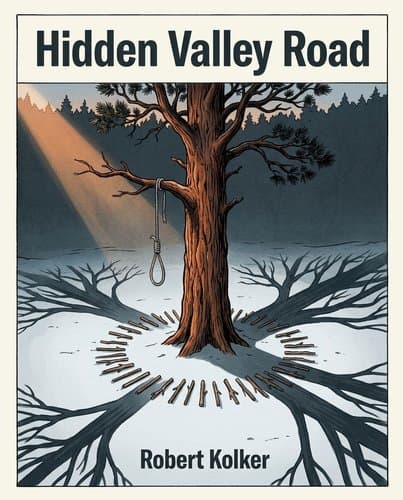
Seven-year-old Mary Galvin leads her twenty-seven-year-old brother Donald up a pine-covered hill behind their house in Colorado Springs, carrying a rope. Donald follows without hesitation — he has decided Mary is the Virgin Mary, and the Virgin Mary can ask him for anything. When they reach the tree she selects, she tells him she'd like to tie him to it. He hands her the rope and stands against the trunk while she circles him, pulling tight, reciting nothing, planning everything.
Her plan is to burn him alive. She has seen it in the sword-and-sandals epics her mother watches: heretics at the stake. She gathers kindling, drops armfuls at his bare feet. Donald doesn't resist. He's praying — a litany entirely his own, a loop of orders and saints that ran without stopping, indifferent to everything around it.
She abandons the plan only because she has no matches. And because she is not like her brother. Her mind is anchored in the real world the way his isn't. She walks back down the hill and leaves him standing there among the flies and pasqueflowers, praying.
Robert Kolker's Hidden Valley Road opens here — the rope, the kindling, the praying man still standing when she walks away. The Galvin family of Colorado Springs had twelve children; six of the sons developed the disease. But the story Kolker pursues belongs as much, maybe more, to the six who didn't. The illness never touched Mary's mind the way it did her brothers'. What it did instead was build the architecture of her childhood: determined what she was permitted to feel (nothing visible), taught her to suppress every reaction so her parents wouldn't worry that something was wrong with her too, left her, by age seven, gathering kindling at the feet of a man she loved and feared and could not escape.
Forty-five years later, she makes the six-hour drive from Telluride to visit Donald at an assisted living facility in Colorado Springs. She is the only family member who comes. The illness has lived in her life for nearly half a century, not as a diagnosis but as a landscape she still moves through.
The Psychiatric Establishment Gave Families a Rational Reason to Hide
Don and Mimi Galvin hid their son's illness because the medical system of their era had made disclosure into a punishment — and the person punished would be Mimi.
In 1948, the psychiatrist Frieda Fromm-Reichmann coined the term that would define American psychiatry for two decades: the "schizophrenogenic mother." Schizophrenia, she argued, wasn't biological. It was produced by a certain kind of mother: cold, controlling, perfectionistic, incapable of genuine warmth. The profession embraced the concept immediately. Gregory Bateson, an anthropologist with zero clinical experience, formalized it into the "double-bind" theory: a mother who says "obey me" while projecting disapproval of obedience traps her child in inescapable anxiety until psychosis becomes the only exit. By 1965, Theodore Lidz, a Yale psychiatrist, was recommending that schizophrenia patients be removed from their families entirely; their mothers had manufactured the illness. The lesson was unmistakable: if something seemed off about your child, telling a doctor was the last thing you should do.
Now place Mimi Galvin inside that framework. She ran the household with taxonomic precision: sport coats to Sunday mass, speed-reading classes, detailed critiques instead of praise for children's artwork. Don played good cop: warm, charming, perpetually absent. Mimi fit the archetype so precisely you could almost believe it had been written for her. Seeking help for Donald meant handing a psychiatrist everything needed to confirm she had caused this.
When Donald's collapse in late 1966 became undeniable — found washing his hair with beer, shouting about CIA agents shooting at the family — Don and Mimi turned to a friendly Air Force doctor who had watched Donald play football. Major Lawrence Smith wrote Colorado State a letter attributing Donald's breakdown to bad housing, a breakup, and exam stress. He never learned about the cat Donald had tortured and killed, the homicidal fantasies Donald had shared with campus doctors, or two suicide attempts at age twelve. Donald didn't volunteer any of it. Neither did his parents.
The cover-up was the only rational move available to a family living inside a mental health system that had decided, ahead of any evidence, where the blame would land.
The Silence That Protected the Parents Left the Daughters Unprotected
Margaret Galvin is asleep on a green-flowered damask couch, a hand-me-down from her mother, in the living room of her brother Jim's house. She is five years old. Jim works the late shift at a bar; Kathy, his wife, is already in bed. The fish tank burbles. The television is still on. Then Jim comes in.
Years later, Margaret remembered every detail of what followed: the damask pattern of the cushions, the wicker rocking chair angled toward the kitchen, record albums lined up between cinder blocks on the floor, the window looking onto the courtyard. She remembered the national anthem playing as the TV stations signed off for the night. Jim would buy her gifts afterward. Once, a polished stone called a tiger's eye that she kept for years, adoring it, until she finally understood what it had been for.
What makes this possible, what keeps it happening for years as Jim grows more unstable, is not in Jim's house at all. It's in the silence maintained at the house on Hidden Valley Road. Don and Mimi Galvin were hiding so many things by the time Jim began abusing Margaret that one more secret was simply the shape of their lives. They had told no one that Donald was ill when Jim started showing the same symptoms. In 1970, Donald pumped cyanide gas under his wife Jean's door. She opened it and the smell hit her before she understood what she was breathing. Don and Mimi sent him to an institution and wrote cheerful letters home about Argentine ambassadors and ballet galas without mentioning a word of it. When Brian shot his girlfriend and then himself in 1973, they told the youngest children it was a bicycle accident and hid, for decades, that Brian had been prescribed an antipsychotic before his death. Each secret became its own reason not to mention the next one.
Jim remained, in practice, the family's designated rescuer: the stable son, the one who took the girls ice-skating and skiing and riding on the Manitou Incline funicular where he worked, the one Don and Mimi called when things at home got too bad to manage. His own psychiatric hospitalization was behind him. He seemed fine. The girls and their parents had no larger pattern to set him against.
By the time her older sister Mary was thirteen, in the spring of 1979, Jim had been abusing her for three years. That night, at the cottage behind the incline's upper station, she finally fought back. She was terrified of getting pregnant, and that terror was larger than her fear of him. Jim raped her anyway. Then he disappeared from her life entirely. She had expected to feel only relief. Instead, she found herself heartbroken. Some part of her had truly believed this was love, she later understood. She had been given no context to see it as anything else. The silence that protected her parents had given what Jim did to her the shape of love.
Schizophrenia Was a 'Disease of Theories' for a Century — and Families Waited in the Wreckage
What would you expect from a field that had been arguing about the same disease since Freud and Jung split over it in 1912? Progress, maybe. A narrowing of the debate. At the very least, some agreement about what counted as evidence. Instead, Thomas Szasz's 1961 The Myth of Mental Illness gave the anti-psychiatry movement academic cover, starving biological research of funding for nearly a decade.
In the summer of 1967, the most prominent schizophrenia researchers in the world gathered at a resort hotel in Dorado Beach, Puerto Rico, the tropical setting apparently chosen to ease the tension, and spent a week making none of that happen.
David Rosenthal, an NIMH psychiatrist, arrived with what seemed like a decisive finding. He and his colleague Seymour Kety had searched Denmark's meticulous medical records for adopted people who later developed schizophrenia, then compared the health records of their adoptive families against their biological ones. The result was unambiguous: biological heritage predicted schizophrenia far better than environment. Families with a history of the disease were more than four times as likely to produce it, even when children grew up entirely apart from their blood relatives. Mentally ill adoptive parents, with no genetic tie to their children, transmitted nothing. Rosenthal believed he had finally closed the case.
He hadn't. Theodore Lidz, a Yale psychiatrist who had spent his career arguing that family dysfunction caused schizophrenia, took the podium and cited no data whatsoever — only his own clinical impressions. Other speakers attacked mothers for being cold and controlling without explaining why those same mothers' other children had stayed healthy. The week ended with Rosenthal offering a joke: the heredity-environment debate reminded him of a duel in which both parties maneuvered so carefully to avoid each other that they never risked "even the danger of catching cold."
Three years later, participants were still described as "warring camps." Schizophrenia was "a disease of theories," the psychiatric historian Edward Shorter later observed — and the twentieth century produced hundreds of them. Families like the Galvins waited inside that argument for decades, with no treatment strategy that synthesized what was actually known, because the field was too busy fighting itself to build one.
The Science That Finally Cracked Schizophrenia Was Built on This Family's DNA — and Arrived Too Late to Help Them
Robert Freedman spent two decades tracing schizophrenia to the α7 nicotinic receptor, a structure in the brain that needs acetylcholine to reset the brain's information-processing circuits. People with schizophrenia have roughly half the normal number of these receptors. The ones they do have function normally; their brains simply don't produce enough of these receptors to reset that signal.
His first proof came from nicotine. He gave patients three pieces of Nicorette gum, then ran his auditory gating test, a measure of whether a brain, hearing the same click twice, can quiet its response to the second one. Normal brains do this automatically. Schizophrenia brains can't. The patients who chewed the gum passed. It also explained why so many schizophrenia patients, Peter Galvin among them, chain-smoked: they had stumbled onto the one thing that gave them, briefly, a working mind.
Freedman then developed a synthetic drug, DMXBA, that replicated nicotine's effect without the addiction. In a 2004 clinical trial, one patient told him she had finally been able to finish a short story she'd been struggling with for months. Another said he'd stopped noticing his voices. A third's mother reported that her son had spent an afternoon watching the rabbits in the yard, undistracted, for the first time she could remember. The drug worked.
Pharmaceutical companies couldn't buy Freedman's version (the patent was nearly expired), so they made their own and insisted on once-daily dosing, because that's what patients will take and what insurers prefer. Freedman had already established that the drug only worked in three or four small doses across the day. Abbott Laboratories ran through three phases of clinical trials with the once-daily version. When it failed, they stopped. "Their marketing people rule how they make drugs," Freedman said. "And so, they sort of were doomed to failure."
Jim Galvin died alone in his Colorado Springs apartment in 2001 after weeks of ER visits where staff dismissed his complaints as paranoia. Joe Galvin died alone in 2009, his heart slowly destroyed by the antipsychotic that had been managing his symptoms. Both deaths were almost certainly caused by neuroleptic malignant syndrome, a condition triggered by the very drugs prescribed to treat them. Their DNA had been gathered by Lynn DeLisi, a researcher who spent years collecting genetic material from schizophrenia families across the country, and it helped identify a mutation in the SHANK2 gene, published in 2016 as a key mechanism of schizophrenia. When researchers traced that mutation back through the family tree, it came from Mimi's side, not Don's. The woman the psychiatric establishment had spent decades blaming for causing the illness turned out to be its unwitting carrier. By then, both had been dead for years.
Freedman has since turned toward prevention. He's now focused on choline supplementation during pregnancy for families at genetic risk, on the theory that priming the α7 receptor system before birth might stop the disease before it begins. In early trials, 76% of infants born to mothers who took choline passed the auditory gating test; 43% of controls did.
The science the Galvins helped build is real, and it points somewhere. The treatments it was supposed to generate never reached them.
Lindsay and Margaret Survived. Their Brothers Didn't. The Difference Wasn't Just Resilience.
The sisters didn't survive because they were stronger than their brothers. They survived because an oil millionaire decided to rescue them.
Sam Gary struck oil in southeastern Montana in 1967 on his thirty-sixth try — luck underwritten partly by intelligence Don Galvin passed from his Federation contacts about when federal land leases expired. The debt was never formally acknowledged, but it was paid. When Margaret was thirteen, Nancy Gary pulled her out of Hidden Valley Road and enrolled her at an exclusive Denver private school on full tuition. When Mary applied to boarding school to escape Jim, the Garys paid her way to Hotchkiss in Connecticut. The fortune that rescued both sisters had been built, in part, on their father's favor.
The brothers got something different. When Peter's symptoms became unmanageable at fourteen, the family sent him to the state hospital at Pueblo. When Donald became dangerous, Pueblo. When Joe and Matt followed, Pueblo. Then neuroleptics that stabilized them enough to survive while making them, year by year, more brittle.
Decades later, the Garys were still paying. When Lindsay's teenage son Jack started skipping class and smoking pot, an evaluation revealed he wasn't struggling with substances — he was consumed by anxiety about inheriting the Galvin disease. Sam and Nancy covered ninety days at a wilderness therapy program followed by twenty-one months at a therapeutic boarding school at $8,300 a month. Jack came home with a clinical vocabulary for his own interior states. Lindsay's accounting was plain: "The haves have these options and the have-nots do not." If her brothers had gotten early, sustained intervention instead of antipsychotics and the institutional revolving door, she believed, they might not have become as ill as they did.
The research backs her. The NIMH-funded RAISE study enrolled patients within two years of a first psychotic episode and gave them coordinated specialty care: therapy, family education, and medication managed at lower doses than standard. Those patients did significantly better. It just costs more than most families can afford.
Lindsay's daughter Kate is eighteen now, interning in Freedman's schizophrenia lab at CU Denver, close enough to the science to watch where it might go. When a lab tech made a crack about her family being "huge donors," Kate didn't miss a beat: "Are you talking money, or tissue?"
The People Who Built the Science Never Got the Treatment
The Galvin blood is sitting in freezers right now — at Pfizer, at the Coriell Institute, in Freedman's lab in Denver. Jim and Joe and Peter, the men who died alone in apartments while their chest pain was dismissed as paranoia, helped build the map of a disease that may one day be prevented by a treatment that might protect the next generation of Galvins. That's the irony you're left holding: the knowledge that might have saved them was assembled from them, and arrived thirty years too late. Lindsay's daughter Kate interns in Freedman's lab now. Her son Jack survived adolescence with the early intervention her brothers never got. That science is real. It points forward. But Lindsay's accounting stays with you long after the book closes: the future the Galvins helped build will reach some people. Just not all of them.
Notable Quotes
“I don't know what you're talking about.”
“It is easy to be number one,”
“but not everyone can be number ten.”
Frequently Asked Questions
- What is Hidden Valley Road about?
- Hidden Valley Road chronicles the Galvin family — twelve children, six of whom developed schizophrenia — showing how mental illness, medical failure, and institutional shame destroyed not just the diagnosed but everyone around them. Drawing on the family's story and decades of psychiatric research, it reveals what science understands about schizophrenia's genetic roots and emerging prevention strategies. The book exposes how harmful theories like the "schizophrenogenic mother" theory delayed proper treatment, and demonstrates how family members—especially undiagnosed children—absorb psychological trauma while their needs disappear.
- How does schizophrenia affect family members beyond the diagnosed?
- Mental illness in a family is never contained to the diagnosed members — the psychological burden falls hardest on the undiagnosed people living alongside them, especially children, who absorb violence and terror while their own needs disappear. These undiagnosed relatives experience severe psychological trauma that often goes unaddressed. Identifying and supporting 'well' family members is as important as treating the sick ones. The Galvin family demonstrates how the unspoken anguish of siblings shaped their entire lives and contributed to their own struggles with mental health and wellbeing.
- What scientific discoveries about schizophrenia does Hidden Valley Road present?
- Schizophrenia is genetic but not simply heritable: mutations in genes like SHANK2 and CHRNA7 affect brain pathways rather than directly causing the disease. The same logic that led to statins for heart disease (a rare family mutation exposed the cholesterol pathway that helped millions) now points toward specific prevention strategies for schizophrenia. Choline supplementation during pregnancy shows genuine promise for preventing schizophrenia in genetically at-risk families. Robert Freedman's trials show 76% of supplemented at-risk babies pass auditory gating tests vs. 43% in controls, suggesting this nutritional intervention could become as routine as folic acid for spina bifida.
- What prevention and treatment approaches does Hidden Valley Road recommend?
- Early, intensive therapeutic intervention before a first psychotic break may prevent progression to chronic schizophrenia. Options include wilderness programs, family therapy, and supported housing—though these interventions remain accessible only for families with resources. Each psychotic break causes measurable gray matter loss, making patients progressively more "brittle" over time. The book reveals dangers of long-term antipsychotic medications: both Jim and Joe Galvin likely died of neuroleptic malignant syndrome caused by the drugs prescribed to treat them. Cardiovascular monitoring and taking mental health patients' complaints seriously could save lives.
Related Book Summaries
Read the full summary of 50088631_hidden-valley-road on InShort