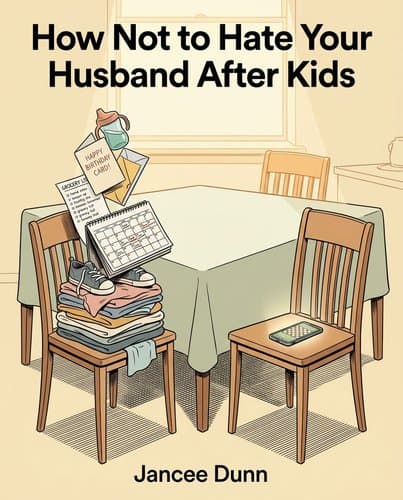
40611244_how-not-to-hate-your-husband-after-kids
by Jancee Dunn
Parenthood doesn't destroy love—unequal labor, maternal gatekeeping, and unspoken resentment do, and they're entirely predictable. Research-backed scripts and…
In Brief
How Not to Hate Your Husband After Kids (2017) examines why having children so reliably erodes marital satisfaction — through labor imbalance, sleep deprivation, and unspoken resentment — and offers concrete tools to reverse it.
Key Ideas
Formalize household ownership, don't debate fairness
Schedule a biweekly household management meeting — fifteen minutes, Saturday morning, every chore named and owned. Domestic labor doesn't redistribute itself fairly after kids; it requires explicit infrastructure and regular calibration, not recurring conversations about fairness.
Exit before anger becomes words
When rage starts building, make the T sign and leave the room before opening your mouth. Then return with 'What I'd like you to do now is...' instead of a complaint. The exit is the intervention — the words come after.
Stop undermining partner's household competence
Watch for maternal gatekeeping: if you correct, criticize, or take over every time your partner attempts childcare or housework, you are training him into the expert-apprentice dynamic. The Clifford homework scene is not about Tom; it's about what happens when help gets punished.
Speak appreciation withheld by assumption
Ask your partner to write five things they love about you, then read the lists aloud to each other. Most couples discover years of unspoken appreciation, withheld under the assumption the other person already knows. They don't.
Lead with compliment then because
Lead requests with a genuine specific compliment, then add the word 'because' before your ask. Research shows 'because' triggers compliance even when the reason isn't impressive. Directness plus a stated rationale outperforms dramatic speeches and loaded silence every time.
Consistent presence beats expensive moments
Children's top wish isn't more time with parents — it's that their parents be less stressed and tired. The expensive Memorable Moment is almost never what kids remember; the small daily ritual is. The same logic applies to spouses.
Who Should Read This
People working on personal growth in Marriage and Relationships, especially those tired of generic motivational advice.
How Not to Hate Your Husband After Kids
By Jancee Dunn
9 min read
Why does it matter? Because your domestic resentment has a structural cause — and so does the fix.
Here's something that will either comfort you or send you into a spiral: if your marriage got substantially worse after you had children, you're not the exception. You're the pattern. The labor split, the sleep debt, the invisible mental load, the resentment that quietly hardens — the whole arc shows up in study after study across thousands of couples, consistently enough that it has a name. What it doesn't have, usually, is a fix. That's what Jancee Dunn went looking for: not by burning the marriage down or pretending everything was fine, but by interrogating psychologists, couples therapists, and a former FBI hostage negotiator, then dragging her thoroughly decent husband along to find out who was right.
You're Not Failing at Marriage — You're Falling Into a Documented Trap
Jancee Dunn is on a timed phone call with Jennifer Hudson — Academy Award winner, major magazine cover — when her three-year-old materializes beside her and announces, with increasing urgency, that she needs to poo. Dunn waves her off. She throws her shoe down the stairs to signal Tom, who is somewhere below. She whispers "Have Daddy do it" while laughing too loudly at whatever Jennifer Hudson just said. The child chants "Poo. Poo. Poo. Poo. Poo." Eventually Dunn grabs Sylvie's hand and races downstairs, where she finds Tom on the couch, phone in hand, face tilted toward the screen, midway through an online chess game with someone in the Philippines.
She calls this a scene from a good marriage. She and Tom are both freelance writers working from home, the structural setup for genuine equality. He is gentle, loving, present. And yet she has become the household manager, the emotion tracker, the person who arranges the snack tray before important calls, while Tom is the person who plays SocialChess.
Dunn refuses to treat this as a mystery. The gap between what she expected and what she got isn't a personal failure; it's a documented, reliably reproducible outcome. Researchers at Ohio State found that by nine months after a baby arrives, mothers are carrying 37 hours of childcare and housework per week; fathers average 24, even when both partners work equal paid hours. Across that same window, two-thirds of couples see their marital satisfaction drop, according to marriage researchers John and Julie Gottman. The slide isn't because the people are wrong for each other. No one warned them that a structural trap was about to spring.
The trap has a specific shape. Women absorb not just the tasks, but the management of the tasks: whose birthday is coming, which car seat fits, the emotional weather report for everyone in the house. As sociologist Arlie Hochschild argued, even telling your husband what needs to be done is itself labor.
Yale psychologist Alan Kazdin, mid-conversation with Dunn, set aside his professional composure long enough to make things plain: you and the person you chose to be with are arguing about housework. Life is unpredictably short. It isn't worth it.
The resentment is real. It's also a structural default — predictable, documented, and nothing to do with love. That's where this book begins.
The Research Implicates Both of You — Which Is Actually the Good News
The easy story about the domestic imbalance is that he doesn't try. The more useful — and more uncomfortable — story is that she keeps stopping him, often without realizing it.
Ohio State researcher Sarah Schoppe-Sullivan found that maternal gatekeeping (mothers controlling or limiting a father's involvement) can begin in the third trimester, before the baby exists outside the womb. Mothers whose partners admitted low confidence in their (entirely theoretical, untested) parenting abilities were already closing the gate before those abilities had a single chance to develop. The cycle is self-sealing: the less he does, the less confident he becomes, the less he does.
Dunn catches herself in the act. She retreats to the bedroom so she won't interfere while Tom helps their daughter Sylvie work through a Clifford book report. She lasts about three minutes before she's calling instructions from down the hall. When Tom pushes back (making, actually, a defensible point about whether Clifford's character develops at all), she marches in, grabs the paper, and waves him off. He didn't fail; she didn't let him finish. The gate came down.
What keeps this from being simply a story about women needing to back off: men aren't passive bystanders in the arrangement. A USC study found that a man's cortisol levels — the body's stress signal — dropped most reliably when he was relaxing while his wife was simultaneously doing household tasks. Not when both were resting together. When she was working and he wasn't. Researcher Darby Saxbe had expected the opposite finding. What she discovered instead is that the asymmetry doesn't merely persist through habit; it's biologically reinforcing for the person it benefits. His nervous system isn't just tolerating the imbalance; it's rewarding him for it.
None of this makes either party look good. But that's the point: "he's selfish" and "she's controlling" are both too tidy, and too easy to harden into positions. What's actually happening is a feedback loop: his uncertainty, her takeover, his increasing uselessness, her increasing resentment, with biology running in the background. You can't break a loop by blaming one end of it.
Your Anger Feels Justified — But Your Child Can't Tell the Difference
Five hours into an $800-an-hour session in Boston (arranged out of desperation, attended with their six-year-old watching cartoons in the waiting room), couples therapist Terry Real turns toward Jancee and asks her to repeat, word for word, the things she says to her husband during a fight. She recites them. Real nods slowly. "You're verbally abusive," he says.
She pushes back. It's venting. It's what happens when you're doing everything and getting nothing back.
"Yes. You are." He tells her to buy a book called The Verbally Abusive Relationship by Patricia Evans. "You're in it." He has a name for the role she's built around her anger: what Real calls the Self-Righteous Angry Victim. He tells her she's not a victim. He tells her to knock it off.
Then he uses the one piece of logic she can't argue with. Jancee never screams at Sylvie. Never. Even when her daughter is trying, she stops herself. Real points to that and removes her alibi: if you can control it with her, you can control it for her. The anger isn't something that happens to her. She chooses where it lands.
The protocol: when the anger starts rising, flash a T with your hands and get out before you say anything. Another room. Door closed. Keep a photo of Sylvie somewhere close. Take it out. Then say out loud, to that face in the photo, what is actually happening: you know this will hurt her, and you're choosing your anger over her anyway.
All three people in the room — Jancee, Tom, and Real — start crying.
That sentence closes the gap between how the anger feels from inside (earned, righteous, involuntary) and what it looks like from outside: a choice a child is watching. Six-year-olds don't parse why mom is furious. They register her face, her voice, the alarm in the room. You can be completely right about the injustice and still be doing something harmful with it.
The session doesn't let Tom off. Real calls out his passive withdrawal, his entitlement, the way stonewalling isn't neutrality; it escalates. But the chapter's emotional center is Jancee arriving at a specific realization: waiting for a fairer arrangement before she stops being cruel is not a plan. The distribution of labor and the anger are separate problems, and only one is hers to fix right now.
She leaves with a protocol, not a principle: T sign, exit, photo, sentence. It sounds doable. That's intentional. The space between knowing it and doing it when your face starts turning purple is what the rest of the book is about.
Stop Waiting for Him to Notice — Ask Like an FBI Negotiator
After Boston, Dunn found herself halfheartedly pedaling an elliptical machine, watching a hostage standoff resolve itself on a gym television. The negotiator on screen wasn't yelling or demanding. He was asking questions, slowing everything down. She picked up her phone and called Gary Noesner, thirty-year FBI veteran and former chief of the Bureau's Crisis Negotiation Unit, and asked whether his techniques could work on an angry spouse. He said yes. Most people, he told her, escalate when they feel unheard: the first request goes nowhere, so they restate it with more frustration, until the volume signals urgency. What it actually signals is threat. And a threatened brain responds the same way whether it's dealing with a SWAT team or a spouse: it shuts down.
The FBI's Behavioral Change Stairway runs through active listening, empathy, and rapport before any behavioral change. You can't reason with someone who's already flooded. Dunn later measured Tom's heart rate after a minor argument: it had climbed from his usual 60 to 102 beats per minute. He wasn't stonewalling. He was underwater.
Tom field-tested the approach when he forgot to pick Sylvie up from art class, leaving Dunn to manage the rescue from a booth at a work meeting. She came home in a full burn. He followed her into the bedroom and, visibly consulting his mental notes, worked through the playbook: "You think I'm unreliable," he paraphrased. "Yeah, you still had to deal with it," he said, feeding her words back to her. "Go on," he offered as a minimal encouragement, a phrase he had never used with her in their entire marriage. She knew exactly what he was doing. She deflated anyway.
This is the part that surprises people: the techniques don't require sincerity to work at first. Someone who feels heard becomes available to reason with, whether or not the listening is genuine. And the practical payoff Noesner described goes beyond de-escalation — active listening contains the situation before it expands into everything unresolved since 2013. The reframe is small but it changes what you're solving for: the problem usually isn't that he doesn't hear you. It's that you're speaking into a system already in defense mode. You have to get it out of that mode first.
Fair Chores Don't Sort Themselves Out — They Need a Meeting
Why do couples who genuinely agree that housework should be shared still end up with the same skewed arrangement three months later? The culprit is almost never character — it's the absence of any structure to hold the agreement in place.
Dunn discovers this the hard way. After enough failed attempts to let things sort themselves out, she consults Guy Winch, a psychologist who later became their couples therapist, and he reframes the problem: the marriage has needs of its own, separate from either partner's preferences, and those needs require a meeting. A brief check-in every two weeks, treating the household as a managed operation: what's working, what isn't, who owns what. Dunn resists. It sounds clinical. Winch is unmoved: there's no naturally occurring version of fair. Domestic labor doesn't sort itself out; it has to be coordinated, and coordination will feel like coordination.
They start holding fifteen-minute Saturday meetings after a late breakfast. Sometimes collaborative, sometimes like negotiations between opposing counsel. The daily renegotiation that had exhausted them both starts to shrink. UCLA researchers studying family life found the same pattern: couples who had clarity about who owned which tasks moved through their days with measurably less friction. Those who lacked it were trapped in a loop of requests and avoidance.
The fix is specific: Dunn takes grocery shopping, cooking, vacuuming, bathroom. Tom takes bills, dishes, laundry, Swiffering. Every job named, every owner clear. The Pew Research Center, after seventeen years of polling, found that sharing household chores ranked third on its list of what makes marriages work — above decent housing, common interests, and income. Couples hadn't grown more enlightened; the distribution of domestic labor was what they'd been fighting about all along, even when they thought they were fighting about respect.
The meeting doesn't fix everything. But it converts an attitude problem into an infrastructure problem, and infrastructure, unlike attitude, you can actually schedule.
The Most Important Things You Feel About Each Other Are Going Completely Unsaid
In a therapist's office in Manhattan's Flatiron district, Tom nervously pulls out a piece of paper and begins to read. Their couples therapist Guy Winch had assigned both of them homework: each partner secretly lists what they love about the other, then reads the list aloud in session while the other person watches their face. Tom has never done anything like this. Neither has Jancee. They have been married fifteen years.
He reads through his list. Then he gets to a line near the bottom: she is his best friend. There is no one he would rather spend time with, tell things to, wake up beside, or share a wordless glance with. Romantic love gets all the attention, he writes. This, he thinks, is more important.
Jancee had never heard it. In fifteen years.
Winch noted that few couples actually do this — and when they do, the effects can last months or years.
The reason it doesn't happen is the same assumption that keeps domestic labor invisible: you already know. She assumes he sees how much she values him. He assumes she can read it in everything he does. Neither says it out loud because saying it feels like narrating something already understood. Winch's exercise doesn't invent new feelings — it makes existing ones cross the room.
Ellen Galinsky found the same pattern in children's memories. When she asked more than a thousand children ages eight to eighteen what they would remember most from their childhoods, parents overwhelmingly predicted big-ticket moments: the planned vacation, the special trip. Children said something else. One girl's defining memory was her father saying "You go, tiger — you go get them" every morning before school. A throwaway send-off he almost certainly forgot once the door closed. Lodged in her forever anyway.
The same study asked kids their single wish about how their parents' lives might change. Parents guessed: more time together. What children actually wanted was for their parents to be less stressed and less tired. Only two percent of parents got it right.
What your partner and your child absorb isn't the effort you think you're broadcasting. It's the small, repeated, unremarkable moments of being noticed and told. The part most of us skip because we assume it's already understood.
The Things Worth Remembering Are Already in the Room
The Galinsky finding cuts the other way too. What sustains a marriage over the long haul probably isn't the anniversary trip or the grand gesture — it's the unremarkable Tuesday when you say the thing you've been carrying around quietly for years, assuming they already know. They don't — Jancee didn't learn she was Tom's best friend until year fifteen. And the child in the next room? She's not watching for the highlight reel. She's absorbing the texture of how two people treat each other on an ordinary morning. So the question worth sitting with: what have you been feeling that you've never actually said out loud?
Notable Quotes
“I just need that hour,”
“—my biggest thing is banana pudding, but it's the devil!”
“So no one is allowed to bring it into my house.”
Frequently Asked Questions
- What is How Not to Hate Your Husband After Kids about?
- How Not to Hate Your Husband After Kids (2017) examines why having children so reliably erodes marital satisfaction and offers concrete tools to reverse it. Journalist Jancee Dunn draws on research and her own marriage to deliver practical strategies including household management meetings, conflict de-escalation scripts, and techniques for redistributing domestic labor. The book addresses the core drivers—labor imbalance, sleep deprivation, and unspoken resentment—and provides interventions before low-grade misery hardens into contempt. It focuses on structural, actionable changes rather than simply recognizing the problem.
- What are the key strategies How Not to Hate Your Husband After Kids recommends?
- The book recommends six core strategies. Schedule biweekly household management meetings where "every chore [is] named and owned" (fifteen minutes, Saturday mornings). When conflict arises, make the T sign and leave before speaking; return with "What I'd like you to do now is..." instead of complaint. "The exit is the intervention." Avoid maternal gatekeeping by resisting the urge to correct your partner's childcare attempts. Ask your partner to write five things they love about you and read them aloud; most couples discover "years of unspoken appreciation, withheld under the assumption the other person already knows." Lead requests with genuine compliments plus "because"—research shows this triggers compliance even with weak justifications.
- What is maternal gatekeeping and how does it damage marriages?
- Maternal gatekeeping—when a mother corrects, criticizes, or takes over every time her partner attempts childcare—creates damage. "If you correct, criticize, or take over every time your partner attempts childcare or housework, you are training him into the expert-apprentice dynamic." When help gets punished through correction, partners disengage from household responsibilities, concentrating all domestic labor on one person. Breaking this requires consciously resisting the urge to intervene and allowing your partner's approach to differ. The dynamic deepens resentment and erodes partnership equity. By permitting autonomy and avoiding constant correction, couples prevent the expert-apprentice pattern and distribute responsibilities more fairly, strengthening the marriage.
- How do you rebuild connection and appreciation in marriages with kids?
- Most couples harbor years of unspoken appreciation, withheld under the assumption their partner already knows. The book recommends: "Ask your partner to write five things they love about you, then read the lists aloud to each other. Most couples discover years of unspoken appreciation, withheld under the assumption the other person already knows. They don't." This practice reconnects partners and rekindles appreciation. Additionally, lead requests with genuine compliments, then add "because" before asking—research shows this triggers compliance. The book notes that children's top wish isn't more time with parents but that "their parents be less stressed and tired." Making appreciation explicit and reducing parental stress rebuilds connection effectively.
Related Book Summaries

Read the full summary of 40611244_how-not-to-hate-your-husband-after-kids on InShort