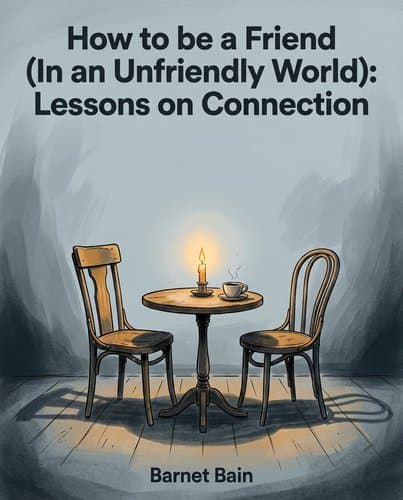
236570102_how-to-be-a-friend-in-an-unfriendly-world
by Barnet Bain
Most friendships are transactions dressed up as affection—but Cicero's ancient standard demands more: virtue, honesty, and the courage to tell hard truths.
In Brief
Most friendships are transactions dressed up as affection—but Cicero's ancient standard demands more: virtue, honesty, and the courage to tell hard truths. Learn to build the rare, character-forged connections that make you more fully yourself rather than merely more comfortable.
Key Ideas
Utility and pleasure reveal friendship's true foundation
Most friendships are built on utility or pleasure — recognizing this isn't cynicism but the first step toward seeking something deeper. Ask honestly: would this friendship survive if there were nothing to gain from it?
Character development builds the deepest friendships
True friendship, in Cicero's account, requires moral goodness as a foundation — which means working on your own character is the most direct path to the friendship you actually want.
Assess character before emotional investment deepens
Test character before love is formed. Once you love someone, your judgment is compromised. Small actions under pressure reveal character more reliably than self-report or shared good times.
Honor non-negotiable in true friendship
A friend who asks you to compromise your honor has revealed the friendship was conditional. Cicero's rule: never ask a friend to do anything shameful, and refuse if asked — not despite the friendship, but because of it.
Honest feedback matters more than comfortable praise
Flattery is not kindness. A friend who consistently tells you what you want to hear is prioritizing your comfort over your growth. Truth, even when uncomfortable, is what friendship owes.
End friendships with care and deliberation
When a friendship must end, unravel rather than cut. The care with which you exit a friendship reflects the seriousness with which you entered it.
Long-term friendships deserve intentional continued investment
Invest in older friendships deliberately. The shared history of a long friendship — the people who knew you before you became whoever you are now — carries a value that newer relationships cannot replicate quickly.
Who Should Read This
Readers interested in Relationships and Stoicism, looking for practical insights they can apply to their own lives.
How to be a Friend (In an Unfriendly World): Lessons on Connection
By Barnet Bain
9 min read
Why does it matter? Because the friendships you already have may not be friendships at all.
You think you already have friends. Good ones, probably. People who check in, who show up, who know your coffee order and your worst ex. Cicero would not call most of that friendship. He'd call it something warmer than useful, but nowhere near true. Writing in 44 BC, exiled and grieving, he set down the argument that genuine friendship is not a social arrangement but a moral achievement — something available only to people who have done the harder work of becoming worth knowing. The gap between what we casually call friendship and what he means by the word is the entire subject of this book. Cross it, and you'll understand why a Roman general speaking to his sons-in-law two thousand years ago about the death of his closest friend still has something to say about the loneliness you can feel in a full room.
Most of What We Call Friendship Is Actually Something Else
Most of what you call friendship probably isn't, at least not by the standard Cicero sets.
He was writing in Rome, a city where social bonds were explicitly contractual. Romans cultivated amicitia the way you'd tend a business relationship: favors given, favors owed, the ledger more or less balanced. He doesn't pretend this kind of connection is worthless. It's real, it's useful, it keeps the world running. But he names it for what it is: mutual advantage dressed up as closeness.
Against that backdrop, he offers a single devastating image. Any Roman of his acquaintance could tell you instantly how many sheep or cattle he owned — could name every animal in his flock. But ask that same man how many genuine friends he has, and he goes quiet. He hasn't counted, because he hasn't really looked. The livestock get careful management; the friendships get pleasant neglect.
What Cicero is reaching for instead is friendship rooted in amor — love — from which the Latin word amicitia actually derives. Not utility. Not the comfortable warmth of someone who can do you a favor. The real thing, he argues, arises when you see virtue in another person and feel pulled toward it the way you're pulled toward light. The friendship that results doesn't keep score, doesn't dissolve when circumstances change, and isn't really about what you get from the other person at all.
That's a narrow gate. Most of what fills our days — the colleagues we genuinely like, the neighbors we'd help without hesitation, the old acquaintances whose company still gives us pleasure — Cicero would call those good things, worth having, but not the same category. True friendship, in his account, is so rare he can only name three or four pairs across all of recorded history. Which means the interesting question isn't whether you have friends. It's whether any of them would survive his definition.
Friendship Begins in Virtue, Which Means Most of Us Aren't Ready for It
What if the reason you're lonely — really lonely, even when surrounded by people you like — is that you aren't yet the kind of person capable of the friendship you're looking for?
Cicero's answer, delivered through the voice of Laelius, is uncomfortable but precise. He argues that genuine friendship can only exist between good people — and by good he doesn't mean morally flawless. He explicitly dismisses the Stoic standard, which holds that only a perfectly wise sage can be truly virtuous, and notes, drily, that such a person has never actually existed. What he means by good is something you can recognize in real life: the Roman statesman Gaius Fabricius, who turned down bribes from an invading general rather than betray his city; Manius Curius, who defeated that same general on the battlefield and then returned to his farm. Men who demonstrate faithfulness, honesty, and fairness under pressure, in actual circumstances, over time.
The bond amor names — and amicitia inherits — is what forms when you recognize something genuinely admirable in another person and they in you. That's why purely transactional friendship is unstable by definition. If you're drawn to someone because they're useful, the connection lasts precisely as long as the usefulness does. Virtue doesn't change with circumstances. Advantage does.
The hard implication sits right there: to attract this kind of love, you have to be worth attracting it. Laelius doesn't soften this. The friendship you're capable of is a reflection of who you are, not just who you've found. Which means the question of friendship is, at bottom, a question about character — yours first, before anyone else's.
What Laelius and Scipio Actually Had
Imagine you are Laelius, seventy years old, sitting in a garden in Rome in the summer of 129 BC. Your closest friend died three weeks ago — found dead in his bed after a day of political triumph, the cause still whispered about in the Forum. You are not performing grief. You are doing something stranger and more demanding: trying to say honestly what you had.
What Laelius comes out with, when his sons-in-law press him, is a list so specific it stops feeling like philosophy. He and Scipio shared one house and one table. They served together on campaigns in Spain and Africa. When public life allowed them quiet, they spent it studying — reading, discussing, arguing out ideas far from the eyes of the crowd. In forty years of close friendship, Laelius says, he never gave Scipio the smallest offense that he knew of, and never once heard from Scipio a word he wished had gone unsaid.
That last detail is worth sitting with. Not a single word either man wished unsaid. Think about the people you love most and count how many conversations you'd revise if you could. The standard Laelius is describing — not aspirational, but actual, lived, remembered — is almost incomprehensible in its completeness.
Cicero frames this through an image borrowed from a Greek philosopher named Archytas, which his own father heard from his father before him. The thought experiment goes like this: suppose you ascended into the heavens and stood before the full beauty of the cosmos — the stars, the wheeling planets, the structure of everything. Now suppose you had no one to tell. Archytas's claim is that the wonder would turn bitter. The most delightful experience imaginable becomes joyless in isolation, because nature made us creatures who need to share what moves us. The sweetest support, he says, is a close friend.
What Laelius and Scipio had was that. Someone to whom the good things became more real in the telling. The military victories, the long evenings of scholarship, the satisfaction of work well done — all of it doubled when brought into the presence of a person who cared about it as genuinely as you did.
A Friend Who Asks You to Cross a Line Has Already Revealed the Truth
Picture Gaius Blossius standing before Laelius in the immediate aftermath of a political disaster, trying to explain himself. Tiberius Gracchus, the radical tribune who had tried to redistribute Roman land and been clubbed to death by a mob of senators, was gone. Blossius had been Gracchus's closest companion. Now he needed to be forgiven, and this was his argument: he had held Gracchus in such high regard that he considered himself duty-bound to do whatever the man asked.
Laelius pressed him. What if Gracchus had asked you to carry fire into the Capitol and burn it down?
Gracchus would never have asked that, Blossius said. But if he had — I would have done it.
Laelius calls this a nefarious answer, and the story doesn't stop there. Blossius turned out to be as good as his word, and worse: far from merely following Gracchus, he had been one of the architects of the land reform that tore Rome apart, the man helping to draft the legislation and organize the movement that ended in bloodshed. When the legal consequences caught up to him, he fled to Rome's enemies in Asia and eventually took his own life. The loyalty he had mistaken for devotion became the instrument of his destruction.
The lesson Cicero draws from this is one of his sharpest inversions: if a friend asks you to do something wrong, the request itself is the revelation. Not a test of your loyalty. Not a measure of how much you care. A disclosure about what the friendship actually was.
The reasoning goes like this. Genuine friendship, in Cicero's account, is founded on virtue — the recognition of goodness in another person, and the pull that recognition creates. That foundation means the friendship can only survive as long as both people remain oriented toward what is right. A friend who asks you to betray your honor has announced that they were never drawing you toward anything worth having. The bond wasn't virtue attracting virtue. It was need recruiting complicity.
So Cicero's first law of friendship isn't sentimental: never ask a friend to do anything shameful, and if asked, refuse. The refusal isn't a betrayal of the friendship. It's the proof that a real friendship existed — because real friendship cannot require you to become worse.
Every loyalty test you've ever faced looks different in this light. Think of the old friend who asks you to cover for them — not some hypothetical, but a specific afternoon when you knew exactly what covering for them would cost you, and they asked anyway, invoking the years between you as the reason you should look away. Cicero's question isn't how loyal are you, but what is this bond actually made of? A friend who needs you to cross a line to keep them is telling you, in the clearest possible language, what they think you're for.
Flattery Is Not Kindness — It Is the Slow Destruction of a Friendship
Imagine a doctor who only tells you what you want to hear — your results look fine, the symptoms will probably clear up, no need to change anything. The relationship stays pleasant. You stay sick. That is roughly what Cicero thinks you're doing to your friends every time you choose their comfort over their improvement.
His sharpest illustration comes from the Roman stage. In Terence's comedies, there's a recurring character type: the fawning yes-man, the toady who magnifies everything his patron says, who agrees before the sentence is finished, who answers 'tremendous thanks' when a simple 'great thanks' was already more than enough. Cicero calls this figure — embodied most memorably in a character named Gnatho — the most dangerous enemy friendship has. Not because he's obvious. The crude flatterer who praises everything is easy to spot. What makes Gnatho dangerous is that the skilled version will sometimes disagree with you, pick a small quarrel, and then gracefully let you win, so that you come away convinced you were the sharper thinker all along. You've been handled, and it felt like respect.
Cato put it with characteristic bluntness: bitter enemies are often more useful to us than sweet-seeming friends, because enemies will tell you the truth. The friend who always agrees is performing a version of you back at yourself — a more comfortable fiction than the actual person. Over time, that's not closeness. It's a slow replacement.
What real friendship requires, Cicero insists through Laelius, is counsel given freely, sometimes harshly, always honestly — and received the same way. Not ledger-keeping, not accounting for every favor — but the willingness to say the difficult thing because you care more about the person than about the mood of the afternoon. A friend who withholds that is protecting themselves from awkwardness while calling it kindness. The friendship becomes a pleasant arrangement between two people who've agreed, implicitly, never to actually see each other.
Choose Friends Slowly, and Unravel Rather Than Cut
The flattery problem Laelius identified — the friend who tells you what you want to hear — has a mirror problem in how most people choose friends in the first place. Someone enters your life, warmth develops gradually, and eventually you look up and realize you've got a friend. Cicero thinks this is how you end up with the wrong ones.
His practical counsel, delivered through Laelius, is blunt: once genuine love for another person takes hold, your ability to judge that person is gone. The evaluation you most need — is this someone of genuine good character? — becomes impossible once you're already attached. So the only moment to look clearly is before the bond forms. Test character in small things first. Watch how someone handles a minor financial pressure, a small slight, a moment where honesty would cost them something. The person who behaves well when little is at stake will usually reveal themselves when the stakes rise. By then, though, the friendship has already taken root.
Laelius compares old friendship to old wine — it deepens with time in ways that cannot be manufactured or rushed. But that richness only accumulates if the starting material was sound. Pour the wrong thing into the barrel and age only concentrates the flaw.
And when the time comes to end a friendship that has soured or drifted — which it sometimes must — Laelius's instruction is to unravel rather than cut. Gradual dissolution preserves what the friendship genuinely was. A violent rupture converts years of real warmth into active enmity, which is both wasteful and false to the history. The fire, Laelius suggests, should seem to have burned out on its own rather than been stamped out by someone's heel.
The counterintuitive weight of all this: the quality of friendship available to you is bounded by who you are. Virtue attracts virtue. Which means self-cultivation isn't preparation for friendship — it is the work of friendship, done in advance.
The Wonder That Turns Bitter
Cicero wrote this in his sixties, stripped of political standing, watching the republic he'd served crack apart, grieving the death of his daughter. He wasn't making an abstract case. He was writing from inside the specific weight of a life that had lost its witness.
Laelius, the man Cicero uses to carry the argument, is remembered for one thing above all else: after forty years of friendship with Scipio, there was not a single word he wished unsaid between them. Not one. That's the standard Cicero is quietly holding up — not warmth, not loyalty in the abstract, but a friendship so carefully tended that nothing needed to be taken back.
Most of us, if we're honest, can't say that about the people closest to us. We can name things left unsaid, or said badly, or let go of too soon.
What would it cost you to take friendship this seriously? And what might it be worth?
Frequently Asked Questions
- What are the key takeaways from How to be a Friend (In an Unfriendly World)?
- The book distinguishes true friendship from relationships built on utility or pleasure. "Most friendships are built on utility or pleasure — recognizing this isn't cynicism but the first step toward seeking something deeper." Key principles include working on your own character, testing character before love forms, refusing shameful requests, providing honest feedback instead of flattery, and investing deliberately in long-standing friendships. The book also emphasizes unraveling rather than cutting off friendships when they must end. Based on Cicero and classical philosophy, it offers practical principles for building character-based connections that are more enduring than surface-level bonds.
- What does Barnet Bain say defines true friendship?
- According to Barnet Bain, "True friendship, in Cicero's account, requires moral goodness as a foundation." This means working on your character is the most direct path to the kind of friendship you want. Most friendships fail this test because they're built on utility (what you can do for each other) or pleasure (enjoyment of each other's company), not on shared commitment to goodness. To find true friendship, you must first ask honestly whether a friendship would survive "if there were nothing to gain from it." Only by understanding these distinctions can you pursue deeper, more meaningful bonds.
- Why does Bain recommend testing character before love is formed?
- Testing character before love forms is crucial because "Once you love someone, your judgment is compromised." When you already care deeply about someone, you're more likely to excuse flaws, ignore red flags, or rationalize concerning behavior. Instead, Bain suggests observing small actions taken under pressure, which "reveal character more reliably than self-report or shared good times." This approach prevents discovering serious character issues only after emotional bonds form. By prioritizing character assessment early, you build friendships on solid ground rather than discovering incompatibilities after significant investment of time and emotion.
- What does the book say about honesty and flattery in friendship?
- Honesty is a cornerstone of true friendship in Bain's framework. "Flattery is not kindness." In fact, "A friend who consistently tells you what you want to hear is prioritizing your comfort over your growth." Real friendship demands truth, even when uncomfortable. This doesn't mean being brutally critical or unkind, but rather having the courage to offer honest feedback when a friend is heading toward a mistake or compromising their values. By distinguishing between the comfort of flattery and the value of truth, Bain redefines what it means to genuinely care for someone.
Related Book Summaries



Read the full summary of 236570102_how-to-be-a-friend-in-an-unfriendly-world on InShort