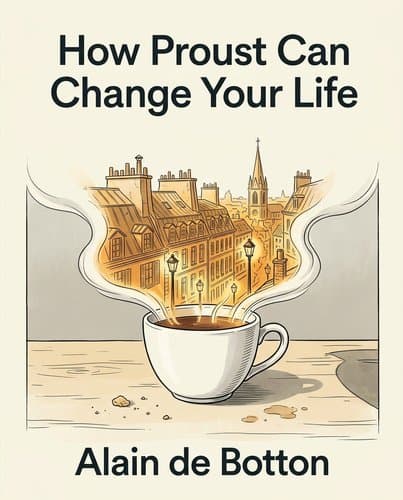
23420_how-proust-can-change-your-life
by Alain de Botton
Proust's 3,000-page masterpiece contains a practical philosophy for escaping habitual blindness—de Botton extracts its core lessons on slowness, precise…
In Brief
How Proust Can Change Your Life (1998) uses Proust's seven-volume novel as a practical guide to living more fully. Alain de Botton extracts concrete lessons — on habit, suffering, desire, language, and attention — showing how the mental habits that make great literature great can sharpen perception, recover lost experience, and make everyday life richer.
Key Ideas
Habit shapes life more than circumstance
When life feels thin or wasted, the culprit is almost always habit — the confidence that tomorrow exists — rather than any real deficiency in your circumstances. Proust's prescription: treat mortality as a fact, not a concept.
Fiction names emotions already within you
Reading fiction is most valuable not as escape but as recognition — use it actively to identify emotions and perceptions you already have but couldn't name. The test of a good book is how many 'Saniettes' and 'Duchesses' you find in your own life.
Precise language sharpens actual perception
The quality of your experience depends heavily on the precision of your language. Before reaching for the obvious phrase, ask whether it describes what you actually perceive or merely signals that you've perceived something.
Mediocrity lives in representation, not reality
What feels mediocre about your past or present is usually your representation of it, not the thing itself. The madeleine doesn't create a better childhood — it restores access to the one that was always there.
Delay strengthens desire through imagination
Deprivation and obstacle are not enemies of desire — they are its engine. The interval between wanting something and having it is where imaginative possession happens; eliminating it by getting what you want immediately is often what ruins it.
Transform suffering into understanding people
When someone causes you genuine pain — grief, jealousy, rejection — treat it as an investigation rather than a wound. The bad sufferers are those who convert pain into defense mechanisms; the good ones convert it into sharper understanding of how people actually work.
Apply authors' vision to undescribed worlds
Books are incitements, not conclusions. The goal of reading a great writer is to be temporarily equipped with their way of seeing — then to put the book down and use it on the world they never described.
Who Should Read This
Thoughtful readers interested in Literary Fiction and Self-Improvement willing to slow down and wrestle with ideas.
How Proust Can Change Your Life
By Alain de Botton
10 min read
Why does it matter? Because the obstacles you most resent — boredom, grief, jealousy, bad conversation — are not problems to escape but the only reliable raw material for a richer life.
Most people's relationship with Proust goes like this: vague guilt about never having read him, a mental image of something vast and French and probably about cookies, a private conviction that this particular monument of civilization was built for someone else. Alain de Botton thinks that's exactly backward. In How Proust Can Change Your Life, he takes the seven-volume novel that everyone respects and nobody finishes and reads it as something stranger and more useful — a field guide to the specific ways ordinary life goes wrong. The boredom in long relationships. The friendships conducted entirely in flattery. The creeping certainty that real experience is happening somewhere you're not. De Botton's argument is that Proust spent two decades in a cork-lined bedroom not escaping these problems but mapping them with surgical precision — and that the habits of mind required to write a masterpiece turn out to be the same habits required to actually live.
We Are Spectacularly Good at Wasting Our Lives — and Proust Was No Exception
In the summer of 1922, a Parisian newspaper called L'Intransigeant posed an elaborate hypothetical to French celebrities: an American scientist has confirmed the imminent destruction of the continent — hundreds of millions will die — what do you do with your last hours? The responses came back scattered and telling: one man planned to climb a mountain and admire alpine flowers, another promised himself a last round of golf. Marcel Proust, reclusive and mustachioed, writing in bed by inadequate lamplight for the previous fourteen years, sent in the most interesting answer. He argued that life would suddenly seem wonderful if we faced genuine extinction, because laziness — the lazy confidence that tomorrow is always available — makes the actual possibilities of our lives invisible to us. The Louvre, a love affair, a trip to India: all things we defer because we are certain of a future that will never quite arrive. 'We find ourselves back in the heart of normal life,' he wrote, 'where negligence deadens desire.' His punchline was precise and quietly devastating: we shouldn't have needed the threat of apocalypse. Thinking clearly about our own mortality — that death might come this evening — would have been sufficient.
Four months after filing this answer, Proust went to a party despite flu symptoms, wrapped in three coats and two blankets, then waited in a freezing courtyard for a taxi. He developed bronchitis, then pneumonia, refused the doctors' injections to protect his writing time, survived on hot milk and stewed fruit, and briefly rallied enough to send out for a grilled sole. The fish was bought and cooked. He couldn't touch it. He died at fifty-one. The man who diagnosed our laziness about living, who identified precisely how we defer the good stuff until the future evaporates, spent his last weeks deferring basic medical care. This isn't a gotcha — it's the whole point. The gap between seeing something clearly and actually living differently turns out to be enormous, which is why Proust spent the rest of his life writing a very long book about it.
Reading Is Not Escape — It's a Technology for Seeing What's Already Inside You
Most people assume the point of reading fiction is to get out — to disappear into a world that isn't yours for a few hours. Proust thought the opposite. A novel, properly used, is a lens turned inward.
He revealed this not in anything he wrote but in how he looked at paintings. When a friend accompanied him to the Louvre, Proust stood in front of a Ghirlandaio portrait from the 1480s — a kindly Renaissance man with a cluster of carbuncles on his nose — and immediately declared it was the spitting image of the Marquis de Lau, a well-known figure in contemporary Parisian society. A surviving photograph of the Marquis, seated in a garden in his dark suit and winged collar, confirms the resemblance was apparently real. Five centuries of separation, and here were the same features, the same essential person.
Proust's point wasn't that he was good at spotting faces. The number of distinct human types turns out to be surprisingly small — small enough that you keep encountering people you already know in places you'd never expect to find them. The same is true when you read. The author of this book, Alain de Botton, admits he cannot get through a description of the haughty, socially impeccable Duchesse de Guermantes without picturing the Devon-dwelling, non-French-speaking stepmother of an ex-girlfriend. The timid character Saniette — who masks his longing for social contact with elaborate displays of indifference ('You don't happen to know what you'll be doing in the next few days? Not that it makes the slightest difference') — is indistinguishable from a college friend named Philip, who shared the same terror of rejection.
The novelist's work is an optical instrument — not a window onto a foreign world but a lens through which you see your own experience with sudden clarity. You already knew someone like Saniette. You'd observed him, felt faintly sad about him, never quite found the words. Then Proust found them. And the instrument, it turns out, only works once you've lived enough to need it.
Suffering Is Not the Obstacle to Wisdom — It's the Delivery Mechanism
Think of the mind as a car engine running at idle. It will tick over indefinitely, consuming fuel, performing all its necessary functions, without ever revealing what it's actually capable of. You only discover the engine's real character under strain — on a steep grade, in cold weather, when something starts to go wrong.
His brother Robert was the engine that never strained. As a young man, Robert fell from a tandem bicycle directly under a five-ton coal wagon; the wagon rolled over him; he recovered rapidly. Later, posted to a field hospital near Verdun during the First World War, he continued operating on a German patient while shrapnel from a direct shell hit scattered around the table. He fractured his skull in a car accident and was back in active life before the family had finished being alarmed. Marcel, meanwhile, was more frightened of mice than of the German bombs falling on Paris in 1918. He could detect an altitude change of eighty-three meters — the difference between Versailles and the center of the city — as a physical malaise. He wiped his nose eighty-three times during a single three-page letter.
Who would you rather be? Robert, obviously. But Robert, for all his extraordinary durability, noticed almost nothing. He couldn't detect pollen, altitude, or noise. He could have slept on five mattress-stacked peas without any suspicion. Marcel noticed everything, and noticed it painfully — which is precisely, Proust argued, how he came to understand anything at all. A little insomnia teaches you things about sleep that an unfailing sleeper will never learn. An unreliable memory gives you a reason to investigate how memory actually works. Remove the friction and you remove the inquiry.
This is why Proust thought wisdom cannot be taught — only earned. His fictional painter Elstir says it directly: the people whose teachers successfully instilled good values from the start, who have no embarrassing earlier selves to disown, tend to be sterile. Their virtue has never been tested. The only path to understanding runs through the fatuous incarnations, the humiliations, the mistakes you'd rather not have made.
The catch is that suffering alone does nothing. It opens a door; most people walk past it. Proust's novel is full of characters who convert pain directly into defense. Madame Verdurin, excluded from aristocratic salons, solves the problem by declaring the aristocracy boring — which preserves her self-image while ensuring she learns nothing about why social worlds exclude people, or how they might be entered. Swann receives an anonymous letter exposing his lover's secret history, can't decide which of his friends sent it, wipes his glasses, shakes everyone's hands, and understands nothing new about human duplicity. Grief, Proust concluded, only changes anything at the moment it converts into an idea.
The Words You Reach For First Are Probably Lying to You
When you hear a piece of music that undoes you, what do you actually say? Probably something in the vicinity of 'amazing' or 'so good' — or, if you're Proust's friend Lucien Daudet leaving a Beethoven concert, you hum a few vague notes and announce, with great feeling, that it was a 'wonderful bit.' Proust's response was swift and unsentimental: 'It's not your poum, poum, poum that's going to convey this wonderfulness. It would be better to try and explain it.' Daudet was embarrassed. He later called it an unforgettable lesson.
What Proust objected to — and spent enormous energy objecting to — is that the words we reach for first are almost never adequate to the experience they're meant to carry. This isn't a minor aesthetic complaint. It's a claim about perception itself. When you describe a sunset as 'the sky on fire,' you haven't captured the sunset; you've replaced it with a convenient placeholder that lets you stop looking. The moon may well appear discreet on a given night, but call it that and move on and you've mistaken the beginning of an observation for its conclusion. Proust demonstrated what he meant with his own example: instead of reaching for the stock lunar image, he described a daytime moon as resembling an actress who doesn't go on for another hour, so she slips into the auditorium in her street clothes to watch the rest of the company — present, but keeping herself to one side. The description takes longer. It also actually gets there.
If the way we describe experience determines how fully we register it, then lazy language isn't just imprecise — it's a way of opting out of your own life. Most of what makes life feel thin isn't a shortage of remarkable things. It's the habit of reaching for the pre-approved description before the experience has had time to register.
What You Already Have Is Invisible to You — and Memory Is Why
Proust's narrator is sitting at home on a grey winter afternoon, rheumatic and miserable, when his mother brings him lime-blossom tea and a small scallop-shaped cake — a madeleine — of the kind his Aunt Léonie used to dip into her own cup on Sunday mornings at Combray. He takes a sip. Something extraordinary happens. Not simply memories, but the actual texture of that childhood — the smell of Léonie's bedroom, the sound of the garden bell, the feel of damp air above the river — comes flooding back with a vividness that makes his present life, with all its adult competence and accumulated experience, feel suddenly thin by comparison. He had been walking around for years carrying what he thought was a memory of his childhood. The madeleine reveals it was only a sketch.
The key move Proust makes here isn't sentimental. He argues that the narrator's childhood wasn't mediocre — the image he'd kept of it was mediocre. Voluntary memory, deployed when someone asks where you grew up, produces what Proust compares to pictures by bad painters: technically recognizable but drained of the particular qualities that made the thing what it was. You remember that there was a river, a garden, an aunt. You don't remember the moistness of the air, the specific quality of morning light, the exact pitch of the bell. You mistake the stripped-down copy for the original, and conclude that the original wasn't worth much.
This is the same argument Proust makes about the dissatisfied young man who envies wealthy bankers their gold-plated coal tongs and looks at his own kitchen with contempt. Proust's proposed cure isn't to give the man more money. It's to walk him through the galleries where the French painter Chardin hung — rooms full of saltcellars, coffeepots, crusted bread loaves, knives left lying on tablecloths. Chardin painted the exact world the young man lived in, and painted it as extraordinary. After standing in front of those canvases long enough, the young man would walk back into his own kitchen and see it differently — not because the kitchen had changed, but because he now had a precise image to hold against it.
The madeleine doesn't restore the past — it restores the resolution.
Desire Requires Distance — Why Getting What You Want Often Ruins It
Imagine being handed everything you wanted the moment you wanted it. The fantasy collapses quickly: what you'd lose is the wanting itself, and the wanting, it turns out, is where most of the value lives.
Proust illustrates this through Noah, of all people. Noah spent six hundred years with the world spread out around him — every bush, every mountain, every sky — and noticed almost none of it. Why would he? It was always there. The visual information arrived continuously, was filed, and was forgotten. Then the Flood came. Shut in a dark Ark with nothing to look at but the animals, Noah began, for the first time, to actually see what he'd been surrounded by for six centuries. Deprived of the physical thing, he had to reconstruct it internally — and that reconstruction, that imaginative labor, was the real act of perception. What he'd been doing before was merely looking.
Proust applies this directly to love. The problem with cohabitation isn't that you come to know someone too well — it's that reliable physical presence generates a counterfeit of familiarity. You feel you've done the work simply by securing the relationship, exactly as Noah felt he'd seen the world simply by living in it. The imaginative engagement that drove your desire during the early, uncertain phase — when you were reconstructing this person in their absence, turning them over in your mind — quietly stops. You've arrived; the journey ends; you stop looking.
This is why the kiss Proust's narrator finally exchanges with Albertine is such a disaster. He'd spent months building her up imaginatively — her black hair, her confidence, the smell of the Normandy coast she'd come to represent — and when their lips finally meet, his nose is squashed flat and he can't see her face. His lips, he concludes, can only ever brush against the sealed envelope of a person; they cannot deliver what the imagination had been assembling all along. What the body gains in contact it loses in access: the closer you get, the less you can see.
Even Proust Must Eventually Be Put Down
Drive southwest from Chartres and you'll eventually see a road sign for Illiers-Combray — a town that, until 1971, was just Illiers, before it renamed itself after its most famous occasional visitor. Inside the tourist office, a leaflet by a local enthusiast named Larcher insists you must spend an entire day there before opening the novel, to grasp its 'deep and occult sense.' The patisserie sells Proustian madeleines in packs of eight or twelve. In the house where Proust's aunt once lived, a plastic madeleine sits inside a Perspex case on a table beside the bed. The hushed, semi-religious atmosphere is the atmosphere of a church.
Proust warned against exactly this. Revering the objects depicted in art rather than the spirit that did the depicting — the church, the bed, the plastic biscuit — is a way of missing the art entirely. A picture's beauty, he insisted, has nothing to do with what's in it. Which means Proust's novel has nothing special to offer in the town where he happened to spend a few childhood summers. Had his aunt lived in neighboring Bonneval or Courville, the pilgrims would be buying madeleines there instead, with equal misplaced devotion. That's the point.
The goal was never to understand Proust. It was to use Proust to look at everything else. And the sign that you've succeeded is precisely that you no longer need him. After six years of devoted translation work, Proust declared Ruskin — his great master — 'silly, maniacal, constraining, false and ridiculous.' This wasn't ingratitude. It was graduation. For authors, he said, books are conclusions. For readers, they are incitements: doors to push through, not rooms to live in. The greatest homage you could pay to Proust is to pass the same verdict on him eventually, put the book down, and go look at something else entirely.
The Petrol Station with Daffodils
The plastic madeleine in its Perspex case is the book's real punchline — not a tribute to Proust but a monument to missing the point. Everything he wrote aimed in the opposite direction: not at the preserved and sanctified, but at the unexamined and bypassed. The Elf petrol station near Courville, with its daffodils and its pump like a stout man in burgundy dungarees leaning against something — Proust never saw it, which means nobody has yet looked at it the way he would have. That task is now available. What you point that attention at is entirely your problem. The goal was never Proust. It was always the forecourt.
Notable Quotes
“We don't ever see you playing golf,”
“You don't happen to know what you'll be doing in the next few days, because I will probably be somewhere in the neighborhood of Balbec? Not that it makes the slightest difference, I just thought I'd ask,”
“one cannot read a novel without ascribing to the heroine the traits of the one we love.”
Frequently Asked Questions
- What does Proust say causes life to feel wasted or thin?
- Life feels thin or wasted not because of actual deficiency but because of habit. According to Botton's interpretation of Proust, "the culprit is almost always habit — the confidence that tomorrow exists — rather than any real deficiency in your circumstances." Proust's solution is to treat mortality as a fact, not merely a concept. This breaks the unconscious assumption that we have infinite time to notice and appreciate what we already have. By recognizing finitude, we can recover the intensity and attention that transforms ordinary experience into something rich.
- What's the best way to read fiction according to de Botton's Proust?
- According to Botton's Proust, fiction's value lies in recognition rather than escape. "Use it actively to identify emotions and perceptions you already have but couldn't name. The test of a good book is how many 'Saniettes' and 'Duchesses' you find in your own life." Great literature names the unnamed and validates the unvalidated aspects of your experience. This transforms reading from passive distraction into active self-discovery—where you recognize that what felt private or strange are actually universal patterns Proust already documented. You're not gaining new feelings from books; you're finding names for feelings that already exist in you.
- Why is deprivation actually good for desire according to Proust?
- Deprivation and obstacles fuel desire rather than destroy it. Botton explains that "the interval between wanting something and having it is where imaginative possession happens; eliminating it by getting what you want immediately is often what ruins it." When you must wait for something, imagination fills the gap and creates a richer, more complex experience than the thing itself might provide. This counterintuitive insight reveals why instant gratification often disappoints — the wanting, the fantasy, and the delay are crucial ingredients. Understanding this transforms how we approach desire, suggesting that sometimes the most fulfilling path is patience, not immediate acquisition.
- How should you handle emotional pain like grief or rejection?
- Convert emotional pain into understanding rather than self-protection. Botton advises, "when someone causes you genuine pain — grief, jealousy, rejection — treat it as an investigation rather than a wound. The bad sufferers are those who convert pain into defense mechanisms; the good ones convert it into sharper understanding of how people actually work." Instead of defending against hurt by building walls or rationalizations, use it as data. Pain reveals truths about human nature, attachment, and vulnerability that can't be learned any other way. This reframe makes suffering productive, turning what feels like damage into hard-won wisdom.
Related Book Summaries


Read the full summary of 23420_how-proust-can-change-your-life on InShort