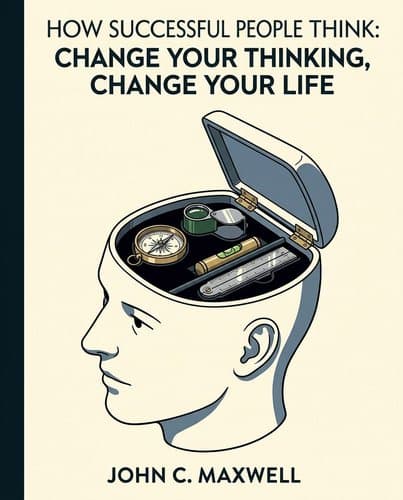
6012533_how-successful-people-think
by John C. Maxwell
Thinking isn't something that happens to you—it's a set of learnable disciplines you can deliberately choose. Maxwell shows how to question popular consensus…
In Brief
Thinking isn't something that happens to you—it's a set of learnable disciplines you can deliberately choose. Maxwell shows how to question popular consensus before the advantage disappears, name worst-case fears on paper to dissolve them, and build a permanent sacrifice list that makes deep focus a standing policy, not an intention.
Key Ideas
Question Consensus Before Following Majority
Before following any consensus decision, pause and ask: is everyone doing this because it's correct, or because everyone else is doing it? By the time a trend is popular enough to feel safe, the advantage is usually gone — and the history of majority agreement is not reassuring.
Name Worst Case Scenarios Explicitly
Write down your single worst-case scenario before any important decision. Do it in specific, concrete terms — not 'things go badly' but 'sales fall to X, key person quits, funding dries up.' Naming the worst case produces calm; unnamed risks produce fear when they arrive as surprises.
Create Explicit Sacrifice Lists for Focus
Make an explicit and permanent sacrifice list to support any meaningful focus. Focus is not concentration — it is a standing policy of exclusion. List what you will stop doing, stop learning, and stop attending so you can go deep on what produces the highest return.
Impossibility Often Lives in Belief
The next time you encounter 'it can't be done,' ask whether the person saying it has actually tried or is inferring impossibility from their existing frame. Senior engineers couldn't reduce car weight; junior engineers without the preconception did. The barrier is often the belief, not the problem.
Access Expert Knowledge Through Humble Questioning
Identify one person whose knowledge in a critical area you would pay $100 to access for one hour, then ask for that hour. When you get it, speak as little as possible. Ask questions, take careful notes, and leave without trying to impress anyone.
Clarify Purpose Through Three Core Questions
Clarify your personal or professional bottom line in a single sentence by answering three questions: What is my work actually for? Who does it serve? What does that person consider valuable? Every other thinking mode only produces compounding results when aimed at this answer.
Who Should Read This
Business operators, founders, and managers interested in Decision Making and Cognitive Psychology who want frameworks they can apply this week.
How Successful People Think: Change Your Thinking, Change Your Life
By John C. Maxwell
9 min read
Why does it matter? Because "think harder" is the most useless advice ever given.
You think. Probably more carefully than most people around you.
Everyone assumes the same about successful people — that they think better, sharper, faster, more creative. It's a flattering story and almost entirely wrong. The actual advantage isn't intensity. It's selection. The most effective thinkers have learned to treat cognition as a toolkit rather than a single lever, and that the wrong tool, applied with great force, still produces the wrong result.
The problem isn't that most people don't think hard enough. It's that they've never been taught that different situations call for different modes — that realistic thinking and possibility thinking are not opposites but instruments, each with a purpose and a moment when it should be set down in favor of another. The discipline of choosing which mode to engage, and when to switch, is itself a learnable skill. One you almost certainly were never taught.
What follows is how to tell them apart — and when to put each one down.
The Lens Cap Was Never Removed — and Everyone Said They Could See Fine
A high school physics class lines up to view a planet through a telescope. Each student steps forward, peers through the eyepiece, and reports back: yes, they can see it. The planet, the moons, all there. The second-to-last student breaks the pattern. He cannot see anything, he says. Just black. The teacher snaps at him to adjust the lenses. The student tries again. Still nothing. Exasperated, the teacher steps up himself, looks through the telescope, and goes quiet.
The lens cap was still on. It had never come off.
Thirty-eight students had stood at that telescope and performed agreement. Not lying, exactly — something more automatic than lying. They saw what a room full of peers and an authority figure expected them to see. No one stopped to ask whether they saw anything, because the social cost of that question was higher than they wanted to pay.
Geneticist Benno Muller-Hill was in that line. His read on it: most of what we call consensus works exactly this way. Not through reasoning. Through social performance. The majority is not a quality-control system. It is a pressure system. Keynes wrote that the real difficulty with ideas is not developing new ones but escaping old ones. The telescope story shows why: the old idea doesn't have to be correct. It just has to be embarrassing to contradict.
For centuries, the majority held that the earth sat at the center of the universe. Copernicus did not poll the majority. He studied the math and proved otherwise. The people defending the old view were not uniquely unintelligent. They were doing what most people do: adopting positions that cost the least to hold.
Maxwell's conclusion is blunt: popular thinking produces popular results — meaning normal, meaning average. Not a floor to build from. A ceiling.
The One Thinking Mode Everyone Avoids Is the One That Actually Protects Them
Most people skip worst-case thinking not because they're lazy but because they're afraid it will make them pessimistic: that naming what could go wrong will pull them toward expecting it. That fear is exactly what makes realistic thinking the most skipped step in decision-making.
Maxwell spent the early part of his career skipping it deliberately. He believed worst-case thinking would poison creativity and drag him toward pessimism, so he delegated it when he could and engaged reluctantly when forced. He had the causality backwards.
On February 3, 2002, the Super Bowl was played in New Orleans — and Maxwell was there. The game had been designated a National Security Special Event, meaning the U.S. Secret Service ran the operation. Eight-foot perimeter fences ringed the Superdome. Concrete barriers blocked vehicle access. Sharpshooters were stationed on rooftops. Officials recommended arriving five hours early. Evacuation routes had been rehearsed. A no-fly zone covered the stadium. Every conceivable bad outcome had been named, modeled, and planned for.
People walked in and felt calm. The mayor had declared the city the safest place in America that day, and the crowd believed him. The exhaustive worst-case planning — precisely because it was exhaustive — produced confidence.
That's the mechanism. Most people treat realistic thinking as a mood risk: name what could go wrong and you'll start expecting it. But the scenarios you don't name don't disappear. They wait. When surprise arrives, you're destabilized. When you've already thought through the worst, it loses its power to shock you.
Maxwell's point: the gap between what you expected and what actually happened is exactly what realistic thinking closes. It builds readiness. Readiness feels indistinguishable from confidence.
Optimism without it is just deferred surprise.
You Can't Have Depth Without a Sacrifice List
Focus is not a technique for concentrating hard. It is a trade: breadth permanently exchanged for depth, and once made, it does not reverse.
Robert Lynd put it plainly: knowledge is power only if you know what facts not to bother about. Not what to concentrate on — what to ignore. The standard framing of focus treats it as additive: more attention, more discipline, more effort aimed at a target. Lynd is pointing at the other half of the equation, where the real work lives. Every depth requires a renunciation of breadth. The question is whether you're willing to name what you're renouncing.
Maxwell names four. He cannot know everyone: despite being the kind of person energized by rooms full of people, he keeps a tight inner circle and relies on others to keep him current on the wider network. He cannot do everything: he sets direction at the start of a project, hands the bulk to others, then returns for the final push. Projects he would genuinely enjoy doing himself get passed off every week. He cannot travel freely for pleasure: millions of miles logged as a speaker crowd out the leisure travel he loves with his wife. And he cannot be well-rounded: he has concluded that one percent of what can be known is worth his attention, and has organized his life around that estimate.
The list refuses to be aspirational. Maxwell is not describing habits to build. He is reporting costs already paid, in permanent language: can't, not "I try not to." The language is the point.
Most people treat sacrifice as what you endure until things get easier. This list suggests something less comfortable: the sacrifice is the strategy. You do not achieve depth and then figure out what to give up. You decide what to give up, and depth is what fills the space.
Possibility Thinking Isn't a Personality Trait — George Lucas Describes Himself as Cynical
When George Lucas started making Star Wars in the mid-1970s, the effects he needed had never been produced. Industry veterans told him so directly: what he wanted couldn't be done. His response was to build a company, Industrial Light and Magic, to produce them. ILM delivered, then kept going. Lucas chose not to sell it or fold it into a studio deal. He kept it as a separate commercial enterprise, and the revenue came back to Lucasfilm.
Lucas does not describe himself as an optimist. His own words: he is "very much a cynic" who uses optimism as a defense mechanism — a deliberate choice deployed against his natural disposition, not an expression of it.
That distinction matters. The standard objection to possibility thinking is that it's a temperament: some people are wired to see opportunity, others aren't, and no amount of advice changes the wiring. Lucas dismantles that argument from the inside. The man who built ILM into a commercial studio serving half of Hollywood was running against his own grain every day. The optimism was a tool, not a trait. The behavior is learnable. The default, the comfortable assumption that most things can't be done, has to be overridden.
The compounding is worth tracing. ILM was built to solve one problem on one film. By the early 1980s, it was doing effects work for Poltergeist, E.T., and a string of other productions Lucas had nothing to do with. That commercial revenue, combined with Star Wars' profits and the sequel and merchandising rights Lucas had negotiated upfront, gave Lucasfilm the capital to self-finance Return of the Jedi in 1983 without studio interference. Possibility thinking, applied once with full commitment, had produced a company; the company produced financial independence; the independence produced creative control over everything that followed.
That's the whole argument. Possibility thinking doesn't require a sunny disposition. It requires a decision, made deliberately and renewed regularly, to treat what's achievable as still open.
The Best Idea You'll Ever Have Is Already in Someone Else's Head
In the early 1970s, John Maxwell sat down and wrote ten letters. Each went to one of the most successful pastors in America, and each contained the same offer: $100 for an hour of his time. That was not small money to Maxwell then. When one of the recipients said yes, Maxwell traveled to meet him. When he arrived, he barely spoke. He had a short list of questions, he asked them, and then he took careful notes and listened to everything the man said. He was not there to impress. He was not there to debate. He was there to accelerate his own thinking by borrowing from someone who had already logged the experience he lacked. Those sessions, he later said, changed his life. The best thinking available to him was already living in those men's heads. He just had to get to it.
The instinct toward solo thinking looks like rigor. Work through a problem alone and you sidestep groupthink, social pressure, and the dilution that comes from averaging everyone's half-formed opinions together. That instinct is not wrong. It just has a ceiling.
The ceiling is visible in Maxwell's story. What made those visits work was not simply that he sought input from others. He was precise about which others. He did not poll his peers or solicit the nearest available opinion. He identified people with specific expertise and experience he didn't have, paid for access, and then made himself small enough to actually receive what they offered. The quality of what he took away was entirely determined by the quality of who he chose to ask.
Maxwell names this directly: shared thinking is only as good as the people doing the sharing. He knew it because he had experienced the failure mode — professors filling unprepared class time by soliciting uninformed student opinions. The process was not the problem. The participants were.
When you select shared-thinking partners for what they know rather than who they are to you, the returns compound. Each conversation adds a layer of thinking you could not have generated alone — and that layer becomes part of how you approach the next problem. Solo thinking, however disciplined, draws from a fixed well. Shared thinking, done with the right people, keeps deepening the well.
One Clear Answer Makes Every Other Thinking Mode Point in the Same Direction
In 1976, Frances Hesselbein walked into a national organization hemorrhaging its audience and had no obvious move. Teenage girls were abandoning the Girl Scouts. Women entering the workforce made adult volunteers harder to find. The Boy Scouts was quietly weighing whether to open membership to girls, a move that would erase the Girl Scouts' foundational reason to exist. Any consultant surveying the situation might have proposed a dozen initiatives simultaneously: modernize programming, recruit more aggressively, launch a media campaign, expand the demographics.
Hesselbein asked three questions instead. What is our business? Who is our customer? What does the customer consider value? The answers converged on a single sentence: help a girl reach her highest potential. That was the bottom line. Not one of several priorities. The one. Every other decision in the next fourteen years was a question of how.
The cascade that followed was not cautious. She reorganized the national staff and built a planning system that reached all 350 regional councils. Activities designed for a different era got replaced: parties gave way to computer skills. She created bilingual materials and took the program directly to minority communities and low-income households. If the bottom line was helping girls reach their highest potential, then the girls with the fewest opportunities were the most urgent constituency. Minority participation tripled. Clinton awarded her the Presidential Medal of Freedom in 1998 and described the measure of success in his citation: "not in dollars, but in changed lives."
Hesselbein's story isn't evidence that mission statements work. A genuine bottom line — one answer to what you're actually here for, not a list of values — converts every other kind of thinking into something useful. Creative thinking generates options that serve the mission. Realistic thinking identifies which obstacles actually matter. Strategic thinking has a destination to aim at. Collaborative thinking has a shared standard for what's worth discussing. Without the bottom line, each of those modes runs on its own, producing sophisticated noise rather than coordinated progress.
The divided-focus failure mode is the mirror image. As George W. Merck himself put it: medicine is for the people, not for the profits — the profits follow. When an organization installs two bottom lines and calls them equals, it doesn't optimize both. It hedges on both. Purpose and profit each pull against the other just enough to prevent full commitment to either.
Here is the uncomfortable end of that argument: what you're producing right now isn't determined by your situation. It's determined by how clearly (or muddily) you've answered the question of what you're here for. An organization drifting produces exactly what drift predicts. A life organized around a genuine bottom line produces outcomes that compound.
Power without direction is just motion. The bottom line is what turns motion into movement.
The Results You Already Have Are the Thinking You Already Did
There is no mystery to where you are. Every result in your life — the ones you're proud of, the ones you're embarrassed by, the ones you've explained away with bad timing or bad luck — traces cleanly back to a thinking pattern you were running at the time. Not your intentions. Your actual patterns: borrowed from the crowd when independent thought felt risky, reactive when strategic felt slow, shallow when depth required a sacrifice list you weren't ready to write. You designed them. Mechanisms run in both directions. The same causal chain that carried you here is available right now. The only real question Maxwell leaves you with is whether your thinking will keep happening to you, or whether you'll finally pick up each instrument deliberately and point it somewhere worth going.
Notable Quotes
“Find the one thing you do well and don't do anything else.”
“Ninety-nine percent of everything in life I don't need to know about.”
“John, I bet you asked those coaches a hundred questions tonight.”
Frequently Asked Questions
- What are the main thinking disciplines in How Successful People Think?
- "How Successful People Think" identifies eleven distinct thinking disciplines that high achievers use to drive better decisions and outcomes. The book covers modes ranging from creative and reflective to shared and focused thinking. By deliberately choosing the right thinking mode for different situations, readers learn how to solve problems more effectively, generate innovative ideas, and produce tangible results. The work provides readers with a practical diagnostic map for identifying their weak thinking habits and replacing them with the specific mental approaches used by successful people across various fields and industries.
- What are the key takeaways from How Successful People Think?
- The book offers six critical takeaways for improved thinking. Before accepting consensus decisions, pause and ask whether something is correct or merely popular—"by the time a trend is popular enough to feel safe, the advantage is usually gone." Before major decisions, write down your worst-case scenario in concrete terms to produce calm instead of fear. Create an explicit sacrifice list defining what you'll stop doing to focus on highest-return activities. Challenge the belief that it can't be done by questioning whether someone has actually tried. Seek out experts in critical areas and listen more than you speak. Finally, clarify your personal bottom line by answering what your work is for and who it serves.
- How does worst-case scenario planning help according to Maxwell?
- Writing down your worst-case scenario before important decisions is a powerful thinking discipline. Maxwell advises using specific, concrete terms rather than vague language like "things go badly." Instead, name exact outcomes: "sales fall to X, key person quits, funding dries up." This practice produces a paradoxical effect—naming the worst case creates calm, while unnamed risks produce fear when they arrive as surprises. By visualizing specific adverse outcomes, you reduce the psychological impact of uncertainty. This thinking mode removes the element of shock and allows you to mentally prepare contingencies, shifting from reactive fear to proactive planning.
- What role does focus play in achieving results according to How Successful People Think?
- Maxwell defines focus not as concentration, but as "a standing policy of exclusion" that enables deep work on high-return activities. To support meaningful focus, he recommends creating "an explicit and permanent sacrifice list" specifying what you will stop doing, stop learning, and stop attending. This deliberate approach to prioritization is crucial because attempting to pursue multiple directions dilutes effectiveness. By clearly identifying what to abandon rather than what to add, successful people allocate their limited time and energy where it generates maximum value. Focus becomes a disciplined thinking mode that distinguishes high achievers.
Related Book Summaries

Read the full summary of 6012533_how-successful-people-think on InShort