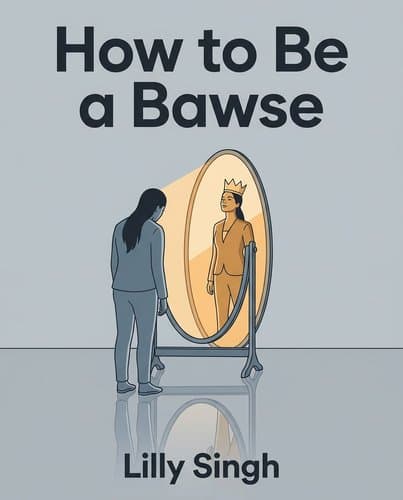
31202835_how-to-be-a-bawse
by Lilly Singh
Surviving rock bottom and building an empire demand the exact same internal tools—just applied at different scales. Lilly Singh decodes the mental frameworks…
In Brief
Surviving rock bottom and building an empire demand the exact same internal tools—just applied at different scales. Lilly Singh decodes the mental frameworks behind a billion-view career: why your Plan B is quietly sabotaging Plan A, and why incompetence is always the required entry price for mastery.
Key Ideas
Control your reaction to frustration
When someone or something is frustrating you and you can't change it, redirect that energy into controlling your reaction — frustration at the uncontrollable is not a moral stance, it's waste. Singh's dance company collapsed because she spent years trying to control twenty people who hadn't bought into her vision.
Build transferable emotional insight codes
Build personal 'cheat codes' by asking WHY you feel something, not just what you feel. Then test whether those codes transfer. If the insight 'hurtful behavior is usually about the attacker's pain, not you' handles hate comments, it probably handles road rage too — the code is the thing, not the situation.
Incompetence is competence's entry price
The first ten times you do anything, you'll be bad at it. Singh traces a billion YouTube views to the 'horrifying experience' of her first ten videos. This isn't inspirational — it's structural. Incompetence is the required entry price for competence.
Uncover real reasons beneath narratives
Run the tiramisu model on any behavior that costs you: what you tell others (Layer 1), what you tell yourself (Layer 2), the actual reason (Layer 3). Layer 3 is rarely flattering and almost always actionable in a way the others aren't — Singh's 'I love being independent' turned out to be 'I don't believe healthy relationships exist.'
Commit to domain, iterate strategy
Replace Plan B with Plan A 2.0. The domain stays constant; the strategy adapts. If you have a fallback in a completely different field, you've already signaled to yourself you expect to fail — and that expectation degrades the effort you give Plan A.
Focus on available resources now
When something collapses, the useful question is not 'what did I lose?' but 'what do I actually have access to right now?' The #GirlLove campaign — which eventually reached the White House and funded Kenyan girls' scholarships — started because a celebrity collaboration fell apart two days before the shoot.
Self-compassion enables peak performance
Self-love is not separate from high performance — it's a prerequisite for it. The practices Singh developed to survive depression (not being hard on herself during relapses, encouraging herself out loud, being patient with whatever she felt) are the same ones that enabled 12-hour creative days. They're not in tension; they're the same toolkit at different scales.
Who Should Read This
People working on personal growth in Self-Improvement and Motivation, especially those tired of generic motivational advice.
How to Be a Bawse
By Lilly Singh
10 min read
Why does it matter? Because the tools that kept Singh alive at rock bottom are the same ones that built an empire.
Most self-help books assume you're already standing — you just need a better angle on things. Lilly Singh's doesn't. The toolkit in these pages was first used when she was lying on a basement floor, pouring cheap whiskey she didn't want, toasting herself with the word pathetic. She wasn't optimizing anything. She was trying to get through the night. What makes this book unusual, and unusually useful, is that the same practices she used to survive depression turned out to be exactly what she needed six years later to see her own face on the side of a Times Square building. One discipline. Two completely different scales of application. You don't need to wait until you feel ready. You just need to understand what readiness is actually made of.
You Can't Control Anyone Else — And Fixing That One Thing Fixes Everything
It's another rehearsal day for Lilly Singh's Toronto dance company. Three dancers are late. One won't show at all. Two will leave early. The wedding gig next weekend requires professional attire; someone will turn up in shorts and flip-flops.
Singh had converted her basement into a full office for this. She'd held auditions across hip-hop, classical, fusion, and Indian dance styles. She'd organized photo shoots, pulled all-nighters on marketing materials, spent her own money on whatever the vision needed. The vision was a dance empire, not a dance team. The problem was visible only in retrospect: it belonged entirely to her. Her dancers had never agreed to build anything. No amount of all-nighters would change that.
The diagnosis matters more than the story. Singh wasn't dealing with especially bad people; she was directing enormous energy at the one variable she couldn't move. Getting frustrated at people for not caring as much as you do produces nothing: the harder you push, the more evidence you collect that it isn't working. The people don't change. You just get tired.
YouTube dissolved the problem. She wrote a video, shot it, edited it, uploaded it to her Superwoman channel. No collaborators needed. The same drive that had been leaking into cajoling and chasing could now land entirely on what she could actually move. The dance company quietly collapsed. The channel scaled.
Singh's rule is clean: you can't move the people around you, so move your reaction instead. You can't stop a situation from forming, so prepare for it. That's not resignation, it's a reallocation. The energy was always there. The address was wrong. The right address is internal — which would be useful information if anyone had taught you how to operate the thing that's actually in charge.
Your Brain Has Cheat Codes — You Just Haven't Found Yours Yet
Think of your brain as a device you've been using for decades without reading the manual. You know the basics — it runs on sleep, hates Mondays, occasionally tortures you at 3 a.m. with a song you can't shake — but the deeper functions? Untouched. Singh's entry point is simple: touch your nose. Stop, do it, register what just happened. A thought appeared, you acted, your brain fired signals down through your body and moved a limb on command. You run that machine. If you can consciously redirect neural traffic to your index finger, she asks, why not to the part currently convinced it can't stop feeling jealous, or terrified, or crushed by what a stranger typed about you?
Most people never bother to look. They accept emotional reactions as weather, something that arrives and passes without any input. Her claim: reactions follow patterns, and patterns can be cracked.
The evidence is her own comment section. Six years on YouTube, over a thousand videos, and at various points: death wishes, racial slurs, a cancer wish, a shooter threat. Her early plan was to develop "thick skin," which is another way of saying she had no method. The method came from doing what most people skip: working her own reactions the way a detective works a scene, honest question by honest question, until the actual driver surfaced.
What came out of that process was a handful of personal cheat codes. The one that generalized most immediately: hurtful behavior is almost always about the attacker's pain, not yours. She found it true for the death-wish comment, then for the person who cut her off in traffic. A second: happiness is a stronger decision filter than fear (useful when a brand deal felt wrong despite the money). A third: catch the impulse to reply before acting on it. Mid-argument, she spotted herself about to make a remark purely to score a point, and stopped. Same methodology, three completely different rooms.
That's what the rest of the book builds on: your mind is the only thing in your life you can actually rewrite, but only after you've done the work to read it.
Discomfort Isn't an Obstacle to Success — It's the Raw Material
The waiting room was full of gorgeous, composed women who didn't smile back. Singh had no script — just an hour in the lobby trying to memorize alien place names she'd never seen, guessing which ones were characters and which were sound effects. Two weeks earlier, her manager had called about an audition for a major sci-fi franchise, the kind where the proper nouns sounded like someone sneezed into the alphabet. Singh's first response was panic. Her second was a convenient scheduling conflict. Then the casting director personally requested another slot, and she ran out of excuses.
When they finally called her in, she fumbled her lines almost immediately. She ran the scene again. Nailed it. The casting agent told her she was genuinely impressed.
Singh did not get the part. She said so immediately, on purpose — because the whole point is that she wasn't supposed to. By this point she'd made five hundred YouTube videos with over a billion combined views, and every one of those views traces back to ten early videos that were, by her own account, horrible. The first ten times she does anything, she's bad at it. She knew this going in. The audition was video one of acting. Getting the part would have been a miracle. Surviving the audition was the actual goal, and she survived.
Discomfort isn't a signal that you're on the wrong path. It's proof you're on the right one.
You Know What You Tell People — But Do You Know Your Own Layer Three?
Why do you avoid relationships? Or overschedule yourself? Or surround your apartment with motivational quotes? You probably have an answer ready. The question is whether it's the real one.
Singh's framework starts from an uncomfortable observation: every behavior has at minimum three layers, and the one you offer most confidently is almost always the shallowest. She calls it the tiramisu — the most interesting part is buried at the bottom.
Her own example: she told everyone she didn't want to be in a relationship. Layer one was the smooth public version — too busy, too focused, very Beyoncé. Layer two, what she told herself, was almost convincing: her career required total commitment, and a relationship would dilute it. Layer three is where the real driver surfaced. She doesn't run from relationships because she loves ambition. She runs because she doesn't know how to maintain one while building something, so the moment she senses one forming, she bolts. She kept digging. Deeper than three: she never saw a healthy relationship growing up and had quietly concluded they don't actually exist.
The difference between Layer two and Layer three is traction. Layer two tells you to protect your schedule. Layer three tells you what you actually need to work on.
Singh is honest that this doesn't always lead somewhere fixable. She's spent years on her inability to forgive disloyalty, made some headway, still can't fully override it. Her solution: stop pretending otherwise. Tell people about the leak before they step in it. Self-awareness is the substitute for a cure that isn't coming. In practice: upfront honesty instead of repeated surprised apologies.
Layer one sounds honest. Layer two feels honest. Layer three is the one you can actually do something with.
A Commitment With Conditions Isn't a Commitment
Los Angeles, 2014. Singh has flown from Toronto, brought her own videographer, built a complete set, and rehearsed a nine-minute skit, beat by beat, with enough precision that she and her crew could execute the whole thing in exactly forty-five minutes. That window included the time it would take Seth Rogen and James Franco to walk through the door, say hello, and hear the plan.
The obstacles arrived on schedule. When the two walked in, nerves hit her as a physical shock — she'd been so absorbed in preparation she'd forgotten to be nervous beforehand, and the feeling rushed in all at once. She pushed through. Confusion crossed James Franco's face mid-pitch, and the internal spiral kicked in: not funny enough, wrong career, basically Shrek. She pushed through that too. Ten people on set began talking over each other while she was trying to deliver dialogue, killing the audio. She kept moving. Then a scene required her to kiss Seth Rogen (four takes, different camera angles), and with each take she accumulated something distinctly herbal on her lips from his well-documented off-camera habits. She finished the shoot anyway.
What matters is the asterisk Singh never added. Her stated commitment was to finish in forty-five minutes. Period. Not forty-five minutes unless the nerves got too bad, the room too loud, or the kisses too strange. The moment you attach conditions to a commitment, she argues, you've stopped making one.
Most people bury the conditions in the fine print and wonder why they never finish anything. If you gave something 70% and it didn't work, you didn't learn whether you could succeed. You only learned that 70% wasn't enough, which tells you nothing about your ceiling.
Singh could go in without a backup plan because she'd already built enough that losing this one thing wouldn't end her. The YouTube channel, the book, the collaborations, the brand partnerships: she had enough pillars that no single audition or badly received video could bring the whole structure down. That's what makes 110% survivable. Not emotional toughness. Architecture.
The Failure Didn't End the Plan — It Revealed the Better One
The instinct when something falls apart is to declare the idea dead along with it. Singh disagrees — and she has receipts.
In December 2015, she'd built her annual holiday collaboration series around a concept she invented: the #GirlLove Challenge, where participants fire rapid compliments at images of influential women. A major Hollywood actress with a film opening that season had agreed to take part. Singh was two days from flying to New York for the shoot when her manager called. Canceled.
She spent a day barely functional. That night, lying awake, the question shifted. She'd been fixating on who she'd lost access to. But she already had access to her own network, built over years. Why did the plan require a movie star?
Over the following week she reached out to every influential woman she knew, collected clips of them complimenting each other, and assembled eighteen contributors. She released it as a Christmas collaboration. It spread immediately: Tyra Banks and Priyanka Chopra amplified it, and young women across the world started using the #GirlLove hashtag.
That would already be a clean comeback story. But Singh tracks what happened downstream. By 2016 she'd hired a team and turned it into a formal campaign and episodic series. It took her to the White House for a conversation with Michelle Obama, then to Kenya to study girls' education in the Maasai community. A bracelet partnership funded secondary school scholarships for Kenyan girls. A sold-out workshop followed in Singapore. Every one of those outcomes traces back to the shoot that collapsed.
That's the external version. Singh also runs it on something much harder to look at. She started making YouTube videos in 2010 to escape her depression — comedy as self-medication, a reason to get out of bed. She calls it the worst thing she's ever felt and the thing she's most grateful for, because every video and every opportunity she's had grew from turning that pain into something: comedy. The canceled shoot rearranged a plan. The depression built the career.
The Same Person, Six Years Apart, Crying at a Mirror
- Lilly Singh gets home from the temple (the only place she can stand to be, where she sits in the back row, as far from everyone as possible) and stops in front of her mirror. She can't look at it. They haven't been friends for a while. She turns away.
Six years later, backstage at a sold-out tour stop, Singh stands in front of a mirror before every show and after every show. She meets her own eyes and tells herself she's proud. She calls her reflection her best friend.
Same person. Same mirror. Opposite everything.
The distance between those two moments is the entire book. Its quiet insistence: the tools that moved Singh from one mirror to the other weren't invented for success. They were assembled for survival.
In 2009, she was on a basement floor, unable to control her breathing, drinking whiskey she gagged on because she didn't drink, raising a glass to herself as someone who had no business thinking she was special. She'd once been an imaginative kid with a dream list that included becoming a rapper, hanging out with The Rock, and traveling the world. All of that felt robbed. She didn't know if her life was worth getting back up for. She wasn't looking for the path to a career. She was looking for a reason to stay in it.
The tools she built — the brain cheat codes, the three layers of honesty, the commitment with no asterisks, the discipline of pointing energy at what you can actually move, the habit of extracting something from pain — were built in that basement and at that temple and in front of that mirror she couldn't face. They worked well enough to keep her going. Then, without changing, they also worked for building something.
The payoff arrives in Sicily in 2016. Private dinner at an ancient temple, Alicia Keys performing live beneath the stars. Singh had been calling herself Superwoman since she was nineteen, the name lifted from a Keys song she'd watched on repeat, wondering if she'd ever deserve it. After the performance, Keys taps her on the shoulder and says she'd been planning to sing "Superwoman" for her. The person who invented the identity is the one who confirms it became real.
Singh doesn't take this as proof she was special. She takes it as proof the distance is crossable. The same person who couldn't look in the mirror in 2010 arrived at that temple. The gap between those two places isn't talent. It's the work — and you're already standing in the middle of it.
What It Actually Means That It Was a Dream Come True
Singh never frames any of this as a story about becoming someone different. She frames it as discovering what she was already built to do. The distance between not being able to look in a mirror and standing in Sicily wasn't personality or talent. It was the consistent application of practices she assembled when she needed them to survive.
You're already assembling yours. Which version of the story are you in the middle of right now?
Notable Quotes
“Maybe they're having a bad day.”
“Should other opinions impact what you think about yourself?”
“I don't want to stop making videos, because they make me happy.”
Frequently Asked Questions
- What is How to Be a Bawse about?
- How to Be a Bawse draws on Lilly Singh's parallel journeys through depression and building a billion-view YouTube career to argue that internal discipline drives both survival and success. Singh provides concrete tools including reframing frustration, diagnosing self-deception through layered honesty, and treating early incompetence as structural rather than personal. The book teaches readers how to perform at the highest level without sacrificing self-compassion, showing that the practices Singh developed to survive depression are identical to those that enabled sustained success.
- How does Lilly Singh say to handle frustration you can't control?
- Singh argues that when someone or something is frustrating you and you can't change it, you should redirect that energy into controlling your reaction. She emphasizes that "frustration at the uncontrollable is not a moral stance, it's waste." Singh illustrates this through her dance company collapse—she spent years trying to control twenty people who hadn't bought into her vision. Instead, focus your energy on what you can actually control: your response and effort.
- What is the tiramisu model in How to Be a Bawse?
- The tiramisu model is a three-layer framework for diagnosing self-deception about any behavior that costs you. Layer 1 is what you tell others, Layer 2 is what you tell yourself, and Layer 3 is the actual reason. "Layer 3 is rarely flattering and almost always actionable in a way the others aren't." Singh applies this to her own life, discovering that her "I love being independent" claim actually masked "I don't believe healthy relationships exist." These root insights enable real behavioral change in ways surface explanations cannot.
- Why does Lilly Singh say self-love is essential for high performance?
- Singh argues that self-love is not separate from high performance—it's a prerequisite for it. She demonstrates that the practices she developed to survive depression—not being hard on herself during relapses, encouraging herself out loud, being patient with whatever she felt—are the identical ones that enabled 12-hour creative days and sustained success. Singh states these practices "are not in tension; they're the same toolkit at different scales." This means self-care and peak performance emerge from the same internal discipline foundation, making compassion essential to achievement rather than opposed to it.
Related Book Summaries
Read the full summary of 31202835_how-to-be-a-bawse on InShort