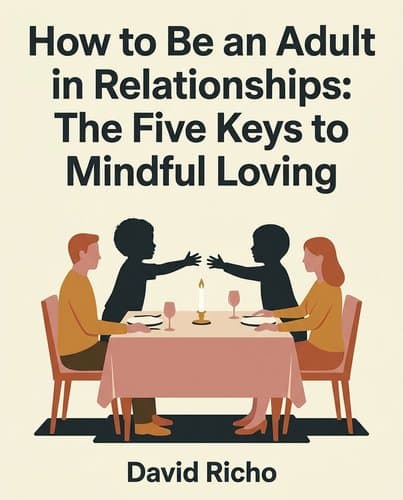
500901_how-to-be-an-adult-in-relationships
by David Richo
Most relationship pain isn't about your partner—it's a frightened child still demanding what your parents couldn't give. Richo's five-key framework shows how…
In Brief
Most relationship pain isn't about your partner—it's a frightened child still demanding what your parents couldn't give. Richo's five-key framework shows how to stop projecting unmet childhood needs onto love and build the mature, mutual intimacy adults are actually capable of.
Key Ideas
Recognize unmet A's rooted in childhood
Name the five A's in your own relationships — attention, acceptance, appreciation, affection, allowing. When you feel most hurt by a partner, ask which of these you're not receiving, and whether you're expecting them to supply what your parents couldn't. That's your work, not their failure.
Partner supplies only 25% of needs
Expect roughly 25% of your emotional needs to be met by a partner. The rest must come from yourself, friendships, work, and spiritual practice. The belief that one person should fill all of these is the engine of resentment — and a signal that inner work remains undone.
Steady current differs from electric shock
Test whether intense attraction feels like a 'steady current' or an 'electric shock.' Healthy connection builds interdependence; the addictive pattern intensifies with withdrawal and generates a fix even from leaving. Both feel compelling — only one leads somewhere.
Apply APR sequence to all conflicts
When conflict arises, work the APR sequence: addressing (seeing what's actually happening and naming your triggers), processing (tracing feelings to their roots and genuinely opening to the other's inner world), resolving (making specific agreements that prevent repetition). Defending your position is the opposite of addressing it.
Accept life's five conditions of existence
Replace 'Why did this happen to me?' with 'Yes — now what?' The five conditions of existence — things end, life is not fair, growth costs suffering, plans fail, people are not always loyal — are not exceptions to life. They are its ingredients. The ego's energy spent fighting them is the primary cost of intimacy.
Separate actual loss from projected hopes
In any breakup, ask: am I grieving the literal person, or the hope I projected onto them? The inner figure — what Richo calls 'the mannequin wearing the garments of my unfulfilled wishes' — and the actual person are rarely the same. Locating the real loss is where real healing begins.
Who Should Read This
People working on personal growth in Relationships and Intimacy, especially those tired of generic motivational advice.
How to Be an Adult in Relationships: The Five Keys to Mindful Loving
By David Richo & Kathlyn Hendricks
10 min read
Why does it matter? Because you've been sending a frightened child to do an adult's work.
You've told yourself a story about why it didn't work. Bad timing. Incompatible people. Someone who couldn't open up. And maybe some of that's even true. But after fifty years of sitting across from people in pain, people who were genuinely trying, David Richo kept finding the same thing buried under all the different stories: not the wrong partner, but the wrong assignment. Two adults in the room, and the negotiation happening somewhere else entirely, between two frightened children who never got what they needed the first time around. The five A's (attention, acceptance, appreciation, affection, allowing) were supposed to arrive in childhood. For most of us, they arrived late or barely. We walked into adulthood carrying a quiet, insistent hunger, expecting the right person to repay what childhood withheld. This book names the mechanism — and shows the way out.
You're Not Looking for a Partner — You're Looking for a Parent
The reason most relationships fail has nothing to do with compatibility. Every person walking into an adult relationship is carrying, beneath the surface, a child who never received enough of five specific things: attention, acceptance, appreciation, affection, and the freedom to be genuinely themselves. David Richo calls these the "five A's," and his central claim is radical in its simplicity: these same five elements are what we needed from our parents, what we unconsciously demand from our partners, and what we eventually learn to offer to the world.
The framework sounds tidy until you see what it actually describes. When two adults argue, they are rarely two adults arguing. Beneath the conflict, Richo suggests, are two wounded children reaching toward each other, each one demanding: fix what was done to me before you existed; give me now what I needed long before I met you. Neither knows they're doing this. The real need is buried in the nervous system, in patterns so old they predate language. The person receiving that need has no map to it and no skill to repair it, so they respond with their own unmet needs, and two bewildered adults spend the evening fighting about something neither of them could actually name.
Love, Richo argues, is not enough. The feeling is real. The intention is sincere. But without understanding which of the five A's went missing and why, a loving relationship becomes a prolonged replay of childhood deficits, mislabeled as incompatibility, or the wrong person, or bad luck.
The five A's weren't optional in childhood; they were how a self got built. Attention from a parent teaches a child that their inner life is real and worth noticing. Acceptance communicates that who they are (not who they might become, not the corrected version) is fundamentally welcome. Appreciation and affection together build a sense of worth — the conviction that they are, simply as they are, lovable. And allowing, the most overlooked of the five, gives them permission to want what they want, to live as who they are without performance or apology.
When any of these are missing, a child doesn't conclude the parent fell short. They conclude something is wrong with them. And they spend the following decades searching, in partner after partner, for the person who will finally close the gap.
You are not, Richo argues, looking for a romantic partner. You are looking for a corrective experience. The partner is simply the latest person who seemed, briefly, like they might finally deliver it.
Your Body Kept a Record of What Your Mind Was Afraid to Know
At forty-two, David Richo was in a body-focused therapy session when an image arrived without warning: his aunt Margaret's refrigerator, always full, set against the one at home, mostly empty. He had no conscious memory of being hungry as a child. His body, it turned out, had kept the ledger anyway.
The mind manages. It files the unbearable under "fine" and "over" and "not that bad," builds a story in which the past is behind you, the difficult parents were doing their best, and the childhood that shaped you has already been processed and released. The body refuses this accounting. It knows the difference between nourishment and scarcity, between welcome and shame, between a parent who actually saw you and one who looked through you. Nothing in a cell excuses or softens. The body records only the raw truth: this hurt, this frightened, this left me empty.
The five A's weren't optional comforts in childhood. They were structural requirements for becoming a self. When they went missing, the nervous system registered the deficit as a permanent alert. That alert doesn't age out. It transfers. The adult version of the hungry child doesn't raid refrigerators; they reach for the person across the table and feel, without being able to name it, some underground urgency that has nothing to do with tonight.
Staying in a relationship that clearly isn't working isn't weakness or stupidity. What's painful is also familiar — and the nervous system treats familiar as safe, even when safe is the last word anyone watching from outside would use. Richo spent fifty years as a psychotherapist. When he asked himself what single problem he'd seen most often in clients, the answer didn't vary: staying too long in what doesn't work. Then he added, without ceremony, that this had been true of him too.
The childhood you've consciously moved on from is still running calculations in your body. Somewhere in those calculations is a precise record of what you're still looking for — and exactly how much it's going to hurt when the next person can't provide it.
Wuthering Heights Is Not a Love Story — It's a Portrait of Addiction
Consider Wuthering Heights: two people unable to be together and unable to let go, for decades, across death itself. We're taught to read this as the ultimate proof of love's power. Richo reads it differently: it's a portrait of addiction, and the distinction matters more than the genre label.
The mechanism is neurological and counterintuitive. In addiction, rejection and acceptance produce the same internal response: an adrenaline spike. The addict isn't just hooked during the good moments; they're equally hooked during the ruptures. You can get a fix from someone even as you're leaving them. The breakup carries the same chemical signature as the reunion. This is why people in genuinely destructive relationships keep returning, baffled at themselves for doing it. They aren't confused about their feelings. They're addicted to the adrenaline cycle, which neither the person nor the relationship can interrupt — because the cycle is the point.
This is what Richo calls the seduce-and-withhold pattern. One person draws the other close, then retreats. The other mirrors it back. Neither is executing a strategy; both are responding to private terror, one afraid of abandonment, one afraid of engulfment. The person who pulls away isn't cruel; they're bracing. The person who chases isn't weak; they're panicking. Neither can stop. The oscillation feels like passion. It's the mechanism of the trap.
Healthy romance is different, but the difference is in what's actually being seen. In the early phase of any relationship, before the other person's shadow side has had time to appear, you're in love with a projection of your own deepest longings. Yalom puts it plainly: in romance, you're seeing the reflection of your own yearning, not the other person. Projection is simply how humans begin to love: a road sign pointing toward a real person, not the person themselves. The trouble comes from mistaking the sign for the destination, from staying with the image after reality has started to show its edges.
Richo draws a distinction that carries real weight: falling in love versus rising in love. Falling implies powerlessness, surrendered judgment, someone swept away from their own values and life. Rising implies a conscious choice in response to genuine attraction. In the 1938 Adventures of Robin Hood, Maid Marian tells Robin she loves him and stays behind to serve England. The feeling is fully present. The choice is still hers.
The intensity you feel at the beginning of a relationship is real data — just not about the relationship's depth. It's data about your unfinished work.
Fear, Attachment, Control, Entitlement: The Four Forces That Guarantee You Can't Be Loved
Every morning Edna Sue arrives at the bank and becomes, without any apparent effort, someone formidable. She grants and refuses loans on clear, unsentimental grounds. She forecloses on mortgages without losing compassion. She manages her staff with firm expectations and real allowance for human error. Professionally, she is everything a healthy, functioning adult can be.
At noon she sprints home.
Her boyfriend Earl Joe is threatening to leave again. He has stolen her food money, broken her wrist, and coerced her into sending her teenage son to live elsewhere. She is going home to beg him to stay. The split is total: at the bank she refuses to accept anything below her standards; at home she accepts whatever remains after everything has been taken.
The tempting explanation is that Edna Sue lacks relationship skills, or that Earl Joe is simply the wrong person. The precise explanation: something operates in her during that lunch-hour drive that has nothing to do with competence or love. Richo calls it F.A.C.E.: Fear, Attachment, Control, and Entitlement — the ego's specific mechanisms for blocking love, even when love is genuinely present. In Edna Sue's case, the operating force is Fear: a terror of abandonment so total it overrides everything she knows professionally about standards and self-worth.
Each force closes a different door. Fear seals off affection; you can't offer genuine warmth when you're braced against loss. Attachment locks you into a version of reality you won't release, crowding out acceptance. Control crowds out allowing; you cannot grant freedom while managing where someone stands. Entitlement (the belief that love is owed, that loyalty can be demanded, that wrongs justify retaliation) kills attention and appreciation before they can form.
The ego doesn't manifest only as arrogance. Richo describes the neurotic ego as the King Baby: royal in its demands, infantile in its helplessness. The arrogant pole makes claims without reciprocating. It expects loyalty it hasn't earned, intimacy it hasn't risked, the five A's flowing in while none flow out. The impoverished pole runs the other direction: it accepts whatever scraps remain, because some version of love feels safer than the void of none. Both block the five A's equally, just from opposite ends. One hoards what it won't release. The other has decided, before anything is offered, that it isn't worth receiving.
An Adult Loves Unconditionally — but Commits Conditionally
Most people enter relationships believing that unconditional love and lifelong commitment mean the same thing: staying, no matter what, is how love proves itself. Richo calls this the most well-intentioned confusion in intimate life, and argues it produces resentment and enabling in equal measure.
He draws a distinction that sounds simple until you sit with it: the essential bond versus the existential commitment. The essential bond is permanent and unconditional; it survives disagreement, divorce, even death. A man's mother dies; he is still her son. The argument they never resolved, the conversation that never happened — none of it touches that fact. He can mourn what was never said without losing the bond. The existential commitment is something else: the daily choice to show up, to work through conflict, to remain present with this specific person in these specific circumstances. That commitment is conditional — not on whether you feel love, but on whether the relationship is workable.
Most vows reverse this logic. "Till death us do part" attaches permanence to exactly the wrong thing. What can honestly be promised is workability, not duration. The purpose of a relationship is human happiness, not conservation of an institution. A vow to time is a wish dressed as a guarantee. When the guarantee isn't honored, guilt holds people in place long after the relationship has stopped serving either of them.
The distinction liberates in both directions. An adult can love someone fully and still decide they cannot live with them. The bond holds whether the commitment does or not. And because the commitment is conditional rather than compelled, it means something precisely because it can be withdrawn.
The Loss That Hurts Most Isn't the Person — It's the Hope You Placed in Them
Selene is a psychiatrist who has spent years studying other people's grief. When Jesse, her partner of five years, leaves her for someone else, she starts keeping a journal she never intends to send, and discovers inside it that the man she is devastated to lose is not quite the man she had been living with.
She writes: Jesse is no longer only Jesse. He has become the latest figure she came to in a state of hunger, seeking what he couldn't give. The coincidence is almost too neat — her father had abandoned her for another life; Jesse has just abandoned her for another woman. Her psyche, she realizes, didn't choose him randomly. It chose someone shaped precisely like the original wound.
Richo's clearest observation about grief: when a relationship ends, we mourn the wrong thing. Selene's pain cannot be explained by the actual relationship, which was hurtful, mutual, and had stopped working for both of them. She is grieving the inner Jesse — a kind of emotional placeholder she'd dressed in every unfulfilled wish since childhood. The literal Jesse, who was never able to offer her emotional nourishment, cannot account for the size of what she feels. Nobody could. That is the point.
Once she can name it, the work changes. The goal is no longer to get Jesse back. It is to stop outsourcing the longing — to see that the need she placed in him was never his to satisfy. In one journal entry she will never send, she lands on the thing that changes the work: he helped her discover a longing she didn't know she carried, but he was never capable of answering it. That is not a character flaw in him. It is simply the wrong job description.
The book's entire argument lands here. The five A's we needed from parents, searched for in partners, projected onto everyone who seemed capable of delivering them. They can only be given, finally, by us. Not as resignation, but as liberation. When you stop needing a partner to close a loop that opened in childhood, you are free to love the actual person in front of you, not the symbol, not the stand-in. That is when love stops being something you extract and becomes something you give.
The Moment He Stopped Wanting Anything from His Father
Richo was crossing California Street in San Francisco when it happened — no confrontation, no apology from his father, no scene of closure he had engineered. Just a moment, unrequested, in which the longing released itself. That's the promise buried in this book. Not a better partner. Not a more enlightened version of the relationship you're already in. A private threshold, crossed when you're ready, after which you stop requiring any particular person to fill the gap that opened before you could name it. That's what adult love looks like: not the disappearance of need, but the end of neediness. And something strange happens. The five A's you spent years hunting in other people (attention, acceptance, appreciation, affection, allowing), you find yourself quietly offering them. First to one person. Then, almost without deciding to, to the world.
Notable Quotes
“Look what happened to me when I was a kid! Make it stop, and make it better for me!”
“I perceive a threat in you or am afraid you may not like me, so I am on the defensive.”
“I am trying to get something from this or you.”
Frequently Asked Questions
- What are the five A's in How to Be an Adult in Relationships?
- The five A's are 'attention, acceptance, appreciation, affection, and allowing' — the core framework for understanding relationship needs. When you feel hurt by a partner, identify which of these needs you're not receiving and crucially, whether you're expecting them to supply what your parents couldn't. This distinction matters: recognizing unmet childhood needs redirects your work inward rather than blaming your partner for their failure. By naming the specific A you're lacking, you move from vague resentment to clear understanding. The framework transforms 'my partner doesn't love me' into 'I'm seeking parental reparenting through romantic love' — a diagnosis pointing toward actual healing rather than endless blame.
- What percentage of emotional needs should a partner realistically meet according to this book?
- Richo advises to 'Expect roughly 25% of your emotional needs to be met by a partner. The rest must come from yourself, friendships, work, and spiritual practice.' The belief that one person should fulfill all emotional needs generates resentment and signals inner work remains undone. This framework liberates both partners from impossible expectations. When you expect your partner to fill voids left by family wounds or existential loneliness, you've assigned them an impossible task. Developing a robust inner life and diverse support network creates genuine interdependence rather than desperate dependence. This shift from 'you complete me' to 'I'm responsible for myself' is transformative.
- What is the APR sequence for conflict in relationships?
- The APR sequence is a three-step process for conflict resolution: 'addressing (seeing what's actually happening and naming your triggers), processing (tracing feelings to their roots and genuinely opening to the other's inner world), resolving (making specific agreements that prevent repetition).' The sequence transforms conflict from battle to puzzle. 'Defending your position is the opposite of addressing it,' so genuine honesty about your reactions matters most. Processing demands curiosity about your partner's experience, moving beneath surface reactions to underlying wounds. Resolving creates concrete commitments that honor both people's needs. This framework shifts relationships from reactive patterns to conscious partnership.
- How should you process grief after a breakup according to Richo?
- Richo reframes breakup grief by distinguishing between two losses. He describes a projection as 'the mannequin wearing the garments of my unfulfilled wishes' — an inner figure constructed from your needs rather than their actual self. Real healing begins when you distinguish between mourning the actual relationship while releasing the idealized figure who never existed. This distinction prevents staying stuck grieving someone who didn't exist as you imagined. 'Am I grieving the literal person, or the hope I projected onto them?' is the clarifying question. Once you locate the real loss — the specific person you actually knew — genuine closure becomes possible, freeing you to move forward.
Related Book Summaries

Read the full summary of 500901_how-to-be-an-adult-in-relationships on InShort