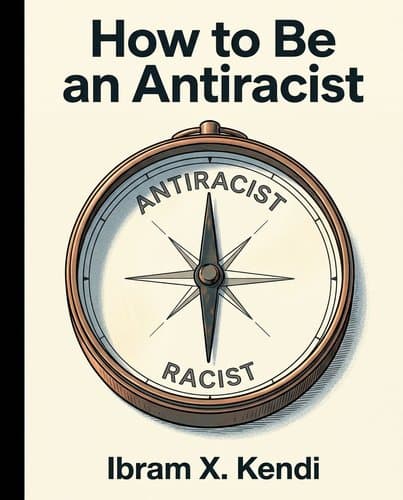
40265832_how-to-be-an-antiracist
by Ibram X. Kendi
"Not racist" is a myth—every policy either creates racial equity or sustains inequity, with no neutral ground between them. Kendi shows that racism lives in…
In Brief
"Not racist" is a myth—every policy either creates racial equity or sustains inequity, with no neutral ground between them. Kendi shows that racism lives in policy, not character, and that dismantling it means targeting the specific rules producing unequal outcomes, not the people experiencing them.
Key Ideas
Target specific policies causing inequity
When you encounter racial inequity in outcomes — in test scores, wealth, incarceration rates, maternal mortality — look for the specific policy producing it and the specific policymaker who installed it, not a deficiency in the people experiencing it.
Neutrality sustains racial inequity
'Not racist' is not a resting state. Every measure you support either produces racial equity or sustains racial inequity, with no neutral position between them. Passivity is a choice.
Change policy before changing minds
Racist ideas were historically created after racist policies, to justify their effects and redirect blame onto people. Fighting ideas alone leaves the underlying policies intact — the fight must target policy first.
Opportunity gaps explain achievement gaps
The racial 'achievement gap' in test scores reflects an opportunity gap (unequal funding, unequal access to test prep, unequal school resources), not intellectual difference. Pennsylvania data shows majority-White districts receive significantly more funding than majority-nonwhite districts at the same poverty level.
Policy precedes public opinion shifts
White support for desegregation, interracial marriage, and the Affordable Care Act all rose after the policies changed — not before. Suasion works with policy's tailwind, not against policy's headwind. Demonstrations publicize problems; protests create conditions where policy change becomes in power's self-interest.
Name specific policies, not abstractions
Replace vague terms like 'institutional racism' with 'this specific racist policy made by this specific policymaker.' The concrete target is the actionable one — and it makes racism visible rather than abstract and unknowable.
Who Should Read This
History readers interested in Social Issues and Policy who want a deeper understanding of how we got here.
How to Be an Antiracist
By Ibram X. Kendi
9 min read
Why does it matter? Because 'not racist' is a permission slip, not a position.
Most people carry "not racist" around like a clean bill of moral health — the absence of something bad, a baseline they earned by not using slurs or joining hate groups. Ibram X. Kendi spent years there. He stood on a stage on MLK Day and attacked Black youth for their laziness and lack of ambition, while a crowd of three thousand Black people applauded every line. He considered himself progressive the entire time. His argument is simple and unsettling: "not racist" isn't a moral position — it's a mask. Racism doesn't live in character. It lives in policies. And policies can be changed. Which means the question was never who you are. It's what you're supporting right now.
'Not Racist' Is a Position — and It's the Wrong One
On January 17, 2000, seventeen-year-old Ibram Kendi stepped onto the pulpit of a Virginia chapel before 3,000 Black attendees at a Martin Luther King Jr. oratorical contest. He won. But the speech he gave was a remix of King's dream filtered through every racist idea he'd absorbed: Black youth were "in captivity" because they refused to think, because they let pregnancy cut their futures short, because they'd confined their ambitions to sports and music. The crowd applauded every line. Kendi kept going, calling these young people "they" while being one of them, as if the stage had lifted him above the group he was indicting.
The shame Kendi still carries from that day is diagnostic. A racist culture handed him the ammunition, and he used it on his own people, including himself. He calls this internalized racism: racist ideas make people of color think less of themselves, which makes them more vulnerable to more racist ideas. What he didn't understand that afternoon was that he wasn't critiquing Black youth — he was serving racist ideas about them, ideas that blamed the behavior of Black people for racial inequality rather than the policies built to produce it.
Kendi defines racial inequity as any gap between racial groups: in 2014, 71 percent of White families owned their homes compared to 41 percent of Black families. A racist policy is any rule or practice that produces or sustains that kind of gap. An antiracist policy closes it. There is no neutral policy: every law, procedure, and regulation either moves toward equity or away from it. Which means there's no neutral position either.
"Not racist" sounds like an absence: no malice, no prejudice. But if every policy either produces equity or sustains inequity, then doing nothing still produces an outcome. The person who stays passive while a discriminatory system runs isn't standing outside it; they're allowing it to continue. "Not racist" is the mask, Kendi argues, that makes inaction feel principled.
The binary that matters is racist versus antiracist. A racist is anyone whose actions or inaction support policies that produce racial hierarchy, or who expresses ideas that cast one group as inferior to another — not a fixed identity, but a description of what you're doing right now. An antiracist supports policies and ideas that produce equity instead. You can move between them in a single moment, but you can't occupy neither.
Racist Ideas Are Written After Racist Policies — Not Before
The conventional wisdom has the chain backwards. Kendi was taught (and you probably were too) that ignorance and hate produce racist ideas, which produce racist policies. Fix hearts and minds, and the laws will follow. That gets the sequence exactly wrong.
In 1434, Prince Henry, a Portuguese royal who never left Lisbon but controlled his nation's maritime commerce, sent ships south along the African coast to bypass Islamic slave traders. The transatlantic slave trade had begun. It ran for nearly two decades before anyone invented a justification for it. Then King Afonso V commissioned a royal chronicler named Gomes de Zurara to write a biography of Prince Henry's African adventures. Zurara finished the work in 1453: the first European book on Africa, and the first act of race-making. He took captives of entirely different ethnicities, skin tones, and languages, then collapsed them into a single category: a Black race, described as lost, barely human, incapable of reason. The enslaved weren't being exploited; they were being saved. That was the cover story.
The actual story: by 1466, a traveler noted that King Afonso was collecting more revenue from selling enslaved Africans than from all of Portugal's taxes combined. The profit existed before the race did. Zurara didn't identify Blackness in those captives — he invented it, on royal commission, to make an enormously lucrative commerce look like a humanitarian mission. Race was the receipt written after the transaction, not the reason for it.
If racist ideas come from ignorance, the solution is education and moral reform. But if racist policies come first, driven by economic self-interest, and racist ideas are written afterward to justify those policies and redirect blame onto people rather than onto those who built the system, then educating racists while leaving policies intact is treating a symptom while ignoring the disease.
Ideas that were commissioned can be retired. Policies that were written can be rewritten. Racism isn't inscribed in the nature of people — it lives in structures humans built and can dismantle. The fight isn't against human nature. It's against a set of policies with a return address, maintained by those who profit from keeping them in place.
The harder problem is that ideas manufactured to serve a policy don't travel with a warning label. They spread as common sense, and most people absorb them long before they think to ask who made them.
You Don't Have to Hate Anyone to Hold Racist Ideas
You can hold racist ideas while actively working against racism. That's the uncomfortable truth Kendi keeps discovering about himself — not through some dramatic moral failure, but through ordinary moments of not asking why.
At Florida A&M University, Kendi wore orange-tinted contact lenses. Not blue, not green: those he considered shameful, a clear sign that someone was straining to pass for White. His honey lenses were just a style choice, he told himself, a personal refinement. Meanwhile, he'd started cornrowing his hair, an antiracist act, a deliberate refusal to flatten the kinks that marked him as Black. Both were true: the cornrows said I'm proud of what I am; the lenses said I'd like my eyes a shade lighter. He held both without noticing the tension.
What he was aspiring toward, without naming it, was what sociologist Margaret Hunter calls the post-racial beauty ideal — not quite White, but Lighter. Lighter skin, straighter hair, thinner noses, eyes that read as racially ambiguous rather than distinctly Black. The ideal sells itself as multicultural and modern; it's actually the old White beauty standard with better marketing. Kendi couldn't see this because he wasn't looking. He wasn't judging Dark people; he wasn't rooting against anyone. He simply wanted lighter eyes because lighter eyes seemed more attractive. That preference didn't arrive from nowhere. It was taught to him, quietly, by every advertisement, film, and compliment he'd absorbed since childhood. He just accepted it as taste.
That's the mechanism the book keeps exposing: racist ideas don't require a host who hates. They require a host who doesn't ask why they believe what they believe. Kendi was looking down on go-go, the percussion-heavy music native to DC, while defending hip-hop, judging Virginia Ebonics while championing Queens slang, as though the standard he'd absorbed from his particular corner of Black America was neutral ground rather than just another culturally specific preference. He was running the exact same logic Europe used to rank the world. Whoever makes the standard puts themselves at the top. He'd just replaced Paris with Queens.
The release built into this diagnosis is real. If racist ideas were a choice, finding them inside yourself would mean something irreparable about who you are. But Kendi treats them as absorbed furniture: things you took in without examination that can be moved once you see them. When he finally asked why he wanted lighter eyes and couldn't answer without reaching for a hierarchy, the contacts came out. Junior year, he locked his hair and retired the lenses. Not as penance, but because he'd run the question to its conclusion.
The enemy isn't the person who holds the idea. It's the idea, and the willingness to stop examining it.
'Black People Can't Be Racist' Is Itself a Racist Idea
What do you call a Black official who uses state power to suppress Black votes? Call it the powerless defense: the claim that Black people cannot be racist because they lack institutional power. Accept it, and you'd have to call him an antiracist. Kendi calls that argument a cage.
The defense has a logic: since White people built and control American racism's structures, racism is something White people do. Black voices pushed back against that framing with a definitional wall. The wall caught the wrong people inside.
Ohio, 2004. Ken Blackwell was simultaneously the state's Secretary of State and co-chair of George W. Bush's Ohio campaign. Under his direction, county boards cut off access to provisional ballots, the only option left for voters wrongly purged from the rolls. He required voter registration forms printed on expensive 80-pound paper stock, filtering out newly registered voters, disproportionately Black. Fewer voting machines went to Democratic cities. Black Ohioans waited an average of 52 minutes to vote; White Ohioans, 18. Long lines pushed an estimated 174,000 people to leave without voting — more than Bush's 118,000-vote margin of victory in Ohio. According to the powerless defense, Blackwell had no power to do any of this.
The defense doesn't describe reality — it erases it. Fifty-seven thousand Black police officers had the power to brutalize or protect. More than 700 Black state court judges shaped who went to prison and for how long. The defense strips all of them of their agency and inflates White power into something total and unchallengeable. Historian Carter G. Woodson put the trap plainly: control what people believe about their own powerlessness and you don't need to control anything else.
Education Won't End Racism. Policy Will.
Kendi traces the inversion across three centuries of failed antiracist strategy. Moral suasion, trusting that appeals to conscience would end slavery, powered William Lloyd Garrison's abolitionist movement in the 1830s. Slavery expanded. Educational suasion, trusting that spreading the facts would change what White Americans did, powered the next wave. In 1934, W.E.B. Du Bois looked at the results: Americans knew the facts. They remained unmoved.
What moved them wasn't moral awakening. It was Cold War self-interest. In 1946, Dean Acheson warned the Truman administration that American racial discrimination was damaging relations with newly decolonizing nations. By 1963, Secretary of State Dean Rusk was telling Congress that segregation was undercutting American influence abroad. Racist power acted when acting served its interests, and stalled when the diplomatic pressure lifted. Conscience wasn't the engine.
Here's the reversal: once the policies changed, the attitudes followed. White support for integrated schools and neighborhoods rose steeply after integration was in place, not before. White support for interracial marriage climbed after the Supreme Court legalized it in 1967. The minds that moral suasion couldn't budge came around once the feared outcomes didn't materialize. Fighting for attitude change before policy means fighting against growing fear with nothing to show. Fighting for it after means fighting alongside evidence that the fears were wrong.
The difference matters practically: a demonstration publicizes a problem; a protest makes change in power's own self-interest. Marches, petitions, and hashtags build energy, funds, and conviction. A protest is a prolonged campaign: boycotts drain revenue, strikes stop production, sustained organizing turns officials into electoral liabilities. The national rallies for the Jena Six — six Black teenagers in Jena, Louisiana who faced felony assault charges for a schoolyard fight — were demonstrations. What freed them was the legal fund those marches helped fill, which paid for attorneys who spent two years quietly reducing those charges to misdemeanors with no prison time.
An activist is someone with a record of policy change. Not changed minds. A changed policy.
Racism Is Less Than 600 Years Old — We Caught It Early Enough to Treat
The consulting room had no windows. A picture of the GI tract hung on the wall. On January 10, 2018, Kendi sat there groggy from anesthesia while his wife Sadiqa helped him dress, and then the doctor entered with a look he already didn't like. She'd found a large mass in the colon. Bleeding. Too obstructed for the scope to pass. Most likely cancerous. Three days later came the confirmation: metastatic colon cancer, stage 4. About 88 percent of people with that diagnosis don't survive five years.
Three days after that, Kendi published a piece in the New York Times arguing that racism endures wherever people refuse to name it, and that honest confession is the first act of resistance. He was 35, sitting in hospital waiting rooms between tests and procedures, writing with clinical precision about society's refusal to diagnose itself — while privately refusing to admit that he was likely to die. The same man. The same week.
That gap isn't hypocrisy. It's the pattern the whole book has been building toward. Denial is the reflex, for individuals and for societies alike: the person who insists they can't be racist, the nation that insists its policies are color-blind, the patient who insists the symptoms will pass. All of them are protecting themselves from a diagnosis they can already feel coming.
What shifted Kendi's thinking about racism wasn't more reading. It was watching his wife. Sadiqa was 34 when she was diagnosed with stage-2 breast cancer, and she fought it the way oncologists fight cancer: by targeting the tumor, not the symptoms. Kendi came to believe antiracism works the same way: locate the policy producing the inequity, target it precisely, monitor for return.
Here the book lands its hardest claim: racism is less than 600 years old. Before the Portuguese slave trade opened in the 1430s, people saw color but didn't organize it into continental races, didn't attach fixed inferiority to it, didn't build legal systems on that attachment. Racism isn't primordial. It was commissioned. Which means it can be ended by decision. The hope on offer here isn't sentimental — it's oncological.
The Diagnosis Is Not the Verdict
The same man. The same week. That gap isn't hypocrisy — it's the pattern the whole book builds toward.
You don't need to be a different kind of person to be antiracist. You need to ask a different kind of question: not am I racist?, a question designed for verdict and defense, but what does this policy actually produce? The first looks inward. The second looks at outcomes. Racism is less than 600 years old. It was commissioned, not discovered. That's not comfort — it's leverage. A system assembled by human decision can be dismantled by human decision. The treatment exists. The question is whether you're willing to apply it.
Notable Quotes
“for instance. But those are vaguer terms than”
“When I use them I find myself having to immediately explain what they mean.”
“is more tangible and exacting, and more likely to be immediately understood by people, including its victims, who may not have the benefit of extensive fluency in racial terms.”
Frequently Asked Questions
- What is the main argument of How to Be an Antiracist?
- Kendi reframes racism as a policy problem rather than a character flaw. The book argues that racial inequities in outcomes—whether in test scores, wealth, incarceration rates, or health—always trace back to specific policies and the policymakers who sustain them, not to deficiencies in the people experiencing them. By identifying these concrete policies, readers understand how systemic racism operates and what must change to achieve racial equity. Kendi's framework moves beyond abstract blame toward actionable targets for change and practical antiracist action.
- What is the difference between being "not racist" and being antiracist?
- According to Kendi, "'Not racist' is not a resting state." Every measure you support either produces racial equity or sustains racial inequity, with no neutral position between them. Passivity itself is a choice that upholds existing systems. Being antiracist means actively opposing policies that create racial inequity and working toward equitable outcomes. It requires constant evaluation of whether your actions and positions move toward or away from racial justice. Neutrality in this framework functions as complicity rather than independence from systemic racism.
- Why does Kendi focus on policies rather than changing people's racist ideas?
- Racist ideas were historically created after racist policies to justify their effects and redirect blame. Fighting ideas alone leaves the underlying policies intact because changing hearts and minds doesn't automatically eliminate systems producing inequity. The fight must target policy first. Kendi demonstrates that once discriminatory policies change, public support often follows—showing that policy change drives attitude change, not the reverse. Real antiracism requires concrete, specific policy targets, not abstract ideological appeals that leave structural racism untouched and continue producing inequitable outcomes.
- What examples does Kendi use to show how policies create racial inequity?
- Kendi uses education funding disparities as a key example: majority-White school districts receive significantly more funding than majority-nonwhite districts at the same poverty level. This creates the 'achievement gap' often attributed to student ability, but actually reflects an opportunity gap in resources and test access. He traces how segregation, interracial marriage bans, and healthcare policies each created measurable racial disparities. These examples demonstrate that inequity stems from specific policy choices, not group characteristics. Identifying the policy source—not vague concepts like 'institutional racism'—makes problems concrete and solvable.
Related Book Summaries



Read the full summary of 40265832_how-to-be-an-antiracist on InShort