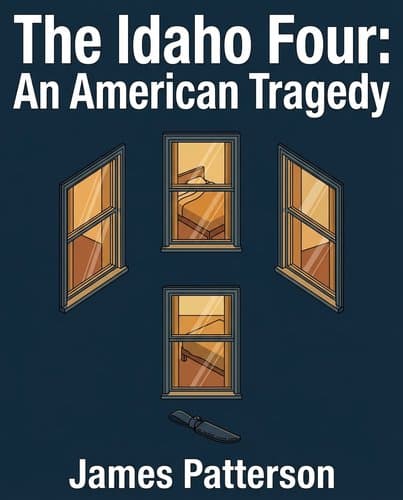
222733476_the-idaho-four
by James Patterson
Four college students are murdered in their beds, and the killer had been flagged as dangerous by a dozen different institutions that never talked to each…
In Brief
Four college students are murdered in their beds, and the killer had been flagged as dangerous by a dozen different institutions that never talked to each other. Patterson and Ward expose how fractured systems, social media surveillance, and our instinct to dismiss 'weird but harmless' let evil hide in plain sight.
Key Ideas
Institutional silos hide warning signs systemically
Red flags are only visible in retrospect when we connect dots across institutions — Kohberger's heroin addiction, theft, stalking, academic misconduct, and incel ideology were each processed by a different system (family, school, police, university) that never shared information with the others
Digital openness becomes predatory surveillance tool
Social media openness that feels empowering in life can become a targeting mechanism in death — Maddie's lit window, public Instagram, and 'Meet the Roommates' post were features of a normal college existence that a predator used as a surveillance map
Official silence fuels conspiracy theory narratives
Police silence during an active investigation is a legitimate strategy that creates an information vacuum the internet will fill with conspiracy theories — in the social media era, refusing to provide a narrative is itself a narrative choice with consequences
Grief monetized through true-crime media machine
Grief in a high-profile case gets monetized almost immediately, often without the families' consent — true-crime pages, podcasts, and psychic TikTokers are operating parallel to and often in conflict with both the official investigation and the victims' families' needs
Weird but harmless masks genuine danger
'Weird but harmless' is the most dangerous assessment a community makes — Kohberger was called creepy by students, banned from a brewery, reported to WSU faculty, and interviewed by a police chief who sensed something 'antisocial'; none of these encounters produced a paper trail that connected to the next
DNA conviction depends on forensic luck
DNA evidence alone does not guarantee conviction — the arrest depended on a chain of specific contingencies, including a genealogy database loophole, a father's DNA in a trash can, and a model-year discrepancy in a BOLO that nearly let the suspect go undetected for weeks
Who Should Read This
Readers interested in Social Issues and Behavioral Psychology, looking for practical insights they can apply to their own lives.
The Idaho Four: An American Tragedy
By James Patterson & Vicky Ward
18 min read
Why does it matter? Because the people who should have seen it coming were the ones least equipped to look
Most people who followed this case thought they understood it: a disturbed outsider, four innocent students, a small town shattered. A story about one man's evil, contained and explained by a mugshot. James Patterson and Vicky Ward are here to dismantle that comfort. The Idaho Four is not really about Bryan Kohberger. It's about every boxing gym and criminology classroom and ignored HR complaint and unanswered Reddit post that built him, degree by degree, into someone capable of walking into a house on King Road and walking back out again. It's about the systems — academic, digital, legal, social — that watched the warning signs accumulate and decided, collectively, that quietness wasn't the same as danger. And it's about four specific, irreplaceable people whose lives were vivid and complicated long before they became a tragedy. By the end, you won't just know what happened. You'll understand, with a precision that makes the how worse than the what.
Four Real People Were Living Their Best Year Before Anyone Knew Their Names
On a Sunday morning in October 2021, a group of freshman fraternity brothers arrived at a house on King Road in Moscow, Idaho, summoned to play a game called champagne shackles. The rules were simple and deliberately uncomfortable: a man and a woman would have their wrists zip-tied together and stay that way until they finished a bottle of champagne — bathroom trips included. Xana Kernodle, the small, loud, laughing woman who had organized the whole thing, was wearing a psychedelic sun hat in shades of pink and purple, a yellow bustier, and black jeans. She was in her element before the game even started.
Ethan Chapin, all six feet four of him, ended up zip-tied to someone else that morning, but his eyes kept drifting to Xana. She was running the music — her housemates kept shouting
The Killer Assembled Himself in Plain Sight — and Every System That Processed Him Filed and Moved On
Here is what the record shows: Bryan Kohberger did not emerge from nowhere. He assembled himself, piece by piece, across a decade of institutions — boxing gyms, rehab programs, criminal justice classrooms, police internship interviews — and every one of them logged something unsettling, then let him walk out the door.
The clearest version of this lives in a forensic psychology classroom at DeSales University in 2018, where Kohberger sat among students learning to catch killers. His professor, Dr. Katherine Ramsland, a criminologist who had spent years corresponding with the BTK Killer, ran a course built around a staged crime-scene house. Students would walk in, analyze brain spatter and bullet holes and body placement, and theorize about what happened. The course covered everything a murderer would need to know about avoiding detection: that killers develop tunnel vision under adrenaline and forget things they otherwise wouldn't; that white men statistically favor knives; that digital footprints are nearly impossible to erase. Kohberger took careful notes. His final essay recorded that 'staging is common' among killers and that investigators should wear 'fiber-free clothing' to avoid contaminating scenes with their own DNA.
In the same class, Ramsland projected footage of Elliot Rodger — a young man from a wealthy family who had spent years nursing his rage at women who rejected him before embarking on a 2014 killing spree near a California sorority house. She walked students through the warning signs of a murderer-in-waiting. Kohberger exhibited them. He'd been addicted to heroin as a teenager, stealing from friends and family to fund it. A brewery owner in Bethlehem had recently added him to a watch list after women complained that the wide-eyed man with the darting gaze was pushing himself into their conversations and asking for their home addresses. In private texts, he described his existence in terms lifted almost directly from Rodger's manifesto — the isolation, the bitterness, the self-pity reframed as grievance.
The students watching the classroom projector did not know any of this. Neither did Dr. Ramsland. That's the sentence the book keeps returning to in different forms: no one person had the full picture. A police chief in Pullman sensed something 'antisocial' in a Zoom interview and simply gave the internship to someone else. Each institution processed one fragment — addict, thief, creep, underperformer — and filed it away.
Kohberger moved to Washington State University in August 2022, three months before the murders, telling himself this was a fresh start. He worked the faculty meet-and-greet like a man auditioning for a role, pumping hands, projecting confidence. His classmate Ben Roberts thought he seemed unusually articulate — the quiet, angry introvert playing the person he'd always wanted to be, in a criminology department, on the Idaho border, three months before four students would be killed in the way the textbooks had described.
Maddie's Lit Window Was Her Biggest Vulnerability — and Her Most Vivid Memorial
Think of a lit window at night. From inside, it's warm, domestic, invisible as wallpaper. From outside, it's a stage. Maddie Mogen never thought much about the difference.
Every night that senior year, she sat at the vanity in her King Road bedroom — foundation first, then mascara, then fake lashes, then the curling iron — and the whole routine played out in full view of the parking lot through the window where she'd spelled out her name in block letters. She'd taken over the lease from graduating sorority sisters, curated the perfect roommate group, and posted a photo of all five women on the deck with the caption 'Meet the Roommates,' set to public, because she was planning a career in marketing and more followers meant more opportunity. There was no naivety in this. It was just the logic of her generation: visibility was currency.
According to Corporal Brett Payne's affidavit, Kohberger's phone pinged off a Moscow cell tower at least twelve times between late August and mid-November 2022, almost always after dark. On the night of August 21st, the records placed him near King Road for over an hour. On his way back to Pullman, a sheriff's deputy pulled him over for a missing front plate. He was smooth, relaxed, gave nothing away. The deputy had no reason to wonder what he'd been doing on the other side of town.
The bitter irony the book keeps turning over is that the same openness that may have made Maddie a target — the public Instagram, the lit window, the name in the glass — is exactly what allowed investigators, journalists, her family, and eventually the world to reconstruct her afterward. The 'Meet the Roommates' post became a document. Her nightly routine, witnessed by neighbors like Lexi Pattinson, became testimony. Her digital footprint, built carefully as a professional asset, became a memorial. Maddie didn't hide her life because she had no reason to. The tragedy isn't that she was careless. It's that she was living exactly as she was supposed to, in full light, while someone watched from the dark.
The Night Dylan Mortensen Talked Herself Out of Calling 911
At 4:17 a.m. on November 13, 2022, Dylan Mortensen opened her bedroom door for the first time and saw nothing. She closed it and went back to bed. She opened it a second time after hearing what sounded like Xana crying, then a male voice saying something along the lines of 'it's okay, I'm going to help you.' She closed it again. The third time she opened it, she saw a man in black — masked, carrying something she thought might be a vacuum — walking toward the sliding doors at the back of the house. They made eye contact for a moment. He kept walking. She locked her door, reached for her Taser, found the battery dead, texted Bethany, got no answer, then sprinted downstairs and climbed into her best friend's bed. By 4:37 a.m., both women had concluded that Dylan had frightened herself with a drunken hallucination. They fell asleep.
Before you judge the eight-hour gap between that moment and the 911 call, consider what the house had trained Dylan to expect. The back door lock had been broken for months — everyone in their circle, including their parents, knew you just lifted the mechanism and the door released. People came and went through that entrance at all hours. A man inside at 4 a.m. wasn't, on its face, an anomaly. The voice saying 'I'm going to help you' matched the script of someone handling a drunk friend, not threatening one. And Dylan had, by her own account, been drinking. Each piece of what she observed had a plausible innocent explanation. The killer didn't just exploit the broken lock — he exploited the entire social logic of that house: the tolerance for strangers, the late-night foot traffic, the lowered threshold for alarm. He left the same way the invited guests left, through the back sliding door, and Dylan's brain did the only reasonable thing a brain can do with partial information: it reached for the boring explanation.
Hunter Johnson reached the house around midmorning the next day and knew something was wrong before he could say why. Xana's bedroom door was cracked open a few inches. She never slept with her door open. He found her on the floor and Ethan in the bed behind her, and the blood told him everything immediately. He went downstairs, told Dylan and Bethany to call 911 and wait outside, then returned to the kitchen and took a knife from the drawer. When he intercepted Emily on the stairs and said, as quietly as he could, 'I don't think Xana's going to wake up,' he was translating the untranslatable for someone still walking toward what she thought was a sleeping friend.
Dylan did not fail to stop a murder. She survived one, in a house specifically chosen because its architecture made ordinary terror look like an ordinary night.
Chief Fry's Silence Was Both His Greatest Discipline and His Worst Strategic Error
What does a police chief owe the public when he has evidence he can't share? James Fry had an answer from the first hour: silence. And for the purposes of catching a killer, he was right. The knife sheath found beside Maddie Mogen's body was the one physical object that might carry the killer's DNA, and Fry and prosecutor Bill Thompson agreed immediately that it could never be mentioned publicly. If the suspect knew the sheath existed, he knew what the investigators had. The blackout held completely. In purely forensic terms, it's one of the investigation's real achievements.
The problem is that silence doesn't stay silent. It gets filled. While Fry protected his evidence, the internet populated the void with Colombian drug cartels, OnlyFans conspiracy theories, and accusations against the surviving roommates who'd been sitting on the curb in the cold waiting for someone to tell them something. By the time Fry gave his first national press conference on November 16th, he faced reporters who weren't asking about a knife sheath — they were demanding he explain two weeks of contradictory messaging. He'd spent those weeks insisting there was 'no threat to the public,' and now he stood at a podium admitting the suspect was still at large. When a reporter asked why the public shouldn't be alarmed, Fry said the threat was 'targeted,' then clarified it was 'not a random attack,' then allowed it was 'an isolated incident,' then conceded that yes, an armed killer remained unidentified. Across the state line, Pullman's mayor — a man with a PhD in communications — watched the performance and slowly shook his head.
The families experienced the silence as abandonment. Kaylee's sister Alivea had already hand-delivered the Grub Truck video to investigators, already identified the man in the gray hoodie, already built a timeline from Kaylee's call log — and still the police were publishing the wrong time that Kaylee and Maddie came home that night. Alivea went to the press not because she was reckless but because she was the only one generating information and nobody in authority was sharing any back. What Fry saw as discipline, the Goncalves family experienced as being iced out of their own daughter's murder.
Both things were true at once, and neither side gets off the hook. Fry was protecting real evidence using sound investigative logic. The families were responding rationally to a vacuum that was actively hurting them. The tragedy isn't that one side was wrong. It's that the social media era doesn't allow for the kind of patient, contained silence that once caught killers — and nobody in Moscow had prepared for that.
The Goncalves Family Found Evidence Before the Police Did — and That Complicated Everything
Alivea Goncalves was twenty-two weeks pregnant and riding in the passenger seat of a car headed east from Los Angeles when she turned her phone into a crime-scene command center. Her husband Robbie drove through the night while she pulled up Kaylee's call log from their mother's phone plan, texted the rideshare driver who'd picked the girls up from the Grub Truck at 1:50 a.m., tracked down a Twitch livestream of that same truck to visually place Maddie and Kaylee in line at 1:30 a.m., and sourced a neighbor's Ring camera that confirmed they'd made it home safely by 1:57 a.m. By the time they arrived in Rathdrum, twenty hours later, Alivea had also identified the man in the gray hoodie watching the girls from behind — a fraternity acquaintance named Jack Showalter — and passed his name to investigators.
When Steve Goncalves asked detectives whether they knew about the food truck and the rideshare driver, both answers were no. That single exchange calcified something in him. The family had not just grieved faster than the police — they had investigated faster. The vape shop footage made it worse: Kaylee had allegedly mentioned a stalker there in the days before her death, and the family asked the owner whether police had collected the CCTV recording. They hadn't. By the time anyone asked, the footage had already looped and was gone. That lost tape became the emotional foundation for everything that followed: the press interviews, the lawyer, the two-year parallel investigation the Goncalves family ran alongside the official one.
Eleven days before the arrest, Steve hired Shanon Gray, a criminal defense attorney with a suspended bar history and a visible appetite for television cameras. The suspension matters because it signals something about Gray's relationship with institutional authority — which was precisely the energy Steve was buying. The police stopped talking to the family directly and routed everything through Gray instead. The move meant to force transparency had the opposite effect: it severed the informal channel that had, however imperfectly, kept the Goncalveses connected to the investigation. Their public pressure — Kristi on NBC, Alivea on local television — unsettled the other families. Stacy Chapin's family had chosen quiet. When Steve and Kristi suggested on-air that police may have cleared suspects too prematurely, it reopened wounds that other families were trying to close.
None of this makes the Goncalveses wrong, exactly. They were running on information that the police had failed to collect, protecting a daughter whose reputation was being shredded on Reddit, and operating inside a grief that demanded action. But the cost was real: the loudest family in the story became isolated from the investigation at precisely the moment it was closing in on an answer.
The Killer Was Caught Because of a Trash Can in the Poconos and a DNA Loophole
The arrest of Bryan Kohberger did not hinge on a single stroke of brilliant detective work. It hinged on a chain of specific contingencies, and it nearly didn't happen at all.
Start with the near-miss. When FBI vehicle analysts first identified the white car circling King Road on the night of the murders, they classified it as a 2011–2013 Hyundai Elantra. A WSU campus officer running plates in Pullman found exactly one white Elantra registered to a graduate student — a 2015 model. Because the year fell outside the BOLO range, he logged it and moved on. The FBI had already quietly updated their estimate to include models as late as 2016, but that revision hadn't reached the officer checking the lot. The man who would eventually be charged with four murders had his car spotted, noted, and dismissed because of a two-year discrepancy in a bulletin.
Once the investigation finally locked onto a name — delivered by the FBI on December 19, after invoking a Justice Department loophole to search private genealogy databases without user consent — the case accelerated into something stranger and more contingent than a procedural drama would allow. Investigators pulled cell tower records and found Kohberger's phone going dark for almost exactly the two-hour window of the murders, then reappearing on the Pullman network at 4:48 a.m. They also found the selfie he took the morning after — damp hair, deathly pale, grinning, thumbs up — which doesn't prove anything and doesn't need to.
The actual smoking gun came from a trash can in the Pocono Mountains. FBI surveillance teams hidden in freezing woods outside the Kohberger family home watched him emerge at 4 a.m. wearing nitrile gloves to deposit garbage into a neighbor's bins. He did it repeatedly, over several hours, in the dead of winter. He was careful enough to keep his own DNA out of everything he touched. He was not careful enough to keep his father's out. The Idaho state lab matched the elder Kohberger's DNA to the profile left on the knife sheath beside Maddie's body — a probability so high it excluded 99.9998 percent of the male population. His father's trash closed the case his own caution couldn't.
When SWAT arrived at the family home, blowing out windows and doors, they found Bryan awake in the kitchen, wearing medical gloves, placing garbage into Ziploc bags. He was, right up until the moment they zip-tied his wrists, still trying to clean his way out of it.
Grief in the Social Media Age Gets Monetized Whether the Families Want It to or Not
What does it cost to become the person who solves a murder? The true-crime internet has its answer: nothing, or almost nothing. A Facebook account, a lot of spare hours, and an appetite for a case that hasn't been closed yet.
When the Moscow police went silent in the weeks after the murders, Kristine Cameron — an assistant principal in Rochester, New York — and her high school friend Alina Smith filled the vacuum. Their University of Idaho Case Discussion page reached 200,000 members in weeks. What happened inside it was something stranger than gossip. Gen Z students who distrusted the police and refused to post publicly created burner accounts just to reach two middle-aged women they'd never met. The admins connected these witnesses to the FBI, moderated fistfights between strangers, and absorbed the guilt confessions of kids who'd spent the day with Kaylee and Maddie and gone home at the wrong time. At its peak, Cameron described the role as therapist, FBI intermediary, and rumor-squasher, all at once.
Then there was Pappa Rodger — a user with a military-uniform avatar who cut through the noise by being right in ways that unnerved everyone around him. He insisted the investigators had found a knife sheath before that detail was public. He estimated the killer spent fifteen minutes in the house. He stated flatly that the killer was an outsider to the victims' social circle, and had already left the area. All of it, detail for detail, would eventually appear in the official arrest affidavit. On December 30, 2022 — the same day Bryan Kohberger was taken into custody in Pennsylvania — every message Pappa Rodger had ever posted vanished. His profile picture disappeared. Cameron pulled up the mugshot on her television, compared it to what she remembered of that avatar, and sat with the thought that the killer may have been inside the community all along, posting questions about his own crime. That possibility has never been ruled out. It just sits there.
Two years later, a fifteen-minute text fight ended with Cameron deleting Alina from all ten of their co-managed pages. Years of work, gone in seconds. Alivea Goncalves, Kaylee's sister, sided publicly with Alina. The people who had genuinely helped — who had connected scared witnesses to investigators and beaten back the worst slanders — ended up in the same wreckage as everyone else the case touched. Attention fills the silence, but it doesn't leave cleanly, and it doesn't always spare the people who deserved better.
Justice and Closure Are Not the Same Thing — and the Families Are Learning That the Hard Way
The arrest of a suspect does not end grief. It redirects it — into courtrooms, gag orders, procedural delays, and the slow realization that the legal system was designed to produce verdicts, not meaning.
Steve Goncalves understood this early. By the one-year anniversary of Kaylee's murder, he was on his black leather couch in Rathdrum — the same couch that had become recognizable to the true-crime internet — giving television interviews while consulting FBI sources about federal charges, running a parallel forensic investigation, and managing a Facebook page that had become a global clearinghouse for families who wished they'd fought harder. A trial date had not yet been set. Kohberger was appearing in court in a pressed suit and fresh haircut, unshackled, watching his own media coverage from a jail cell with vegan meals. The judge had imposed a gag order that extended, without public explanation, to the lawyers representing the victims' families. Every tool Steve reached for hit a wall he hadn't anticipated. He could neither speak nor stay quiet nor compel anyone to act. 'Don't be victims,' he kept saying. 'Don't ever be a victim.' The legal system had already made that decision for him.
Stacy Chapin made a different choice. At CrimeCon in Orlando — a convention billing itself as the world's premier true-crime event — she walked into a packed seminar where an Alabama professor was conducting what he called a forensic analysis of her son Ethan's murder. She sat, left, came back, and stood up at the microphone in front of 3,200 strangers. Her voice shook. She told the room that the four victims were exactly as wonderful as everything they'd read, and asked them not to forget it. The crowd went silent, then loud, then the clip went viral. Stacy drove it all the way to Priest Lake, sat on the wooden bench engraved with Ethan's name, and watched the sun go down over the water. That bench, those mountains, the foundation in his name that had already given out thirty-three scholarships — this was the structure she and Jim had built in the absence of a verdict.
By August 2024, when the university dedicated a Healing Garden and representatives of all four families stood together on the Moscow campus for the first time since the murders, both approaches were visible in the same frame. Steve shook Jim Chapin's hand. Kristi wore a shirt that read VANDAL STRONG. Less than a mile away, Kohberger sat in a basement cell.
The Weeds Growing Where the House Used to Be
The house is gone. Where 1122 King Road stood, weeds have taken over a small, unremarkable field. No tape, no marker, no sound beyond birds. Students pass it every day who were in middle school when it happened, which means they don't stop, which means the ground has already forgotten faster than the people have.
A short walk away, four plaques hold four first names. Not case numbers. Names.
Try to hold both images at once: how quickly the physical world closes over a wound, and how permanently those four people existed — mid-story, mid-laugh, mid-becoming. The real question this case leaves behind isn't how to design a better warning system. It's whether we're willing to look honestly at the quiet, undramatic strangeness we keep filing under harmless — before the cost of that word becomes something no healing garden can hold.
Notable Quotes
“It’s okay. I’m going to help you.”
“Call 911. And stay outside.”
“Ha-ha. Should I bring my pepper spray?”
Frequently Asked Questions
- What is 'The Idaho Four: An American Tragedy' about?
- The Idaho Four: An American Tragedy reconstructs the 2022 murders of four University of Idaho students and the capture of their killer, Bryan Kohberger. The 2025 book by James Patterson and Vicky Ward examines how disconnected institutions, social media vulnerabilities, and overlooked red flags allowed a predator to operate in plain sight. Beyond chronicling the crime and investigation, the authors expose systemic failures in modern American systems of safety, grief, and justice. The work reveals how multiple encounters with Kohberger across different institutions—from family and school to police and university—failed to create a connected narrative that might have prevented tragedy.
- What institutional failures does 'The Idaho Four' expose?
- Red flags are only visible in retrospect when institutions fail to share information across systems. Kohberger's heroin addiction, theft, stalking, academic misconduct, and incel ideology were each processed separately by his family, school, police, and university—none of which communicated with the others. This fragmentation meant warning signs remained invisible. Each institution identified concerning behavior but lacked context from the others. Patterson and Ward demonstrate how this systemic disconnection is not unique to Kohberger's case but endemic to modern American institutions. They argue that connecting these dots across institutions is essential to preventing similar tragedies.
- How does social media affect victim vulnerability in 'The Idaho Four'?
- Social media openness that feels empowering in life can become a targeting mechanism in death. Maddie's lit window, public Instagram, and 'Meet the Roommates' post were ordinary features of college existence that Bryan Kohberger used as a surveillance map. Patterson and Ward reveal how modern digital sharing, while promoting connection and authenticity, simultaneously creates detailed blueprints for predators. The book examines the tension between social media's promise of community and its actual risks. The case illustrates that privacy decisions made freely during life can become weaponized by someone with predatory intent, exposing a fundamental vulnerability in contemporary digital culture.
- What does 'The Idaho Four' reveal about grief and justice in the digital age?
- Grief in a high-profile case gets monetized almost immediately, often without the families' consent. Patterson and Ward document how true-crime pages, podcasts, and psychic TikTokers operate parallel to and often in conflict with official investigations and victims' families' needs. The book exposes how the internet commodifies tragedy, turning personal loss into content to be consumed, analyzed, and profited from. This commercialization complicates both the investigation and the families' ability to process their grief privately. The authors demonstrate that modern justice systems must grapple with a new reality: crimes instantly belong to millions of strangers.
Related Book Summaries

Read the full summary of 222733476_the-idaho-four on InShort