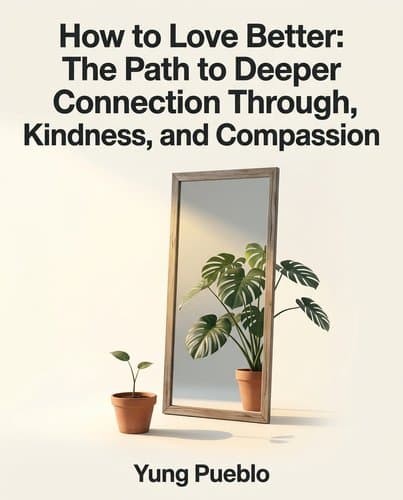
215100951_how-to-love-better
by Yung Pueblo
Every fight with your partner is actually a fight with your past—and Yung Pueblo shows you exactly how to tell the difference. Learn the specific habits and…
In Brief
Every fight with your partner is actually a fight with your past—and Yung Pueblo shows you exactly how to tell the difference. Learn the specific habits and frameworks that transform reactive, attachment-driven relationships into ones built on genuine freedom and mutual growth.
Key Ideas
Daily emotional temperature check prevents arguments
Run a daily 'emotional temperature check' with your partner — name your raw mood each morning before the day starts, without needing to justify it. This one habit stops manufactured arguments before they begin.
Reaction intensity reveals past, not present situation
When you feel a strong reactive impulse during conflict, recognize it as a bridge to the past, not a response to the present. The intensity of the reaction reveals how much the past still has a hold — not how bad the current situation is.
Love preserves freedom, attachment demands control
Distinguish attachment from love by asking: am I trying to preserve this person's freedom, or control my image of them? Closeness fosters; clinging stifles. Drama is a symptom of attachment, not evidence of deep feeling.
Establish conflict rules before needing them
Build a 'loving container' for conflict early in a relationship — agree on the rules of engagement before you need them. Jan's rule ('I want to have a lot of arguments with you, but don't raise your voice') is a model: it normalizes disagreement while protecting the culture of the relationship.
Intuition feels like craving, requires discernment
If you're considering leaving a relationship, check whether the impulse comes from persistent intuition (physical aversion, no mutual growth, genuine incompatibility) or from craving (restlessness, pursuit of newness, attachment to perfection). The two feel similar and require very different responses.
Relationship skills survive the ending intact
After a relationship ends, resist the urge to jump immediately into the next one. The skills built inside the failed partnership — boundary-setting, communication, patience — are yours to keep. Use the transition to close the gap between your present self and your truest self.
Care works when given partner's way
Give care in the way your partner needs to receive it, not the way you prefer to give it. Feeling like you're giving a lot while your partner feels unsupported usually means understanding is missing, not effort.
Who Should Read This
People working on personal growth in Relationships and Intimacy, especially those tired of generic motivational advice.
How to Love Better: The Path to Deeper Connection Through Growth, Kindness, and Compassion
By Yung Pueblo
13 min read
Why does it matter? Because you've been confusing the feeling of love with the practice of it.
Most people quietly believe that if a relationship requires too much work, it's probably the wrong relationship. That the right person should soften the edges of life, not add more friction. Yung Pueblo spent years inside that assumption — unable to leave and unable to stay peacefully — before he discovered something more unsettling: the conflict was never really about her. It was his own unprocessed past showing up, looking for somewhere to land. This book is built on that inversion. The friction you've been trying to escape is precisely the mechanism through which two people actually change each other.
You Can't Love Someone Better Than You Know Yourself
Diego and Sara said 'I love you' after two weeks together. Both meant it completely. Then spent the next six years in what he describes as an emotional hurricane. Not because the connection was weak—because neither of them knew how to actually be together.
What was happening in those fights wasn't really about the fights. Every time Diego felt a surge of internal tension—stress, irritation, that low-grade heaviness that doesn't announce its cause—he did what comes naturally to most people: he aimed it at Sara. Made it her fault. Tried to drag her down into whatever he was carrying. She did the same to him. This is the blame game, and it has nothing to do with incompatibility. It's what happens when you haven't learned to sit with your own difficult emotions, so you outsource the discomfort by making the nearest person responsible for it.
The cruel irony: the closer someone is to you, the more they absorb this. Partners see you when your guard is finally down—exhausted, raw, at your most reactive. That vulnerability is real and even precious, but without self-awareness it turns the relationship into an emotional dumping ground.
What changed things wasn't a better communication framework or a relationship counselor, though those have their place. It was meditation—specifically, the slow and uncomfortable work of learning to observe their own inner states instead of immediately acting on them. As Diego describes it, the relationship had been functioning like a mirror the whole time, faithfully reflecting back every unresolved pattern each of them carried. They just hadn't been looking.
What he eventually discovered wasn't a better technique for managing conflict. It was something more unsettling. The peace they'd been demanding from each other couldn't come from each other. It had to be built inside each of them first. Connection, no matter how magnetic, can't substitute for that internal foundation. You can love someone with total sincerity and still be completely unprepared to love them well—because loving well is a skill, and skills require knowing yourself well enough to see when your past is running the show.
The Wound You Carry Is the Wall Between You
Healing yourself and learning to love someone well are not two separate projects you complete in sequence. They are the same work, because the patterns formed during the hardest moments of your life are exactly the ones that surface the moment a relationship gets intimate.
Pueblo understood this late and painfully. For years in his early twenties, he was drowning in anxiety and sadness he didn't know how to name, and he dealt with it the way the culture around him modeled: drugs, alcohol, constant company. Never alone, never still, never forced to actually feel what was moving through him. Then one night he took too much, and his heart lost its rhythm. He lay on the floor for hours convinced he was dying — a doctor later told him it sounded like a mild heart attack. He was in his twenties. When it was over, he had to reckon with the fact that all that numbing had brought him to the edge, and that he was a stranger inside his own body.
What he discovered when he finally stopped running — through Vipassana meditation, sitting in silence for ten days at a stretch — reframed everything about his relationship with Sara. The mind doesn't react to thoughts. It reacts to sensations in the body. Anxiety is a physical signal. So is the flash of anger when a partner uses the wrong tone, or the shutdown that happens when a conversation gets too serious. Those sensations aren't responses to what's happening right now; they're bridges back to older moments, older dangers. The present just pulled the trigger.
Before he understood this, he and Sara couldn't break through the surface of anything real. When their conversations turned serious, he felt genuine alarm in his chest. His thinking went defensive, his listening shut down. Not strategy — reflex, survival code running on top of an otherwise ordinary Tuesday. The past had no interest in letting the present be peaceful.
This is what makes healing inseparable from loving: until you learn to recognize your own sensations and pause before they hijack your behavior, you aren't really responding to the person in front of you. You're responding to everyone who hurt you before them. The peace they'd been demanding from each other couldn't come from each other. There's no shortcut where you fix yourself first and then bring a clean version into the partnership. The relationship is where the patterns show up — which means it's also where the real work begins.
Attachment Isn't Love — It's Love's Most Convincing Impostor
Think of someone who collects rare objects and calls it love. They keep each piece under glass, away from light and handling, catalogued exactly as it was the day they acquired it. The moment something shifts — a crack appears, a color fades, the value changes — they panic. That panic isn't love. It's the terror of losing an image they built in their own mind.
This maps uncomfortably well onto how we love each other. Kahlil Gibran wrote that the pillars of a temple stand apart, and that line does real diagnostic work. Two people in genuine closeness maintain their own structure. They're near each other, shaped by each other, but not fused, not propped up by the other's stillness. Clinging looks similar from the outside but runs on fear: keep the other person exactly as they are, because the image you fell for can't survive their changing.
Pueblo is direct about what this produces. You fall for an idea of someone — vivid, specific, yours — and then the actual person begins drifting from that image, as every living person inevitably does. The drift feels like betrayal. So you fight it. You ask them, directly or through pressure, to stop growing in the direction that inconveniences your mental picture. You call the resulting tension passion. You call the jealousy proof of how much you care. But drama in a relationship isn't a measure of depth. It's attachment mistaking itself for love.
The distinction Pueblo draws is between freedom and control. Love, he argues, creates the sensation of freedom in the presence of another person. Attachment is the opposing current — it tries to hold the world still, to lock someone into the version of themselves you decided to want. Every relationship contains both currents, because almost no one arrives without accumulated fear and craving. The question worth sitting with is which current you're feeding when you feel the most intense. If the intensity spikes when something threatens your control — when they change their mind, pull back, grow into someone slightly new — that heat is attachment signaling its own anxiety. That's the mirror turning inward.
The Conversation That Saved 48 Years of Marriage
Early in their marriage, Sara's parents Jan and Steve got into a heated disagreement. Steve's voice started climbing the way voices do when someone is desperate to be heard. Jan stopped him. 'I want to have a lot of arguments with you,' she told him. 'I look forward to years of disagreeing. But don't raise your voice at me. If you raise your voice, I can't hear you.' Steve thought he was just speaking forcefully, not yelling — but he recognized that the distinction didn't matter if it shut down the conversation. He adjusted. From that single exchange, they built the culture of forty-eight years of marriage, raised six children, and created a home their family still returns to.
What Jan did wasn't avoid conflict. She invited it. She just built the container first — one agreed rule that kept friction from becoming destruction. That rule did something structural: it meant the argument always had somewhere to go other than nuclear. Without a container like that, the default is ego logic, where the goal of any disagreement quietly shifts from understanding to winning. And winning is a trap. The person made to lose doesn't forget. They accumulate resentment, quietly, until there's more of it than love. The winner buys short-term control at long-term cost.
The reason this trap is so hard to escape is that perspective feels like truth when you're inside it. During a fight, your read of events seems obvious and complete — the facts arranged into a verdict. But what each person perceives is always partial: a slice of causes and history filtered through their own formation. Your partner isn't seeing a different version of events. They're standing in a different room of the same building. Treating an argument like a debate to win means treating your slice as the whole and forcing your partner to accept it.
The alternative is what Pueblo calls selfless listening — not waiting for your partner to finish so you can reload, but actually receiving what they're saying as information that widens your picture. It means suppressing the reflex to defend and treating the argument as a joint effort to locate something true. Jan modeled the spirit of this in one sentence: I want to have a lot of arguments with you. That's not resignation. It's an acknowledgment that two real people with real inner lives are going to collide, and love is the container that makes those collisions productive rather than corrosive.
Stop Waiting Until You're Upset to Talk About How You Feel
How often do you walk into a tense evening with your partner carrying weight that started long before you saw them? The argument that breaks out over dishes or scheduling isn't usually about dishes or scheduling — it's about whatever was already pressing on you before you walked through the door.
Pueblo and Sara discovered this the hard way during the early weeks of the COVID pandemic, trapped together in their small New York City apartment. Being home all the time stripped away the buffer of separate schedules, and they found themselves prone to flare-ups that seemed to come from nowhere — arguments that, on reflection, weren't really arguments at all. The pattern: when one of them was already carrying inner tension, the mind would look for somewhere to put it. Whoever was nearby became the target. The fight would feel urgent, even justified, but the source had nothing to do with the other person.
Their fix was disarmingly simple. They started naming their emotional state to each other a few times a day — sometimes while still in bed, before either of them had done anything to merit complaint. Not an explanation, not a conversation, just a raw signal: I feel great, my mood is heavy, I'm tired and off today. No reason required. Just the current weather, stated plainly.
The effect was structural. If you already know your partner woke up stormy, you don't interpret their short answer as a slight — you understand the conditions they're moving through. The tension that might have manufactured an argument dissipates because it's been named before it needed a story to attach to.
Pueblo also noticed something worth keeping: shifting the language from 'I am sad' to 'it feels like sadness is moving through me' changes the relationship to the emotion itself. The first version fuses you with the state. The second treats it as weather — real and present, but passing. That small adjustment, made daily, slowly retrains the mind to observe its own moods rather than be consumed by them.
The principle is that communication works best before the problem takes shape, not after it already has a name and a villain.
When to Fight for a Relationship and When to Let It Go
How do you know whether you're in a relationship worth fighting for, or one you're staying in because leaving feels harder than hoping it improves?
Pueblo's answer begins with a warning about the wrong question. Most people ask themselves 'am I happy right now?' — and that question will mislead you almost every time, because happiness inside a relationship fluctuates constantly with circumstances, moods, and the ordinary friction of two people living closely. The more honest diagnostic runs through three things: Are you still growing? Can you actually be vulnerable here? And is what you're feeling a persistent signal from somewhere deep, or just the discomfort of difficulty?
The craving trap is the hardest to see from the inside. Pueblo describes craving as a hunger that can't be satisfied — once it takes hold, it scans your relationship for insufficiency and finds it everywhere. Your partner becomes 'not quite right.' The relationship feels like it's missing something you can't name. The challenges between you read as evidence you've chosen wrong, rather than the ordinary weather of two real people building something together. The insidious part is that craving disguises itself as discernment. It feels like clarity when it's actually appetite — an attachment to a frictionless version of love that doesn't exist.
Against that, Pueblo offers six genuine signals that a relationship may have run its course: relentless conflict that leaves no room for repair, a physical aversion that persists even in calm moments, no mutual growth, an inability to reach real vulnerability, life goals pointing in fundamentally different directions, and a persistent intuition that has survived every attempt to explain it away. The difference between that kind of intuition and craving is what Cecily discovered over dinner when she told her partner Soren, diagnosed with breast cancer not long into their relationship, that she'd understand if he wanted to leave. She offered him the exit because she'd spent her life inside transactional relationships — ones where love was implicitly conditional on convenience. Soren's response, immediate and without hesitation, wasn't just reassuring. It cracked something open in her. She'd mistaken her fear of being a burden for wisdom. That wasn't intuition signaling incompatibility. It was old damage mistaken for clarity.
Discomfort in a relationship is not evidence it's wrong. It's evidence you're in it. The question is whether you're growing through the discomfort together — or whether the real you, the vulnerable one, has gone permanently into hiding.
Heartbreak Is a Mirror You Can Finally Look Into
Every failed relationship is proof of wasted time — that's the story heartbreak tells, and it's wrong. The patience you built sitting through hard conversations, the boundary you finally learned to hold, the way you started naming your emotions instead of just firing them — those are yours now. They don't dissolve when the relationship does. The partnership was a mirror, and what it showed you couldn't have been seen any other way.
Pueblo does something quietly radical with the idea of loss here. The sting of a breakup, he argues, is largely an ego-wound — because when two lives have been deeply entangled, one of them becomes part of your identity. When it ends, you don't just lose the person. You lose the self you were while with them, and that disorientation is real. But the skills built inside that relationship — emotional fluency, self-awareness, the ability to see your own triggers — are integrated in you. They travel forward.
The more unsettling insight is what a serious relationship had been quietly masking. When your life is organized around another person, there's always a portion of your inner world you never had to face — they were filling the space. Heartbreak removes that buffer. The grief points you toward the distance between who you are and who you actually are when no one else is doing the navigating. Closing that gap — through solitude, through reinvesting in friendships that had quietly withered, through the slow work of self-friendship — is the actual recovery. Not consolation for what you lost, but the thing you were always meant to find.
You are not starting over. You are starting with more.
Love Becomes Freedom When You Stop Needing It to Look a Certain Way
Think of a plant that someone keeps moving to find the perfect window. North wall, east wall, south-facing sill — never quite right, always searching for conditions where growth will finally happen effortlessly. The plant doesn't move itself. The gardener does. And the anxiety of the search is the thing preventing the tending.
What most people bring into relationships is a quiet hope that the right person will provide the conditions in which life becomes easier to bear. Pueblo's final turn is to dismantle that hope gently — not to discourage love, but to relocate what love can actually do.
The paradox he names is precise: your partner should love you exactly as you are, and that love, because it creates genuine safety, will energize you to change in ways external pressure never could. But notice the sequence. The change doesn't come from your partner needing it. It comes from the safety itself — a feeling of being so fully seen and accepted that the old defenses relax enough for real growth to move through. That's a completely different mechanism than trying to become someone your partner approves of. One produces transformation. The other produces resentment.
What a serious relationship had been quietly masking, for many people, is how little practice they've had simply being on their own side — learning their own needs, sitting with their own discomfort, building a basic tolerance for their own company. That work can't be outsourced to a partner. It has to happen in the ordinary moments: noticing what you actually feel instead of what you think you should feel, treating your own distress with something closer to curiosity than contempt.
This is why, Pueblo argues, we're living inside a rare historical moment. As more people do that inner work — therapy, meditation, sitting honestly with what they carry — they stop arriving at relationships depleted and demanding rescue. They bring something to tend instead of a hole to fill. Individually, this shifts what each person can offer. Collectively, it shifts what love looks like.
Freedom inside a relationship isn't what you find. It's what you build, in yourself, until you stop needing the relationship to be anything other than what two growing people make together. At that point it becomes, quietly, the most nourishing thing in your life. You are not starting over. You are starting with more.
The Struggle Was Never the Problem
Here's where the thread from that earlier wreckage lands: all that starting with more doesn't mean starting clean — it means arriving with the scar tissue already mapped. Pueblo and Sara didn't choose each other because they were ready. They chose each other before they had a single tool, then built every tool inside the wreckage of choosing wrong repeatedly. That's not a cautionary tale — it's the actual sequence. The friction didn't mean something was broken. It was the mechanism. Two people grinding against each other's unexamined patterns until something true got exposed.
What the couples who last seem to understand, eventually, is that hard seasons aren't interruptions to the relationship — they're the relationship doing its most important work. You don't get depth by avoiding the difficult parts. You get it by deciding the difficult parts are worth staying for.
And right now, something unusual is happening. More people are arriving at commitment having already done real work on themselves — therapy, recovery, years of figuring out what they actually need rather than what they thought they should want. That changes the starting conditions. It doesn't eliminate the friction, but it means fewer people are blindsided by their own patterns when the friction arrives. For the first time in a while, the generation entering serious relationships may be the most emotionally literate one we've had — not because life got easier, but because enough people decided that understanding themselves was worth the effort before asking someone else to.
That's not nothing. That might be everything.
Notable Quotes
“Stop, wait a second, I want to have a lot of arguments with you. I look forward to many years of disagreeing, but just don’t raise your voice to me. Please don’t yell. If you raise your voice at me, I can’t hear you.”
“I want to have a lot of arguments with you”
“I would understand if this is not a journey you want to be on for your life.”
Frequently Asked Questions
- What is "How to Love Better" about?
- The book argues that lasting relationships require self-understanding first, with most conflict tracing back to unresolved inner patterns. It offers concrete practices for managing emotional reactivity, communicating honestly, and giving care effectively. The core message: personal growth and emotional awareness form the foundation for deeper connection with others. Rather than focusing solely on relationship dynamics, it prioritizes inner work as the pathway to external relationship health. Understanding yourself comes before understanding your partner, and this self-knowledge becomes the basis for all healthier connections.
- What are the main practices from "How to Love Better"?
- Key practices include a daily "emotional temperature check" where partners name their raw mood each morning without justification. "This one habit stops manufactured arguments before they begin." The book teaches recognizing reactive impulses during conflict as "a bridge to the past, not a response to the present." It also recommends building a "loving container" for conflict early with established rules of engagement. Finally, give care in the way your partner needs to receive it, not the way you prefer to give it, as understanding gaps typically underlie unsupported feelings.
- How does the book distinguish between attachment and love?
- The book distinguishes attachment from love by asking: "am I trying to preserve this person's freedom, or control my image of them?" Closeness fosters while clinging stifles, and drama signals attachment rather than deep feeling. Attachment operates from control and fear, whereas true love preserves autonomy. Attachment-based relationships create dependency and control, but loving relationships support freedom and growth. This distinction matters because intense attachment can feel similar to love but lacks the mutual support characteristic of genuine connection. Recognizing this difference helps readers build relationships based on freedom rather than possession.
- What does the book recommend after a relationship ends?
- Resist jumping immediately into the next relationship. The skills built inside a failed partnership—boundary-setting, communication, patience—are yours to keep. Use the transition period to close the gap between your present self and your truest self. When considering leaving, distinguish between persistent intuition (physical aversion, no mutual growth, genuine incompatibility) and craving (restlessness, pursuit of newness, attachment to perfection), as they require different responses. This approach transforms relationship endings into opportunities for self-development rather than mere transitions to new connections. The work you do on yourself after a breakup creates the foundation for healthier future relationships.
Related Book Summaries

Read the full summary of 215100951_how-to-love-better on InShort