205397858_impossible-to-possible
by R.C. Bhargava
A bureaucrat with no business degree and a frugal Japanese billionaire built India's most successful car company not by importing better technology, but by…
In Brief
A bureaucrat with no business degree and a frugal Japanese billionaire built India's most successful car company not by importing better technology, but by proving that workers trusted as genuine partners—through equal uniforms, shared canteens, and two-thirds of productivity gains—outcompete any rival.
Key Ideas
Genuine Worker Stake Unlocks Floor Knowledge
Workers who spend their careers operating machines develop knowledge that engineers and managers cannot acquire from an office — unlocking that knowledge requires giving workers a genuine stake in the company's success, not just better procedures
Authentic Equality Demands Real Management Cost
Trust is built through specific, visible acts of equality that cost management real status: same uniform, same canteen, same time clock, same toilet. If the equality has no cost, workers won't believe it's real
Early Payment Converts Suppliers to Partners
Paying vendors on time — and ahead of the industry norm — is not a courtesy, it is a trust investment that converts transactional suppliers into partners willing to take risks on your behalf
Cashless Operations Signal Partnership Authenticity
Banning cash transactions isn't only an anti-corruption measure; it is the foundation of worker trust, because workers who know management is siphoning money will never believe the partnership is genuine
Two-Thirds Gains Unify Economic Interests
A productivity bonus scheme where workers capture two-thirds of the gains from exceeding output targets aligns incentives structurally — it makes workers' wealth and company profitability identical rather than adversarial
Daily Executive Presence Drives Culture
Cultural transformation cannot be delegated to HR. At Maruti, the MD personally ran monthly union meetings and chaired quality circle competitions. The model only works when the personal commitment comes from the top and is visibly, daily demonstrated
Outsider Hires Escape Broken Assumptions
Selecting for people without existing industry habits — hiring from hotels to run car sales, from Tier-2 colleges instead of IITs for shop floors — can be more valuable than hiring experienced people who carry the assumptions of a broken industry
Who Should Read This
Readers interested in Business Strategy and Leadership, looking for practical insights they can apply to their own lives.
Impossible to Possible: Maruti's Incredible Success and How It Can Change India
By R.C. Bhargava
10 min read
Why does it matter? Because the assumptions you have about Indian manufacturing — and about workers everywhere — are backwards.
In 1981, a socialist government that had spent thirty years treating private cars as a bourgeois embarrassment suddenly found itself running a car factory — not because anyone planned it, but because Sanjay Gandhi, a prime minister's son, had died. Every expert who looked at the situation said the same thing: wrong country, wrong ideology, wrong infrastructure, wrong workforce. Foreign embassies warned their manufacturers to stay away. The Indian component industry was two decades obsolete. Strikes were a seasonal event. And yet one Japanese CEO, ignoring his own advisors, flew to Delhi and signed the deal anyway. R.C. Bhargava — a civil servant with a mathematics degree and zero automotive experience — was the man who had to make it work alongside him. What they figured out together wasn't a manufacturing secret. It was something stranger: that the workers everyone had written off were, if treated as partners rather than problems, the most powerful competitive weapon in the room.
The Experts Were Wrong, and the Reason Tells You Everything
In the summer of 1982, Osamu Suzuki sat across from Indian negotiators in a conference room in Hamamatsu. The humidity was brutal enough that both sides had stripped to their shirts, arguing over legal clauses while eating junk food late into the evening. His own advisors had told him to walk away. Foreign embassies had briefed interested manufacturers on exactly what awaited them in India: a component industry on obsolete technology, a chronic foreign exchange shortage, labor relations defined by strikes and occasional violence, and a car market stuck below 40,000 units a year for decades. No other manufacturer would commit cash equity. Suzuki signed anyway.
The question worth sitting with is not whether he was right — the numbers eventually answer that, with MSIL producing 2 million cars a year and carrying a market capitalization larger than its Japanese parent. The question is what he understood that his advisors missed. The answer has almost nothing to do with market analysis or capital allocation. It has to do with the specific, personal stakes of the people in that room.
R.C. Bhargava, the future MD, walked away from a guaranteed path to Cabinet Secretary — the pinnacle of India's civil service — to join a public-sector car company his peers described as career suicide. He needed his judgment vindicated. Suzuki had personally overruled his advisors and staked his reputation on a country every informed observer had written off. Two people, each with something irreplaceable to prove, negotiating in their shirtsleeves until midnight.
The standard explanation — Japanese money plus government protection — leaves this out entirely. The machinery and the equity mattered, but the force that pushed MUL through hostile conditions was the combustible motivation of people who had personally bet everything on the outcome. They had no interest in managing expectations. They needed to be right. The deeper question is what that kind of commitment let them see about the workforce their advisors had already dismissed — and whether it was replicable.
The Real Reason Indian Manufacturing Underperforms Has Nothing to Do With Policy
Bhargava's bluntest observation is that the assumption costs more than any infrastructure deficit. The assumption: educated people give instructions, less educated people carry them out. Flip that, and the entire gap between Indian manufacturing and world-class competition starts to look less like a story about roads, power supply, or trade policy — and more like a story about what management believes workers are for.
The Japanese figured this out while rebuilding after the war. Workers — the 60 to 70 percent of a company's headcount who spend entire careers on machines — accumulate knowledge that engineers cannot get from offices or drawing boards. They know the specific vibration that precedes a breakdown, the sequence adjustment that saves thirty seconds per cycle, the quality defect that appears only on the third shift. The question was never whether workers had this knowledge. The question was whether management would build a workplace that let them use it.
MUL's answer was yes, and Bhargava has the numbers: roughly 20 percent higher productivity than comparable Indian factories. No new machinery. No consultants. The entire gain came from starting work at the exact scheduled time and holding the lunch break to 30 minutes. Workers accepted both rules because management kept the same rules — open-plan offices, no exceptions, Bhargava included.
Once workers were treated as people whose observations mattered, MUL workers generated hundreds of thousands of Kaizen improvement suggestions. Some were good enough to be adopted in Suzuki's Japanese plants — Indian factory workers improving operations in Japan, the supposed source of all the expertise. The people closest to the machines were not the last source of knowledge. They were the first.
You Can't Buy Trust With a Mission Statement — Here's What It Actually Costs
What does it actually cost to convince a factory worker that management is serious about equality? Not the poster-on-the-wall version, but the kind workers believe?
The price Bhargava discovered was status — management's own, surrendered in ways specific enough to be embarrassing. At most Indian companies, including the public-sector giants where MUL's early recruits had built their careers, the physical layout of the workplace was a continuous broadcast about who mattered. Separate dining rooms. Different food quality. At BHEL, managers wore better-cut uniforms in better fabric — same category of garment, different caste signal.
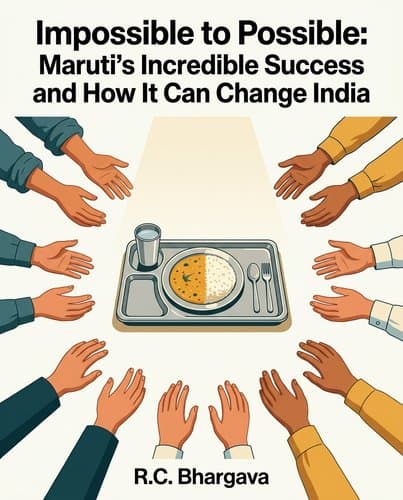
MUL eliminated all of it, and the most important move was the canteen. One room, one menu, one queue. Directors collected their food from the same counter as welders, carried their own trays, and deposited their plates in the same cleaning area when they were done. Workers who had come from BHEL — where the hierarchy was served to you with your lunch — described this as the moment they started believing management meant what it said. Bhargava is precise about why it worked when rhetoric alone hadn't: you can argue with a mission statement, but you cannot argue with the man responsible for your performance review standing behind you in line waiting for the same dal.
The same logic drove the other visible equalizations. Identical uniforms, down to fabric and cut, from Bhargava and Krishnamurthy through to the shop floor — and both men wore theirs to meetings outside the company, removing the easy escape hatch of dressing differently when it mattered. Open-plan offices where even directors had no private rooms and every table was the same size.
Senior managers objected to open offices, arguing they couldn't concentrate or hold confidential conversations. Some left rather than comply. Bhargava's response was to add a few small meeting rooms for genuine privacy needs and hold the line on everything else. The discomfort was the point. Workers were watching not for grand gestures but for the moment management found a dignified reason to carve out an exception — a private dining corner for the board, a slightly nicer bathroom on the fourth floor. The exception would have confirmed what experience had taught them to expect. The absence of exceptions is what built the trust.
The Incentive That Made Everyone an Owner
That was the mechanism Bhargava built into MUL's productivity bonus scheme, and the elegance of it is that it was not designed as a welfare measure. It was designed as a performance lever.
The government, offering public enterprises more autonomy, required them to sign performance agreements committing to specific targets. Bhargava negotiated a clause: if output exceeded 25 cars per employee per year — the figure baked into the original project report — two-thirds of the manpower cost savings from beating that threshold would be distributed across all employees. No upper cap. No exclusion except directors. Workers on the line received 15 percent above the average payout, indirect workers got the average, white-collar staff got 15 percent below. The logic was transparent and workers could see it: the people physically building the cars had the biggest leverage over output, so they should capture the biggest share of the gains.
The government approved the scheme because nobody expected MUL to blow past the 25-car threshold by enough to make the bonus meaningful. They were wrong in a direction that changed workers' lives. Attendance climbed above 95 percent — not because anyone mandated it, but because a substitute on the line slowed output and every worker understood the arithmetic. Quality discipline tightened for the same reason: a defective car that had to be reworked was a car that didn't count. Within a few years, the bonus a worker received exceeded their base salary.
The result was not just a productivity statistic. Bhargava insisted workers own their homes rather than rent from the company, resisting the standard PSU model of employer-owned colonies. As Gurgaon land values compounded over the decades, that ownership became generational wealth. By the time the numbers were tallied, 54 percent of MUL employees under 30 owned a home — in one of India's most expensive real estate markets. The same mechanism that made the company competitive made the workers prosperous. There was no tradeoff to manage because the structure had eliminated the tradeoff.
Before a Single Car Was Built, MUL Was Already Profitable
Before Maruti had manufactured a single car, Bhargava's team opened an advance booking window and asked the Indian public to hand over ₹10,000 each — roughly 20 percent of the car's eventual price — for a vehicle that existed only in planning documents. Osamu Suzuki thought it wouldn't work. No car company anywhere in the world had tried collecting deposits at this scale on an unbuilt product, and India's government institutions had spent decades teaching citizens to expect exactly nothing from them.
120,000 people paid anyway. The resulting ₹120 crore pool, parked in instruments earning double-digit interest rates, made MUL profitable before a single unit rolled off the line. When Bhargava told Suzuki the books were in the black from year one, Suzuki was genuinely shocked — this wasn't how manufacturing companies were supposed to work.
The deposit scheme was solving two problems at once. MUL's planners knew that demand would dwarf production capacity for years, and in that gap lived every temptation the Indian system had to offer: dealers extracting premiums, officials accelerating delivery for favored buyers, the inevitable corruption allegation landing on Bhargava's desk. The deposits closed that gap preemptively. Applicants registered during a one-month window, and a computer algorithm — not a bureaucrat — determined who got a car first. To prove the system couldn't be manipulated, Bhargava had the Vice President of India press the key that generated the distribution lists, with the media in the room to watch. The first names to appear were ordinary citizens. In a country where people had learned to assume that government institutions existed to benefit the connected, this was not a minor PR event. It was proof of a different kind of institution.
The cash surplus meant MUL never had to go back to the government for funding beyond the initial project allocation. That independence — bought with a booking scheme Suzuki himself had doubted — gave management room to run the company differently from every other PSU. The trust-first model didn't cost returns. It produced them first.
The Japanese Secret Was a Dry Towel
Imagine squeezing a towel completely dry, wringing it until no water comes out, and then being told to keep squeezing. That is the image Osamu Suzuki reached for when Bhargava asked how kaizen improvements kept arriving after two decades of the practice. Surely, Bhargava pressed, the scope for gains had been exhausted. Suzuki's answer: the suggestions hadn't stopped — wringing a dry towel just takes more effort. And to prove it, he mentioned a company-wide campaign he had just launched with a single objective: remove exactly one gram of weight from every component in every car. Not a kilogram. One gram.
Bhargava's reaction captures what makes this hard to transplant. He couldn't name another CEO, in India or the West, who would think this way. The barrier isn't technical. It's about who you think is worth listening to — whether the person operating a machine for ten years is someone whose knowledge you build a system around, or someone who builds your system's output.
Bhargava landed inside that barrier personally. Early in MUL's operation, transport tenders for shipping CKD kits from port to factory came in at a certain floor. A Gujarat car dealer, asked informally whether the rates looked reasonable, offered to run a trial shipment. After one run he quoted thirty percent below the lowest tender bid. Bhargava took it to the board, got approval, signed the contract, and saved MUL crores annually as production scaled. A decade later, the CBI filed a corruption case against him for deviating from tender procedure. The savings were not a defense. The procedure had been broken. The case was eventually dismissed, but only after more than a decade of proceedings.
The same instinct that drives kaizen — looking past the established method toward the better result — is procedurally indistinguishable from the corruption it isn't. That is why government systems calcify. The officer who saves money by improvising and the officer who extracts a bribe both broke procedure. Audit culture cannot tell them apart after the fact, so the rational response is to break nothing, save nothing, and let the dry towel stay wet.
Integrity as a Competitive Strategy, Not a Moral Stance
Bhargava's first suggestion to Krishnamurthy, before a single car had been manufactured, was to ban cash transactions entirely — every purchase, every sale, every delivery, settled by cheque or credit card. His reason was workers, not auditors. If MUL's accounts showed anything other than a complete picture of the company's finances, workers would find out. In every company Bhargava had seen, they found out. And the moment they knew cash was being siphoned — the standard practice in Indian industry, where scrap sales were routinely recorded at a fraction of actual proceeds and the rest disappeared — the model collapsed. You cannot ask workers to trust you as partners while stealing from the company they're supposed to be partners in.
This was not an ethics initiative. It was load-bearing infrastructure.
The practical consequences cascaded outward in ways Bhargava had calculated in advance. When government inspectors arrived expecting the usual informal payment to overlook violations — and they arrived, because they always did — MUL managers could say, truthfully, that no cash existed on the premises. Not 'we don't do that.' Literally no cash. The inspectors had nothing to grab. When scrap was auctioned, winning bidders paid by cheque. When a minister quietly asked Bhargava to have MUL build a heated swimming pool at his private residence, Bhargava responded by asking for the request in writing, with a note specifying which budget line the expenditure should come from. The request was never committed to paper. The pool was never built.
Each of these moves reinforced the same signal: management's interests and workers' interests were structurally aligned because there was no cash channel for them to diverge. Workers didn't have to trust management's intentions. They could see the mechanism.
Why Every Other Japanese Joint Venture in India Failed to Replicate This
Why did every other Japanese joint venture in India produce ordinary results while Maruti produced an industrial miracle? The honest answer is uncomfortable: the model wasn't transferable because the model was a person.
Osamu Suzuki visited India an extraordinary number of times — not to inspect, but to pressure, to learn, and to signal that this project carried his personal credibility. When the license agreement allowed for a fixed number of training hours in Japan, he ignored the clause and trained over 1,200 Indian workers and managers at Suzuki's expense, for periods up to three months. Other Japanese partners sent teams and moved on. Suzuki came himself, repeatedly, paid for the human infrastructure the agreement didn't require, and treated the factory's success as a direct reflection on him. The gap in outcomes was proportional to that gap in personal stakes.
But the harder problem was on the Indian side. Bhargava spent months trying to find someone to run the personnel function who believed workers and management could genuinely cooperate. He interviewed every credible candidate. Every single one saw their job as containing the union — negotiating with it, managing it, keeping it from exploding. The Japanese model, in which workers become voluntary partners in the company's profitability, was not a philosophy any of them had encountered or thought possible in India. Bhargava eventually gave up and ran the function himself, with Krishnamurthy alongside him. The culture stayed intact because the most senior people in the building had no one to delegate it to.
That is the real reason the model didn't spread. You cannot hand kaizen to an HR department that doesn't believe workers have knowledge worth surfacing. You cannot install a single canteen and call it culture change if the CEO eats first. The tools Japan produced were real, but they only worked when the person at the top was willing to be personally inconvenienced by them — visibly, consistently, without exempting himself on account of rank. Maruti found two such people at the same moment. That combination, Bhargava suggests, was the accident at the center of everything — and the reason what follows is a story about one company rather than an era.
The Lunch Break That Explains the Gap
Here is what Bhargava is really asking you to sit with: the most expensive thing in Indian manufacturing isn't the infrastructure gap or the capital shortage or the policy environment. It's the lunch break. Twenty percent more output, no new machinery, just the decision to mean it when the clock said start. Maruti proved this in 1983. The proof is still sitting there, forty years later, largely uncollected. The Manesar violence happened on Bhargava's watch. He couldn't find a single HR professional who believed workers were worth believing in. The model that worked didn't spread because the model required someone to be personally inconvenienced by it, daily, in public, with no exceptions — and that person is apparently harder to find than capital. Bhargava doesn't end with a victory lap. He ends with a question: if the gap is a lunch break, why is the rest of Indian industry still eating separately?
Frequently Asked Questions
- What are the main principles behind Maruti's success?
- 'Impossible to Possible' identifies four core principles that transformed Maruti into India's most successful car company. The book argues that shared sacrifice, aligned incentives, vendor trust, and top-led cultural change are concrete, applicable principles for any manufacturer. Rather than viewing workers as costs, Maruti treated them as partners with valuable knowledge from daily machine operation. This required giving workers genuine stakes in company success. The book emphasizes that 'workers capture two-thirds of the gains from exceeding output targets,' structurally aligning worker and company interests rather than creating adversarial dynamics.
- How did Maruti build trust with workers through equality?
- Maruti built worker trust through specific, visible acts of equality that cost management real status. The book emphasizes: 'same uniform, same canteen, same time clock, same toilet.' Bhargava stresses that 'if the equality has no cost, workers won't believe it's real.' Additionally, banning cash transactions served dual purposes—anti-corruption and trust foundation. Workers knowing management siphons money would never believe the partnership was genuine. These concrete measures demonstrated authentic commitment to equality, converting skepticism into genuine partnership where workers would share productivity gains and company challenges.
- What is the significance of on-time vendor payments in Maruti's model?
- In Maruti's approach, paying vendors on time—and ahead of industry norms—is more than a courtesy; it's a trust investment. 'Paying vendors on time — and ahead of the industry norm — is not a courtesy, it is a trust investment that converts transactional suppliers into partners willing to take risks on your behalf.' This restructured vendor relationships from transactional to collaborative, with suppliers becoming invested in Maruti's success and willing to innovate. The principle demonstrates that financial reliability builds institutional trust, converting supply chains from adversarial relationships into genuine partnerships aligned around mutual success.
- Why must cultural transformation come from top leadership?
- Cultural transformation at Maruti could not be delegated to HR departments. The MD personally ran monthly union meetings and chaired quality circle competitions. The book's emphasis is clear: 'The model only works when the personal commitment comes from the top and is visibly, daily demonstrated.' This direct, visible leadership created credibility that HR-led initiatives cannot replicate. By personally engaging with workers and their concerns, top leadership proved authentic commitment to partnership principles. This approach ensured cultural change wasn't theoretical policy but lived reality visible throughout the organization daily.
Related Book Summaries

Read the full summary of 205397858_impossible-to-possible on InShort