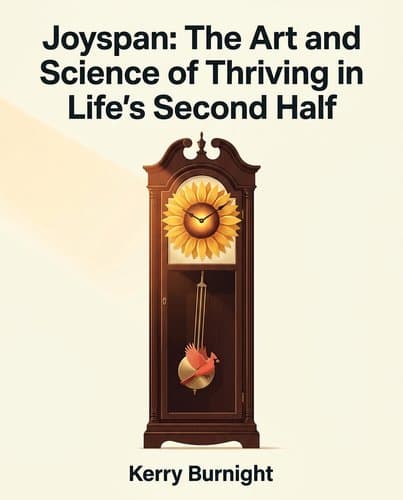
218372381_joyspan
by Kerry Burnight
Longevity without joy is just more time to suffer—but four concrete practices (growing, connecting, adapting, and giving) can transform your second half into…
In Brief
Longevity without joy is just more time to suffer—but four concrete practices (growing, connecting, adapting, and giving) can transform your second half into your most meaningful decades yet, backed by research showing your beliefs about aging literally add or subtract years from your life.
Key Ideas
Audit and rebuild your Dunbar circles
Map your own Dunbar Circle: count the people in each ring (5 close, 15 good, 50 friends, 100 acquaintances) and identify which rings are thin — then treat rebuilding them as a project with specific actions, the way Margo did with her photography Meetup group.
Practice weekly actions over stated values
Treat the four pillars as verbs, not values: schedule one concrete act of Growing, Connecting, Adapting, or Giving each week — the research shows the action creates the meaning, not the other way around.
Name emotional thieves to stop spirals
When you feel a joyspan dip coming, name which of the five thieves is operating (Frustration, Isolation, Burden, Loss, or Defeat) — naming it breaks the loop of attributing the collapse to 'just aging.'
Prosocial giving rewires your biology
Reframe your relationship with purpose: the UCLA gene-expression data suggests that finding one prosocial giving goal — however small — has measurable biological effects that simply feeling happy does not.
Your age beliefs shape your lifespan
Challenge internalized ageism as a health intervention: Dr. Becca Levy's research found that people with positive age beliefs lived 7.5 years longer than those with negative ones — meaning the story you tell yourself about aging is itself a longevity variable.
Age-diverse friendships buffer against distance
Diversify your social portfolio deliberately by building friendships across age groups: this protects against the 'Big Ds' (distance, disease, dementia, death) that thin older social networks.
Who Should Read This
People working on personal growth in Longevity and Positive Psychology, especially those tired of generic motivational advice.
Joyspan: The Art and Science of Thriving in Life's Second Half
By Kerry Burnight
11 min read
Why does it matter? Because adding years to your life without adding joy is just more time to suffer.
Most people approaching their sixties have a rough plan: eat better, exercise more, maybe finally take that genetics test. The assumption is that longevity is basically a biological negotiation — your habits versus your DNA. But spend enough time watching people age — Kerry Burnight has spent thirty years doing exactly that — and a different pattern emerges. The people who genuinely flourish in their eighties and nineties aren't just the ones who watched their sodium. They're people who kept getting curious, who stayed in the business of other people's lives, who bent when circumstances demanded bending. The ones who merely endured? Often in perfectly decent health. What separated them wasn't cholesterol — it was something interior, something buildable. Burnight calls it joyspan, and she's here to argue it's less a feeling than a practice — one you can begin, right now, from wherever you are.
The Worst Suffering Burnight Witnessed Wasn't from Disease — It Was from Emptiness
Kerry Burnight flew home from Washington, D.C. clutching a National Crime Victims' Service Award from the U.S. attorney general — and spent the entire flight feeling sick. She'd spent years co-directing the country's first Elder Abuse Forensic Center, a multidisciplinary hub where medical, legal, and social workers investigated elder mistreatment cases together, reviewing thousands of cases of neglect, exploitation, and abuse. The award was real. So was the problem: looking back, she could see she'd been stationed at the bottom of a skateboard ramp, patching people up after they'd already hit the pavement. The damage was done. The scars stayed.
The suffering she witnessed wasn't primarily biological. Mrs. C had physical pain, yes — but what hollowed her out was the loneliness surrounding it. Mr. R wasn't crushed by his diagnosis; he was crushed by a choice between his medication and his next meal. Again and again, the common thread wasn't disease. It was isolation. Purposelessness. No one at the door. No reason to get up.
Burnight is a gerontologist, and she'd been operating on the assumption most of us share: that aging is fundamentally a physical problem, best handled by medicine. That flight home cracked the assumption open. The real threat wasn't what was happening inside her patients' bodies. It was what had gone missing from their lives — connection, meaning, a sense of forward motion.
If the worst suffering comes from emptiness rather than decline, then the preparation that actually matters isn't just medical. It's internal. You don't build a good old age by outrunning physical decay. You build it — deliberately, in advance — by cultivating the things that give life weight. That's what this book is about.
Your Genes Explain Less Than 16% of How Long You'll Live
Most of us carry a quiet fatalism about how long we'll live. If your grandfather died at 67 and your mother at 72, you do the math and brace yourself. Longevity feels like something handed down — or withheld — by genetics. Burnight's answer to this is blunt: that story is almost entirely wrong.
Consider Josephine and Janice, identical twins who shared every strand of DNA they possessed. If genes were destiny, their stories would rhyme. They don't. Josephine was still driving her 1995 Oldsmobile at 97, working part-time at a hospital gift shop and rotating among four different bridge groups. Janice died at 78, after years of dementia and chronic illness, with four people at her memorial. Same genetic inheritance. Nineteen years apart. The difference came entirely from how they chose to move through the world — Josephine leaning into connection, curiosity, and adaptability; Janice growing progressively more rigid and isolated.
The research behind this is starker than most people expect. Dr. James Vaupel, one of the world's leading demographers and a founding director of the Max Planck Institute for Demographic Research, noted that your parents' height explains 80 to 90 percent of your own height. Their longevity? About 3 percent of yours. The largest study of its kind — an analysis of 86 million genealogy profiles — put the heritability of lifespan at roughly 16 percent. That's it. The remaining 84 percent flows from behavior, attitude, relationships, and the meaning you make of your days.
This is not alarming. It's the opposite. It means the dice aren't loaded against you by your family tree. It means the daily choices that feel small — whether you reach out to a friend, stay curious, find a reason to show up tomorrow — are doing the heaviest lifting of your life. Josephine didn't win a genetic lottery. She shaped something, steadily, that Janice didn't. That kind of shaping is within reach.
Joy Isn't Just a Feeling — It's a Biological Force That Extends Your Healthy Years
Think of joy the way you think of exercise. You wouldn't describe a run as merely "nice to have" — you'd call it cardioprotective, metabolically necessary, measurably good for your brain. Joy works the same way. It just doesn't look like work, so we've miscategorized it.
Run happy for a few months and something changes at a cellular level. Your baseline cortisol drops — and cortisol, when it stays chronically elevated, is quietly corrosive: it thickens artery walls, suppresses immune function, and nudges blood sugar toward diabetes range. This isn't abstract. People who carry sustained positive emotion aren't just in a better mood; their inflammatory load is measurably lower, which means less of the systemic wear that compounds into heart disease over decades. You can feel the difference as more energy, better sleep, a body that recovers faster. What you're actually feeling is your stress chemistry running cooler.
The Women's Health Initiative study put a number on this. Researchers followed 95,000 women — all free of cardiovascular disease and cancer at the start — for eight years. The women who reported more positive emotional states were significantly less likely to develop coronary heart disease, die from heart-related causes, or suffer a stroke. Same diet range, same healthcare system, different emotional weather — and the outcomes diverged sharply. Positive emotion also predicted fewer rehospitalizations and less carotid artery blockage. The heart, it turns out, is keeping score of your interior life.
Joy isn't a reward you collect after getting your health right. It's one of the inputs. The body carrying more of it produces more serotonin and dopamine, which strengthen immune response. It sleeps better, which lowers obesity and diabetes risk. It moves more, because people in positive emotional states are likelier to exercise. Each feeds back into the others. Joy runs through the wiring of health, not alongside it.
Growth Requires a Public Belly Flop First
The first pillar Burnight calls Growth — and her entry point is a childhood memory.
When I was seven years old, I climbed a high-dive ladder on shaking legs, arranged my arms in what I hoped looked like a diver's posture, and launched myself off the edge. What came next was not a dive. It was a full-body slap against the water — loud, public, and witnessed by everyone at the pool. I came up gasping, face and belly matching shades of red, while adults around the pool made sounds of collective sympathy and suppressed laughter. My parents, watching from the deck, told me to go back up and try again. Mortified, I did.
That night, my mother pressed a small charm into my hand — and it came with a story. A few years earlier, Betty had walked into the kitchen and found her husband John slumped at the table in his bathrobe, head in his hands. One word explained everything: bankruptcy. The family lost their home; the business made the local papers. Betty, who had left teaching three decades earlier to raise children, now needed to earn money immediately, with an expired credential and no recent work history. So at 55, she enrolled in interior design school — the oldest student in every classroom by roughly twenty years. She felt, as she later described it, like a fish dropped on dry land. She fumbled. She also grew, and she kept the lights on. My father had given her the charm after that catastrophe. It read: "true grit."
Burnight's point, built from both stories, is that growth in later life isn't the comfortable kind — the hobby picked up, the podcast subscribed to. The growth that actually protects against stagnation requires tolerating public awkwardness and genuine identity disruption. Betty wasn't adding a pleasant skill to an otherwise stable life. She was reconstructing who she was, from scratch, in a room full of people half her age, after a failure her community had read about in the newspaper. That kind of stretch — the kind that costs you something — is what keeps the mind flexible, the sense of purpose intact, and the descent into purposelessness at bay. The belly flop, it turns out, is not the obstacle to growth. It's the method.
Social Connection Predicts Survival Better Than Diet, Exercise, or Quitting Smoking
Social connection is not a comfort — it is a clinical variable. Treat it like one.
The evidence comes from Julianne Holt-Lunstad, who pulled together 148 epidemiological studies covering more than 300,000 patients. The studies examined the usual suspects: smoking, obesity, blood pressure, exercise habits, alcohol, air pollution. They also tracked social factors — how often people interacted with others, whether they felt part of a community, how many close relationships they maintained. When Holt-Lunstad looked at what actually predicted whether someone survived a stroke or a heart attack, the social measures won. People genuinely integrated into a network of relationships increased their survival odds by 50 percent. No physical health factor came close. A lack of meaningful connection did more damage than obesity or hypertension. The loneliness you've been treating as a personal problem turns out to be a physical threat, as measurable as blood pressure.
Burnight's name for this pillar of joyspan is Connection, and she opens it with Byron, a ninety-year-old man whose memorial drew hundreds of people, most of them convinced he was one of their closest friends. What Byron did was systematic: he kept a wall list of birthdays, anniversaries, and the dates people had died, and he used it to make sure he was always the one who reached out. He called for no reason other than to hear how someone was doing. He showed up at bedsides. He did all of this from a wheelchair, in pain, while managing his own medical appointments. Byron wasn't especially lucky with people. He had decided that connection required maintenance, and he did the maintenance.
Connection can be engineered — not stumbled into. When Margo, 71, watched her social network collapse after retirement, she approached rebuilding it the way she'd once approached a work problem: she listed her interests, then identified three specific actions under each one. Photography led to a community college course, an online meetup group, and a local arts festival. She started with the meetup and found herself in a diverse, energetic group of strangers who shared her frustrations and discoveries. Within that group she met someone who had attended her same college, missing her by 27 years. What had felt like a social emergency became, with methodical effort, a replenished life.
Adaptation Is a Skill, Not a Personality Trait — And It Can Be Learned
A snowstorm is bearing down, the train platform is empty, and two octogenarians can't reach anyone by phone. Howie Martin's fingers are going numb. His wife Beth, scanning the darkened street, spotted a pizza place across the road. Within minutes they'd ordered a pizza — addressed to their son's house, forty minutes away — and Beth asked the delivery driver a question that has entertained the family ever since: could they ride along? They arrived at Wednesday night dinner warm, laughing, and carrying the food.
What makes that story memorable isn't luck. Beth didn't have a gift for crisis. She had a habit of scanning for what was still possible rather than cataloguing what wasn't. That habit is what Burnight calls adaptation — and she's careful to treat it as a learnable skill, not a fixed personality feature.
Her framework divides the skill into two toolboxes. The first is internal: the cognitive moves you make when everything's going sideways. When Harry, an 82-year-old former Green Beret, was swindled out of $400,000 and his home after his wife's death, the shame was crushing — until he deliberately relocated it. The fraud wasn't evidence of his weakness; it was evidence of criminals who target the recently bereaved. That single reframe, which psychologists call cognitive restructuring, didn't undo the damage, but it freed him to start rebuilding. He found a volunteer position greeting children at an equestrian therapy center, which gave him purpose, routine, and human contact all at once. The external toolbox — social support, professional counseling, community engagement — did for Harry what the internal work couldn't do alone.
Burnight's 96-year-old mother Betty illustrates how these tools compound over time. Neighbors urged her to leave her two-story home. Betty declined, then set about solving each constraint the house created: a stationary bike replaced walking for exercise, a physical therapist who made home visits replaced the clinic she could no longer reach, online grocery delivery replaced the supermarket that felt the size of a football field. When she needed a walker, she found a lightweight triangular model that came in red and used it. None of these were dramatic gestures. Each was a small, specific problem met with a specific solution — which is exactly what adaptation looks like in practice. Not a personality. A repertoire, built one problem at a time.
Purpose Does What Happiness Can't: It Rewrites Your Gene Expression
What if feeling happy is actually the wrong target? Most people assume that joy means positive emotion — that the goal of a good life is to feel good. A UCLA study of more than 1,500 adults between 50 and 98 suggests otherwise, and the finding startled even the researchers who produced it. Dr. Steven Cole's team collected DNA samples and asked participants two separate questions: how happy did they feel, and how much did their life have direction and purpose? Self-reported happiness had no measurable effect on gene expression. But a strong sense of purpose rewrote the biology entirely — people who reported clear direction showed lower markers of inflammation and stronger antiviral responses, the immune profile you'd want if you were trying to fight off disease. Those who lacked purpose showed the reverse pattern, resembling people suffering from chronic loneliness. An empty, purposeless life does roughly the same biological damage as smoking.
This is the fourth pillar of joyspan: giving. And the research is specific about what kind of giving actually matters. By old age, only prosocial purpose — helping other people — keeps delivering well-being. Financial goals, status, recognition: they stop paying out. Giving to others doesn't.
Burnight's brother Russ is the clearest illustration. After decades in real estate and raising three kids, retirement left him unmoored. The answer arrived from a five-year-old in a supermarket checkout line who asked his exhausted mother whether she'd ever had a substitute teacher. Russ went home and looked into it, discovered his community had a severe shortage of male substitutes, and completed the training. His first day, a kindergartner looked him over and asked, without ceremony, whether he was old. Russ grinned and said he was old compared to them, young compared to others. The kids loved him. When he came back from cancer surgery with a scar across his forehead, he walked in brandishing a wand and introduced himself as Mr. Harry Potter. The room erupted. The giving hadn't just given the children something — it had given Russ a reason to show up with joy, even after a cancer diagnosis. That's what prosocial purpose does that a happiness strategy can't: it anchors you outside yourself, which turns out to be where the biology changes.
Aging Actually Makes You Better at Five Things the Anti-Aging Industry Doesn't Want You to Know About
The anti-aging industry has made a fortune on the story that growing older is an unbroken catalog of losses. Here's what it leaves out: aging also produces measurable cognitive and emotional gains — specific, documented improvements that younger people simply don't have access to yet.
Take emotional stability. As the brain ages, the amygdala — the region that processes threat and negative emotion — becomes demonstrably less reactive. Stanford researchers studying older adults found they were more emotionally balanced, better at solving interpersonal problems, and less likely to be derailed by setbacks than their younger counterparts. The biology had quietly shifted in their favor. Oliver Sacks, at 81, had just learned that liver cancer had metastasized through his body. His response was not dread but what he called an intensifying of aliveness — a sharpened attention to friendships, to writing, to the pleasures of understanding. That capacity to face the worst news of your life and find it clarifying rather than annihilating is not personality. It's a brain that has, literally, been restructured by time.
Four other gains compound this one. Social anxiety — the exhausting need to know what people think of you — declines significantly after fifty, as activity drops in the brain region responsible for social self-evaluation. People describe it less as confidence and more as relief: the audience they'd been performing for just quietly disperses. Problem-solving shifts from fluid intelligence, which handles novel logic and does decline, to crystallized intelligence: the accumulated solution playbook built from decades of navigating actual problems. A 65-year-old who has managed a sick parent, a failing business, a divorce, and a teenager has pattern-matched her way through situations that no amount of raw processing speed can simulate. That's not a consolation prize — it's a different and often more useful kind of smart. Spirituality deepens too: surveys across 60 countries found older adults consistently more likely to report both religious practice and a felt sense of meaning, and that depth correlates with four to seven additional years of life expectancy. And humor sharpens, because once you've stopped performing for an audience, you can finally find the right things funny.
None of these are compensations for what's lost. They're a different kind of capability — one that only becomes available on the other side of enough lived experience. What comes next, it turns out, isn't only loss.
A Minor Car Accident Can Collapse a Joyspan — Unless You Know the Five Thieves
On Ann's 62nd birthday, a distracted driver rear-ended her car. She was shaken but unhurt — or so it seemed. By the next morning she had a throbbing headache. Weeks passed and it didn't lift. Sleep became impossible. She dropped out of her morning walks, skipped Pilates, felt the distance between herself and her husband widen. Housework accumulated. Some days she stayed in her pajamas until noon. When her son visited for Thanksgiving and asked if she was alright, Ann had a ready answer: this was just aging. What else could explain the fatigue, the mess, the low-grade misery spreading through her days?
Except it wasn't aging. It was a cascade — each problem feeding the next. The headache disrupted sleep, the sleep deprivation killed her energy, the lost energy severed her from the activities and people that had been sustaining her. What looked like decline was actually a spiral, and spirals have starting points.
Burnight names the forces that drive them: five thieves of joy that ambush older adults, often together. Frustration arrives first, usually through a health setback. Isolation follows — and this one is particularly insidious because it arrives as a side effect of the headache, not as a choice; Ann didn't decide to withdraw, she just hurt too much to show up. Then comes the feeling of being a Burden, the corrosive belief that your struggles are wearing out the people who love you. Loss shows up as grief, not only for people who've died but for the version of your life that existed before things went sideways. And Defeat settles in last and heaviest: the conviction that your best days are categorically behind you.
They reinforce each other before you've noticed any of them. Ann's headaches were a health problem; this is just aging turned a temporary spiral into what felt like a verdict. Naming the thief is the first recovery move — because once you see a spiral for what it is, you've already interrupted it. The chapters ahead give you the rest of the toolkit.
The Question Betty Is Still Answering at 96
Betty takes her cocktail. She pedals her stationary bike at the lowest setting. She orders groceries online because the parking lot alone takes twenty minutes and she has better things to do. None of this is heroic. What it is, is deliberate — and that distinction is the whole argument. Joyspan was never about becoming someone exceptional. It was about deciding that your remaining years deserve an actual answer to the question most people keep deferring: for what, for whom? That question isn't morbid. It's the most generative one available to you, at whatever age you're reading this. Because here's what the research, and Betty, and Byron, and Russ all point toward together: how you age is not a private matter. The four pillars — movement, nourishment, connection, purpose — don't exist in isolation. The habits you build, the relationships you maintain, the purpose you refuse to abandon: these become the proof of concept your children and grandchildren are quietly watching. Your joyspan is their permission slip.
Notable Quotes
“you may join me on my walk tomorrow, but I leave right at seven a.m. Be ready to go or I’ll go without you.”
“I like to know which leaders are from which countries, and what they are doing,”
“Lifespans are not like height, a trait that is strongly inherited,”
Frequently Asked Questions
- What is Joyspan: The Art and Science of Thriving in Life's Second Half about?
- Joyspan argues that psychological wellbeing in older age is not luck but a learnable set of practices. Written by Kerry Burnight and published in 2025, the book combines behavioral science and gerontology research to provide concrete tools for building social connection, countering internalized ageism, and sustaining purpose across the second half of life. It's organized around four pillars—growing, connecting, adapting, and giving—that serve as actionable frameworks rather than abstract values. The book emphasizes that meaningful aging isn't determined by chance but by deliberate, evidence-based practices that readers can implement in their daily lives.
- What are the four pillars in Joyspan?
- The four pillars of Joyspan are growing, connecting, adapting, and giving. Rather than treating them as values to aspire to, Burnight recommends treating them as verbs—actionable practices to integrate weekly into your life. The research shows that the action creates the meaning, not the other way around. Growing involves continuous learning and skill development, connecting means building and maintaining social relationships, adapting requires flexibility in facing life changes, and giving centers on prosocial contribution. Scheduling one concrete act from each pillar weekly forms the foundation of the book's practical approach to sustained wellbeing.
- What are the five thieves of joyspan?
- The five thieves of joyspan are Frustration, Isolation, Burden, Loss, and Defeat. These represent distinct patterns that can undermine psychological wellbeing in older age. According to Burnight's framework, when you feel a joyspan dip coming, identifying which thief is operating breaks the loop of attributing the collapse to "just aging." By naming the specific thief—whether it's Frustration with physical limitations, Isolation from thinned social networks, the Burden of caregiving, Loss of relationships or abilities, or Defeat from setbacks—you shift from accepting decline as inevitable to recognizing addressable emotional and social patterns. This distinction is crucial for intervention.
- How does age beliefs affect longevity according to Joyspan?
- According to research cited in Joyspan, challenging internalized ageism is itself a health intervention with measurable consequences. Dr. Becca Levy's research found that "people with positive age beliefs lived 7.5 years longer than those with negative ones." This finding fundamentally reframes aging: the story you tell yourself about getting older becomes a longevity variable rather than merely a psychological factor. Burnight emphasizes that internalized ageism—negative beliefs about aging internalized from society—isn't just mentally limiting but biologically consequential. This research suggests that shifting from age-negative to age-positive self-narratives is as significant as other health interventions for extending both lifespan and healthspan in the second half of life.
Related Book Summaries
Read the full summary of 218372381_joyspan on InShort