53007534_kaizen
by Sarah Harvey
Your brain is hardwired to resist big change — Kaizen exploits that by making each step so small it slips through undetected, turning imperceptible daily…
In Brief
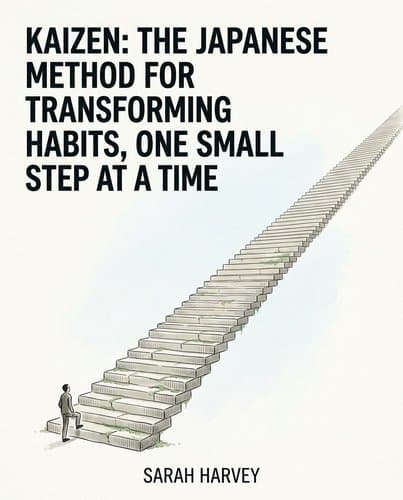
Kaizen: The Japanese Method for Transforming Habits, One Small Step at a Time (2019) explains why big self-improvement goals fail — the brain resists large demands on its resources — and shows how making each step small enough bypasses that resistance entirely.
Key Ideas
Inventory all life domains before action
Run a life inventory across six domains — health, work, money, home, relationships, new challenges — and rate each honestly before making any changes. Seeing the whole picture first prevents targeting the loudest problem at the expense of the most important one.
Five written questions per improvement area
For each area you want to change, answer five questions in writing: Where am I succeeding? Where am I ineffectual? What would improvement look like? What is the smallest possible first step? What does long-term success look like? The answers often arrive in the shower, not at the desk.
Embarrassingly small steps trigger no resistance
Make the first step embarrassingly small. If you cannot sustain 200 words a day, write 100. If a full yoga practice feels impossible, set the alarm five minutes earlier. The step should be too small to trigger resistance — that smallness is the mechanism, not a compromise.
Visual habit tracking builds momentum quietly
Build a habit tracker in a bullet journal: turn a page horizontally, write days of the month across the top, write habits down the left column, and colour in each completed day. Review monthly to see what has quietly become automatic. The retrospective evidence is as motivating as the tracking.
Scheduled windows replace constant notifications
Turn off email and phone notifications and designate specific windows for checking. The compulsion to check constantly is a variable-interval reinforcement schedule — a behavioral trap identical in structure to a slot machine — not a sign of professionalism or importance.
Handwritten spending tracking builds awareness
Track spending by hand using Kakeibo's method: record income, fixed expenses, variable spending, and extras daily in a physical notebook. The act of handwriting forces mindful processing that digital apps bypass. Check the ledger daily and review monthly to set next month's target.
Invest in radiators, limit drains
Audit close relationships using the 'radiators, not drains' filter. List key people by category (family, romantic, friends, colleagues), evaluate each against how they make you feel, and actively invest in one or two who boost you. Limiting exposure to people who deplete you is not cruelty — it is maintenance.
Shrink habits rather than restart completely
When a habit slips, do not restart — shrink. Replace the original goal with the smallest possible version of itself. A short walk on a bad day keeps the habit loop alive in a way that a missed 5K does not. The method handles relapse with the same tool it uses for everything else.
Who Should Read This
People working on personal growth in Habit Formation and Self-Improvement, especially those tired of generic motivational advice.
Kaizen: The Japanese Method for Transforming Habits, One Small Step at a Time
By Sarah Harvey
9 min read
Why does it matter? Because every ambitious resolution you've abandoned was designed to fail.
When your ambitious resolution collapses by January 12th — and studies confirm most do — the story you tell yourself is about character. You didn't want it enough. But neuroscience has a different explanation, and it's more forgiving to you and considerably less flattering to the industry selling you forty-day transformations. Your brain is wired to protect its resources, and it reads large behavioral demands as threats. It shuts them down. Every extreme diet, every 5am discipline routine, every dramatic fresh-start challenge runs directly into that system. Kaizen doesn't. The Japanese method of continuous improvement makes each step so small the brain's alarm never triggers. The results compound. The resistance nearly vanishes. What follows is a practical system for the person who's already tried the obvious approach and found it works perfectly until it doesn't.
Your Willpower Isn't the Problem. Your Brain Is Doing Its Job.
Every time you've abandoned a resolution, the explanation probably isn't weak character. It's that you were asking your brain to do something it was designed to resist.
Ben Gardner, a psychologist at King's College London, describes the human brain as a "cognitive miser." Its core job is conserving mental energy, so it converts repeated actions into automatic habits that run without conscious attention. Making tea doesn't require deliberation; it happens on autopilot, freeing your mind for things that genuinely need thought. That's useful. It also means that changing any established habit is costly: you're trying to override a system that exists precisely to resist that kind of intervention.
Habits don't just run on autopilot — they're triggered. A cue fires a behavior, the behavior delivers a reward, and that reward strengthens the association until the cue alone sets things in motion. Stress prompts nail-biting; the relief nail-biting brings makes stress more likely to trigger it next time. Repeat this often enough, in the same context each time, and the behavior runs without any conscious decision at all. This is why telling a habitual smoker that cigarettes cause cancer doesn't make them stop. You're applying information to a reflex, and information is the wrong tool.
Here's where the self-help industry makes it worse. It's been selling a number: 21 days to form a new habit. A University College London study found it to be entirely made up. The actual range is anywhere from 18 to 254 days, depending on person and habit.
So if you've tried to overhaul your eating, break a bad pattern, or build a new practice (and failed), the brain defended its existing system, exactly as designed. That's not a moral failure. Sarah Harvey's argument is that the only reliable route past this defense is to make the change so small the brain doesn't register it as a threat worth fighting.
What a Tokyo Road Crew and Seven Olympic Gold Medals Have in Common
Dave Brailsford walked into British Cycling in 2002 with an MBA and not much else. The team had earned one Olympic gold medal in its entire history. He drew up a list of every measurable component of the sport — aerodynamics, rider nutrition, bike maintenance schedules — and wrote the same target next to each: 1 percent improvement.
Nobody thought this added up to anything meaningful. Improvements of 1 percent are invisible — you can't feel them in training or see them on a stopwatch. But Brailsford kept finding them: better sleep routines for athletes, small adjustments to hand positioning, hygiene protocols to reduce illness during competition. Each gain was negligible. Their combined effect was not. At the 2008 Beijing Olympics, the British team won seven of the ten available cycling gold medals. Four years later in London, they matched the tally exactly.
The logic is almost offensive in its simplicity. No single 1% gain won anything. The accumulation did. Brailsford built a system that got marginally better at everything and let the arithmetic do the rest.
Harvey had been collecting examples of this logic before she knew what to call it. A Tokyo street being resurfaced was one of the clearest. There was no small crew attacking the job. There was a large team, each person assigned one micro-task: one measured, one dug, one directed pedestrians around the blocked footpath. From a distance it looked like overstaffing. It was actually a system built on the idea that mastering a small task beats approximating a large one. The road was back in use within days.
That's the claim Kaizen makes, and why it travels out of Olympic cycling and into the much more practical question of why you can't seem to make anything stick — a sleep schedule, a new routine, a project you keep meaning to start.
The Four Tools That Turn Theory into Tuesday Morning
Imagine a thermostat that raises the room temperature by half a degree every two hours. Nobody notices. Nobody reaches for a sweater. By the time the room is genuinely warm, everyone inside has already adjusted — because at no point did the change feel like a change. That's the engineering logic behind Kaizen. The method doesn't try to overpower the brain's resistance to new habits. It slips past the guard by staying below the threshold that triggers it.
Harvey's practical system has four components. Each one matters precisely because of how undemanding it is.
It starts with an inventory. Before any action, she asks you to map your life across six domains — health, work, money, home, relationships, and whatever new challenges appeal to you — in a spider chart or column diagram. The goal isn't to see everything that's broken. It's to see the whole picture before narrowing focus, because patterns appear at that scale that aren't visible inside a single problem. You might discover that "I want to move more" and "I've always wanted to learn salsa" are the same goal.
Once you've flagged the areas for change, five questions drive the analysis: Where am I already succeeding here? Where am I falling short? What would real improvement look like? What is the smallest possible first step? What does long-term success look like? Take the house-share scenario in the book: housemates who leave toilet seats up and schedule impromptu parties on Monday nights. The micro-action they produce is almost comically modest — have one honest conversation with one housemate. Not move out. Not call a house meeting. One conversation. The mundane scale is deliberate. The method is designed for friction, not crisis.
The 1 per cent rule is where the neurological logic from the previous section snaps into place. The first Kaizen step must be small enough that it barely registers as a change. Harvey illustrates this with the writing variant: if 200 words a day feels like too much, write 100. Seven hundred words by Friday beats zero, which is what perfectionistic overreach reliably delivers. The brain never identifies 100 words as a threat worth mobilising against. That's not a consolation prize — that's the mechanism.
The fourth tool is a bullet journal, and Harvey's version is more structured than the name implies. It runs on a monthly cycle: a calendar page for events, a goals list alongside it, a habit tracker with the page turned sideways so days of the month run across the top and habits run down the left column, progress colour-coded in each cell. A gratitude list sits alongside these; its job is to redirect attention from what's unfinished to what's already working, which makes the next small step easier to take. Then a daily to-do built on three symbols: a dot for tasks pending, a crossed dot for tasks done, and an arrow for tasks carrying forward to tomorrow. The point of looking back over previous months, Harvey says, is to see which habits have become automatic — which is the closest thing Kaizen has to a finish line.
Four tools. All of them small on purpose. The brain that defeated the last twenty resolutions never sees any of these coming.
Why Checking Your Inbox Feels Like Pulling a Lever in Vegas
Imagine someone designs a machine that delivers a small reward at completely unpredictable intervals. Not every time you pull the lever — that would teach you to pull it exactly as often as rewards appear. Instead, randomly: sometimes after one pull, sometimes after twenty. Behavioral psychologists call this variable-interval reinforcement. It's the design principle behind every slot machine ever built. It also describes email exactly.
Harvey borrows this framing directly. Roughly one in twenty emails contains something genuinely interesting: a useful update, a request that matters, an offer worth reading. The rest is noise. But you can't predict which pull of the lever pays off, so you keep checking — not because you're anxious or undisciplined, but because that's what variable-interval reinforcement does to brains. It produces compulsive checking that runs well below conscious awareness. The same mechanism that keeps gambling addicts at the machines at 2am keeps you reaching for your phone before breakfast.
Harvey puts a number on this: the average American checks their phone 47 times a day. One in ten do so during sex. These aren't people who've decided notifications matter more than everything else. They're people caught in a designed loop, checking not because they believe something important has arrived but because the system has taught them it might have.
Here's where the argument turns useful. If email compulsion were a motivational problem, a failure of discipline or resolve, the fix would be to try harder. But it's an environmental problem: the notification fires, the checking reflex follows, the same way a bakery smell produces hunger. Which means the fix is environmental too. Harvey's own moment of clarity came by accident: she turned off her email notifications by mistake and found she could stay inside a task for forty-five minutes without once surfacing. The solution wasn't more resolve. It was designating specific windows for checking, keeping only actionable messages in the inbox, and waiting thirty minutes before replying to anything that raises your blood pressure.
Email is the easiest case because the trap is visible. Harvey's real interest is what happens when the same loop runs inside money and social life, where it has been considerably better engineered.
The 1904 Ledger and the Grandmother's Rule
In 1904, a Japanese journalist named Hani Motoko sat down to solve a problem that had nothing to do with journalism. Japanese women had little formal control over household money, and Motoko, the first woman to work in Japanese print media, believed this was making them unhappy in a particular, fixable way. Her solution was a ledger she called kakeibo (kah-keh-boh): a household financial journal, written by hand, checked daily, reviewed monthly. The handwriting was deliberate. Physically forming the numbers forced a kind of reckoning that glancing at a banking app never quite delivers — you can't scroll past something you've just written down.
Harvey calls kakeibo the money equivalent of a bullet journal: log everything coming in and going out, check in each day, use the monthly review to set next month's priorities. Harvey is explicit that she shops when bored, stressed, happy, and celebratory. The method accepts all of that. The point is the audit. Before you can change where the money goes, you have to see where it actually went.
The same move appears in the relationship chapter. Harvey's Relationship Inventory asks you to list the important people in your life by category (family, friends, romantic partners, colleagues), evaluate each against seven questions (Do they make equal effort? Do you feel like your best self with them? When did you last spend real time together?), then choose one or two to actively focus on. Not everyone. One or two. The Kaizen logic is identical: audit first, then the smallest possible action.
Harvey's grandmother put the relationship question simply: fill your time with radiators, not drains. That single line contains the whole inventory — the seven questions collapse into one, and the answer tells you exactly where to direct your energy.
The Method Has a Built-In Recovery Mode
The method doesn't have a failure mode. That's not reassurance — it's the structural argument.
Most approaches to self-improvement treat relapse as a reset: you fell off, the streak is broken, you start again from the beginning with a fresh resolution and renewed commitment. Harvey says this framing is the problem. Kaizen doesn't have a beginning you can fall back to, because it doesn't have a finish line you're racing toward. Change is continuous, which means stopping is just a pause in something that never ended.
Harvey calls it going back to small. On a bad mental health day — the kind where the ceiling feels low — you don't skip the habit, and you don't push through it. You shrink it. If you'd planned a 5K run, you go for a short walk instead. The habit loop stays intact. Your nervous system registers forward motion. The direction holds even when the distance drops to almost nothing, and from almost nothing you can rebuild to something without ever having to declare a new beginning.
Kaizen uses the same tool for recovery as for everything else — you're just applying it to the method's own breakdown rather than to an external goal. The step size is variable. The direction is not.
Harvey learned this in a slower, less obvious way. Before she moved to Tokyo, she said yes to every invitation regardless of whether she was exhausted or broke, because the anxiety of missing out felt worse than the cost. The cost turned out to be real: disrupted sleep, rising anxiety, a bank account that reflected every impulse decision. What Japan gave her, unexpectedly, was distance from the pattern. She names two things directly: declining an invitation to recover is always better than overextending, and after months away, her friends were still there.
The Beige Food Days Are Part of the Method
The honest version of self-improvement doesn't end with a transformation montage. Harvey describes days of eating only beige food, skipped habits, and impulses that won the argument. The method absorbs all of it, because it was built for real life — for inconsistency. What Kaizen actually offers isn't a new you. It's a reliable way back. After the setback, after the streak breaks, after the motivation disappears entirely, the question is always the same: what is the smallest possible step you could take right now? Not next Monday. Not after you've sorted everything else. Now, however small. That step is always there. That's the promise — not that you'll arrive somewhere, but that you'll always know where to start.
Notable Quotes
“I've taken the cup out of the cupboard – what next?”
“behaviours becomes clear when we want to change those behaviours. Habitual behaviours can proceed even when we lack the motivation to do them – and sometimes, when we expressly do NOT want to do them. This can be useful where they”
Frequently Asked Questions
- What is Kaizen about?
- Kaizen explains why big self-improvement goals fail—the brain resists large demands on its resources—and shows how making each step small enough bypasses that resistance entirely. The method applies across six life domains: health, work, money, home, relationships, and new challenges. Rather than relying on willpower, Kaizen offers concrete tools for building lasting habits. It begins with running a life inventory, rating each domain honestly to see the whole picture before making changes, preventing targeting the loudest problem at the expense of the most important one.
- How does Kaizen recommend starting a habit change?
- Make the first step embarrassingly small. "If you cannot sustain 200 words a day, write 100. If a full yoga practice feels impossible, set the alarm five minutes earlier." The step should be too small to trigger resistance—that smallness is the mechanism, not a compromise. Before making any changes, answer five questions in writing: Where am I succeeding? Where am I ineffectual? What would improvement look like? What is the smallest possible first step? What does long-term success look like? Note that "the answers often arrive in the shower, not at the desk," reflecting how relaxation often yields better insights than forced desk work.
- What practical tools does Kaizen offer for building habits?
- Kaizen provides three concrete tools. First, build a habit tracker in a bullet journal: turn a page horizontally, write days of the month across the top, write habits down the left column, and color in each completed day. Second, manage email and notifications by turning them off and designating specific windows for checking, recognizing that "the compulsion to check constantly is a variable-interval reinforcement schedule—a behavioral trap identical in structure to a slot machine." Third, track spending using Kakeibo's method: record income, fixed expenses, variable spending, and extras daily in a physical notebook. Handwriting forces mindful processing that digital apps bypass.
- What should you do when a habit slips?
- When a habit slips, do not restart—shrink. Replace the original goal with the smallest possible version of itself. "A short walk on a bad day keeps the habit loop alive in a way that a missed 5K does not." The method handles relapse with the same tool it uses for everything else: extreme smallness. Monthly reviews of your habit tracker provide retrospective evidence that habits have quietly become automatic, making the review process as motivating as daily tracking. This approach prevents the all-or-nothing thinking that causes people to abandon habits after a single missed day.
Related Book Summaries



Read the full summary of 53007534_kaizen on InShort