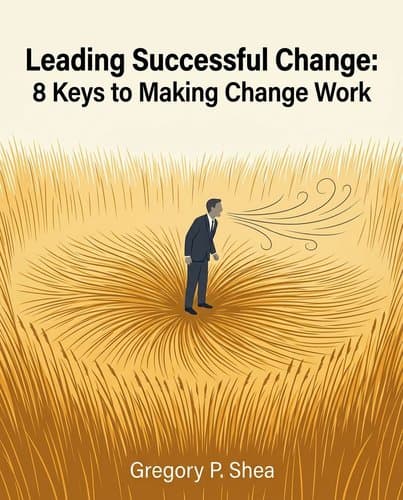
50730278_leading-successful-change
by Gregory P. Shea
Change doesn't fail because people resist it — it fails because the work environment quietly rewards the old behavior. Master the 8 levers that make new…
In Brief
Leading Successful Change: 8 Keys to Making Change Work (2020) argues that organizational change fails not because people resist it, but because the work environment contradicts it.
Key Ideas
Write scenes before launching change
Before launching any change initiative, write a 1–4 page 'scene' depicting a specific person in a specific role behaving in the desired new way — narrated in first person, with concrete props like mock dashboards or sample meeting agendas. If you can't write the scene, you don't yet know what you're asking people to do.
Change must engage multiple organizational levers
Test whether you can meaningfully move at least four of the 8 levers (Organization, Workplace Design, Task, People, Rewards, Measurement, Information Distribution, Decision Allocation). If you can't, don't proceed — the change will dissolve back into the existing environment.
Audit systems, not people, for failures
When individuals repeatedly fail to adopt a change, audit the system before the person. Per Deming: repeated individual failure rates signal a flawed system, not flawed individuals. Replacing people without redesigning the system produces people who quickly resemble the ones they replaced.
Ensure organizational systems send consistent signals
Check your levers for internal contradictions before launch: if financial rewards flow to individual performers while social recognition goes to best-performing teams, or if training builds skills the organization doesn't actually reward, your levers are canceling each other out and sending contradictory signals.
Radical alignment beats incremental hedged change
Big, radical change that aligns work systems is easier to sustain than incremental, hedged change. Incremental changes compete for scarce resources and emit contradictory environmental signals — employees default to the old way because it is less cognitively costly than reconciling the noise.
Redesign environment before sending change advocates
When you send a change disciple into an unredesigned environment, you are not setting them up to struggle — you are setting them up to be predictably marginalized, neutralized, and eliminated by the system they were supposed to change. Redesigning the environment first is an ethical obligation, not a management nicety.
Who Should Read This
Business operators, founders, and managers interested in Leadership and Management who want frameworks they can apply this week.
Leading Successful Change: 8 Keys to Making Change Work
By Gregory P. Shea & Cassie A. Solomon
10 min read
Why does it matter? Because the assumptions you have about why change fails are backwards.
You did everything right. You communicated the vision, modeled the behavior, got leadership aligned, built the case until people could recite it back to you. And for a few weeks, something seemed to shift. Then it didn't. The change didn't collapse — it just got quieter, then quieter still, until one day nobody brought it up anymore and the old way had reclaimed every inch of ground you thought you'd taken.
The usual postmortem blames the people. Not enough buy-in. Wrong culture. Resistant middle management. But there's another explanation, and it's more useful: while you were busy inspiring, the actual work environment — who decides what, what gets measured, what gets rewarded, what happens when someone tries something new — kept broadcasting the same signals it always had. People adapted, as they always do. Just not in the direction you wanted.
This book explains what was happening while you were giving speeches, and what to do about it instead.
The Execution Was a Disaster — But the Diagnosis Was Wrong
Tom Keating had a plan that made sense. As purchasing executive at Halloran, a specialty chemicals company with plants across four continents, he could see the problem: the supply chain was too fragmented to be cost-competitive. His solution was to outsource logistics entirely to a firm called Straight Arrow, which would build regional warehouses, centralize purchasing in China, and manage the forecasting. Keating and his Straight Arrow partners ran a four-continent presentation circuit — presenting the vision, demonstrating leadership commitment, answering questions. Everything the playbook called for.
Eighteen months later, the program was a wreck. Plant managers resented being charged for a program whose savings landed on someone else's scorecard. Local purchasing agents — people who'd spent years cultivating supplier relationships — refused to yield to consultants they found arrogant and overpriced. Keating couldn't move either side. Six months after the review, he was gone. His replacement failed too. After 36 months, Halloran canceled the contract, watched competitors pull ahead, and had nothing to show for it. The verdict from inside: the strategy was sound, but the program never had a chance.
The authors offer a sharper diagnosis: Keating never specified what behaviors he actually wanted from people on the ground. He built a strategy and ran a road show, but never answered the question of what a purchasing agent at a regional plant should do differently when they sat down to work on any given morning. Without that clarity, there was nothing to design toward. The environment around workers — their incentives, their authority, their relationships — stayed exactly as it was. And so people did exactly what their environment rewarded: they protected their turf.
That pattern shows up in the numbers. Between 50 and 75 percent of change initiatives fail — a figure that has held across 25 years of research. The standard explanation is familiar: leadership didn't communicate enough, employees resisted, someone wasn't inspired. That framing locates the failure in people while leaving the system that produced the failure untouched. The actual culprits are structural. Leaders describe desired change in language too vague to act on ("increase collaboration," "improve communication"), and then send people back into work environments that reward exactly the behaviors they're trying to eliminate. No amount of inspiration overcomes an environment pointing the other direction.
Leaders Are the Wind. The Work Environment Is the Climate.
That conclusion — modeling works only while the leader stands there — turns out to be a specific instance of something much older. Confucius described it two thousand years ago: the relationship between superiors and subordinates is like wind over grass. The grass bends while the wind blows. Then the wind moves on, and the grass straightens, exactly as it was before. Think of a leader as weather: powerful while present, irrelevant the moment the front passes through.
The metaphor is about rationality. Workers, managers, even executives are big-brained mammals doing exactly what you'd expect: scanning their environment and adapting to it. When the leader appears, people receive one set of signals. When the leader disappears, the actual work environment floods back in with its own signals: who gets promoted, what gets measured, which behaviors earn recognition and which go unnoticed. People revert because the environment is still pointing the same direction it always has, and adapting to it is the rational move.
The "lead dog" theory of change fails on exactly this logic: the idea that if a leader walks the talk, communicates relentlessly, and demonstrates commitment, the organization will follow. It helps, but only while the leader is standing there. Keating showed up, delivered the message, answered questions, then flew home. Plant managers looked around at their unchanged P&Ls, their still-intact supplier relationships, their day-to-day incentive structures. None of that had moved. So neither did they.
The operative question isn't "how motivated are the people?" It's "what does the environment around them reward?" Change the environment, and adaptation follows — not because people are passive, but precisely because they're active. That's the mechanism the authors want leaders to work with rather than against. Speeches are wind. The work environment is climate.
You Can't Redesign What You Can't Picture in Specific Detail
When exactly does redesigning the work environment become possible? The instinctive answer: once leadership has agreed on direction. That's wrong. You can't usefully redesign an environment until you can describe, in specific first-person detail, what a person in a specific role does differently when they open their laptop at 9am on a Monday.
Abstract goals don't give you enough to work with. "Increase collaboration" tells you nothing about what tools to build, what meetings to restructure, or who makes which decision. You can't engineer toward a slogan.
Göran Carstedt, who led IKEA's North American operations, understood this. When he gathered his top executives to share the strategic plan, no slides appeared. He narrated a scene instead: a mother getting two kids off to school — coffee, breakfast, chaos. Then he named the strategy in one sentence: make that family's life easier with convenient, affordable household items in an accessible location. Period. The scene did what a slide presentation never could — it gave every executive a living picture of the customer IKEA existed to serve, specific enough to make decisions against.
The authors call this a "scene": a one-to-four-page first-person narrative following one person through one role. Not "purchasing agents will collaborate more with sales," but: I am a purchasing manager, and when I get to work in the morning, I have an urgent message from my internal customer in sales: I need to decide right now whether to escalate to a category manager in China or call my local supplier directly. The scene includes props (a mock dashboard, a sample meeting agenda) not because the format matters, but because designing the props forces you to specify what tools must exist to produce the behavior you want.
Contradictions between scenes are features, not mistakes. If one scene shows a frontline manager making decisions independently while another shows a VP approving the same calls, that tension surfaces a design problem to resolve on paper, not six months into rollout.
One practical test: have you depicted the right 20 percent of the change (the scenes that, if realized, make you confident the remaining 80 percent will follow)? If yes, stop writing scenes and start redesigning the environment. If not, keep writing. The scene isn't an inspirational artifact. It's the specification.
The Lever Everyone Reaches for First Is the One Most Likely to Fail Alone
The People Lever is the most intuitive response to a failing change initiative — and pulling it alone almost guarantees the change will fail.
The authors identify eight pressure points in any work environment — organization structure, workspace design, task flow, people, rewards, measurement, information distribution, and decision rights — and the whole thesis rests on a single observation: leaders almost always pull one while leaving seven untouched. The one they reach for is the fourth. "We just don't have the right people on the bus" is one of the most reliable sentences in the vocabulary of organizational disappointment, and it points immediately to a familiar solution: swap out the individuals, upgrade the team, retrain the laggards.
People clearly matter. But treating People as the master lever leads somewhere specific. W. Edwards Deming, who spent his career redesigning production systems, made the point bluntly: when individual after individual fails in the same role, that failure rate is information about the system, not the people inside it. The Stanford psychologist Lee Ross named this the fundamental attribution error — our tendency to explain behavior by pointing at character rather than circumstance. Leaders who fire one regional manager, hire another, then watch the same dysfunction reproduce are living inside that error without knowing it.
New people enter an old environment and begin receiving the same cues as their predecessors: the same incentives, the same reporting lines, the same signals about what actually gets rewarded. They adapt — because adaptation is what intelligent people do — and within months they resemble the people they replaced. The system was designed to produce those behaviors. Google's own research found that team conditions predicted performance far better than individual talent. Even exceptional people regressed toward what the system rewarded. There is no right hire for the wrong environment.
The authors put a number on the minimum: four levers, moved far enough that people perceive the environment itself has changed. Their analysis of successful initiatives found that below four, the unchanged majority collectively pulls the changed minority back into place. And those levers have to point the same direction. A company that pays individual bonuses while publicly celebrating team performance generates what the authors call competing sound waves: levers pulling against each other until the signals cancel. The mismatch doesn't just slow change; it teaches employees that the stated values are decorative.
Below four levers, the environment wins.
How Portugal Turned the Heroin Capital of Europe Into Its Safest Country for $10 Per Person Per Year
In 2000, Portugal's prime minister convened a panel of scientists and doctors to confront a national emergency. Lisbon had earned a reputation as Europe's heroin capital — one percent of the entire population was addicted, and by 1999 the country had the highest rate of drug-related AIDS in the European Union. The panel, led by a physician named João Goulão, returned with a recommendation that shocked the international community: stop treating drug possession as a crime. Handle it as a public health problem instead. Critics forecast social collapse. Goulão explained the reasoning plainly: "We were facing a devastating situation, so we had nothing to lose."
The policy took effect in 2001. And this is where the Portuguese story stops being about drug policy and starts being about the environment-redesign framework.
Portugal didn't just pull one lever. Decriminalization alone would have amounted to changing only the Rewards structure. It redesigned the entire system. Courts were replaced by Dissuasion Commissions staffed with psychologists, social workers, and physicians who evaluated each case individually. Mobile vans staffed with doctors and nurses went into the streets to meet addicts where they lived, dispensing methadone, running blood tests, exchanging syringes, providing basic healthcare that most of these patients had never received before. The vans were intentionally low-threshold — you didn't have to be sober to get help. Psychosocial technicians without university degrees built relationships on the ground at a fraction of specialist cost. When former addicts were stabilized enough to re-enter society, work reintegration programs replaced the criminal records that would have kept them unemployable.
The entire scaffolding changed. Adjudication moved from criminal courts to health panels. Enforcement moved from police to street clinicians. Punishment became treatment and reintegration. The precise legal threshold for what counted as possession (rather than dealing) was codified in law, stripping discretionary power from individual officers and standardizing how cases were handled.
Eighteen years later, the numbers are difficult to argue with. The heroin-using population fell from roughly 100,000 to 25,000. Portugal now records the lowest drug-related death rate in Western Europe: one-tenth of Britain's, one-fiftieth of the United States'. HIV diagnoses tied to injection drug use dropped by more than 90 percent. The cost: under ten dollars per Portuguese citizen per year. Over the same period, the American War on Drugs spent the equivalent of more than ten thousand dollars per household.
This wasn't inspiration. It was architecture. For the 75,000 people who didn't end up addicted, the distinction was the difference between a life and a statistic.
Sending Change Disciples Into Unredesigned Environments Is a Moral Failure
Whether a change disciple succeeds or fails has almost nothing to do with how talented or motivated they are. It comes down to whether the environment they've been sent into has been redesigned to support the behaviors they're asking for.
Here's what actually happens when it hasn't. The disciple pushes for new behaviors — cross-unit collaboration, standardized processes. The local environment is still pointing the other direction: individual performance reviews, siloed budgets, a decision structure that rewards protecting your own territory. Employees aren't confused. They face a simple binary: do what the disciple wants and get punished by the system, or do what the system rewards and get punished by the disciple. They bet on the system. The disciple responds with more pressure. The employees tighten ranks. The sequence runs in one direction: the disciple gets sidelined, then ignored, then replaced. Nobody needs to conspire. The system just keeps rewarding what it has always rewarded.
When the change fails, the disciple absorbs the blame. The environment that generated the failure stays in place to do the same thing to whoever comes next.
Deploying change agents without redesigning the environment is, first, a fiduciary breach: you're spending organizational resources on an outcome the structure makes impossible, which is predictable waste. And second, it's immoral. You recruited a person, gave them a mandate, and sent them into conditions designed to reject them. That's not a management outcome. It's something you did to a human being.
Environment design, on this view, isn't a best practice. It's what you owe to anyone you ask to carry change.
What You Owe the People You Ask to Lead Change
What this frame gives you is a different place to point. The person who went back to their floor full of conviction and came back six months later defeated — you used to read that as a motivation problem, a fit problem, maybe a hiring mistake. It wasn't. They walked into an environment you never changed, and environments win. That's the whole argument.
The obligation that follows is uncomfortable. Every change initiative recruits believers to carry the new way into places where your authority doesn't reach. The moment you ask someone to do that, you've taken on something. This is both a fiduciary failure and a moral one: you gave them a mandate and sent them somewhere you never bothered to redesign. What happened to them afterward wasn't an outcome you failed to prevent. It was a choice you made before they ever walked in the door.
Notable Quotes
“We just don't have the right people on the bus”
“I'm playing with a B team.”
“If the only tool you have is a hammer, you tend to see every problem as a nail.”
Frequently Asked Questions
- What is "Leading Successful Change: 8 Keys to Making Change Work" about?
- The book argues that "organizational change fails not because people resist it, but because the work environment contradicts it." Drawing on eight concrete levers — from task design and decision allocation to rewards and measurement — it provides leaders with a systematic method for redesigning the environment so that new behaviors become the path of least resistance. The framework emphasizes that successful change requires aligning multiple work systems and organizational elements simultaneously to support new behaviors.
- Why do organizational change initiatives fail?
- "Organizational change fails not because people resist it, but because the work environment contradicts it." When individuals repeatedly fail to adopt change, the system should be audited before the person. Per Deming's principle, "repeated individual failure rates signal a flawed system, not flawed individuals." Replacing people without redesigning the system produces people who quickly resemble the ones they replaced. Leaders must redesign the work environment by meaningfully moving at least four of the eight levers to create conditions where new behaviors become inevitable.
- What are the 8 levers for successful change?
- The eight levers are Organization, Workplace Design, Task, People, Rewards, Measurement, Information Distribution, and Decision Allocation. Leaders must meaningfully move at least four of these levers; if they cannot, "the change will dissolve back into the existing environment." These levers must work together without internal contradictions. If "financial rewards flow to individual performers while social recognition goes to best-performing teams, or if training builds skills the organization doesn't actually reward, your levers are canceling each other out and sending contradictory signals."
- How should leaders start designing a change initiative?
- Before launching any change initiative, leaders should write a 1–4 page 'scene' depicting a specific person in a specific role behaving in the desired new way, "narrated in first person, with concrete props like mock dashboards or sample meeting agendas." As the book states: "If you can't write the scene, you don't yet know what you're asking people to do." This exercise forces leaders to clarify the actual, specific behaviors required and understand the environmental changes needed to make those behaviors sustainable.
Related Book Summaries



Read the full summary of 50730278_leading-successful-change on InShort