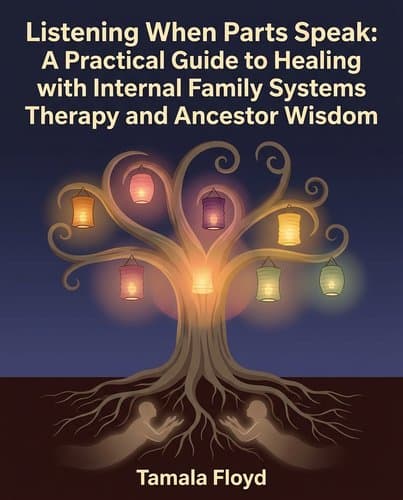
202324479_listening-when-parts-speak
by Tamala Floyd
The destructive patterns you can't stop—the rage, the numbness, the relentless overachieving—aren't character flaws but ancestral wounds waiting to be heard.
In Brief
The destructive patterns you can't stop—the rage, the numbness, the relentless overachieving—aren't character flaws but ancestral wounds waiting to be heard. Floyd combines Internal Family Systems therapy with indigenous healing wisdom to show you how to finally negotiate peace with the parts of yourself you've spent years fighting.
Key Ideas
Destructive patterns protect against deeper wounds
When you notice a destructive pattern — rage, numbness, compulsive achievement — ask 'what is this protecting me from?' before asking 'how do I stop it?' The behavior is the bodyguard, not the wound.
Parts decide if they move
Unblending is a request, not a command: place a hand on your heart, acknowledge the part's presence, and ask it to make a little room — the part decides whether to move.
Generational burdens passed down unsafely
If a painful pattern feels disproportionate to your own life history, consider that it may be a legacy burden — an emotional inheritance from a generation that had no safe place to put it down.
Parts freeze at their formation age
Parts freeze at the age they were formed. Showing a protector what has happened in your life since then — your adult competencies, your resources, your decades of survival — is often enough to change its role.
Release burdens through sensory pathways
Unburdening has a physical address: ask where in the body the burden lives, ask if the part is ready to release it, and offer a sensory vehicle — fire, water, air, earth — to carry it away.
Protectors need new purpose after healing
After an exile is healed, the protectors who guarded it need attention too. They have been working without rest and now face an identity crisis. Ask them what they would want to do if they no longer had to protect.
Practice the U-turn with triggers
Each new trigger is information, not regression. The 'U-turn' — pausing to notice which part has been activated before responding to the outside world — is the practice, not the exception.
Who Should Read This
Curious readers interested in Mental Health and Mindfulness and the science of how the mind actually works.
Listening When Parts Speak: A Practical Guide to Healing with Internal Family Systems Therapy and Ancestor Wisdom
By Tamala Floyd
12 min read
Why does it matter? Because the parts of you that cause the most damage are the ones working hardest to protect you.
You probably call it self-sabotage. The way you blow up relationships just before they get good, or grind yourself to exhaustion proving something to someone who stopped watching years ago, or go completely blank at the exact moment you most need to feel. The standard assumption is that these patterns are failures of character — proof that something in you is broken and needs to be fixed, toughened, or outgrown. Tamala Floyd has spent decades sitting across from people holding that assumption — and what she's found is almost the opposite. Your most destructive habits are not malfunctions. They are ingenious, loyal, exhausted protection systems, doing exactly what they were built to do, sometimes for wounds that arrived before you were born. The question isn't how to overpower them. It's how to finally understand what they've been trying to say.
Your Worst Behaviors Have a Bodyguard Logic You've Never Met
Romero is crying on the couch — the first time he has let himself feel anything about the boy he was, the one who was abused for three years starting at age eight — when something inside him slams a door. Not metaphorically. The shift is instant. His body stiffens, the tears stop, and a voice comes out of him that sounds like contempt wearing a face. When the therapist asks who showed up, the answer comes fast and mean: Byron. And Byron's first move is to call Romero a punk who deserved what happened to him.
This is the moment the book is built around. Byron speaks in slurs, positions Romero's pain as weakness, and uses the specific cruelty of the man who abused him. Every instinct says: this is the problem. This is the thing that has nearly destroyed Romero's marriage, the rage his partner gave him an ultimatum about. But Floyd doesn't treat Byron as a villain. She treats him as someone doing a job, and she asks him about it.
What she learns — across months of sessions, because Byron does not trust easily — is that he learned his cruelty from the abuse itself. His entire logic is this: if Romero had been harder, meaner, more impenetrable, the abuse never would have happened. So Byron became those things, internally, and applied them without mercy whenever Romero got soft. He wasn't trying to break Romero. He was trying to armor him. When Floyd asks Byron directly whether he realized his tactics had become the abuse — that he was, inside Romero, the thing he was protecting Romero from — Byron goes quiet. His voice drops. He says he didn't know.
That moment carries the whole argument of this book. Byron's behavior was not a character flaw or a moral failure or evidence of brokenness. It was an ingenious, desperate protection system built by a child who needed one and had nothing else to work with. The rage was the bodyguard. And like any bodyguard who's been on the job for decades, Byron had no idea the threat had changed.
Byron is what Floyd calls a firefighter: a part that shows up when pain is already burning and douses it by any means necessary. He didn't calculate collateral damage. He just stopped the feeling, using the only tool he'd ever been given. The insight that unlocks everything is this: the behavior and the intention are two completely different things. You can't get through the behavior by attacking it. The only door is through what it's protecting.
The Way to Disarm a Part Is Not to Fight It — It's to Get Curious About What It's Guarding
The move isn't suppression — it's curiosity. When a part floods your system, the instinct is to shut it down, push through, or white-knuckle your way back to function. But that's a war you can't win, because the part will just come back louder. What actually works is making space beside the reaction, close enough to witness it without being swallowed by it.
Floyd demonstrates this from inside a panic attack. She's in the shower when a part she'll later identify as Antsy takes over completely — chest pain like something hammering from the inside, heart rate spiraling toward nausea, vision going. She is certain she is dying. This is what IFS calls blending: the part occupies the seat of consciousness so fully that there's no daylight between you and it. You don't experience Antsy's fear. You are the fear, with no perspective available.
What breaks through isn't willpower. It's a voice — quieter than the panic, but persistent — that says something like: you don't have to do this alone. Make room for me. That's the Self speaking, and it doesn't command Antsy to stand down. It can't. This is the counterintuitive center of the whole framework: unblending has to be the part's choice. The Self can only invite. Floyd places her hand over her heart, repeating the offer of presence, and Antsy — feeling recognized rather than fought — gradually reduces the intensity. The chest pain eases a fraction. The heartbeat slows a degree. Not because it was suppressed, but because the part that was screaming for attention was finally getting it.
Curiosity is what gets you there. Not interrogation, not confrontation, but the kind of genuine wondering that asks: what are you actually guarding? When parts experience that question without judgment behind it, something in them can finally exhale. What Antsy needed, Floyd eventually learned, was safety and connection — needs she couldn't ask for directly, so she expressed them through a body convinced it was dying.
And sometimes, it turns out, the part carrying that need has been carrying it for much longer than one lifetime.
The Trauma Your Body Is Carrying May Not Have Started with You
What if the anxiety eating you alive was never yours to begin with?
Annamarie is a Black entrepreneur pulling in a high six-figure income, living well below her means, saving more than half of what she earns — and she cannot stop imagining homelessness. Every financial decision sends her into a spiral. She feels shame buying anything nice, even things she can comfortably afford. The fear has no relationship to her actual life. It belongs, Floyd eventually discovers, to a grandmother Annamarie never knew: a widowed woman left alone with five children, bill collectors at the door, multiple jobs, never enough. By the time Annamarie sat in Floyd's office, she was running on a survival program installed two generations back. The original memory was gone. The fear remained.
Floyd calls this a legacy burden — a pattern of shame, scarcity, or hypervigilance that travels down a family line long after the conditions that created it have changed. The person carrying it didn't earn it through their own wounds. They inherited it, the way they might inherit a cheekbone or a musical ear, except this inheritance has been quietly organizing their inner life for decades.
The Strong Black Woman is the most expansive version Floyd traces. The compulsion to be endlessly capable, emotionally sealed, never asking for help — Floyd locates its origin in the institution of slavery itself, and watches it travel forward through every generation that followed, reinforced by a society that kept demanding it. When her client Taren, a therapist running a group practice while working sixty-hour weeks and single-handedly managing her ailing mother's care, came in asking for better time management skills, Floyd recognized the pattern immediately. Every woman across Taren's family line was described the same way: the one who held everything together, because no one else would.
In an IFS session, Taren located the feeling of compulsive strength in her body — everywhere, she said, in every cell — and Floyd asked her what percentage of it didn't belong to her. Eighty-five percent, Taren answered, without hesitation. What followed was a visualization in which Taren gathered that inherited weight from her blood and bones and passed it backward through a circle of women — mother, grandmothers, aunts — each releasing what she had absorbed from the one before her. A presence Taren identified as a Well Ancestor collected what remained: something dark and thick, which she buried near water. A tree grew on the spot. What came back to Taren in exchange were gifts she hadn't known were hers — the knowledge of when to rest, the right to exist beyond what she produced.
Within two weeks, she had restructured her entire life. When you understand that the most exhausting parts of you may have been handed to you by someone else's survival story, the work of dismantling them stops being about willpower or discipline. It becomes something closer to returning a weight to its rightful origin — and finally setting it down.
Young Parts Don't Know the War Is Over
Imagine a soldier still fighting a war that ended thirty years ago — not from stubbornness, but because no one ever told him it was over. He's in the jungle, running the same defensive perimeter, responding to the same threat, because as far as his nervous system knows, the danger is still present. That's not pathology. That's loyalty to the last reliable information he had.
This is what a frozen part looks like from the inside.
Sherrie came to therapy for postpartum depression — depressed most days, unable to bond with her newborn, experiencing pelvic pain that no physician could explain. When Floyd began working with the part located in that pain — a reddish-orange fiery ball that Sherrie had to coax into tolerating her own attention — something emerged: the part thought Sherrie was incapable of caring for her baby because she was incapable of caring for herself. The logic felt juvenile, and it was. When Floyd had Sherrie ask the part directly how old it believed her to be, the answer came back: three or four years old.
Before that revelation could fully register, a firefighter intervened. The moment Sherrie got close to a memory involving childhood babysitters, her body staged a takeover — involuntary swaying, beads of sweat forming along her hairline, her stomach contracting in jerks. The firefighter, when Floyd spoke to it directly, was unequivocal: Sherrie can't handle what happened, and I will not let her get there. The nausea escalated until Sherrie was bolting for the bathroom, and Floyd sat in the office listening to the sounds of retching — not as a sign of failure, but as evidence of a part willing to cause genuine physical suffering to keep a decades-old secret. It had been doing this since she was a toddler. It had no information suggesting the situation had changed.
What shifts things in IFS isn't forcing access to the memory — it's showing the part what it missed. When protectors learn that the person they're guarding is now an adult who has navigated thirty years of life since the original wound, something in them recalibrates. The threat assessment updates. The part doesn't need to be defeated or bypassed. It needs to be brought current.
The part was never the problem. It was working from the only map it had.
Unburdening Is a Sensory Act, Not a Metaphor
She is nine years old, standing at the end of a Louisiana driveway with a handful of mail, when she notices her father's handwriting on an envelope. The return address stops her cold — not her family's home in Marina del Rey, but somewhere in Inglewood she's never heard of. She doesn't have words for what she knows in her gut. She runs inside crying, demanding answers, and gets lies instead. Her grandmother refuses to explain. Her parents, reached by phone, tell her to enjoy her summer. So young Floyd spends the rest of those weeks — the figs, the sewing, the pool trips all suddenly hollow — alone with something enormous she's not allowed to name. A part of her locks the pain away and builds a wall around it. She calls that wall Pricklee.
Decades later, doing her own IFS work, Floyd goes back for that nine-year-old. What she finds is a girl crouched in a corner, crying silently, back turned. Floyd sends compassion in her direction — not words yet, just the felt sense of another presence — until the girl eventually edges close enough for their legs to touch and asks, half-wondering: "What took you so long?"
What follows is a sequence of concrete events, not a conversation about insight. First, witnessing: the girl tells her story until she feels genuinely heard, not managed. Then a do-over — Floyd offers her the thing that didn't happen, the truth she deserved, the adults who should have helped her carry the weight of it. Only after that comes the release itself. Floyd asks where the girl feels her burdens in her body. The answer arrives as heat in the solar plexus. She asks how the girl wants to let them go. The answer: water. The beach.
Then they are at the water's edge, and Floyd asks her to draw the feelings out from that place of heat and release them into the surf. Unworthiness, abandonment. It takes several minutes to empty all of it. They watch the waves pull the weight outward, toward the horizon, until it disappears.
Healing in this framework is a sequence with a physical location, a direction, and an ending you can witness. Burdens leave the body from where they lived in it. The girl breathes in what she wants instead — intuition, the gift that was covered over by the lie — and says she feels calm and connected.
Pricklee, waiting on the other side of all this, gets the news that the one she's been guarding for thirty years is finally okay.
Her question lands simply, almost quietly: you can do that? And then: just like that, I can choose a different job?
Just like that, yes. That's what makes it real — not the insight that something was wrong, but the moment a part who has been exhausted for decades hears that the war is over, and believes it.
Healing Doesn't End with You — and It Didn't Start with You Either
Think of a river that's been running through the same channel for a hundred years. The water you touch today wasn't there yesterday, but the channel was carved by every flood and drought before it. Something like that is happening in your nervous system — the channel you run through was shaped by people who are gone.
What travels down through a lineage isn't just DNA or cheekbones or musical talent. It's also the survival logic that kept your people alive when alive was hard to stay. Floyd illustrates this with a moment from her own first ancestral healing session: she met a guide from her mother's mother's line, a tall woman dressed in yellows and oranges who moved in a way that looked like dancing. Floyd interpreted it as dancing and praying simultaneously. The guide corrected her gently — the dance is the prayer. They're not two things. Then the guide admitted something stranger: she had been reaching through time to steal Floyd's speaking voice during therapy sessions. Once a week, a lump would form in her throat mid-sentence until she had to gesture to clients that she couldn't continue. The guide wasn't being cruel. Her logic was that Floyd was meant to become a writing healer, and the only way to redirect her was to keep interrupting the path she was on. The theft was the message.
What that moment reveals is the framework's deepest claim — the relationship runs both directions. Burdens travel forward through generations, yes, but so does active guidance. The same lineage that passes down a bone-deep inability to be witnessed in struggle also holds the antidote. Floyd calls these ancestral heirlooms: gifts woven into the line alongside the wounds, obscured when the weight of survival is too heavy but available once that weight is released. A specific kind of knowing — the kind that reads a room before anyone speaks.
Healing stops being a solo excavation project — you, alone, digging through your own damage — and becomes something relational across time. What you release changes what gets passed forward. The channel shifts.
The Goal Is Not a Finished Self — It's a Self That Keeps Listening
The work doesn't end. That's not a warning — it's the whole point.
Twenty years. That's how long Floyd spent in therapy, workshops, retreats, and self-help programs trying to heal the wound her father's departure left in a nine-year-old girl. Some progress, maybe. Never resolution. Then nine IFS sessions — and the part that had been exiled for four decades finally got to speak. The rage that had stretched a father-daughter relationship from strained to eleven years of estrangement simply stopped running the show. Not because Floyd had finally understood enough, but because the part underneath the rage had finally been witnessed.
You'd be forgiven for reading that as a finish line. But when Floyd became the first Black woman promoted to solo lead trainer at a historically all-white IFS organization, a completely different set of parts woke up. A part that suspected she was a diversity checkbox. A part exhausted by the solitude of firsts. A striving part desperate to be worth the representation. The core wound of rejection had healed. New terrain, new parts, same ongoing project.
Floyd calls the practice the U-turn. When something external activates you, instead of directing all your energy at the situation or the person, you pause and look inward. Who got touched? What do they need? The external trigger is just the arrow. The part it points to is where the real information lives. Getting triggered isn't evidence that you failed to heal — it's a part that hasn't been heard yet, raising its hand in the only language it knows.
The goal, then, isn't a version of yourself that never gets activated. That would require becoming someone without a history, without wounds, without the parts that kept you functional when nothing else would. The goal is a Self that recognizes activation as an invitation rather than a defeat — one that can meet each new part with the same curiosity it brought to the last one. Still listening. Always still listening.
What 'Still Listening' Actually Means
The parts that still trouble you are not proof that something went wrong. They are the ones who haven't been asked yet. Every time you feel the chest tighten, the jaw lock, the familiar heat climbing your sternum — that's not a setback. That's a knock on the door. What this work asks of you is neither stamina nor expertise. It asks you to turn toward the knock instead of away from it, to stay curious long enough to find out who's there and what they've been carrying alone. You will keep getting triggered. New situations will wake new parts. That's not a sign you missed something — it's the shape of a life being lived. The most honest thing Floyd offers isn't a method for finally becoming whole. It's the suggestion that wholeness was never a destination. It's the listening itself, repeated, indefinitely, with a little more compassion each time.
Notable Quotes
“What the fuck are you crying for?”
“I’m Byron, who the fuck are you?”
“Good luck, his punk-ass can’t be helped,”
Frequently Asked Questions
- What is Listening When Parts Speak about?
- This book combines Internal Family Systems therapy with ancestral healing traditions to help readers understand the inner "parts" driving destructive patterns. Published in 2024 by Tamala Floyd, it teaches practical techniques — from unblending and unburdening to recognizing inherited trauma — so readers can transform protective behaviors into sources of clarity and find lasting emotional healing. The approach fundamentally shifts how we view destructive patterns by asking what protection they offer rather than immediately trying to eliminate them. This perspective recognizes that behaviors are bodyguards protecting deeper wounds, not the wounds themselves.
- How does unblending work in Internal Family Systems therapy?
- According to the book, "Unblending is a request, not a command: place a hand on your heart, acknowledge the part's presence, and ask it to make a little room — the part decides whether to move." This approach respects the agency of internal parts rather than forcing them aside. The technique recognizes that protective parts developed their behaviors for good reasons and deserve collaboration. By maintaining this gentle, non-coercive stance, readers honor the protective function these parts serve while allowing room for change. This methodology makes lasting transformation more sustainable because it works with, rather than against, the internal system.
- What are the key concepts in Listening When Parts Speak?
- The book teaches that when you notice a destructive pattern — rage, numbness, compulsive achievement — you should first ask 'what is this protecting me from?' rather than 'how do I stop it?' This reframes the problem: "The behavior is the bodyguard, not the wound." Parts tend to freeze at the age they were formed, so demonstrating what has happened since — your adult competencies, resources, and decades of survival — often shifts their role. If a painful pattern feels disproportionate to your own life history, it may be "a legacy burden — an emotional inheritance from a generation that had no safe place to put it down." The unburdening process uses sensory vehicles like fire, water, air, and earth.
- What does the book say about inherited trauma and ancestor wisdom?
- The book introduces the concept of legacy burdens — describing them as "an emotional inheritance from a generation that had no safe place to put it down." Tamala Floyd combines Internal Family Systems therapy with ancestral healing traditions to show how patterns that feel disproportionate to your own life often originate from generational trauma. This integration recognizes that healing addresses not just our individual experiences but also inherited emotional burdens we carry unknowingly. By acknowledging these ancestral wounds, readers can differentiate between their own protective patterns and those transmitted through family lineage. This perspective enables more precise, compassionate healing work that honors ancestral struggles while breaking inherited cycles.
Related Book Summaries

Read the full summary of 202324479_listening-when-parts-speak on InShort