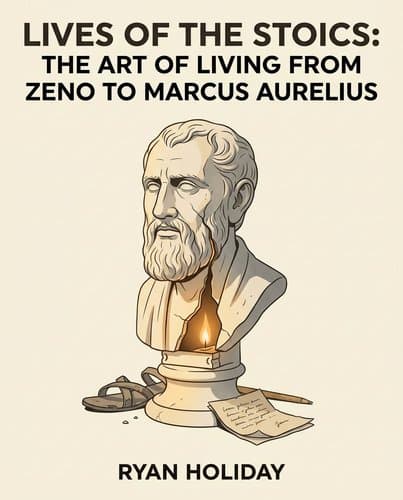
50484473_lives-of-the-stoics
by Ryan Holiday
From Zeno's shipwreck to Marcus Aurelius's throne, twenty-six real lives expose the gap between knowing Stoic philosophy and actually living it—when exile…
In Brief
From Zeno's shipwreck to Marcus Aurelius's throne, twenty-six real lives expose the gap between knowing Stoic philosophy and actually living it—when exile, corruption, or death arrives at your door and demands a choice between your stated values and your survival.
Key Ideas
Transform Adversity Into Character Development
When adversity arrives, ask what Zeno asked after his shipwreck: what is this for? The Stoic tradition was literally built from catastrophe — treat your disasters as the raw material of character, not as interruptions to building it.
Control Only What Is Yours
Separate what is genuinely in your control — your judgments, responses, and choices — from what isn't — outcomes, reputation, others' behavior. Then put your entire attention on the first category and practice genuine indifference toward the second. This isn't resignation; it's the only move that gives you actual power.
Test Your Principles Through Sacrifice
The test of any principle is what happens when following it costs something real. If you have never been tested — never had to choose between your stated values and your safety, comfort, or advancement — you don't yet know whether you have the philosophy or just the words.
Practice Philosophy, Don't Just Study It
Watch for the Cicero pattern in yourself: accumulating knowledge, admiring the right people, even prescribing good medicine to others — while consistently choosing fame, approval, and safety at the exact moment your principles demand you give them up. Knowledge of good philosophy doesn't protect against this. Only daily practice does.
Persist Through Pain, Resist Compromise
Epictetus's two-word summary of the Stoic life — 'persist and resist' (anechou and apechou) — covers most of what the philosophy actually asks: endure what cannot be changed without complaint; refuse to consent to what violates your character regardless of pressure. These two moves together resolve almost every hard situation.
Stoicism Is Practice, Not Destination
Stoicism is not a destination or a personality type you either have or don't. Marcus Aurelius was still recording his own sexual fantasies and murderous thoughts in a private journal at the height of his philosophical maturity. The measure is not immunity from these impulses — it's whether you're building the daily habit of not acting on them.
Who Should Read This
Thoughtful readers interested in Stoicism and Ethics willing to slow down and wrestle with ideas.
Lives of the Stoics: The Art of Living from Zeno to Marcus Aurelius
By Ryan Holiday & Stephen Hanselman
13 min read
Why does it matter? Because the Stoics who changed history were nothing like the word we use to describe them.
The word "stoic" has come to mean something close to numb — dry eyes at the funeral, a jaw that doesn't move when bad news arrives, quiet endurance. A personality type.
The people who invented this philosophy were none of that. They fought emperors, wept openly, lost fortunes and children and entire countries — and kept going. Some of the greatest were undone not by tyrants but by their own inability to live what they so brilliantly taught.
That gap — between knowing a philosophy and actually living it when something real is at stake — is what this book is about. Every life in this book tests where the doctrine held and where it cracked. The question it leaves you with isn't about ancient Rome. It's whether you can tell performed virtue from the real thing, in history, and eventually in yourself.
The Word 'Stoic' Is an Insult the Real Stoics Would Have Despised
The word "stoic" (lowercase) has become shorthand for someone who buries their feelings and endures suffering without flinching. The actual Stoics would have found this deeply insulting.
Take Chrysippus, the man ancient historians credited with saving Stoic philosophy from collapse. He wrote over 700 volumes, systematized every major argument the tradition had, defeated rival schools through decades of relentless intellectual combat, and turned down royal patronage so no one could tell him what to think. He kept one servant. He wrote 500 lines a day. By any measure, a man of iron discipline and serious purpose.
He died laughing at a donkey.
Chrysippus was sitting on his porch when a stray donkey wandered into his garden and began eating his figs. Something about the scene hit him as inexplicably hilarious. "Give the ass some wine to wash down the figs!" he called out to the owner, and then laughed with such unrestrained delight that he died. The man who gave Stoicism its logical backbone (whose face was later minted on coins in his homeland) was undone not by battle or exile or philosophical despair, but by pure joy at a garden pest and a perfectly timed joke.
The misconception goes deeper than temperament. The Stoics were also political militants. They formed the primary organized resistance to Julius Caesar and Nero. Cato the Younger read Plato's Phaedo through his last night at Utica, then killed himself rather than accept Caesar's pardon. Death mattered less to him than surrender. Caesar said afterward that Cato's death was the one thing he couldn't forgive: it denied him the chance to pardon the one man who refused his mercy. These were people who grieved, loved, raised children, and bled for their convictions.
What Stoicism actually gives you is a framework for living more fully — with courage and love and integrity — in a world that will constantly try to knock you flat. The discipline is real. So is the laughter.
The Philosophy Was Born From Catastrophe, Not From a Quiet Life
Late in the fourth century BC, a Phoenician merchant named Zeno set sail across the Mediterranean with a hold full of Tyrian purple dye — a substance so rare and labor-intensive that ancient sources put its value close to silver. Then he lost it all. Ship, cargo, fortune — gone in a single disaster, in a world without insurance or safety nets.
What happened next tells you where Stoicism actually came from. Zeno didn't rebuild his trading house. He wandered into an Athenian bookshop and sat while the bookseller read aloud from Xenophon's account of Socrates — specifically a passage about Heracles at a crossroads, choosing between a life of honest difficulty and an easy one built on pleasure. Zeno had once consulted an oracle about how to live well. The oracle's advice: talk to the dead. There in that bookshop, listening to a philosopher who had died a century before, he realized what that meant. When the reading ended, he asked the bookseller where he could find someone like Socrates. The bookseller pointed to Crates, who happened to be passing by.
Stoicism's founding story is a catastrophe that ended in a bookshop.
The first lesson Crates gave Zeno tells you what kind of school this was going to be. Sensing his new student was too worried about what others thought of him, Crates assigned a humiliating task: carry a large clay pot of lentil soup through the crowded city. Zeno, mortified, took back streets to avoid being seen. Crates tracked him down anyway and cracked the pot open with his staff, soaking Zeno in soup. Then he laughed: "Why run away, my little Phoenician? Nothing terrible has befallen you."
That is the first recorded Stoic lesson — a teacher smashing a clay pot on a public street to make a point about shame. The shipwreck had brought Zeno to philosophy. The broken pot was philosophy's opening move.
Cleanthes, who would eventually lead the school after Zeno's death, arrived in Athens as a broke ex-boxer with barely a week's wages to his name. He spent years hauling water to gardens at night and grinding grain before dawn to fund his studies. Zeno once joked that Cleanthes was so disciplined with his earnings he could have maintained a second Cleanthes on what remained. The founder lost his ship. His successor was a water-carrier. Men who had already lost almost everything knew something that couldn't be reasoned into you: that the worst arrives, and you survive it. This is what Stoicism was made of. A tradition built on ruin would eventually produce a philosophy about what can never be taken away.
Freedom Is the One Thing No Tyrant Can Actually Take From You
What does it actually mean to be free? Most of us assume the answer requires conditions: rights, safety, at minimum a body no one can touch. Epictetus would like a word.
Born around 55 AD in what is now Turkey, he arrived in Rome with his freedom already forfeited. His name, in Greek, means "acquired one" — property before he had a name. He was purchased by Epaphroditus, a man who had himself been freed from slavery and gone on to become Nero's secretary, and nobody in that circle of supposed Stoic wisdom seemed troubled by the arrangement. A freed slave owning a slave. Epictetus didn't have time for the irony. He was too busy surviving it.
The scene that defined his philosophy happened early. His master began twisting Epictetus's leg. For punishment, for dominance; history doesn't say why. Epictetus warned him, calmly, that he was going to break it. The master kept twisting. The bone snapped. Epictetus looked at him without tears and said, "Didn't I warn you?" He walked with a limp for the rest of his life.
What followed, over years of thought, was his core insight: the leg was never really his to begin with. Neither was his labor, his reputation, or anyone else's opinion of him. These things belonged to the world, to masters and emperors and accidents of birth, and placing your sense of self in them guaranteed suffering. What remained entirely his was how he chose to respond. The calmness during the leg-breaking wasn't composure under pressure. It was the natural result of having already placed the leg outside himself: breakable, losable, not truly his. When the bone snapped, there was nothing left to grieve. Ta eph' hemin, ta ouk eph' hemin — what is up to us, what is not. The body goes in the second column. So does everything else you can lose.
Wealthy students who traveled hundreds of miles to study under him left unsettled. Here was a man they would have dismissed as a slave in Rome, physically crippled and legally powerless, and he was more free than any of them. They were enslaved to ambition and reputation, their sense of self contingent on men whose approval was in turn contingent on yet other men. Epictetus had cut that chain at the root.
In 1965, an American pilot named James Stockdale was shot down over Vietnam. Knowing capture was seconds away, he told himself as he parachuted: "I am leaving the world of technology and entering the world of Epictetus." He survived years of imprisonment by treating his captors' power over his body as irrelevant to what actually mattered. Two thousand years after a Roman slave watched his master break his leg, the philosophy held.
The harder question, one Epictetus returned to constantly, is what you're supposed to do with that inner freedom once you have it. Enduring is one thing. Choosing how to act when something is actually demanded of you is another.
The Real Test Isn't What You Believe — It's What You Do When Your Beliefs Become Expensive
Every biography in this book is a stress test. The Stoics who said the right things in safe circumstances are barely remembered; the ones history kept are the ones whose philosophy got tested against something real, and held.
The test always involves a price.
Cato the Younger spent decades making it clear what he believed. He wore the same plain dark robe while his senatorial colleagues dressed in expensive purple. He walked barefoot through Rome's streets, turned down armed guards, and took nothing from the positions that routinely made lesser men rich. He filibustered Caesar's allies for years. He refused to bend. Fine — it costs relatively little to be principled when the principled position is also the safe one.
Then Caesar crossed the Rubicon with his legions, civil war swallowed the Republic, and Pompey's forces collapsed at Pharsalus in 48 BC. Cato led what remained of his army on a brutal thirty-day march across the Libyan desert to Utica. He organized the escape of every senator and officer who'd fought alongside him, told them to go to Caesar and ask for mercy, and asked only one thing in return: don't pray for me, don't beg on my behalf. That kind of pleading belonged to people who had lost. He hadn't.
The night before his death, he hosted a dinner. Wine came out. Dice were thrown for the first cuts. Someone passed the plates. Philosophy came up, as it always did at his table, and the question was whether only good men are truly free, or whether bad men, Caesar included, were slaves regardless of their power. Not an abstract question, in context.
When the meal ended, Cato said his goodnights, hugged his son and friends, and went to his room. He picked up the Phaedo and read it through. Then he called for his sword. His friends had hidden it; they knew what he was planning and hoped that what couldn't be found couldn't be used. When they brought it back, Cato ran his finger along the edge to test it, said "Now I am my own master," and sat back down to read it again from the beginning.
He thrust the sword in sometime before dawn. The wound wasn't quite fatal. Friends rushed in and had a doctor sew it shut while Cato drifted in and out of consciousness. When he came to, he tore it open himself. He died at forty-nine.
That's what it looks like when a philosophy holds. Not the years of principled speeches, not the barefoot walks through the Forum, not even the willingness to march an army across a desert. The test is the small room, in the dark, with everything lost — and finding out whether what you believed was actually what you were, or just what you said when the stakes were low enough to say it safely.
Cato knew the difference. He spent his whole life making sure there wasn't one.
Cicero Knew More About Stoicism Than Almost Anyone. He Failed Every Test.
When Brutus and Cassius gathered their co-conspirators to plan the assassination of Julius Caesar, someone raised an obvious name: Cicero. He was Rome's most celebrated orator, a man who had spent decades with Stoic philosophers, preserved entire schools of Greek thought in Latin for posterity, and declared in writing that the Stoics were "the only true philosophers." A Stoic sage had lived in his home for years, eventually dying there and leaving him his estate. He had studied directly under Posidonius, one of the era's most influential Stoic teachers.
Brutus cut off the discussion. Don't even ask him, he said. He'll never follow anything another man begins.
So the conspirators didn't. And when the blade landed and Caesar fell, Cicero (who had been nowhere near the room) immediately began telling people that Brutus had called his name at the moment of the killing, wanting him to share in the glory.
Knowing a philosophy and living it are entirely different skills, and one offers almost no guarantee of the other. Cicero had arguably done more than anyone alive to understand Stoic thought. The problem wasn't ignorance. It was that he had never done the other work — the unglamorous internal work of building the character the philosophy required. That kind of integrity only comes from choosing principle over reputation in small moments, across years. Cicero spent those years building his reputation instead. By the time Caesar crossed the Rubicon and the Republic genuinely hung in the balance, Cicero had exhausted his gifts on smaller crises and couldn't summon an audience willing to listen. The work hadn't been done. There was just the man.
Seneca went further in both directions. He understood the philosophy deeply — the letters he wrote in the last three years of his life remain among the most honest accounts of what it takes to live well, and people still read them. But he also accumulated, in service to the emperor Nero, a fortune of roughly three hundred million sesterces, five hundred matching citrus-wood tables with ivory legs kept just for entertaining, and a loan portfolio of forty million sesterces he pressed on Rome's British colonies at high interest rates, a loan whose brutal collection sparked a rebellion requiring Roman legions to suppress. He had written that a philosopher's wealth should never be stained by another person's harm. The stain was visible.
Both genuinely loved the philosophy. The failure was structural: the assumption that understanding the ideas was the same as doing the work to embody them. Cato, who wrote less philosophy than either of them and made fewer speeches, had done that work every day for decades. When his moment came, he didn't flinch.
Even the Greatest Stoics Failed. The Measure Was Never Perfection.
What was Marcus Aurelius actually writing when he sat alone in his tent on the Germanic frontier, scratching notes on wax tablets he never intended anyone to read?
Not pronouncements. Not philosophy polished for an audience. In one entry, he wrote something like: "Not some way to sleep with her — but a way to stop wanting to. Not some way to get rid of him — but a way to stop trying." The most powerful man on earth, recording his own lust and resentment as raw material to work with, not evidence of failure. The Meditations weren't a record of virtue achieved; they were the practice itself, the daily discipline of catching the thought before it became the act. He lusted. He feared. He fantasized about rivals disappearing. He wrote it down, then tried again the next morning.
The Stoic tradition looks like this from inside, which is why the failure of Junius Rusticus matters. Rusticus was the tutor who formed Marcus — the man who handed him his first copy of Epictetus's lectures, whom Marcus credits in the Meditations with teaching him to read carefully and reconcile readily with those who had wronged him. He was also the grandson of a man executed by an emperor for principled dissent. That family had been made by refusing to bend.
Then in 165 AD, as Rome's urban prefect — essentially its mayor, with full command of its police and courts — Rusticus sat across from a Christian philosopher named Justin Martyr, who refused to perform the ritual sacrifices Roman law required. Justin chose to die rather than perform a meaningless gesture. It was the same stand Cato had taken before him, the same stand Rusticus's own grandfather had made. And Rusticus, swallowed by the authority of his office, ordered Justin scourged and beheaded. He had been trained to recognize exactly what Justin was doing: the principled refusal, the calm acceptance of consequence, the choice his own tradition had always called courage. He recognized it. He ordered the execution anyway.
Seneca enabled a tyrant for years. Rusticus ordered a man killed for the same refusal his own tradition celebrated as courage. Both had absorbed the philosophy. What they lacked, Epictetus would have recognized immediately: "Is it possible to be free from error? Not by any means, but it is possible to be a person stretching to avoid error." Stretching — not arrived. The measure was never where you stood but which direction you were facing.
The One Stoic Who Failed at the End Was the One Who Never Fully Committed
Here's the quiet thing this book leaves you with: almost everyone in it died well. Zeno on his own terms. Cato tearing his own wound open rather than wait. Thrasea Paetus, the senator who chose a Stoic's death under Nero rather than bend, bleeding out on a couch, still teaching. Even Seneca — who had sold his principles for decades to stay in Nero's orbit — made his last hours into philosophy. Then there's Cicero, who knew more Stoic doctrine than any of them and died running from his executioners. Not because he was weak in some simple sense. Because he had spent a lifetime choosing applause over the quiet, daily work that builds a self capable of holding under pressure. The knowledge was there. The structure wasn't. The question this book actually asks isn't whether you've read the right things. It's what you are building, right now, in the ordinary moments before the test arrives.
Notable Quotes
“It's not good to have too many Caesars,”
“If he does that, sir, he will be the greatest man in the world”
“took all the imperial ornaments to the Forum and sold them for gold. When the barbarian uprising had been put down, he returned the purchase price to those who voluntarily brought back the imperial possessions, but used no compulsion in the case of those who were unwilling to do so.”
Frequently Asked Questions
- What are the key takeaways from Lives of the Stoics?
- Lives of the Stoics profiles figures who built and practiced Stoic philosophy, extracting concrete lessons on virtue and self-discipline. Key takeaways include treating disasters as character-building material; separating what's in your control (judgments, responses) from what isn't (outcomes, reputation); recognizing that philosophy is only proven through real testing and sacrifice; watching for the pattern of knowledge without action; and practicing Epictetus's 'persist and resist'—enduring unchangeable circumstances without complaint while refusing to violate your character regardless of pressure. The book emphasizes daily practice over theoretical knowledge.
- How should you respond to adversity according to Lives of the Stoics?
- According to Lives of the Stoics, adversity should be treated as raw material for character development. The book uses Zeno's question after his shipwreck—'what is this for?'—as foundational, since Stoicism itself was literally built from catastrophe. Rather than viewing disasters as purely negative, treat them as opportunities for growth. The philosophy involves understanding the dichotomy of control: focus entirely on what is genuinely within your control (your judgments and responses) while practicing indifference toward what isn't (outcomes and reputation). "This isn't resignation; it's the only move that gives you actual power." By reframing adversity this way, you transform obstacles into the raw material of character.
- How do you know if you truly practice Stoicism according to Lives of the Stoics?
- The book argues that the real test of any principle is what happens when following it costs something real. If you have never been tested—never had to choose between your stated values and your safety, comfort, or advancement—you don't yet know whether you have the philosophy or just the words. The book profiles historical figures like Cicero to illustrate this gap: accumulating knowledge, admiring the right people, even prescribing good medicine to others—while consistently choosing fame, approval, and safety the moment principles demand sacrifice. Knowledge alone doesn't protect against this pattern; only daily practice does.
- Does Stoicism mean being free from desire and emotion?
- Lives of the Stoics challenges a common misconception about Stoicism being freedom from impulses. The book reveals that Stoicism is not a destination or personality type you either have or don't. Marcus Aurelius, the greatest Stoic emperor, was still recording his own sexual fantasies and murderous thoughts in a private journal at the height of his philosophical maturity. "The measure is not immunity from these impulses — it's whether you're building the daily habit of not acting on them." Stoicism is fundamentally about practice and choice, not eliminating desire or emotion. It's about developing daily discipline to manage impulses rather than pretending they don't exist.
Related Book Summaries
Read the full summary of 50484473_lives-of-the-stoics on InShort