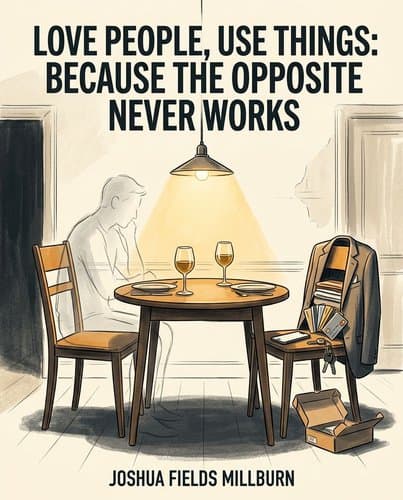
53317419_love-people-use-things
by Joshua Fields Millburn
Minimalism isn't about owning less—it's about stopping the habit of using things, debt, and busyness as substitutes for the harder, richer work of loving…
In Brief
Minimalism isn't about owning less—it's about stopping the habit of using things, debt, and busyness as substitutes for the harder, richer work of loving people honestly. Clear your clutter, then confront the emotional and relational voids that clutter was quietly filling.
Key Ideas
Ditch what you can cheaply replace
Apply the 20/20 Rule before keeping any 'just in case' item: if you could replace it for under $20 in under 20 minutes, you almost certainly don't need to store it.
Wait before spending more money
Before any purchase over $30, wait 30 hours. Over $100, wait 30 days. The 30/30 Rule removes the moment of engineered impulse from the decision.
Test every purchase against six questions
Before keeping or buying anything, ask six questions: Who is this actually for? Does it add real value? Can I genuinely afford it? Is this the best use of this money? What is the full cost — storage, maintenance, attention? Would the best version of me make this choice?
Separate real values from imaginary ones
Map your values into four tiers: Foundational (health, relationships, creativity, growth, contribution), Structural (personal principles like autonomy or honesty), Surface (interests that shift), and Imaginary (things that feel like values but are obstacles — busyness, public opinion, social media).
Move from tolerance toward appreciation
Use the TARA framework to navigate difficult relationships: Tolerate → Accept → Respect → Appreciate. The goal is to reach Appreciate; stop at Tolerate only when core values are in direct conflict.
Technology must support deep values
Before reintroducing any optional technology after a break, apply Cal Newport's binary test: Does this directly support something I deeply value? If the answer requires hedging, the answer is no.
Choose relationships instead of inheriting them
Treat your close relationships as active choices, not inherited obligations. The diagnostic: if you met this person for the first time today, would you choose them?
Connection heals isolation, not productivity
Johann Hari's finding applies beyond addiction: the opposite of disconnection is not productivity or self-sufficiency — it is connection. Isolation is not a neutral state; it is a measurable risk factor with measurable remedies.
Diet, exercise, sleep, sun as foundation
Use Dr. Thomas Wood's four free medicines — diet, exercise, sleep, sunlight — as the minimum infrastructure before expecting any other change to stick. You cannot give what you do not possess.
True love keeps no score
Real love does not keep score. If you are measuring contributions and tracking debts, you are in a transaction, not a relationship. The tennis definition — love as zero — is the operating instruction.
Who Should Read This
People working on personal growth in Self-Improvement and Relationships, especially those tired of generic motivational advice.
Love People, Use Things: Because the Opposite Never Works
By Joshua Fields Millburn & Ryan Nicodemus
10 min read
Why does it matter? Because the minimalism you've heard about is only the entry point.
The closet is fine. The closet is actually the easy part. What's harder is what you've been doing every time you opened it — reaching for another purchase, another subscription, another obligation, another relationship that costs nothing and asks nothing — as a quiet way to avoid the question underneath. The question isn't "do I have too much stuff?" It's "what have I been trading it for?"
The night his mother's corpse was still warm, Joshua Fields Millburn was alone in her apartment with a nurse who didn't know what to do with herself either. A few weeks earlier, his marriage had ended. A few weeks before that, he had searched for how to tie a noose. He was thirty years old, making six figures, with a Queen Anne bed, a two-car garage, and no idea what any of it was for.
The same mechanism that turns a storage unit into a pacifier also turns debt into identity, a smartphone into a nervous habit, and the people closest to you into furniture. The framework Millburn and his co-author Ryan Nicodegas built from it starts with the junk drawer and ends somewhere far more uncomfortable: the honest inventory of what you've been using people for, and what you've been using things instead of.
The Clutter in Your Closet Is a Symptom, Not the Disease
Jennifer Kirkendoll spent Christmas morning 2016 watching her kids lose interest in their new toys before noon. Four hours after the unwrapping, half the gifts were abandoned. The present her husband had charged to their shared credit card was back in its box by lunch, joining a shelf of things they owned but never used. That evening, a documentary about minimalism on Netflix made the contrast impossible to ignore.
What followed looks like a lifestyle-magazine resolution: she and Jason rented a dumpster, spent New Year's weekend throwing out everything they hadn't touched in a year — clothes, electronics, a Ping-Pong table — and felt the house open up around them. Less noise. More laughter. By mid-January, they could see the floor of their garage for the first time in years.
Then the dumpster caught fire. While they were at work, something ignited it, and by the time they got home, the house was gone. The kids had been at school. The pets escaped. Everything else — including what they'd set aside to keep — turned to ash.
What Jennifer felt standing in that wreckage moves through three registers: terrifying, then depressing, then — almost involuntarily — freeing. Not because losing everything is good. But because they'd spent a month practicing letting go, and in that practice had found something the stuff had been hiding: their relationship was getting better, their priorities were clearer, and none of it had required a single object. The fire didn't create their freedom. It removed the last argument against it.
That is the whole argument of this book. Minimalism isn't a campaign against possessions. The stuff is the most visible layer of something much deeper. You can have everything you were supposed to want and still feel like something is missing, because the problem was never inventory. It was the way accumulation crowded out time, attention, and genuine connection — the things that don't fit in a storage unit. Clearing the clutter is where you start. What you find underneath is the actual work.
The Truth You Keep in Storage Is the Most Expensive Thing You Own
Under his dying mother's Queen Anne bed, Joshua Millburn finds four printer-paper boxes sealed with excessive tape. He's in her St. Petersburg apartment dealing with sixty-five years of accumulated life: fourteen winter coats despite living a half-mile from the beach, hundreds of plates, a linen closet stuffed like a hotel's. He's already called U-Haul for their largest truck. Now he pulls out boxes numbered 1, 2, 3, 4 in thick black marker.
Inside: his elementary school artwork, homework, and report cards. Grades one through four. His mother had been holding on to a piece of him — or so she believed.
The boxes hadn't been opened in more than twenty years.
That gap stops him cold. His mother kept these things because she wanted to preserve something. But preservation requires revisiting. You can't access a memory sealed under a bed. The boxes weren't storing his childhood; they were storing the feeling that his childhood was safe somewhere — the comfort of having "kept" him without the harder work of staying connected to him.
The boxes and the silences share the same logic. What we avoid saying (about a marriage that isn't working, about what we actually want, about what we've done) gets stored the same way. We tell ourselves we're preserving something by not disrupting it. We're actually avoiding the cost of honesty while paying a different one: the relationship drifts, the resentment builds, the person across from us speaks to a version of us that hasn't existed for years. His mother found her off-ramp in alcohol; he found his in achievement, possessions, and a marriage he couldn't admit wasn't working.
Joshua cancels the U-Haul and the storage locker. He spends twelve days selling and donating almost everything. He returns to Ohio with photographs, a painting, a handful of items that actually mattered. The lesson he carries back: when you finally stop storing something, you find out whether you actually had it.
Your Body Keeps the Ledger You Have Been Ignoring
In September 2018, Joshua Millburn is standing on a stage in São Paulo at what he'll later describe as the healthiest point of his adult life. The talk goes well. Afterward, he eats the local food, drinks the tap water, and boards a plane home.
What follows doesn't dissipate in a week the way traveler's sickness is supposed to. Instead it accumulates: intestinal pain, rashes, brain fog, lethargy. Then something else arrives, not quite sadness, more like a general draining of signal. He stops being productive. Everyday tasks start requiring effort he doesn't have. By January 2019, he wakes up each morning and wishes he hadn't.
At some point he searches YouTube for tutorials on tying a noose. He doesn't follow through. But the fact that he's looking is its own kind of answer.
When doctors get a small camera into his small bowel, they find over a hundred ulcers. The beneficial bacteria that belong there — bifidobacterium, akkermansia — undetectable. In their place: an overgrowth of opportunistic strains from water he drank four months earlier. But the Brazil trip was a catalyst, not a cause. He'd spent a decade on daily antibiotics (prescribed for scalp acne that turned out to be a soy allergy) and years before that eating poorly, sleeping badly, running on corporate stress. The gut was already compromised. São Paulo just made it legible.
That's what the PillCam actually showed him. Not a travel injury. A ledger.
The body doesn't register unresolved choices immediately. It absorbs them. Every substitution he'd made — convenience over nutrition, productivity over sleep, maintenance over honesty — got recorded somewhere. Eventually the account comes due. It lands in the gut, where the connection to mood and cognition runs so deep that when the gut collapses, so does the capacity to feel like doing anything at all.
He'd been searching YouTube for noose tutorials because his gut was full of ulcers and empty of the bacteria that help regulate mood. That's what the ledger was tracking.
Your Desires Were Manufactured — and So Was Your Scroll Reflex
Your desires were not born — they were built. Both the products you want and the content you can't stop consuming were engineered specifically to prevent the quiet in which you might discover what you actually value.
Edward Bernays, Freud's nephew and the architect of modern advertising, made the foundational shift in the 1920s. Before him, advertising connected producers to genuine need. Bernays realized that exploiting unconscious drives was far more effective than appealing to reason. He called these drives the "true motivators of human action," and what followed was a century of industry learning to manufacture the need rather than meet it. The Viagra story makes the mechanism legible: a drug failed clinical trials for hypertension, an ad agency coined the term "erectile dysfunction," and a $3 billion-per-year market materialized from a side effect. The product didn't find its need. The need was built around the product.
The attention economy runs the same logic Bernays pioneered, updated for the screen. The goal is to capture enough of your attention to sell you to advertisers, which requires preventing you from ever deciding to stop. Notifications, infinite scroll, algorithmically sorted feeds: all calibrated to fire reward circuits faster than reflection can catch up. When digital minimalism writer Cal Newport asked 1,600 people to take a month-long break from optional technologies (social media, YouTube, even text messaging), those who tried to cut back gradually failed. The platforms are designed to overwhelm gradual reduction. What worked instead was a full stop, followed by a single reintroduction question: does this directly support something I deeply value? Most apps fail it immediately.
What both consume is the one thing that would expose them: stillness. When Joshua locked his phone in a drawer for two months, silence arrived — and with it, as he described it, the sound of his own thoughts at full volume. He discovered that response-time expectations were socially imposed, not necessary. That the interstitial moments (checkout lines, airports, waiting rooms) had been colonized by the very device he'd assumed was keeping him connected. That silence is where genuine values live. It is also precisely what both industries are built to keep you from finding.
Pleasure, Happiness, Contentment, and Joy Are Not the Same Currency
Imagine measuring wealth only in nickels, not because they're worthless, but because you never learned that quarters, dollars, and hundreds existed. You optimize furiously for nickels, then wonder why you still feel broke.
That's what most people do with well-being. The word "happiness" gets used the way "money" does in that scenario: as if it's the only denomination available.
He draws four lines most people blur into one. Pleasure is the birthday cake: a dopamine burst from processed sugar that your taste buds register as good news and your body registers as nothing. The pleasure is real, but it's empty, and the moment it fades you reach for another slice, then another, until you're stuffed on something that never actually fed you. Happiness is a healthy meal, beneficial and satisfying, but still gone by morning. Both are fleeting, which is why neither makes a stable goal. Happiness is a side effect of a well-lived life, not the destination.
Contentment is the consistent diet that neither birthday cake nor any single healthy meal can produce. It accumulates from repeated good decisions over months and years, the nutritional equivalent of compound interest. Joy, the highest level, happens only when other people are involved. You can eat well alone; you can't experience joy that way. Joy also holds something the lower levels can't: it makes room for grief, frustration, and loss. Pleasure collapses the moment the sensation ends. It can only move toward more or away from pain. Joy is pointed outward, toward someone else, so it doesn't depend on how you feel right now. You can be in grief and still be in it.
The food metaphor isn't decorative. It does diagnostic work. When you feel vaguely dissatisfied despite having everything you planned to have — the promotion, the house, the income — it gives you a vocabulary for why. You've been eating well by the meal but not by the lifestyle. Or you've been eating alone.
The same confusion runs through his relationship with money. Debt works like birthday cake financing: it delivers the dopamine of acquisition immediately and defers the cost until later, when you're already tired of what you bought. Millburn accumulated fourteen maxed-out credit cards while earning nearly $200,000 a year — not because he was ignorant of math, but because each purchase felt like meeting a need. It was meeting a need, just at the pleasure level, when what he was actually hungry for was operating several tiers higher. He built a rule for the possession side of this: have you used it in the last 90 days, will you in the next 90? If not, it doesn't belong to the life you're living. It belongs to the one you imagined when you bought it.
Love Is a Score of Zero
Love is a practice. That sounds like a greeting-card line until you sit with what it implies: if love is something you cultivate rather than find, the whole project of relationships shifts from searching to becoming.
The title argument arrives as a dictionary footnote. The fourth entry in the New Oxford American Dictionary defines love as a tennis term: a score of zero. In a match, that's the opening number. As a metaphor, it's the whole argument. Real love doesn't tally contributions or track who gave more. No ledger, no measurement of whether you're ahead or behind. Both people give what they can; the split is never exactly even; that's not a problem — it's the point.
Zero also implies something else: it's the starting position before the game begins. You have to show up and play.
Ryan Nicodegas, Millburn's co-author and the other half of The Minimalists, nearly didn't. His overdose is the book's sharpest dramatic rupture, and it's what gives this section its weight. When someone you've built something with almost dies, the abstract project of clearing your life stops being abstract. The question of whether you've actually shown up for the people in front of you becomes immediate.
Erwin McManus, a philosopher and writer whose conversation with Millburn runs through the book's final chapters, makes the inversion explicit. McManus survived stage 4 colon cancer at sixty, and the proximity to death reorganized his priorities. For most of his life he had looked for relationships that elevated him: people who could make his life better, more interesting, more stimulating. Close to the end and taking stock, he found the ledger ran the other way. What mattered wasn't experiences he wished he'd had but people he wished he'd invested in more. His reframe is simple: stop asking how to find the right person and start asking how to become the kind of person who is genuinely useful to others. Useful means you can sit with someone's problem without steering the conversation back to yourself, or give without keeping score. You get there by doing the prior work: examining your relationship with truth, with money, with your body, with your values. Arrive at other people having done none of that and you're still running the search, wondering why nobody feels close enough.
Millburn closes with an itemized list of his own failures: jackets he keeps buying, smartphone habits that stifle his creativity, a brother he doesn't see often enough. By his own account, he's not a finished product. The aspiration is his fifty-year-old self, himself but better. A trajectory, not an arrival.
That's what makes the project feel honest rather than evangelical. Minimalism doesn't solve your problems. It gives you better ones — problems that come from living closer to what you actually value. When the clutter is gone and the internal work is underway, what remains is the only thing that ever mattered: the people in front of you, and the question of whether you've become someone worth showing up for.
The Aspiration Is Trajectory, Not Arrival
Joshua still buys the jacket. He still reaches for his phone when the room gets quiet. He still hasn't called his brother as often as he means to. He lists these things not as confessions requiring absolution, but as proof that the project is ongoing — and that ongoing is enough. The book was never asking you to become someone unrecognizable. It was asking you to notice the trade each time you make it: what you are exchanging, and for what. That noticing, compounded across years, is what changes the trajectory. Not a clean break. Not a dumpster in the driveway. Just a slight turn, made today, that puts you five degrees off where you were heading. You don't need to have arrived. You only need to have started moving.
Notable Quotes
“was the Matthew 22:39 scripture Mom muttered whenever she killed a roach with her slipper. Although when she drank, it often morphed into”
“Why was Mom holding on to all this stupid paperwork?”
“I said aloud in that empty bedroom as I became conscious of the fact that Mom hadn't opened those boxes in over two decades. It was clear she hadn't been accessing any of those”
Frequently Asked Questions
- What is 'Love People, Use Things' about?
- "Love People, Use Things" reframes minimalism as clearing relational, emotional, and psychological clutter alongside physical possessions. Written by Joshua Fields Millburn and Ryan Nicodemus in 2021, the book provides concrete decision tools including a values hierarchy and relationship framework. Rather than focusing solely on decluttering, it emphasizes organizing your life around genuine human connection instead of consumption. The authors offer practical rules like the 20/20 Rule for possessions and the 30/30 Rule for purchases, alongside frameworks for evaluating relationships and technology use. Ultimately, the book argues that love—genuine connection with people—should guide all decisions about what to keep and what to let go.
- What is the 30/30 Rule in 'Love People, Use Things'?
- The 30/30 Rule is a decision-making framework for purchases that removes impulse from buying. For purchases over $30, wait 30 hours before buying. For purchases over $100, wait 30 days. This waiting period creates space between the impulse and the decision, allowing for reflection on whether the purchase truly aligns with your values. The rule directly addresses "engineered impulse"—the psychological manipulation in marketing designed to trigger immediate purchasing. By introducing this temporal gap, buyers can evaluate whether items add genuine value to their lives and whether they represent the best use of money. This simple tool helps transform consumption patterns from reactive to intentional.
- What is the TARA framework in 'Love People, Use Things'?
- The TARA framework is a progression for navigating difficult relationships: Tolerate → Accept → Respect → Appreciate. The goal is to move progressively toward Appreciate—a state where you genuinely value the relationship. However, the authors acknowledge that you should stop at Tolerate only when core values are in direct conflict and reconciliation is impossible. This framework treats relationships as active choices rather than inherited obligations. The book suggests a diagnostic: if you met this person for the first time today, would you actively choose them? This perspective reframes relationships from duty-bound connections to intentional partnerships, encouraging people to invest energy in relationships worth maintaining.
- What does 'Love People, Use Things' say about technology use?
- The book applies Cal Newport's binary test before reintroducing optional technology: "Does this directly support something I deeply value? If the answer requires hedging, the answer is no." This framework prevents technology from becoming another form of clutter—one that occupies mental and emotional space without serving core values. By requiring intentional evaluation rather than default adoption, the authors help readers distinguish between tools that genuinely support their values and those that merely distract. The approach treats technology reintroduction as deliberate rather than assumed necessary. This principle extends the book's core message: that every element in your life—physical, relational, and digital—should reflect your values and support genuine human connection.
Related Book Summaries
Read the full summary of 53317419_love-people-use-things on InShort