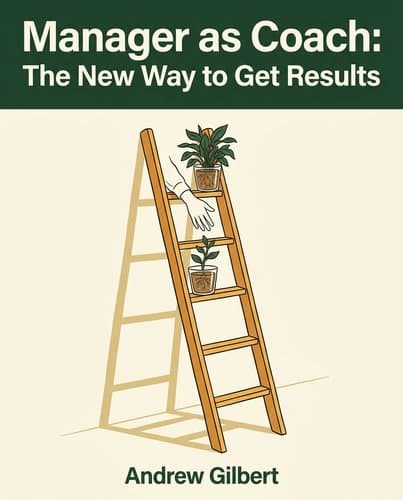
16700010_manager-as-coach
by Andrew Gilbert
Stop waiting to earn the right to ask for help—world-class coaching is already within reach if you know who to ask and how to ask it.
In Brief
Stop waiting to earn the right to ask for help—world-class coaching is already within reach if you know who to ask and how to ask it. Master the Five Coaching Triggers and a 60-second ABC framework to get targeted guidance from the right people, faster than you think possible.
Key Ideas
Coaching Triggers Tell You When to Ask
Use the Five Coaching Triggers (First Time, Stuck, Accelerate, Crush It, Strategic) as a diagnostic — when any one fires, your next move is to find a coach, not to figure it out alone
ABC Framework Wins in Sixty Seconds
Deliver your coaching request in under 60 seconds using the ABC framework: Point A (where you are now, with a specific number), Point B (where you need to be and by when), Context (what you've already tried). This brief tells the coach not just what you've done, but what you haven't.
One Level Above Beats World Class
Look for a coach one or two levels above you on the skill index, not the most senior expert available. Someone who was recently where you are remembers what's actually useful at your stage; a world-class expert often can't.
Specificity Makes Coaching Requests Convert Better
When making the Ask, specificity and flexibility matter more than relationship strength. State exactly what you need, cap the time commitment, offer a small incentive, and make it easy to say yes — a stranger with a well-formed request will outperform a close friend with a vague one.
Triangulate with Multiple Coaching Perspectives
Seek at least two or three coaches on any significant challenge. Like the Mayo Clinic's finding that 88% of second opinions change a diagnosis, multiple perspectives let you triangulate rather than blindly follow one potentially mistaken view.
Teaching Others Encodes Knowledge Permanently
When you coach others, you're not being generous at your own expense — you're encoding your own knowledge more durably and staying current. The Protégé Effect and Ebbinghaus's forgetting curve both point the same direction: teaching is the best way to learn.
Managers Connect Teams to Right Experts
If you're a manager, your job is not to answer your team's questions — it's to make sure the questions get answered. Connecting a report to the right expert, even when you could fake your way through an answer, produces better outcomes and frees you from becoming the bottleneck.
Who Should Read This
Business operators, founders, and managers interested in Mentorship and Management who want frameworks they can apply this week.
Manager as Coach: The New Way to Get Results
By Andrew Gilbert
12 min read
Why does it matter? Because the coaching you've been waiting for was always yours to go get.
Your company probably has a development plan for you somewhere. A manager who's supposed to check in. Maybe even a coaching program, if you work somewhere with a real HR budget. And yet here you are — still stuck on the same problems, still figuring things out alone, still waiting for someone to show you the thing that would actually move the needle. Here's why that feels familiar: the entire system was designed for someone else. The math was never in your favor. This book argues that you've been waiting for a resource that was always too scarce to reach you — and that the solution has been sitting right next to you all along, in the form of the people you already know, work beside, and occasionally eat lunch with. You just need a different belief about who's allowed to ask, and a system for making the answer almost always yes.
The System Was Never Going to Reach You
Atul Gawande had performed the operation a thousand times. As one of Harvard Medical School's leading surgeons, he'd spent years watching his post-surgical complication rates fall — a steady climb toward mastery. Then, somewhere around his mid-forties, the numbers stopped moving. He assumed he'd reached his ceiling.
So when he finally invited a retired surgeon to stand in the corner of his operating room and watch, he expected something close to a formality. The case went smoothly. Eighty-six minutes, clean margins, no complications. Gawande was quietly pleased with himself.
Then his observer opened his notebook. The first note: your elbow keeps lifting, which kills your precision — reposition your feet or switch instruments. The second: for roughly half the operation, the overhead light had drifted out of the wound, and Gawande had been working by reflected surfaces without noticing. Page after page of observations, all invisible to the man holding the scalpel. "That one twenty-minute conversation," Gawande later said, "gave me more to work on than the previous five years combined."
Within two months he was improving again. Within a year, his complication rates were dropping.
Gawande didn't wait for his hospital to assign him a coach. There was no program, no HR initiative, no structural support. He identified his plateau, found someone who could see what he couldn't, and asked. He sought it out himself — the same move Eric Schmidt made when he finally stopped waving off a board member's suggestion that he needed a coach, and later credited that same person with reshaping Google at the moment it mattered most.
The current system will never push you toward that decision. The International Coach Federation and PwC put the global count of professional coaches at roughly 47,500 — a ratio so lopsided it's essentially a closed door for anyone waiting to be matched with one. That ratio isn't a gap in the system. It is the system. Waiting for coaching to arrive is like waiting for a taxi in a town with one cab.
The people getting coached aren't the ones whose companies offered it. They're the ones who decided finding a coach was their job.
Asking for Help Is What High Performers Actually Do
What they share, beyond initiative, is this: they all found someone to watch them work.
Axl Rose in the mid-1980s. Guns N' Roses was selling out arenas, stacking platinum records. And Axl was losing his voice. The physical demands of screaming through 'Welcome to the Jungle' eight nights a month were shredding his vocal cords, and a heavy metal singer without a voice has no career. The coach he found was Elizabeth Sabine — an opera singer in her mid-sixties, about as far from the Sunset Strip as a person could get. Sabine had spent decades learning to redirect breath through the diaphragm to hit notes that would rupture an untrained throat. She taught Axl the same. The technique worked so well that word spread through the heavy metal world and other singers started lining up outside her studio. The community eventually gave her a nickname: the Heavy Metal Grandma.
Notice when Axl made that call. Not after his career collapsed. Not in some humbled second act. In the middle of his peak, when he still had records to protect and a reputation that made asking for help feel like the riskiest possible move.
That timing is the tell. Schmidt reached out for a coach while running Google. Gawande invited scrutiny at the height of his surgical career. The pattern isn't that high performers seek coaching after they fail — it's that they seek it precisely because they intend to keep winning. The numbers back the instinct: three quarters of people now say self-directed learning is their preferred way to acquire new skills, and the majority of Gen Z workers actively hunt down expertise without waiting for anyone to offer it.
Asking for help, done this way, isn't a confession. It's how the best stay best.
You Need a Trigger, Not a Crisis
When should you go find a coach? Most people answer this question the way Axl Rose almost did — they wait until something breaks. A project stalls, a promotion gets denied, a skill gap becomes impossible to ignore. The crisis becomes the trigger. By the time it arrives, months of effort have already been lost.
There's a more reliable system. Five conditions convert the vague question 'should I get some help?' into a clean yes, and any one of them means go now. Two are obvious: you're attempting something for the first time, about to learn lessons someone else has already paid for, or you're stuck and multiple approaches have failed to move anything. The other three apply more pressure. The results you need are coming faster than your current skill level can handle. The stakes are high enough that good enough won't cut it. Or people are counting on your outcome, which means your failure has a blast radius.
Think about Cole, a correctional officer who failed his sergeant's exam by a single placement. He'd given it everything and still come up short — stuck, high stakes, with people counting on him. Three conditions firing at once. He sought out several coaches, each covering different ground: one sharpened his interview technique, another overhauled how he carried himself in front of a panel. On his second attempt he scored a perfect 100 on his presentation. He made sergeant.
Run whatever you're working on through those five conditions. If any one checks, that's the signal — not a crisis, not a rock-bottom moment. Just a simple diagnostic that tells you it's time to go find someone who's already been there.
Knowing when to ask is half the problem. The other half is knowing what to say when you do.
The 60-Second Briefing That Separates Good Coaching from Great Coaching
The quality of a coaching session is determined mostly by the person being coached, not by the coach. Give a sharp, prepared brief to a mediocre coach and the session runs clean. Give a vague, wandering explanation to a brilliant one and you've wasted both your time.
The authors discovered this the hard way in an early focus group. They asked participants to describe their coaching need out loud, exactly as they would to a real coach. What came out was muddy, circuitous, and confused — and the average time to get through it was six minutes. Six minutes of throat-clearing before the actual work could begin.
The fix is a three-part briefing called the ABCs, delivered in under sixty seconds. Point A is your current situation, stated concretely. Point B is your specific destination, with a deadline attached. Context is what you've already tried — not to impress the coach, but to prevent them from sending you back to do homework you've already done. A sales rep running the framework might say: I've closed $100K this year with $600K in the pipeline, and I need to hit $1M by December 31. I've read five sales books and cold-called a dozen corporate decision-makers. Thirty seconds. The coach hears not just what's been attempted but what hasn't — no mention of referrals, no mention of upselling existing accounts, no mention of enterprise outreach. The ABCs surface the invisible.
For goals that resist hard numbers, the Latin dance problem is instructive. One of the book's co-authors walked into a coaching session believing he was a solid five or six — competent, comfortable, plenty of hours on the floor. His coach told him he was a three. He'd never properly executed a core technique called the pretzel, which meant everything built on top of it was shaky. Painful, clarifying, and only possible because both of them were working from the same scale: the 0-to-10 Skill Index, borrowed from the same framework used to rate language fluency or skiing runs. Zero means you can't do it at all. Ten means ten thousand hours of mastery. The number matters less than the conversation it forces. The framework creates alignment before the coaching even begins.
Your Best Coach Is Probably Not the Expert You're Imagining
You don't need the most decorated expert you can find. You probably need someone two steps ahead of you, not ten.
Think of it like asking for directions. The person who drove that route yesterday beats the person who mapped it twenty years ago — not because they know more, but because the detours are still fresh.
Seth, one of this book's authors, learned this training Brazilian Jiu Jitsu in college. He showed up expecting a seasoned black belt and found a blue belt — one level above the white belt Seth was about to become. He stayed anyway. A few months later, his college team entered a tournament against gyms coached by world champions and swept the bracket, taking first or second in every weight class. The explanation only became clear when Seth moved to California and joined a gym run by an actual black belt. He asked how to escape a chokehold. The master showed him five techniques, escalating in complexity, none of them easy to hold in a beginner's head. The blue belt, asked the same question, had given him one answer. One answer that worked.
The black belt's problem wasn't knowledge — it was distance. Years of mastery had erased the memory of confusion. He couldn't feel the chokehold from a white belt's perspective anymore. The blue belt could, because he'd been there recently. That gap in empathy swamped any advantage in expertise.
The recency effect has a direct implication for how you search for coaches. If you're at a 3 on any given skill, you don't need a 10. You need a 4 or 5 — someone close enough to your level that they still remember what it felt like to be stuck where you are, and what actually moved them forward. The 10 is also harder to reach, less likely to have time for you, and prone to giving five answers when you need one.
So before you spend energy chasing the most decorated expert available, ask a simpler question: who do you know — or know of, or could get connected to — who solved exactly your problem about two years ago? That person is your coach. More accessible than the master, more patient with beginner questions, and carrying exactly the map you need.
The Stranger Will Say Yes — If You Ask Right
Cristina Pianezzola needed coaching and had nobody obvious to ask. A gift-planning specialist at a large university, she worked largely alone — no department of peers, no ready-made sounding board. So she did something that felt audacious: she emailed strangers across the country who did similar work. People who had no reason to respond. Every single one of them did.
Consider Tom and Kate. Tom is a neighbor you've known for years — your kids went to preschool together. He catches you on a walk and asks if you'd help him move a storage unit Saturday. You hesitate. How big is the unit? How far away? Two hours or two days? Kate knocked on your door last week for the first time. Two couches, ten minutes, any time Saturday that works for you — and if you're free Sunday, she's hosting an open house with homemade ice cream because she heard you're a fan. You say yes to Kate before she's finished the sentence.
The formula Kate used isn't complicated: specific scope, flexible timing, a small gesture that shows she did five minutes of homework on you. That bundle removes the risk a potential coach feels when they can't see what they're agreeing to.
The research confirms what Kate already knew. Cornell psychologists found that people underestimate others' willingness to help by roughly 50 percent — the fear of rejection is real, but it's a reliable overestimate. And when Wharton and Harvard researchers looked at what happens to someone's reputation after they ask for help, they found the opposite of what most people dread: a thoughtful, specific request actually raises your perceived competence in the helper's eyes.
Which means the relationship gap you're worried about barely matters. Prepare those three things — specificity, flexibility, a light incentive — before you reach out to anyone, and the connection you don't yet have stops being the obstacle you thought it was.
Teaching Others Is the Fastest Way to Learn Something Yourself
There's a twist to all of this that the coaching literature almost never mentions: giving coaching is actually the most efficient investment in your own learning you can make — not a diversion from self-development, but the engine of it.
Here's the mechanism. A German psychologist named Hermann Ebbinghaus spent the late 1800s mapping human memory and arrived at an uncomfortable number: within twenty-four hours of learning something new, the average person has already lost 67 percent of it. Six days later, 75 percent is gone. The forgetting isn't gradual — it's a cliff. Most training, most reading, most self-directed study falls straight off that cliff before it can do any work.
Coaching is the retrieval mechanism that flattens the curve. Stanford educators tested this by asking middle school students to teach a fictional character named Betty how river ecosystems work. The students who taught Betty outperformed students who just studied the same content — because preparing to explain something forces a precision that studying for yourself rarely demands. Every time you explain a skill to someone else, you pull that knowledge back out of storage, reactivate the neural pathways, and push it deeper toward long-term memory. Do it enough times and the forgetting curve barely touches you. The information becomes part of how you think, not something you once read.
The professional stakes are real. The half-life of a marketable job skill is roughly five years — and the workers who coach others are the ones most likely to notice when their knowledge is drifting out of date and sharpen it in the act of sharing. Knowledge hoarding doesn't protect your edge. It lets it quietly go stale. The person who teaches gives away nothing: they're encoding, staying current, and becoming harder to replace, all at once.
The Manager Who Connects Beats the Manager Who Answers
What happens when a manager applies all of this — the listening, the trust, the individual attention — at team scale? The numbers get interesting.
A Gartner study of more than 7,300 employees found that the manager who tries to coach everything, regardless of their own expertise, actually drags team performance down by 8 percent. Gartner called this the 'Always-on' style, and the instinct behind it is recognizable: always have an answer, never look like the weakest person in the room. The problem is it turns the manager into a bottleneck. The style that outperformed every other was the Connector: managers who coached directly when a topic fell within their genuine expertise, and deliberately handed off to someone better positioned when it didn't. Connector Managers drove team engagement up by as much as 40 percent and tripled the likelihood that their direct reports became high performers.
Daniel Carrick, a logistics manager at a manufacturing firm, illustrates why the numbers move that way. His direct report Brandon was repeatedly miscalculating inventory orders — generating stock-outs, shutdowns, and blown budgets. Daniel's background was in supply chain planning, not procurement, and he knew it. Rather than improvise coaching in an area where he'd be guessing, he connected Brandon with a procurement specialist and arranged weekly sessions. Six weeks later, Brandon's ordering accuracy had improved enough to cut raw inventory costs by $250,000, with projections pointing toward $1 million in savings by year's end. Daniel didn't solve the problem. He made sure the problem got solved.
That's the whole model. As organizations flatten and specialization deepens, the idea that any single manager can coach any skill on a team of fourteen or more people simply doesn't hold. The Connector reframes 'I don't know' from an embarrassing admission into a leadership move: I know someone who does, and I'm going to get you there. The manager stops being the ceiling. The whole network is.
Alignment Is the Multiplier — Everyone Pointed at the Same Thing
Picture a single mirror the size of a small house, pivoting slowly in the Mojave Desert. By itself, it does nothing. Add fifty thousand more, each aimed loosely at the same tower, and you still get nothing — scattered light producing scattered heat. The Ivanpah Solar Electric Generating System, a $2.2 billion facility on the California border, only becomes the world's most powerful solar farm when all 170,000 mirrors achieve something precise: every one of them pointing at exactly the same spot on exactly the same tower. One degree of drift and you lose the whole effect. That is the leadership version of this problem.
All the tools covered in this book — the ABCs, the trigger system, the Level Up coach, the Protégé Effect — are individual mirrors. Each one produces real results on its own. But a Connector Manager who understands the fourth role of the model, Lead, gets to point all of them at the same target at once. That target is what the framework calls a Critical Strategic Focus: a single initiative valuable enough that achieving it changes organizational results in a way normal initiatives don't. Cutting onboarding time in half. Accelerating a platform rollout to reach 30 percent more of the company than originally planned. Whatever it is, it converts a collection of personal productivity tools into a coordinated system.
What happens next is worth sitting with. Stanford psychologist Gregory Walton ran a study where participants worked alone on difficult puzzles — completely alone, no collaboration possible. He told one group they were part of a team working on the same problem. The other group knew they were working independently. Same task, same isolation, same tips. The group that merely believed they were connected persisted 48 to 64 percent longer on the hardest challenges and performed measurably better. No structural support. No actual teammates. Just the sense that their effort was pointed at something shared — and it rewired their motivation entirely. That number deserves a moment: not 5 percent longer, not meaningfully longer. Nearly twice as long, on the hard stuff, from a belief alone.
That is what alignment does at scale. When a leader connects every person's individual coaching work to a shared objective — and builds an open coaching community where knowledge flows across teams rather than hoarding inside them — the math compounds. Ten people each developing one skill in isolation is addition. Ten people developing skills that feed the same goal, sharing what they learn across a community where asking for help is normal and giving it is expected, is multiplication. The mirrors stop scattering. The power comes on.
The Question Worth Asking Before Monday Morning
The gap was never talent. It was never access, or timing, or knowing the right people before you needed them. The people who compound — who look back at a year and barely recognize how far they've moved — mostly did one unremarkable thing differently: when they hit friction, they asked someone. Not searched, not stewed, not waited for a program to materialize. They found one person who was two steps ahead of them and made a sixty-second request that was specific enough to be answered. You already know people who could cut months off whatever you're stuck on right now. And this isn't just a personal habit. When that ask becomes the norm — when a whole team does it, openly, toward the same target — the results stop adding and start multiplying. The only thing that was ever missing was the belief that you were allowed to ask.
Notable Quotes
“55% of Gen Zers [those born between 1995 and 2010] seek out new job skills on their own, without expecting help or guidance from their company or boss.”
“we often jump to telling them what to do to fix the problem or improve their performance . . . That activates a psycho-physiological state known as the Negative Emotional Attractor (NEA), what we call coaching for compliance.”
“Our primary role as a coach is to help someone else with their self-directed learning and change with the key being on ‘self-directed’ . . . In essence, the associate drives the agenda.”
Frequently Asked Questions
- What is Manager as Coach: The New Way to Get Results about?
- "Manager as Coach" provides a practical system for getting and giving effective coaching in the workplace. The book introduces diagnostic triggers that signal when coaching is needed, a framework for making coaching requests, and guidance on selecting the right coach. It equips both managers and individual contributors to solve problems faster and develop more durable expertise. Rather than trying to figure everything out alone, the book teaches readers to recognize when coaching is needed and how to request it effectively, transforming how teams approach problem-solving and skill development in organizations.
- What are the Five Coaching Triggers in Manager as Coach?
- The Five Coaching Triggers are diagnostic signals indicating when coaching is needed: First Time, Stuck, Accelerate, Crush It, and Strategic. According to the book, "Use the Five Coaching Triggers (First Time, Stuck, Accelerate, Crush It, Strategic) as a diagnostic — when any one fires, your next move is to find a coach, not to figure it out alone." First Time applies when facing unfamiliar tasks; Stuck means you're not progressing; Accelerate means wanting faster improvement; Crush It means pursuing excellence; Strategic means career-affecting decisions. These triggers help both managers and contributors recognize when to seek external expertise rather than working in isolation.
- How do you structure an effective coaching request according to Manager as Coach?
- The ABC framework structures effective coaching requests under 60 seconds. Point A specifies where you are now with a specific number; Point B describes where you need to be and by when; Context explains what you've already tried. "Deliver your coaching request in under 60 seconds using the ABC framework: Point A (where you are now, with a specific number), Point B (where you need to be and by when), Context (what you've already tried)." This brief tells the coach not just what you've done, but what you haven't, enabling them to provide targeted guidance rather than generic advice based on incomplete information.
- Should you seek multiple coaches or rely on one expert?
- Seeking multiple coaches is more effective than relying on a single expert. The book notes that "Like the Mayo Clinic's finding that 88% of second opinions change a diagnosis, multiple perspectives let you triangulate rather than blindly follow one potentially mistaken view." Additionally, choose coaches one or two levels above you on the skill index rather than the most senior expert available—someone recently where you are remembers what's actually useful at your stage. This approach prevents over-reliance on one perspective while ensuring guidance is appropriately calibrated to your current development level.
Related Book Summaries
Read the full summary of 16700010_manager-as-coach on InShort