19812285_the-start-up-of-you
by Reid Hoffman, Ben Casnocha
The career ladder is gone—replace it with a startup mindset. Hoffman shows how to stack skills strategically, activate weak-tie networks, and build fallback…
In Brief
The Start-up of You (2012) argues that career stability no longer comes from institutions but from treating yourself like a startup — iterating on skills, managing risk intelligently, and leveraging networks strategically.
Key Ideas
Assets, aspirations, and market demand converge
Map your competitive advantage as three overlapping gears — your current assets, your genuine aspirations, and what the market will actually pay for. A skill that doesn't connect to market demand is a hobby, not a career lever.
Complementary skills create rare career advantages
Use skill-stacking instead of chasing world-class status in a single area. Being top 10% in two complementary skills creates a combination that's rare and valuable, even if neither skill alone is exceptional.
Three plans provide psychological freedom to risk
Build your ABZ plan before you need it. Plan A is your current bet, Plan B is a related pivot you've already considered, and Plan Z is the concrete fallback (a gig, a couch, a cheaper city) that gives you the psychological permission to take real risks.
Acquaintances surface opportunities friends cannot provide
Treat weak ties as your primary source of non-redundant opportunity. Close friends already know what you know. Friendly acquaintances surface jobs, ideas, and introductions you'd never find in your inner circle.
Seven-out-of-ten rating signals hidden mismatch
When evaluating a person through references, ask for a 1-to-10 rating. A 7 almost always signals a hidden mismatch worth probing; a 10 requires you to probe the reviewer's bias, not just celebrate the score.
Reversibility determines real risk, not magnitude
Reframe risk as a spectrum of reversibility, not a binary. Before any major move, ask: is this a one-way door or a two-way door? If you can reverse course cheaply, the downside is smaller than your anxiety suggests.
Avoiding turbulence erodes resilience, defers risk
The volatility paradox: professionals who avoid turbulent environments don't eliminate risk — they defer it, while losing the resilience that only comes from navigating small disruptions regularly.
Who Should Read This
Business operators, founders, and managers interested in Career Change and Professional Growth who want frameworks they can apply this week.
The Start-up of You
By Reid Hoffman & Ben Casnocha
12 min read
Why does it matter? Because the career model you were raised to trust was quietly dismantled while you were following its rules.
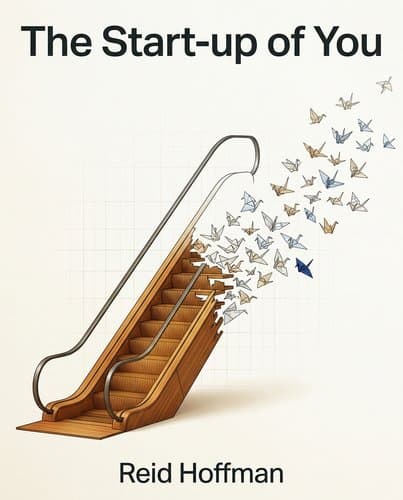
The career escalator didn't break down. It was dismantled — deliberately, quietly, and while you were busy performing well and expecting the ride to continue. What replaced it isn't another system. It's a jungle, and most of the advice you've received about navigating it still assumes there are stairs somewhere. There aren't. The uncomfortable argument at the center of this book is that the only people who thrive in this environment are the ones who stop waiting for institutional safety to return and start treating themselves the way a founder treats an early-stage company: as something permanently unfinished, network-powered, and built to adapt before the next disruption arrives. The framework exists. The question is whether you're willing to use it before risk finds you first.
The Escalator Is Gone, and It's Not Coming Back
Imagine you're handed a map at the start of a long journey. You study it carefully, memorize the roads, plan your route. You walk for years — only to realize, somewhere in the middle, that the territory no longer matches the map. Roads have been rerouted. Some towns are gone. The map wasn't wrong when it was drawn; the ground itself changed.
That's the situation every working professional is in right now, and Hoffman and Casnocha's core argument is that the disorientation you feel isn't personal failure — it's the natural consequence of following directions designed for a world that no longer exists.
For most of the twentieth century, the career model functioned like an escalator. You stepped on at the bottom — an entry-level role at a company like IBM or GE — and the machinery did a great deal of the lifting. Your employer trained you, promoted you on a reasonably predictable schedule, and eventually handed you a pension. Loyalty ran vertically: you gave decades to the company, and the company gave you a livelihood. That bargain excluded plenty of people, and it had real friction even for those it included — but for a broad swath of educated workers, the basic structure held.
Then the machinery seized. Technology automated the skilled white-collar work that once justified stable mid-career positions — paralegals, radiologists, whole categories of knowledge work — and globalization let companies source whatever remained from cheaper labor markets. The employer-employee pact quietly dissolved. Companies stopped funding long-term development because they stopped expecting long-term tenure. Employees stopped staying because the guarantees that made staying worthwhile had evaporated. What replaced vertical loyalty was horizontal loyalty — allegiance to peers, to a network, to your own portable reputation.
Which means the instinct to work harder on the same map is exactly the wrong response. You need a different map entirely.
Stop Looking for Your Passion. Start Building Your Edge.
Here is an uncomfortable truth: there is no passion buried inside you waiting to be excavated. The follow-your-passion advice that fills commencement speeches and career books has it backwards. You don't discover your calling and then build a career around it — you build skills, take them into the market, and watch your interests crystallize around what you're actually good at.
Hoffman and Casnocha's replacement for the passion-first model runs on three interlocking gears: your Assets (skills, knowledge, relationships, reputation), your Aspirations (the values and goals that give work meaning), and Market Realities (what someone will actually pay for). The gears only generate motion when they mesh. A passion with no market demand is a hobby. Assets you feel nothing for will eventually stall. And chasing market trends without personal grounding turns you into a mercenary bouncing between whoever pays most. Career strategy means finding the overlap and then widening it — say, a software engineer who develops a genuine specialty in health data and begins writing publicly about it, until the combination opens doors neither skill alone could.
The most useful tool for widening that overlap is what Dilbert cartoonist Scott Adams called skill-stacking. Rather than spending a decade trying to reach world-class status in a single discipline — a race with very long odds — you aim for the top ten percent in two complementary areas. The combination becomes rare in a way that neither skill alone could be.
Hoffman's own career traces the same logic, though it arrived through a disorienting path. He studied philosophy and cognitive science, convinced he'd become an academic who could shift public thinking at scale. Graduate school corrected that fast: the actual audience for academic work turned out to be a few dozen specialists, not the broad public he wanted to reach. So he adapted — moved into the technology industry, learned product development at Apple, eventually built PayPal and then LinkedIn. His long-standing interest in how human identity and community function online didn't disappear; it became the intellectual engine behind some of the largest internet platforms ever built. The philosophy student wasn't abandoned. He was redirected toward a market that could actually use him.
The lesson isn't that passion is irrelevant. Passion tends to follow competence rather than precede it. Start by asking what you can offer that is rare and that someone will pay for. Build that. Your true self, as Hoffman puts it, doesn't get found — it emerges.
You Don't Need a Five-Year Plan. You Need a Lifeboat and a Pivot.
In 2009, Stewart Butterfield raised $15 million to build a massively multiplayer online game called Glitch — a trippy collaborative fantasy where players crafted worlds inside the minds of dreaming giants. It launched in 2011. It was dead within a year. The problem wasn't creativity; it was that most people, when they log into an online game, want to fight something. A game built around cooperation found a fanbase that was devoted but tiny, nowhere near enough to justify the investment. So Butterfield and his team did what you do after a wreck: they picked through the wreckage.
What they found was something they'd built for themselves. Scattered across different cities, the Glitch team had cobbled together an internal messaging tool — channel-based, searchable, with file sharing baked in — just to keep the project running. Butterfield looked at it and recognized that every company with distributed teams had the same problem his had. In 2014, they raised a new round of funding around that tool. They called it Slack. Salesforce bought it in 2020 for $27 billion.
The point isn't that failure leads to success if you stay optimistic. The logic is structural: Butterfield wasn't executing a master plan. He was moving, learning, and redirecting based on what the evidence showed him. The $27 billion outcome wasn't visible from the starting line — it only became visible after the first plan collapsed and he looked honestly at what remained.
This is the logic behind what Hoffman and Casnocha call ABZ Planning. Plan A is your current bet — the job you have, the skill you're developing, the market you're competing in. Within Plan A, you iterate constantly, making small adjustments as you learn. Plan B is the related pivot: not a random leap, but a move to adjacent territory that draws on what you've already built. Slack's Plan B wasn't a restaurant or a law firm — it was still a software tool solving a communication problem, just for a different customer. The best Plan B keeps one foot planted while the other swings somewhere new.
Plan Z is the piece most people forget, and it may be the most important one. It's your certain fallback — the option you know is available if everything else falls apart. Before Hoffman launched his first company, he asked his father if he could move back into the spare bedroom if the startup burned through his savings. His father said yes. That single conversation changed everything: knowing the worst-case scenario was livable made it possible to take the risks a new venture demands. Plan Z isn't the goal. It's what gives you psychological permission to pursue the goal without paralysis.
The framework also pushes back against the instinct to wait until you're certain. Hoffman's rule is roughly eighty percent: if you're eighty percent ready, move. The last twenty percent of certainty almost never arrives — and the people who wait for it watch the window close while someone less hesitant walks through it. Pivot when you feel almost ready, because almost ready is as ready as it gets.
Your Network Isn't Who You Know. It's How Far Your Information Reaches.
What if the most important information about your next career move is already sitting in the heads of people you barely know?
That question reframes what a professional network actually is. Most people treat networking as a job-hunting activity: something you activate in a crisis and otherwise ignore. Hoffman and Casnocha's argument is that a network is closer to a distributed intelligence system — one that, if you understand its structure, keeps feeding you useful information long before any crisis arrives.
The system has three tiers, and most people only use one. Close allies — the eight to ten people you trust enough to show rough drafts of your thinking — give you honest feedback, honest warnings, and backstage access to their world that no public source can replicate. But they have a structural limitation: they already know what you know. Because allies tend to come from the same industry and professional circles, their information overlaps with yours. The finding that changed how researchers think about this came from Boston: when professionals who'd recently switched jobs were asked who referred the winning lead, the answer wasn't close friends. It was friendly acquaintances — people on the edge of their world rather than at its center. Precisely because those acquaintances moved in different circles, they were more likely to have heard about something you hadn't.
That's the counterintuitive value of what Hoffman calls friendlies — weak ties you might grab coffee with once a year. Their information doesn't overlap with yours. When you're navigating a career transition, these are often the people who surface the option you didn't know existed.
The third tier compounds this further. On social media, followers build reputation and reach that accrue without requiring your active presence. Ryan Graves understood this instinctively. In 2010, he saw a tweet from a founder named Travis Kalanick announcing he needed an executive for a new, unnamed venture. Graves replied publicly and dropped his email. Kalanick hired him. That founder was building Uber, and Graves eventually became a billionaire as the company's first employee. A single tweet, replied to at the right moment, rewired his entire professional trajectory.
The deeper intelligence layer involves not what people broadcast, but what they'll say privately. When evaluating a potential boss or business partner, Hoffman asks references to rate the person on a one-to-ten scale. An eight or nine signals honesty: the person is excellent but imperfect. A ten requires probing the reviewer's own bias — why does this specific person think so highly? A seven is the most revealing score: it almost always points to a real shortcoming or a role mismatch. If you get a seven, the follow-up question is simple — "What would need to be different for this to be a nine?" That one question tends to surface exactly what the reviewer was too polite to volunteer. No job interview or LinkedIn profile would ever get you there. That's the information that only exists in relationships, and only flows to people whose network runs deep enough to reach it.
Luck Is Just Motion With Good Timing
In January 2008, the three founders of Airbnb were broke enough to be frightening. Four maxed-out credit cards. Savings gone. A website that spiked during big conferences and went quiet in between. They needed cash to buy time, so they did the only thing available to them: they found a presidential election, borrowed connections from their design school days, and printed two limited-edition cereal boxes — Obama O's and Cap'n McCain's — folded by hand in their kitchen and sold online for forty dollars each. CNN picked up the story. The Obama O's sold out, netting twenty thousand dollars. That runway was enough to figure out the business, which was enough to attract serious investors. Today, nearly a billion guest stays have happened on the platform.
The cereal story gets told as a punchline, but its real lesson is structural. The founders didn't manufacture luck — they manufactured motion. They used whatever was at hand (a design school network, an election, a kitchen table) and pointed it at the nearest problem. Resourcefulness, at its core, is the refusal to accept that the next move requires resources you don't yet have.
That same refusal to wait is what Hoffman and Casnocha call strategic serendipity: staying in motion until the right moment runs into you. George Clooney spent twelve years auditioning before a friend slipped him a script for a medical drama called ER. He didn't wait for his agent to make the call — he phoned the producer himself and announced he wasn't letting anyone else have the lead role. The producer laughed and invited him in. Clooney got the part. The show became a cultural event, and he built the rest of his career on the velocity it gave him. That phone call wasn't luck. It was what happens when someone who has been paying close attention for twelve years finally sees the signal.
The framework has two parts, and both matter. The first is motion: reading widely, joining groups, attending events, building networks — not because any specific action will pay off, but because you're spinning a web large enough to catch something. The second part is commitment, and this is where most people stumble. There's a temptation to keep options open, to wait for the perfectly timed opportunity that fits your current plan. Hoffman nearly fell into that trap: two weeks into a long-planned trip to Australia after the PayPal acquisition, he recognized that the post-dot-com market had just reopened for consumer internet companies — and that window was open now, not in a year. He canceled the trip and came home to start LinkedIn. The best opportunities don't consult your calendar.
The Safest-Feeling Move Is Often the Most Dangerous One
The safest-feeling career move is often the most dangerous one you can make. Not because caution is foolish, but because stability, when it goes untested long enough, quietly becomes fragility — and the reckoning, when it finally arrives, is devastating precisely because nothing warned you it was coming.
Hoffman borrows a pattern from political history to make this concrete. Italy has been in near-continuous turmoil since World War II — governments toppling, coalitions fracturing, crises arriving on a fairly reliable schedule. North Korea, by contrast, has been frozen in enforced calm for decades. And yet Italy is the resilient one. All those small disruptions work like controlled burns in a forest: they clear enough underbrush that no single fire can become catastrophic. North Korea's stability is an illusion purchased on credit, with a potentially civilizational bill waiting at the end. The same dynamic plays out in careers. The freelance writer who can't predict her income month to month, the real estate agent hustling to find the next client — they're absorbing small shocks constantly. When the magazine industry collapses or the housing market seizes, they already know how to move. The staff editor with his reliable paycheck and automatic promotion has never learned that skill. He's been accumulating fragility the whole time he thought he was accumulating security.
Fear, it turns out, is a signal worth paying attention to — not a warning to retreat, but a sign that an opportunity is real. Reed Hastings has said that if you're not genuinely pained by the risk in a strategic choice, the strategy probably isn't worth much. Hoffman puts it more directly: if you feel no fear about a career move, it probably isn't a breakout opportunity. The discomfort isn't the problem. The discomfort is the point. People who spend their careers optimizing it away don't arrive somewhere safe. They arrive somewhere exposed, with no practice handling the disruption that, sooner or later, finds everyone — which is exactly why the next question isn't whether to take intelligent risks, but how to tell the intelligent ones from the reckless ones.
Permanent Beta Is Not a Metaphor — It's the Only Honest Description of a Career
When Gmail launched in 2004, it spent the next five years labeled beta — not because it was broken, but because the team understood that calling something finished is a kind of lie. Every update, every patch was an admission that the previous version had more to learn. Your career works the same way. The escalator model promised you a destination. This book offers something more honest and more useful: a set of tools for people who've accepted that the destination keeps moving. Your assets, your network, your appetite for reversible risk — none of it is fixed. All of it compounds. The world stopped rewarding people who optimized for arrival a long time ago. It rewards people who stayed in motion, kept shipping, and treated every role as version 0.1 of something they hadn't fully imagined yet. That's not anxiety. That's still becoming.
Notable Quotes
“Monty Python crossed with Dr. Seuss on acid.”
“A Maverick in Every Bite”
“So, you’re running a cereal company now?”
Frequently Asked Questions
- What is The Start-up of You about?
- The Start-up of You (2012) argues that career stability no longer comes from institutions but from treating yourself like a startup. The book, by Reid Hoffman and Ben Casnocha, draws on Silicon Valley principles to provide readers with concrete tools for mapping competitive advantage, building contingency plans, and leveraging networks strategically. Rather than relying on traditional career paths, it encourages professionals to adopt startup thinking—iterating on skills, managing risk intelligently, and using weak-tie relationships to surface opportunities that close networks never reveal. The book fundamentally reframes how we approach our careers in an uncertain economy.
- What is the ABZ plan in The Start-up of You?
- The ABZ plan is a three-part contingency strategy for managing career risk. Plan A is your current bet—your primary career path. Plan B is a related pivot you've already considered, a direction you could move toward using existing skills. Plan Z is the concrete fallback—a gig, a couch, a cheaper city—that gives you psychological permission to take real risks. By mapping all three plans before you need them, you reduce anxiety and increase your willingness to pursue ambitious Plan A goals, knowing you have viable alternatives if circumstances change dramatically.
- How does The Start-up of You define competitive advantage?
- The Start-up of You defines competitive advantage as three overlapping gears: your current assets, your genuine aspirations, and what the market will actually pay for. When these three elements intersect, you've identified a genuine competitive advantage. The book emphasizes that a skill doesn't become a career lever just because you're good at it—"A skill that doesn't connect to market demand is a hobby, not a career lever." This framework prevents professionals from investing years in skills with no commercial value, ensuring your development efforts align with actual market opportunities and personal passion simultaneously.
- Why does The Start-up of You emphasize weak-tie relationships?
- The Start-up of You emphasizes weak ties as your primary source of non-redundant opportunity. Close friends already know what you know, limiting their ability to surface novel information or connections. Weak ties—friendly acquaintances with different networks—introduce you to job opportunities, ideas, and introductions you'd never find in your inner circle. By maintaining relationships with acquaintances across different industries and fields, you exponentially increase the diversity of information and opportunities available to you. This network strategy recognizes that your breakthrough opportunity often comes from someone slightly outside your core social circle, not from your closest friends.
Related Book Summaries
Read the full summary of 19812285_the-start-up-of-you on InShort