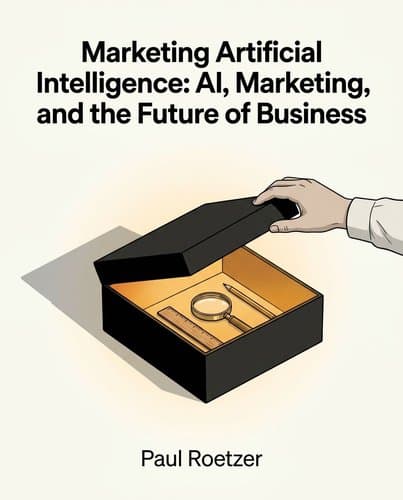
59203014_marketing-artificial-intelligence
by Paul Roetzer
The marketers winning with AI aren't chasing the latest tools—they're the ones who can map a vendor's claim to a concrete capability and spot the gaps.
In Brief
Marketing Artificial Intelligence: AI, Marketing, and the Future of Business (2022) maps the gap between AI's real capabilities and most marketers' understanding of them. It gives practitioners a practical framework — including a capability taxonomy and a maturity scale — for evaluating tools, running pilots, and building organizational readiness to adopt AI systematically rather than reactively.
Key Ideas
Three-category filter for AI vendor claims
Use Language / Vision / Prediction as a three-category filter for any AI vendor claim: identify which category the tool operates in, then ask what specific capability within that category it delivers. If you cannot map the claim to a concrete category, the claim is probably hype.
Rate tool autonomy per specific use case
Apply the M2M Scale to a specific use case in your current tech stack — not to the platform as a whole. Rate each tool from 0 (all human) to 4 (fully autonomous) for that one task. Most will score 1–2. That gap is your pilot roadmap.
Four diagnostic questions for AI tool evaluation
When evaluating an AI tool, ask four diagnostic questions before anything else: What data must I supply? How much training and monitoring does the system require during onboarding? How reliant is the system on continued human inputs? How does it improve over time — and can you see evidence of that improvement?
Autonomous marketing claims warrant healthy skepticism
If a vendor claims their tool operates fully autonomously for a complex marketing task without human inputs or oversight, treat that as a red flag, not a selling point. Level 4 autonomy does not exist in marketing today; vendors who claim it are either misinformed or misleading you.
Maintain visibility and accountability for customer-facing AI
When AI outputs reach a customer — ad targeting decisions, personalized pricing, credit offers, content recommendations — someone in your organization must be able to explain how the algorithm made that decision. Outsourcing the algorithm without maintaining visibility means outsourcing your accountability for its consequences.
Start with data-driven, repetitive, predictive use cases
Start your AI pilot with use cases that are data-driven, repetitive, and predictive. These are the conditions where AI reliably outperforms human analysis at scale — and where early ROI builds the organizational credibility to expand to more complex applications.
Who Should Read This
Business operators, founders, and managers interested in Artificial Intelligence and Marketing who want frameworks they can apply this week.
Marketing Artificial Intelligence: AI, Marketing, and the Future of Business
By Paul Roetzer & Mike Kaput
10 min read
Why does it matter? Because the biggest barrier to AI adoption isn't budget or technology — it's that most marketers still can't define what it does.
Most marketers assume the barrier to AI is technical — a data science hire, a platform overhaul, a budget that keeps getting cut. Wrong. Seventy percent of marketers name lack of education and training as the primary obstacle. Only 14% of organizations have invested in any AI-focused learning program. The problem isn't infrastructure. It's vocabulary. Without a clear way to evaluate what AI actually does versus what vendors claim it does, every tool looks like a black box and every pilot feels like a gamble.
That's a rational response to a bad information environment. The question isn't whether AI changes marketing — it already has, for teams that figured out how to evaluate it rather than just react to vendor claims. This book gives you that vocabulary: how to match machine capabilities to actual marketing tasks, and how to measure what any tool genuinely automates versus what it still depends on you for. The teams waiting for certainty are waiting for something that won't arrive. The ones who've stopped waiting aren't smarter — they just know how to read the odds.
Most Marketers Don't Have an AI Problem — They Have an Education Problem
Not budget. Not engineers. Fear of AI registers at just 16%. The thing keeping most marketers sidelined is a knowledge deficit.
That gap is more disabling than it sounds. Believing AI matters and knowing how to act on it are entirely different positions. Without a working definition of what the technology can do, a marketer cannot evaluate vendor claims, identify which tasks are worth automating, or build a credible pilot. The result is a lot of awareness and very little movement.
The confusion deepens because most automation already inside the marketing stack is less intelligent than advertised. Consider the typical email platform's "AI" feature: it's a rules engine. If a contact hasn't opened in 90 days, trigger the re-engagement sequence. The marketer writes the trigger, writes the email, and sets the win condition. The system executes instructions; it doesn't learn. Calling that artificial intelligence is technically defensible and practically misleading. The machinery is there. The intelligence has not arrived.
In a 2021 survey, 70% of marketing professionals named lack of education and training as their primary obstacle. Only 14% of organizations had any AI-focused education program in place. That gap between problem and response is where the competitive advantage lives. Marketers who invest in understanding what AI can and cannot do become the ones positioned to find viable use cases, run credible pilots, and build internal momentum. The entry requirement is not a machine learning degree. It is clarity about what the territory actually looks like.
You've Been Using AI Every Day for Years — You Just Didn't Call It That
When was the last time you used artificial intelligence? If your answer involves anything technical — a machine learning course, a data science experiment, something you'd need an engineer to configure — you are starting from the wrong place entirely.
Google Maps chose your route this morning. Netflix filled your queue last night. Spotify assembled a playlist that somehow knows what you needed to hear. None of these felt like encounters with sophisticated technology. They felt like convenience. You already navigate by AI, entertain yourself by AI, and let AI predict what you want to buy before you know you want it. The unfamiliarity is not with the experience — it is with the label.
Demis Hassabis, cofounder of Google's DeepMind (the lab behind AlphaGo), defines AI as "the science of making machines smart." Apply the same frame to marketing. Not robots. Not sentient computers. Systems that get better at predictions — what route, what movie, what product — the more data they process.
You have been trusting those systems with your time and attention for years, without friction, without a technical background, without once asking how the recommendation engine worked. There is no reason your relationship to AI in your own marketing work should feel any different.
AI Is Confusing Because You've Been Given the Wrong Map
In 2019, visitors to the Dalí Museum in St. Petersburg, Florida walked up to a life-size screen and found Salvador Dalí staring back at them. He told stories. He took selfies with them, texted the photos to their phones. The artist had been dead for thirty years. The ad agency Goodby Silverstein & Partners had pulled more than 6,000 frames from old interviews, run 1,000 hours of machine learning on his face, and projected the results onto an actor with Dalí's proportions. A voice actor handled the audio. The technical director who built it, Nathan Shipley, pulled the core code from GitHub — publicly available, free.
What Shipley built was a Vision AI application: machines analyzing images and video to recognize and reconstruct faces. Once you have that label, you have a question you can ask about any technology claim — which category does this fall into? — and the answer tells you what the system can actually do.
Roetzer studied how Amazon, Google, and Microsoft categorized their AI products and found the same three categories kept surfacing. Language covers machines that read, write, speak, and understand words. When Gmail suggests "Sounds great, I'll be there" in response to a meeting invite, or a copy tool drafts a product description from a bullet list, that's Language AI processing text to generate more text. Vision covers machines that interpret images and video: recognizing faces, detecting objects, identifying a brand logo in a crowd photo without anyone tagging it. Prediction covers machines that forecast outcomes from historical data, improving accuracy as they accumulate more inputs; Tesla's autonomous driving challenge reduces to one goal: predicting what a skilled human driver would do next. Each category maps to dozens of applications and hundreds of use cases. The categories are the map.
With that map, the Dalí installation reveals something beyond the spectacle. A convincing deepfake requires roughly 500 images of a person — or about ten seconds of video. Every photo your company has published of its executives, every brand video you've posted, is raw material for the same technique. Crisis communications teams have spent careers planning for bad press, regulatory trouble, and product failures. Almost none have planned for synthetic video of company leadership saying things that never happened. The vocabulary that makes the technology exciting is the same vocabulary that makes the risk legible.
The Question Every Marketer Should Ask About Their Tech Stack — But Almost Nobody Does
In September 2018, Paul Roetzer bought a Tesla Model S and immediately started doing something that would, without his knowledge, teach the car to make him redundant at one specific task.
When Tesla first enabled lane-change assistance, the system scanned all eight onboard cameras, calculated the speeds of surrounding vehicles, and then asked the driver: change lanes? Yes or no. Roetzer found the feature mildly useful and somewhat unnerving. What he didn't realize — what almost no Tesla driver realized — was that every answer they gave was feeding a training dataset. Tesla was monitoring accept/reject decisions across its entire fleet of roughly one million vehicles, and once the accumulated data showed its AI matching or beating human judgment on lane changes, it pushed an update. The drivers' own decisions had taught the car to stop asking.
That mechanism — humans providing inputs that train machines to need fewer inputs — is exactly the lens missing from most conversations about marketing AI. The common question is whether a tool uses AI, or how sophisticated the underlying model is. The better question is: how much of this specific task can the machine do without my inputs and oversight?
Roetzer built a framework around that question called the Marketer-to-Machine Scale, or M2M. It rates intelligent automation at the use case level, not a whole platform but a single defined task. Five levels, illustrated through something every marketer runs: an email newsletter.
At Level 0, the human does everything. At Level 1, the machine curates content from the web and drafts subject lines; the marketer still directs most of it. Level 2: the machine writes copy, personalizes for each recipient, and sends. Level 3: the machine plans content, selects audience lists, monitors performance, and generates a KPI report. Level 4: the machine reads that performance data and improves the next send on its own, with no human input required.
The honest calibration: most marketing tools marketed as AI sit at Level 1 or Level 2. Level 3 is achievable, but only after significant investment in data, training, and onboarding. Level 4 does not exist in marketing today. If a vendor tells you otherwise, walk away.
Google Smart Compose illustrates the trap. The underlying technology is genuinely sophisticated: years of deep learning, massive compute. But on the actual email-writing task? You still supply the recipient, the subject, the attachments, the opening of every sentence. Smart Compose finishes your sentences. That's Level 1. Technical complexity and practical automation are not the same metric. The M2M Scale separates them. Putting that scale to work on actual vendor decisions requires one more tool: the 5Ps framework, which comes next.
AI Found a Market Naomi Simson Didn't Know She Had
Naomi Simson was paying $45,000 every month for something she couldn't measure. Her gifts and experiences company, RedBalloon, had hired multiple advertising agencies to run its paid campaigns. The agencies assured her they were experts. The invoices kept arriving. Customer acquisition cost had climbed past $50 per person, and she had no reliable way to tell whether any of it was working.
When she went looking for alternatives, she found an AI advertising platform called Albert and ran a pilot.
On the first day, Albert tested 6,500 variations of a single Google text ad — different headlines, different copy, different combinations — to find which performed best. Her team would have needed weeks to run even a fraction of those tests. Within weeks, Albert had optimized every Facebook campaign the company ran. Return on ad spend climbed past the 500% target Simson had set, then kept climbing. RedBalloon now averages 1,100%, with some campaigns reaching 3,000%.
The ROI was striking. What happened next was something else.
Albert noticed something none of Simson's agencies or analysts had ever spotted: Australians living abroad — in the US, in the UK — were clicking on RedBalloon's ads at high rates. RedBalloon had always advertised domestically, because its adventure and travel experiences were all within Australia. There was no obvious reason to think someone in London or New York was a viable customer. But Albert had processed a volume of behavioral data no human team would have sifted through, and found a pattern inside it: Australian expatriates love to book these experiences when they return home, as a way to reconnect with family or rediscover the country. Albert ran experiments. Conversion rates confirmed it. Simson fired all of her agencies.
The patterns were always there. The question was always whether anyone had the bandwidth to find them.
When You Outsource the Algorithm, You Outsource Your Accountability
When David Heinemeier Hansson and his wife both applied for Apple Card in 2019, they had comparable incomes as entrepreneurs. Apple's algorithm gave him twenty times her credit limit. Hansson posted about it, and the story spread far enough that Apple's cofounder Steve Wozniak confirmed the same had happened to his wife. Apple's response was, in retrospect, more damaging than the disparity itself. Representatives pointed at the algorithm. Nobody could explain it, because Apple had outsourced development to Goldman Sachs and had no visibility into how it worked. The company had handed decisions about customers to a system it couldn't read, question, or override. When the bias surfaced, it had no way to explain or correct the outcome.
That is the accountability trap. The moment you deploy a system, you own its decisions — regardless of who built it, whose data trained it, or how many layers of outsourcing sit between you and the code. Training data reflects the world that produced it: its historical lending patterns, its assumptions about who a typical applicant looks like. When you sign off on an AI-powered system without understanding how it reaches its conclusions, you have also signed off on every outcome that follows. The algorithm cannot apologize on your behalf.
Machines find patterns at a scale no analyst can match. What they cannot do is ask whether a pattern should be acted on — whether the outcome is fair, whether the short-term efficiency justifies the long-term cost. That gap is exactly what human review is for. Adobe caught a problematic ethnic hairstyle representation in a Neural Filters feature before it shipped because a human reviewer on an ethics board saw what the training data had missed. That was not a technical problem. It was a judgment call. The machines were working as designed. The real challenge isn't whether to automate. It's who stays close enough to the algorithm to catch what it cannot see about itself. That is the ethical argument for keeping humans in the loop. Whether they add something the algorithm can't produce at all is a different argument — and the stronger one.
The More AI Does the Thinking, the More Valuable Your Judgment Becomes
In game two of the 2016 Go championship match, AlphaGo placed a stone where no serious player would. English-language commentator Michael Redmond — a professional Go player himself — said live on air he had no idea if it was a good move or a bad one. World champion Lee Sedol stared at the board, sat back, and spent twelve minutes before responding. He lost that game, and the series four to one.
Sedol had entered the match dismissing AlphaGo as a probability calculator. After Move 37, he changed his position: the move was creative, even beautiful. What he registered was a machine showing him something about the game he had never seen in decades of play.
That is the argument the book's final chapters are making. The tasks machines handle best are the exact tasks that have historically crowded out strategy, creative risk, and the relationships that build brand trust. Automation does not replace those capabilities. It clears the schedule for them.
DeepMind researcher David Silver offered a different frame. Everything AlphaGo did, he said, it did because humans created the data it learned from, the learning algorithm it used, and the search algorithm it ran on. The move came from the machine playing millions of games against itself — but it was human ingenuity that built the conditions for that learning to happen.
The question is not whether AI will change your role — it will, and already is. The question is how to structure your work so the machine handles what it does faster and better, while your hours shift toward what only you can do: recognize when a pattern shouldn't be acted on, decide what a creative risk is worth, and build the relationships no algorithm can replicate.
The Machine Optimizes. You Decide What's Worth Optimizing For.
Finding the pattern was the machine's job; what to do with it was always the human's — because deciding what a pattern is worth is a different act than finding one.
The adoption question and the ethics question are the same question from opposite ends. Deciding which tasks to hand to a machine means deciding what your judgment is actually for — which problems matter, what constraints are non-negotiable, what relationship you want with the people you are trying to serve. A machine can tell you what a customer will click on. Only you can decide whether clicking will make their life better.
Notable Quotes
“it only takes about 500 images or 10 seconds of video to create a realistic deepfake.”
“Apple has handed the customer experience and their reputation as an inclusive organization over to a biased, sexist algorithm it does not understand, cannot reason with, and is unable to control.”
“an astounding number of jobs.”
Frequently Asked Questions
- What is "Marketing Artificial Intelligence" by Paul Roetzer and Mike Kaput about?
- The book addresses the gap between AI's real capabilities and most marketers' understanding of them. It provides practitioners with a practical framework—including a capability taxonomy and a maturity scale—for evaluating tools, running pilots, and systematically building organizational readiness for AI adoption rather than reactive, hype-driven implementation. This framework helps marketing teams cut through vendor marketing to make informed, evidence-based decisions about integrating AI into their existing technology infrastructure and workflows in ways that balance efficiency with accountability.
- What are the four diagnostic questions for evaluating an AI marketing tool?
- Before evaluating any AI tool, ask four diagnostic questions first: "What data must I supply? How much training and monitoring does the system require during onboarding? How reliant is the system on continued human inputs? How does it improve over time — and can you see evidence of that improvement?" These foundational diagnostic questions cut through vendor marketing claims and help you identify tools that realistically align with your existing capabilities, governance requirements, and organizational readiness for AI deployment and scale.
- How does the M2M Scale help marketers assess AI capabilities?
- "Apply the M2M Scale to a specific use case in your current tech stack — not to the platform as a whole. Rate each tool from 0 (all human) to 4 (fully autonomous) for that one task. Most will score 1–2. That gap is your pilot roadmap." This approach forces evaluation at the use-case level, preventing vendors from overselling entire platforms while highlighting exactly which areas require human oversight and where AI can increase efficiency within your current workflow.
- What red flags should you watch for in AI vendor claims?
- "If a vendor claims their tool operates fully autonomously for a complex marketing task without human inputs or oversight, treat that as a red flag, not a selling point. Level 4 autonomy does not exist in marketing today; vendors who claim it are either misinformed or misleading you." Additionally, be cautious of vendors who cannot explain how their algorithms make customer-facing decisions, as this signals they cannot ensure your organization maintains proper accountability for AI's consequences in your business operations.
Related Book Summaries
Read the full summary of 59203014_marketing-artificial-intelligence on InShort