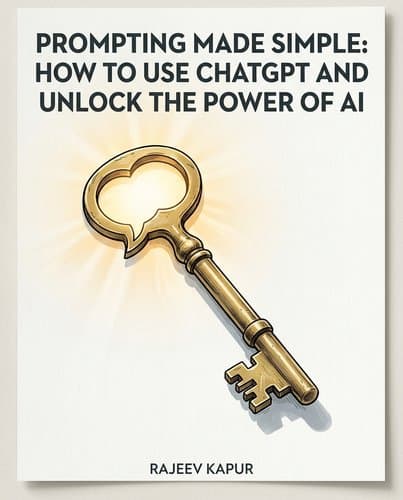
237366450_prompting-made-simple
by Rajeev Kapur
Master AI-assisted freelancing by learning exactly where ChatGPT compresses your workload and where human expertise still commands premium rates—with concrete…
In Brief
Prompting Made Simple: How to Use ChatGPT and Unlock the Power of AI (2025) shows how to use ChatGPT as a productivity tool for freelance work across copywriting, social media management, and other gig economy categories.
Key Ideas
Copywriting rate table: beginner to expert pricing
Use the copywriting rate table as your starting anchor: beginners at $25–$50/hour, intermediates at $50–$100/hour, experienced writers at $100–$150+/hour — this is the book's most grounded earnings ladder and works as a pricing reference whether or not you use AI
ChatGPT as draft tool with human voice refinement
Treat ChatGPT as a draft-compression tool: give it a specific prompt, review the output critically, then rewrite in your own voice. The 'human in the loop' workflow is where the book's practical advice is most defensible
Social media prompts pair platforms with real industries
Use the Social Media Management prompt list (Chapter 4 and 12) as a plug-and-play client pitch tool — it's the most platform-specific and business-concrete section, pairing named platforms with real industry types rather than generic task descriptions
Survey side hustle lacks internally consistent income data
Approach the survey side hustle with skepticism: the income figures are internally contradictory and the advised use of ChatGPT to generate opinions you don't hold undermines the value of market research — this chapter is the book's weakest practical guidance
Niche expertise drives premium earnings over generalist work
Specialize early: across every hustle category, niche expertise is identified as the primary lever for moving up the earnings ladder — legal translation, technical copywriting, and industry-specific social media management all command premium rates over generalist work
Chapter 12 prompts provide quick starting drafts
The 119-prompt compendium in Chapter 12 is the book's most immediately usable section — open it before any client call or new project to get a starting draft in seconds, then treat the output as raw material rather than finished work
Who Should Read This
Readers interested in Artificial Intelligence and Copywriting, looking for practical insights they can apply to their own lives.
Prompting Made Simple: How to Use ChatGPT and Unlock the Power of AI
By Rajeev Kapur
10 min read
Why does it matter? Because the gig economy just got a new entrant — and it doesn't sleep, complain, or charge by the hour.
Here's the real question nobody asks before signing up for an AI-assisted freelance gig: what exactly is ChatGPT replacing? Your slow morning? Your writer's block? Your entire skill set? Because the answer matters enormously, and most of the hype gets it wrong in the same direction — overclaiming what beginners can do with no existing skill. This book maps ten concrete income streams — blog writing, copywriting, video scripts, social media management, resume writing, virtual assistance, children's books, customer support, survey work, translation services — and attaches real earnings benchmarks to each one. But tucked inside that practical framework is a tension the author never quite names directly: ChatGPT is a genuine accelerant for people who already know what good work looks like, and a credible-sounding shortcut for people who don't. Knowing which side of that line you're on is the only thing that determines whether this tool makes you money or just makes you busy.
The Earnings Figures Are Real — Here's What They Don't Tell You
The opportunity is real, but not every number the book hands you is equally trustworthy — and knowing which is which matters before you start setting rates.
The earnings figures across the book's first three chapters vary wildly in how useful they actually are. Chapter 2 claims beginner video scriptwriters can earn $50 to $100 per minute of finished video content. To illustrate the problem: a five-minute tutorial script would theoretically pay $250 to $1,000 — but the figure floats free of any grounding. No source, no typical client, no explanation of whether 'per minute' refers to a 90-second product demo or a 20-minute documentary. Most importantly, there's no sense of how long a minute of polished script takes to write, which is the only number that tells you whether this is a good deal or a bad one.
Chapter 3's copywriting rate table is a different animal. Beginners charge $25 to $50 per hour. Intermediates move into the $50 to $100 range. Experienced writers command $100 to $150 or more. This tiered structure isn't exciting, but it's calibrated — it maps to how most freelance platforms actually bucket talent, gives you a concrete landing zone at each career stage, and lets you reverse-engineer a realistic monthly income target against a plausible client load. It's the kind of benchmark you can use in a rate negotiation without embarrassing yourself.
The lesson isn't that one figure is honest and the other inflated. A number without a denominator — without time, without context, without a realistic floor alongside the ceiling — is decoration. The video figure might be accurate for a specific niche with the right clients. But you can't plan around it. The copywriting table gives you something to stand on.
As you read the chapters ahead, keep that in mind: if a number doesn't tell you how long it takes to earn it, treat it as decoration.
ChatGPT Is a Productivity Multiplier, Not a Ghostwriter — And the Difference Matters
Think of ChatGPT as a pressure washer, not a painter. It strips away the time-consuming layer work — the initial research, the blank-page paralysis, the rough-draft slog — so the person holding the tool can get to the actual craft faster. What it doesn't do is decide what the wall should look like when you're done.
The book is consistent on this point across every hustle it covers, and it matters most in the writing and copywriting chapters. The workflow goes like this: give ChatGPT a specific prompt, get a draft back, then reshape that draft in your own voice for your specific client. For a copywriter building email campaigns, that means feeding the tool a campaign objective and pulling out usable body copy — then reworking it to match the client's tone, testing what converts, adjusting. The AI handles the compression. The freelancer handles the judgment. The book is explicit that skipping the second step produces content that might be grammatically fine but won't fit any particular brand, which is the only thing clients are actually paying for.
Here's what that means when a client asks your rate. Because ChatGPT compresses the time it takes to produce a first draft, you can take on more projects in the same number of hours. But your rate isn't set by how fast you work — it's set by the quality of what you deliver after the human pass. An experienced copywriter charging $100 to $150 per hour isn't selling speed; they're selling the judgment that separates a generic AI output from copy that actually moves a client's audience. ChatGPT improves your throughput. Your skill sets your ceiling.
Starting rates of $25 to $50 per hour aren't a reflection of ChatGPT's limitations. They reflect where your editorial instincts are right now — and editorial instincts take time to build. You're not being paid for prompts. You're being paid for knowing what a good result looks like and being able to get there reliably. The beginner rate isn't a ceiling; it's a starting point that moves as your judgment does. ChatGPT gets you to a draft faster. Experience is what tells you the draft isn't finished yet.
Ten Income Streams, One Toolkit — What the Prompt Library Actually Gives You
What separates a useful AI tool from one that just sits in a browser tab, theoretically available but practically ignored? For most people, the answer is specificity — having a starting point concrete enough to actually run with. That's what the prompt library across the book's chapters is designed to provide, and the Social Media Management chapter is where it works best.
The book covers ten distinct income streams, each following the same rhythm: here's what the work involves, here's what you can earn, here's how ChatGPT fits in, here's how to find clients. Two of the widest earning ranges are worth pausing on:
- Social media managers: $30–$75 per hour, depending on the number of platforms and how much content creation is included versus scheduling and engagement alone.
- Resume and bio writers: $5–$25 per project on Fiverr at the entry level, but writers who specialize in executive résumés or LinkedIn overhauls regularly charge $200 or more — the same basic task, priced by client and stakes.
The range on both is wide enough to accommodate the person testing the waters on a weekend and the person trying to replace a salary.
But the earnings figures are just orientation. The real toolkit is the 20-prompt list in the social media chapter, and its value is in how specific it refuses to be vague. These aren't prompts like "write a social media post for a business." They're prompts like "develop a TikTok content strategy for an eco-friendly cosmetics brand to connect with a younger audience" and "generate a list of 10 Facebook post ideas for a veterinary clinic." Each one names an industry, names a platform, and names a goal. A beginner can copy that prompt directly into ChatGPT, get usable output, reshape it for a specific client, and have a deliverable — without needing to already know what a TikTok content strategy looks like or what veterinary clinics typically post about. The prompt handles the scaffolding. The freelancer handles the final fit.
The prompt library's real function is compressing the learning curve across ten different markets simultaneously. You don't need years of industry experience to write a 30-day content calendar for a bakery's Facebook page. You need to know what prompt gets you close, and then you need enough editorial judgment to clean up what comes back. The library gives you the first part. The editorial judgment — what to cut, what to push the AI to redo, what a good deliverable actually looks like — is what the skill-building covered earlier in this summary is designed to develop.
The Book Promises to Show ChatGPT in Action — Then Mostly Doesn't
The book has a structural promise baked into its title and chapter design: you will see ChatGPT working. Multiple chapters include a dedicated 'ChatGPT in Action' section, set apart from the surrounding instruction, apparently there to deliver exactly this — a live demonstration. In Chapter 2, two examples are flagged by name: a prompt written in the style of Nas Daily, the fast-cut documentary creator, and one modeled on Mr. Beast, the high-production stunt YouTube channel. These aren't vague references; they're specific, recognizable creative voices that would make genuinely useful style templates. Except neither prompt appears. Where the examples should be, there are placeholder lines — the book's scaffolding, never filled in. Chapter 7 does the same thing twice, promising a prompt for building a professional VA website and a second general-purpose VA prompt, then delivering nothing. A book premised on demonstrating prompt power contains gaps where its demonstrations were supposed to go.
A missing example isn't just a production oversight. The entire value proposition rests on showing you what well-constructed prompts produce — not just listing what they could theoretically do. When the demonstration is missing, you're left with a book that describes AI assistance in general terms and asks you to take the output on faith. The 119 prompts in the final chapter are all single-turn requests — 'generate 10 Instagram captions for a fitness brand,' 'draft a 30-day content calendar for a small bakery's Facebook page' — with no contextual variables, no role-framing, no scaffolding. Compare that to something like: 'You are a fitness brand copywriter targeting women over 40 — generate 10 Instagram captions that emphasize consistency over intensity.' One clause of added context and the output gets meaningfully tighter. For a complete beginner, the prompts as written are enough to get started. For anyone who has already spent a few hours with the tool, they read as orientation rather than instruction. The book is consistently better at naming what ChatGPT can do than at proving it.
The Survey Chapter Is Where the Logic Quietly Breaks Down
What happens when the AI-as-accelerant logic gets applied to a task where the human's authentic input is literally the product being sold?
Every chapter up to this point positions ChatGPT the same way: the tool compresses the grunt work, the human refines the output, and the freelancer's genuine judgment is what clients pay for. That framing holds for copywriting, social media management, resume writing. It quietly collapses in the survey chapter.
Chapter 9 describes three ways ChatGPT can help survey participants. The first is reasonable — it can help you structure a coherent answer to an open-ended question. The third is a straight productivity argument: faster answers mean more surveys, more surveys mean more earnings. But the second use case is the revealing one: if you're unsure how to respond to a survey question, ChatGPT can generate ideas and opinions to help you answer it.
Here's the problem. Market research companies, academic institutions, and brand teams pay for survey responses specifically because those responses represent real consumer opinions. The entire value chain depends on that authenticity. When ChatGPT generates the opinion, the researcher gets a data point that reflects the AI's synthesis of existing information — not what an actual person in a specific demographic actually thinks. The survey buyer is paying for genuine consumer opinions — signal. What they receive is noise wearing the signal's clothes.
The chapter doesn't acknowledge this tension at all. It sits alongside tips for staying organized and pursuing referral bonuses, framed as a straightforward efficiency gain. And that's what makes it the book's most revealing moment — not because the advice is malicious, but because the same logic that works cleanly everywhere else breaks the second it touches a context where authenticity isn't just a quality standard but the entire point.
The earnings contradiction buried in the same chapter points to a similar lack of scrutiny. One paragraph calls surveys unlikely to provide substantial income, noting most pay a few cents to a couple of dollars each. The very next paragraph states that many participants earn $50 to $200 per day — a figure two orders of magnitude higher, offered without a source or any explanation of how the two claims coexist. Neither number is wrong in isolation. Together, they suggest a chapter written to fill a slot rather than to actually reckon with whether the hustle makes sense. The survey chapter is where the book stops holding its own logic to account.
What the Book Is Actually Selling You (And Whether That's Enough)
Somewhere around the halfway mark, a reader pausing to absorb what they've learned about social media prompts and copywriting rates hits a chapter called 'Mid Book Review.' It opens with a Stewart Brand quote about technology rolling over people, recites the statistic that ChatGPT hit 100 million users within two months of launch, and then — within a few paragraphs — asks you to leave a review on Amazon. The pivot is that fast. The framing is that a review is an act of generosity toward fellow gig workers, a way to share key prompts with people who need guidance. But what the chapter actually contains is a quote, a usage statistic, and a name-check. No prompts appear. The chapter introduces nothing new. It lands at exactly the point where an engaged reader is most likely to feel good about the book and least likely to have developed critical distance — and it uses that position to collect social proof.
The authorship metadata in the final chapter doesn't add up. The closing words credit Mark Silver, 'The AI Entrepreneur,' author of a series of eight ChatGPT guides — while the chapter header names a different author entirely. The book's internal title differs from its listed title. The byline doesn't match and the title doesn't match. Figure out whose book you're reading before you take the advice on faith.
None of this erases what the book actually delivers — and what it delivers is real enough to act on. The prompt library spanning ten income streams gives a motivated beginner a real on-ramp: specific enough to run with, industry-specific enough to feel like more than filler. The earnings benchmarks, at least the tiered ones, give you numbers to stand on during a rate conversation. The platform-by-platform breakdown of where to find clients is orientation you'd otherwise spend weeks assembling yourself. That's a genuine toolkit.
But go in calibrated. The book is built to get you started, not to make you sophisticated. Treat the prompt library as scaffolding, the earnings figures as floors rather than ceilings, and the missing demonstrations as gaps to fill through your own experimentation. The value is real. The authority is performed.
The Question the Book Doesn't Ask
The tension the book never names is the only one worth taking with you. ChatGPT is genuinely useful — not because it thinks for you, but because it frees up the hours you'd otherwise spend staring at a blank document. That trade works every time you have real judgment to apply once the draft arrives. A copywriter who knows what a brand sounds like, a social media manager who understands why a veterinary clinic's audience responds differently than a cosmetics brand's — those people have something to compress. The survey chapter fails because there's nothing to compress. The AI isn't accelerating your thinking; it's replacing an opinion you were never meant to outsource. So carry the prompt library, use the rate benchmarks, find your first client. The skill might be knowing what a brand sounds like, or knowing that the draft still isn't done. Either way — before you open ChatGPT on any new project, answer one question honestly: what are you actually bringing that makes this output worth buying?
Notable Quotes
“Once a new technology rolls over you, if you're not part of the steamroller, you're part of the road.”
Frequently Asked Questions
- What is Prompting Made Simple: How to Use ChatGPT about?
- Prompting Made Simple shows how to use ChatGPT as a productivity tool for freelance work across copywriting, social media management, and other gig economy categories. It pairs a curated prompt library with practical pricing guidance, teaching readers to generate strong first drafts quickly and refine them with their own expertise to command higher rates. The book bridges technical AI usage with business fundamentals, helping freelancers integrate ChatGPT into existing workflows while maintaining quality standards and competitive advantage through specialized human expertise.
- How does this book recommend using ChatGPT for freelance work?
- The book treats ChatGPT as a draft-compression tool: give it a specific prompt, review the output critically, then rewrite in your own voice. This 'human in the loop' workflow is where the book's practical advice is most defensible. Rather than relying on AI-generated output as finished work, the emphasis is on using ChatGPT to accelerate the drafting stage while ensuring your expertise and voice remain central to client deliverables. This approach helps maintain competitive advantage through professional quality refinement.
- What are the recommended hourly rates for copywriting according to the book?
- The book provides a copywriting rate table as the most grounded earnings ladder: beginners at $25–$50/hour, intermediates at $50–$100/hour, and experienced writers at $100–$150+/hour. The author positions this as a starting anchor that works as a pricing reference whether or not you use AI. The framework helps freelancers establish baseline rates and demonstrates how specialization and AI proficiency can justify moving up the earnings ladder. This practical pricing guidance applies across copywriting specializations and markets.
- Which chapters of the book offer the most practical guidance?
- The 119-prompt compendium in Chapter 12 is the most immediately usable section — open it before any client call or new project to get a starting draft in seconds. The Social Media Management prompt list (Chapter 4 and 12) serves as a plug-and-play client pitch tool, pairing named platforms with real industry types rather than generic descriptions. Both sections prioritize concrete, business-ready applications. Treat the outputs as raw material rather than finished work to maximize their value in your freelance practice.
Related Book Summaries
Read the full summary of 237366450_prompting-made-simple on InShort