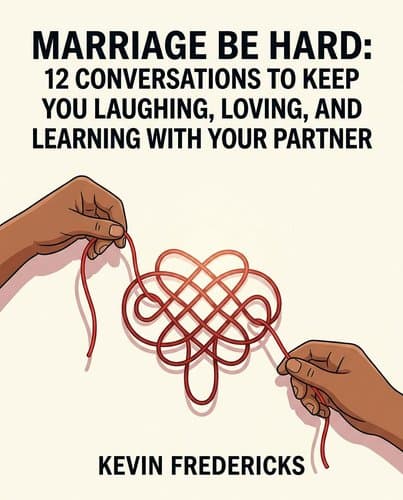
59883569_marriage-be-hard
by Kevin Fredericks
Most marriages quietly erode not from choosing wrong, but from unexamined religious and family scripts running silently in the background.
In Brief
Most marriages quietly erode not from choosing wrong, but from unexamined religious and family scripts running silently in the background. Kevin and Melissa Fredericks arm couples with specific conversation tools—including the honest/transparent/vulnerable ladder—to replace silent assumptions with the radical honesty marriages actually need.
Key Ideas
Vulnerability catalyzes change in relationships
Use the honest/transparent/vulnerable ladder in hard conversations: say what you feel (honest), then why you feel it (transparent), then what you're afraid it means about you (vulnerable). Only the third level exposes something you can actually be rejected for — which is also the only level that changes anything.
Explicitly map sexual desire with partner
Map your accelerators and brakes around sex explicitly with your partner — what builds desire, what kills it — before expecting guesswork. The stoplight method (green/yellow/red) gives both people a shared language without pressure or shame. Red never negotiates.
Renegotiate roles after major life changes
After every major life change — a baby, a job loss, a career shift, a move — explicitly renegotiate your roles rather than assuming the old dynamic still applies. Role calcification is silent and compounding; the longer you wait to renegotiate, the harder it becomes.
Identify jealousy's source: love or insecurity
Distinguish jealousy born of love (a real threat to the relationship, requiring action) from jealousy born of insecurity (suspicion without evidence, requiring internal work). Only the first requires a change from your partner.
Name your vulnerabilities before they're found
Name your emotional vulnerabilities to your partner before someone else finds them first. Knowing what would tempt you — and telling your spouse — is how you shore up the gap before it becomes a crisis.
Self-worth precedes partner affirmations landing
Your partner's affirmations cannot land until you believe them yourself. Self-worth work is a prerequisite for intimacy, not a reward for it. Start with what you already like, build campaigns from there, and say the words aloud in the mirror until you mean them.
Keep sacred moments private from performance
Keep some moments private — not every experience between you and your spouse is content, a lesson, or a story for friends. Privacy is not secrecy; it is the deliberate protection of something sacred from becoming performance.
Who Should Read This
People working on personal growth in Marriage and Relationships, especially those tired of generic motivational advice.
Marriage Be Hard: 12 Conversations to Keep You Laughing, Loving, and Learning with Your Partner
By Kevin Fredericks & Melissa Fredericks
9 min read
Why does it matter? Because your marriage problems started before you were married.
Most people treat a difficult marriage like a dropped call — move to better signal, try again, assume the connection will hold this time. Maybe read a book. Attend a retreat. Have the one honest conversation you've been delaying for three years. Kevin and Melissa Fredericks tried all of that. What they found, across eighteen years, two kids, one job firing between bites of a microwaved chicken thigh, and more therapy sessions than either of them budgeted for, is that the problem wasn't the marriage. It was everything that arrived inside them long before the vows — shame installed by purity culture, silence inherited from parents, expectations shaped by churches that knew exactly what a good marriage was supposed to look like and had almost nothing useful to say about how to actually live one. The damage doesn't announce itself. It just runs.
Before You Said 'I Do,' Someone Already Wrote Your Lines
Melissa was twelve years old when a pastor at her Sunday school held up a fresh piece of gum in its foil wrapper and asked who wanted it. Everyone did. Then he unwrapped it, chewed it slowly, and held up the wet wad. Who wanted it now? Nobody. That, he explained, is what happens to girls after sex.
Nobody told Kevin anything like that. His message ran in the opposite direction: unspoken approval when older men in the congregation bragged about their pre-conversion womanizing, peer pressure that made virginity embarrassing. They watched a woman in their church get removed from the choir when she became visibly pregnant outside of marriage; the man who got her pregnant, the church drummer, kept his seat.
What Kevin and Melissa Fredericks found, and what Marriage Be Hard is built around, is that the hardest fights in a marriage are rarely about the marriage. They're about the scripts written for you before you ever met your spouse. The church culture they grew up in (they call it 'churchy': the specific texture of the Black church, choir rehearsals and chicken dinners between services, call-and-response routines memorized before you could read) handed couples a narrow set of instructions about sex, desire, and worth. Girls got shame. Boys got permission. Neither got practical tools. Both walked into marriage carrying what they'd been taught to feel, with no map for what came after.
Unspoken Moments Don't Disappear — They Wait
Kevin had a bike in high school. Melissa had a car. On the way to a track meet junior year, she pulled over in frustration at his backseat driving and told him and his friend to get out. They walked. Kevin never said how small it made him feel. He tucked it away somewhere, unfiled.
Fourteen years later, married and living in Los Angeles with friends visiting from out of town, they're in Kevin's car at midnight, lost, looking for a Jack in the Box. Kevin is stressed; Melissa keeps directing him forward, certain it's just a little farther. It isn't. The tension builds the way late-night hunger and witnesses in the back seat can make it build. And then Kevin said it: "This is my car. If you don't like it, you can get out."
He thought he was being petty about directions. He was actually cashing a fourteen-year-old chip he'd never told her he was holding.
What Melissa heard had nothing to do with directions either. Her father had raised her with a single operating instruction: Don't depend on nobody for nothing. Ever. He taught her to change a tire and drive a stick shift, not as life skills but as armor against needing a man. Kevin had been out of work for five years, and Melissa had brought home every dollar without once using it against him. Now he had a new car, his first comedy tour was launching, and he was telling her she could get out. She received it as the flex she'd been watching for: proof that financial power, once gained, would be held over her.
She didn't say any of this in the car. Their friends were in the back seat.
That night she cried and explained how humiliated she'd felt. Kevin understood what he'd done wrong. What neither of them processed — not that night, not for years — was what the exchange was really made of: that his two words came loaded from a parking lot they'd never revisited, and that her silence in the car came loaded from a childhood spent watching her parents fight over bills they couldn't pay. They'd been arguing about directions. They'd actually been arguing about power, humiliation, and who gets to leave whom behind.
Even after Kevin's tour income made her salary unnecessary, Melissa kept her job. The fight had quietly answered a question she hadn't known she was asking, and the answer was: keep your own money. An argument about a fast food restaurant had reorganized their finances for the next several years — and neither of them saw it happening in real time.
Being Honest Is Not the Same as Being Vulnerable
Saying what you actually feel is the beginning of communication, not the end of it.
For years, Kevin skipped Melissa's work events while she showed up to his — standing in corners at fancy parties, smiling, saying nothing. When he agreed to attend her company holiday party and then backed out at the last minute for his own company's event, she said nothing then too. Weeks later, already dressed for his coworker's wedding, she announced she wasn't going. Reason given: tired.
Honest would have been: You never come to mine, so I'm not coming to yours. True, but it reads as accusation, and Kevin would have defended himself rather than heard her.
Transparent would have added the mechanism: I want you to feel the same shame I feel walking into an event alone while everyone else has their spouse there. Closer. He'd understand the score she was keeping. But he still wouldn't know what his absence actually meant to her.
Vulnerable is the version that only became possible once she understood it herself: I feel like a fool when I show up without you. It means something real to me that you show up for things that matter to me, even when they don't matter to you.
Honesty is the what: your actual feeling instead of the deflection. Transparency is the why: the fear or wound underneath the feeling. Vulnerability is the third and hardest — exposing what you're afraid all of this says about you, the part that risks real rejection.
The difference is exposure. The honest version tells him what you want. The transparent version tells him why. The vulnerable version tells him what his absence means to you — the interpretation you've been too afraid to name because saying it means he could dismiss it, or confirm your worst fear. That's the version with leverage, because that's the only version that requires something from him to answer.
The Frederickses spent years thinking honesty was enough. They were stopping two levels short of anything that could change their dynamic.
Kevin's response, once he finally understood: if she'd said this back then, he would have immediately corrected it.
The Church Taught You About Sex Without Teaching You Anything About It
Thirteen years in, they found a tool that gave them what purity culture never had: a shared vocabulary for what they actually wanted. The stoplight method: green means comfortable, yellow means open to discussion but not yet approved, red means hard no. The rule is precise — pushing on a red even once is a trust violation, and "can it just be yellow this time?" counts as pushing. They made a list, went on a European vacation to try the green and yellow items, and found that things they hadn't expected to attempt ended up moving from yellow to green. What they'd been missing for thirteen years was simply a shared map.
Emily Nagoski figured out that every person has accelerators (things that turn them on) and brakes (things that kill desire). Melissa's accelerators include emotional closeness and erotic conversation throughout the day; one of Kevin's brakes is being musty himself. Neither of them had these words before, which means neither could tell the other what they needed, or explain why certain moments shut down any possibility of sex. They hadn't been withholding. They hadn't known.
The tools are real and they work. But Melissa notes that after eighteen years of marriage, she still has to actively fight to keep the good-girl mentality out of her sex life. That's not a personal failure — it's how you measure a structural installation. The stoplight and the accelerators map are only accessible once the shame has been named. You can't use a framework to talk about what you want until you've admitted that you're allowed to want it at all.
Your Marriage Froze the Day Your Life Changed
The morning after Kevin Fredericks lost his job, he made his wife's lunch. Melissa came downstairs, kissed his forehead, and walked out the door to work. He stood in the kitchen feeling like someone had swapped the leads in a TV drama — she was the breadwinner now, he was the one at home.
That sounds like a setup. It's a precise report of where the marriage had traveled since the birth of their first son. The firing was just the moment it became undeniable.
Before Isaiah, they'd organized their lives around being in each other's orbit. Then the baby arrived, and the math changed.
Post-baby Melissa worked full shifts at a bank, did daycare pickup, came home to make dinner. The idea of dragging an infant through Seattle's cold, pitch-black rain to a late rehearsal where she had nothing to do was, Kevin acknowledged, obviously unreasonable. He understood it rationally. He experienced it as abandonment anyway — he wasn't foolish enough to ask her to drag the baby out for no good reason, and yet that's exactly what some part of him wanted.
He found a new stage manager. He stopped workshopping jokes with Melissa. Work and marriage filed into separate boxes. She didn't say she felt excluded; he didn't say he felt abandoned. Each of them built a narrative around the new arrangement and operated inside it for the next twelve years.
The roles had calcified so deeply that a financial reversal couldn't break them. Kevin's first tour generated more in a single month than either had made in a year; he asked Melissa to quit and join him, wanting to restore the old arrangement. She couldn't. She'd spent her childhood watching her parents fight over bills, had watched Kevin get fired, and had written herself as the family's last line of defense. That script didn't change because the balance sheet did. Kevin heard her refusal as proof she still didn't believe in him.
The signal broke through years later in the middle of a minor exchange about a soccer uniform, when Melissa said people respected her at her job. Kevin realized he'd had no idea what she was actually saying: not that she needed the income, but that she needed to be seen as competent, something the marriage had never figured out how to give her.
You Cannot Receive Love You Don't Think You Deserve
Try to hand someone a compliment they don't believe is meant for them. They smile, they say thank you, and they hand it back. Not deliberately. They just can't hold it. The mechanism that would let them receive it isn't there.
That's what Melissa Fredericks identified at twenty-four, though she didn't have the language for it yet. She went to the mall on a bank teller's salary and spent $75 on a personalized VeggieTales CD for baby Isaiah (his name in the recording, the first line playing Hi, Isaiah! Are you ready to have some fun?) without hesitation. Then she found a black-and-white pencil skirt that, in her words, spoke to her. She held it up, swayed in the mirror, and put it back when she saw it cost $50. She walked to the clearance rack, where she'd always shopped, because at the time that was where she felt she belonged.
That night she felt something she didn't have a name for: not regret for a purchase she'd made, but for one she hadn't. The skirt was still there in her mind. She'd decided $75 was fine for a one-year-old but $50 was too much for herself, and that was sitting there too, damning.
The work she did over the following year — telling herself in the bathroom mirror, out loud, "Melissa, you are worth it. As is. Without change. Without exception," and a used car lot sign that read For sale. As is. No exceptions. reframed as a rule — wasn't about building confidence so her marriage could give her something. "As is" meant she stopped requiring herself to improve before she decided she deserved things. It was about building confidence so she could receive what her marriage was already offering. Kevin had been telling her she was beautiful. The words were real. They were hitting a wall.
Her line is direct: she had to believe she was beautiful before she could take his word for it.
Which leaves a question at the end of this book. Not a theoretical one. What is the thing your partner has been saying that you have been returning?
The Conversation You Have Been Postponing for Years
Kevin and Melissa started their deepest therapy in the summer of 2021 — fifteen years after the rupture began, on a rainy Seattle morning when neither of them said what Isaiah's birth had just done to their marriage. The Jack in the Box fight, the one that quietly rewrote their finances for years? They didn't fully understand it until they wrote this book. Not the morning after. Not in therapy. In the writing of it.
That's the thing this book refuses to let you ignore. Not which communication framework to use, not whether you're doing the vulnerable version or just the transparent one — but this: what is the unvoiced thing living inside your marriage right now, and how many arguments has it already contaminated, silently, from the inside? How long has it been waiting for you to give it a name?
Notable Quotes
“I'm not going to the wedding because I'm tired.”
“I'm not attending your co-worker's wedding because you never attend things that are important to me!”
“I'm not attending your work event because you never attend mine and I want you to feel the same sadness and shame that I feel when I walk into an event and everyone else has their spouse on their arm and you're never with me. It's your turn!”
Frequently Asked Questions
- What is 'Marriage Be Hard' about?
- "Marriage Be Hard" examines why marriages fail not from choosing the wrong partner but from unexamined expectations, shame, and cultural silence that persist after the wedding. Published in 2022, the book by Kevin and Melissa Fredericks provides couples with practical frameworks for honest, uncomfortable conversations about sex, roles, jealousy, and self-worth. Rather than relying on guesswork, the authors argue that deliberate honesty builds lasting intimacy. The work emphasizes that couples must actively communicate and renegotiate their relationship dynamics to prevent silent role calcification and emotional distance.
- What is the honest/transparent/vulnerable ladder framework in 'Marriage Be Hard'?
- The honest/transparent/vulnerable ladder is a three-level framework for difficult conversations. Level one is honest: express what you feel. Level two is transparent: explain why you feel it. Level three is vulnerable: reveal what you're afraid it means about you. According to the authors, "Only the third level exposes something you can actually be rejected for — which is also the only level that changes anything." The framework prioritizes vulnerability as essential for genuine connection and behavioral change in marriage.
- What is the stoplight method for discussing sex in 'Marriage Be Hard'?
- The stoplight method provides a shared language for couples to discuss sexual desire without shame or pressure. Partners map their accelerators and brakes explicitly: what builds desire (green), what creates hesitation (yellow), and what kills desire entirely (red). According to the book, "Red never negotiates," meaning certain boundaries are non-negotiable. This framework replaces guesswork with clear communication, allowing both partners to understand each other's desires and limits. It transforms sexual intimacy from assumption-based to explicitly agreed-upon.
- What does 'Marriage Be Hard' say about role renegotiation in marriage?
- "Marriage Be Hard" emphasizes that couples must explicitly renegotiate roles after every major life change—birth of a child, job loss, career shift, or relocation. The authors warn that role calcification is "silent and compounding; the longer you wait to renegotiate, the harder it becomes." Assuming old dynamics still apply leads to unspoken resentment. Regular, deliberate renegotiation prevents roles from hardening into patterns that damage intimacy. This prevents silent drift and ensures both partners feel acknowledged.
Related Book Summaries

Read the full summary of 59883569_marriage-be-hard on InShort