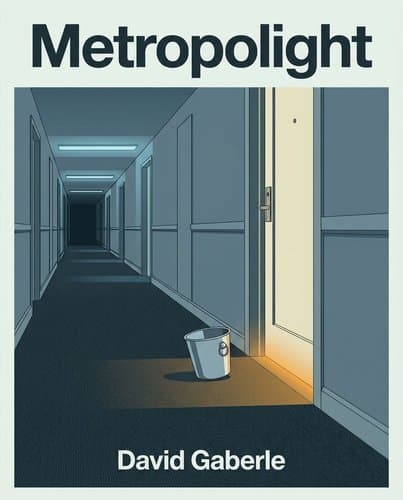
35237275_metropolight
by David Gaberle
Justin spends twelve years mistaking cowardice for kindness—a piercing story about the self-doubt we dress up as selflessness, and what it finally costs us to…
In Brief
Metropolight (2017) follows a man who abandons the love of his life — not from circumstance but from self-doubt dressed up as selflessness — and spends twelve years reckoning with that choice. Through his story, the book examines how fear masquerades as noble sacrifice, how doubt operates beneath conscious reasoning, and what it takes to stop running from what matters.
Key Ideas
Self-Sacrifice Often Masks Hidden Fears
The story 'I'm doing this for you' is almost always a story someone tells themselves — before accepting a sacrifice at face value, ask whose fear it actually protects.
Pre-Existing Doubt Invites External Pressure
Doubt doesn't need to win the argument. It just needs to already be there when the argument starts. External pressure only lands in territory you've already prepared for it.
Why You Leave Determines Your Outcome
There is a difference between walking away to save yourself and walking away to 'save' someone else. Halo found peace; Justin found twelve years of nothing. The direction — toward something real or away from your own fear — matters more than the act.
Love Survives Fear, Not Self-Blame
Love doesn't expire because you were too afraid to claim it. But it does require you to eventually stop inventing reasons why you're the problem.
Staying Still Is Love's Bravest Act
The bravest moment in a love story is rarely the declaration. It's the quieter decision, made in a hotel doorway or on a pier at night, to stay still when every old instinct says run.
Who Should Read This
Readers interested in Literary Fiction and Novels, looking for practical insights they can apply to their own lives.
Metropolight
By David Gaberle
9 min read
Why does it matter? Because the story you tell yourself about why you left might be the only thing keeping you from going back.
You'll probably assume the usual suspects kept them apart — a scheming manager, an incompatible world, a Europe departure. And you'd be half right. But the real obstacle was smaller, more embarrassing, and harder to admit: the story a twenty-two-year-old barista from Georgia told himself about why a rock star would eventually be better off without him. Metropolight is the story of a man who dressed cowardice up in the clothes of selflessness and wore that outfit for twelve years. It's about the distance between "I'm doing this for you" and the truth — that you were doing it for yourself, because loving someone that much, and believing you deserved it back, was simply too terrifying to sustain. Love, it turns out, doesn't expire. It just waits. The question is whether you'll show up before it stops being polite about it.
The Man Who Memorizes Coffee Orders and Calls It Nothing
Justin Holt is wearing coffee-stained Converse and an overgrown haircut when Diego Delgado walks through the door of a Chicago coffee shop called Clouds. He notices everything immediately: the skull-crossbones T-shirt, the violet-streaked hair, the voice that lands on his skin like warm water. He watches Diego move to the sugar station and catalogues every detail — two sugars, a splash of cream — and what runs through his head is not "I'd like to get to know him" but something considerably more final. He never says it. What he says is: "The least I can do is buy you a cup of coffee."
The coffee shop visit happens twelve years before the novel opens. By the time you meet Justin, he is sitting in a low-lit LAX airport bar nursing pomegranate martinis through a five-hour layover. He is a senior copywriter at a successful Chicago ad firm. He owns a lake-view condo. He has a cat named King Louie who tolerates him at best, a rotation of sympathetic friends, and a few men he can call when the physical need arises, which it rarely does. He catalogues all of this with forensic precision, the way you'd inventory a crime scene. Nothing is missing. Nothing is right.
What Justin actually has is a wound he cut himself. One morning twelve years ago, he slipped out of a New York hotel room while Diego Delgado, guitarist and eventual lead singer of a band called the Jetsetters, was asleep. He walked away and never went back. He has been furious at himself ever since. Not bitter, he maintains. He just drinks a lot.
In the LAX bar, a young woman a few stools down is playing music through her earbuds, punk and percussive, loud enough to bleed into the room. Justin recognizes the song immediately: Diego wrote it about him. He watches the woman (dark hair, combat boots, the look of someone who belongs in Diego's world) and starts to tell her that he once knew someone who looked exactly like her. He can't finish it. The sentence breaks somewhere in his throat, and then it's all images: the first concert, the first kiss, the first morning waking up next to the only man he ever loved.
He has been doing this for twelve years.
He Gives You His Dead Father's Dog Tags. That Is Not a Gesture. That Is Everything.
What Diego hands Justin in a Chicago alley — pressed into his palm while the tour van idles — is his entire origin story, compressed into metal.
The dog tags belong to his father, killed in Vietnam during the fall of Saigon, before Diego was ever born. Diego has never met him. But he has spent his whole life looking exactly like him, which carries its own cruelty: his mother, Dolores, has never stopped waiting for the man to come home. She still lives on the third floor of the same Pilsen apartment building where Diego grew up, on Chicago's Lower West Side: faded brick, wrought iron over every window, front steps cracked enough to register. Diego moved to Los Angeles three years ago and hasn't been back. Not because they fought. Because every time he looked at her, he could see exactly how much she was hurting, and there was nothing he could do about it.
The morning Diego is supposed to fly to Europe for a record deal, he tells his manager to wait and takes Justin to Pilsen first. He has never brought anyone here. He was always ashamed of where he came from. He says this sitting on his childhood bed, in a room his mother kept exactly as he left it: Pablo Neruda poetry on the desk, Jimi Hendrix on the wall, a quilt she made, a cartoon cowboy lamp on the nightstand, a single Fender guitar pick beside the clock radio. The room is a cast of the boy he was before he learned to be ashamed of him. He tells Justin this room was who he used to be — and that Justin is who he wants to become.
They arrived at the bedroom by first surviving Dolores. She answered the door in a polyester floral housedress and faded yellow slippers and immediately started feeding them (warm tortillas, rice, beans) before any serious conversation could happen. When Diego dropped his announcement mid-meal (Justin is my boyfriend, mi novio), she paused, looked at Justin directly, asked if he was in love with her son. When Justin said yes, she stood up, placed a warm rough hand on his cheek, and said she would get him more food. "And for me," she added, "the bottle of tequila." No speech. Acceptance delivered through her hands, the way she delivers everything.
She loved someone so completely that losing him never ended. She has been waiting decades for a man the world stopped making any promises about before Diego was born. Justin stands in her living room surrounded by knitted afghans and photographs of a boy growing up without a father.
Diego drops the dog tags into his palm an hour later. The dead father, the mother's grief, the Pilsen childhood, every mile between who he was and who he is trying to become. All of it transferred to Justin's keeping. Justin promises he won't take them off.
He doesn't know yet what keeping that promise will require.
Nina Slid $100,000 Across the Table. Justin Tore It Up. She Won Anyway.
Nina pushes a check across a green room table, the night of the Jetsetters' national television debut. A hundred thousand dollars. Justin tears it to pieces without hesitation and drops the confetti into her lap. He refuses to sell Diego out for the record label. It looks like a victory.
It isn't. The building had already decided to fall.
Months earlier in Chicago, after a bruising encounter with his friend Darla, who had agreed to marry her manager that hour in a lawyer's office to land a record deal, Justin finally ran the calculation he'd been putting off. Watching Darla treat her own future like a contract negotiation made the question unavoidable: in Diego's world, someone was already running that same math on Justin. He already knew how it came out.
He walked down State Street through ankle-deep snow and built the case against himself. Diego was a rising rock star touring Europe. Justin was, by his own unsparing accounting: a barista, a college student, a Georgian transplant still sanding down his accent word by word, the kind of guy who got mistaken for a Mormon missionary whenever he wore a collar and tie. Set against a man he privately thought of as a Latin rock star with thousands of fans per show and half of Europe in front of him, this did not seem like a promising brief.
What followed wasn't a passing anxious thought. It was a complete legal case, generated entirely by his own terror: a fully elaborated fantasy in which Diego falls for a French fan he names "Jacques Pierre" and lives an entire alternative life without him. They stroll through Paris while Justin trudges through Chicago snow. They share Brie under a street artist painting their portrait while a beret-wearing mime performs in the background. They propose at the Eiffel Tower, hold a countryside ceremony in matching tuxedos, open a French bakery, adopt French babies, spend summers on the Riviera. Justin's anxiety is so acute it generates the wedding toast for a relationship that doesn't exist yet. The specificity is the tell: this isn't fear. It's preparation for a verdict already reached.
So when Nina slides the check across the table and tells Justin he doesn't belong in Diego's world — that a man like Diego can't afford a boring, ordinary boyfriend, that Justin's very existence is a liability — she isn't introducing a new idea. She's reading his own notes back to him. He tears the check up, but he can't tear up the argument, because he wrote it himself on a snowy Chicago sidewalk months before Nina was ever in the room.
He waits for Diego to fall asleep, then gets dressed, collects the suitcase he'd moved downstairs while Diego showered (the pre-planning is its own quiet devastation), and slips out with an ice bucket as a prop. He says "I love you" from the doorway. Silence answers.
The person who lights the fuse often has nothing to do with it.
Halo Walks Away to Make Pancakes. Justin Walks Away to Make Nothing.
What's the difference between quitting a rock band and abandoning the love of your life? From the outside, both exits look like the same thing: a person choosing themselves over the machine. Halo is one of the Jetsetters. She walks away from the band the night of the Los Angeles show — sober, calm, utterly decided — having already flushed five of Mary Jane's pill bottles down the dressing room toilet, a parting act of love no one quite understood. Then she pushes the emergency exit door and sets off the alarm on her way out. An accidental fanfare for someone who has finally chosen herself. Five years later, she's running a retro pancake house near Santa Monica, wearing a pink-and-white uniform, and when Justin wanders in on a business trip, stomach empty, heart emptier, the first thing she tells him is she's never been happier.
Justin also exits. He does it with more planning: suitcase moved downstairs while Diego showers, ice bucket tucked under his arm as a prop, "I love you" delivered from the doorway to a man already asleep. No alarm. No fanfare. Just a man slipping out of a New York hotel room and five years of nothing.
Brenda (that's the name on the tag; Halo was a stage name she shed with everything else) doesn't let him off with silence. She tells him Diego has been teaching guitar to inner-city kids, hiding from the press, always single. Not thriving-without-him. Not destroyed. Just quietly, specifically, irretrievably changed. "He'll never be the same without you," she says, and then: "What about you?"
Justin can't answer. He can't sleep. He looks like hell. He said he wasn't counting the years and added "I think" immediately after.
That's the difference. Halo walked toward something she actually wanted. Justin walked away from something that terrified him, which is a direction, but not a destination. Halo's exit produced a life. Justin's produced twelve years and a life he's never quite been able to move into.
The Bravest Thing Left Is Not to Leave Again
Justin Holt arrives at the Santa Monica Pier having already had three martinis at the airport bar and paid fifty dollars to keep a cab waiting — because that is the level of certainty he's operating on. Nina intercepts him at Diego's recording studio on Sunset Boulevard, twelve years of guarding her investment still burning in her eyes. She dismisses the whole history in one line: it was just an affair. She gives up Diego's location only when he presses. Her parting shot is a warning not to screw things up again.
He walks to the pier anyway.
The music stops before Diego sees him. He's sitting on a bench facing the water, singing Bob Dylan's "I Want You" to the moon. Brutal to stumble upon, if you've spent twelve years telling yourself someone has moved on. The song goes quiet when Justin gets close enough, before Diego even turns. As if Diego senses the arrival before registering it. He turns, says Justin's name like a question, and asks: where have you been. Not you left me. Just that.
Justin explains himself: he convinced himself Diego would be better off without him. Diego doesn't argue. He says Justin was everything to him, still is. Then he mentions the song the record label forced him to rename "Justine." He says he kept the original title in the demo file on his laptop, twelve years, never changed it. Didn't see the point in pretending. Justin says quietly that it sounds like people have been making decisions for Diego for a long time. Diego agrees.
The novel has been building toward something grand: a confession, a declaration, an operatic settling of accounts. What arrives is Diego asking Justin to please wait one more minute before they go anywhere. He just wants to be beside him. Right here.
The bravery that took twelve years to reach turns out to be an absence: no exit. No slipping out with an ice bucket while someone sleeps. Just sitting still, next to someone who has been waiting, while the water and the moon and the guitar do their work. The case Justin has been arguing against himself for twelve years (meticulous, internally consistent, strong on the merits) goes to the jury right there on the pier. The jury's been out since 2012. It comes back in about thirty seconds. He doesn't contest the verdict.
The Song He Had to Rename "Justine"
Here is what Diego did while Justin was busy building a twelve-year legal case for why he didn't deserve him: he wrote a song. A real one. The kind with a specific name in the title, a name the record label made him change — Justin to Justine, one letter, the difference between a declaration and a disguise. The label wanted distance. Diego kept the song.
You can spend a long time being the person who doesn't believe they're worth the song. Justin was good at it. Thorough, even. But somewhere between a Chicago alley and a Santa Monica pier, the evidence stopped adding up. The song existed. It always had. The only question, the only one that ever mattered, was whether he'd eventually stop arguing with it.
He sat down. He didn't leave.
Notable Quotes
“My God, where have you been?”
“I was at the airport,”
“Diego stood up, still clutching his guitar.”
Frequently Asked Questions
- What is Metropolight about?
- Metropolight (2017) follows a man who abandons the love of his life due to self-doubt rather than circumstance. The story examines how fear masquerades as noble sacrifice and doubt operates beneath conscious reasoning. Through his twelve-year reckoning with this choice, the book explores what it takes to stop running from what matters. It contrasts his journey with Halo's, showing how the direction we move—toward something real or away from fear—defines our story far more than the act itself.
- What are the key takeaways from Metropolight?
- Metropolight teaches that "the story 'I'm doing this for you' is almost always a story someone tells themselves." The book reveals that doubt doesn't need to win arguments—it just needs to be present beforehand, with external pressure only landing on territory you've already prepared. It demonstrates the difference between walking away to save yourself versus to "save" someone else. Finally, it emphasizes that love doesn't expire from fear, but requires you to eventually stop inventing reasons why you're the problem.
- What does Metropolight reveal about fear and sacrifice?
- Metropolight reveals that fear frequently disguises itself as noble sacrifice and selflessness. The protagonist's story demonstrates how self-doubt operates beneath conscious reasoning, allowing us to rationalize abandoning what matters. A key insight is: "There is a difference between walking away to save yourself and walking away to 'save' someone else. Halo found peace; Justin found twelve years of nothing." The book suggests that before accepting sacrifice at face value, we should ask whose fear it actually protects.
- What does Metropolight suggest about love and courage?
- Metropolight argues that the bravest moment in a love story is rarely the declaration itself. Instead, it's "the quieter decision, made in a hotel doorway or on a pier at night, to stay still when every old instinct says run." The book teaches that love doesn't expire because you were too afraid to claim it, but it does require eventually stopping the practice of inventing reasons why you're the problem. Courage in love means confronting your own doubt.
Related Book Summaries



Read the full summary of 35237275_metropolight on InShort