33004340_millionaire-success-habits
by Dean Graziosi
Wealth isn't blocked by talent or opportunity—it's blocked by mental software other people installed in you without your permission.
In Brief
Wealth isn't blocked by talent or opportunity—it's blocked by mental software other people installed in you without your permission. Learn to identify your inner villain, rewrite your limiting stories, and swap in barely noticeable habits that compound into extraordinary results.
Key Ideas
Find your true motivating why through depth
Run the Seven Levels Deep exercise in writing: ask 'why is that important to you?' seven times, using each answer as the basis for the next question. Stop when the answer produces a physical or emotional reaction — that's your real motivating why, and it's the only one durable enough to sustain action through difficulty.
Eliminate one source of self-sabotage
Audit your three biggest inner villain suppliers — news consumption, focusing on weaknesses, and taking advice from people who haven't done what you want to do — and cut off at least one of them for 30 days to see what changes.
Replace limiting beliefs with proven truth
Write down your current limiting story (the sentence that explains why your desired breakthrough hasn't happened), trace where it came from, list three concrete examples that prove it false, then write a replacement story and say it aloud every morning and night for 30 days.
Eliminate tasks outside your genius zone
Draw your Unique Ability Circle: four rings labeled unique ability, excellent, good, and stink. Identify one task in the outer two rings that you're spending significant time on, and this month either delegate it, automate it, or eliminate it entirely.
Binary thinking eliminates gray area decisions
Apply binary thinking to your daily activity list: for each item, ask 'is this moving me forward or backward?' Anything that lives in the gray area ('I'll get to it eventually') is functionally a no — eliminate it or schedule it with a hard deadline.
Reframe hardships as success tax paid
Reframe your past hardships as your 'success tax' already paid. Write down three struggles you've been treating as disqualifiers and recast each one as a specific capability or resilience it built — the grind you did when no one was watching is what qualifies you.
Protect peace as strategic productivity input
Treat happiness as a productivity input, not a destination. Identify one daily habit that reliably generates genuine joy or calm and schedule it before your work begins — protecting your peace is strategic, not self-indulgent.
Who Should Read This
Business operators, founders, and managers interested in Habit Formation and Self-Improvement who want frameworks they can apply this week.
Millionaire Success Habits: The Gateway To Wealth & Prosperity
By Dean Graziosi
9 min read
Why does it matter? Because the habits steering your life were written by someone else.
You are working harder than any previous generation had to. You have access to more information, more tools, more inspiration than anyone who came before you. And yet something keeps winning — some invisible governor on the engine that caps what you actually do, what you actually earn, what you actually become.
The problem isn't effort. It's not intelligence or timing or the wrong economy.
It's that the software running your daily decisions wasn't written by you. It was installed early, by a teacher who told you what you'd never be, by parents passing down their own fears, by a culture that confused motion with direction. You inherited other people's limits and called them your own.
Dean Graziosi's argument is offensive in its simplicity: you don't need to reinvent yourself. You need to identify what's been doing the steering — and swap it out, one barely noticeable shift at a time.
You're Running at Full Speed — but You Let Go of the Wheel Years Ago
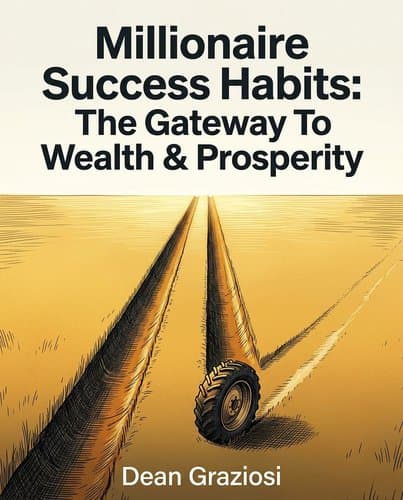
Picture a farmer who drives the same route every morning — a mile out across his pasture, grain on the back of the tractor, cows waiting at the same spot. He does this for twenty years. The wheels trace the same arc so many times that they carve physical grooves into the earth. One morning, he could put the tractor in gear and let go of the wheel entirely. The ruts would do the steering.
That's not a farming story. That's yours.
Most of us let go of the wheel years ago, and the ruts took over: same morning routine, same quiet ceiling on what seems possible, destination chosen by default, not by you.
Here's what the farmer's story actually says about change: he doesn't need to spin the wheel around. A quarter-inch turn, held steady, means that a mile down the road he can't even see the old feeding grounds. The ruts are behind him. He's carving new ones.
You don't need to overhaul your mornings or reinvent your personality. The habits running your life right now are evidence of consistency — just pointed in a direction you didn't consciously choose. Reach for the wheel. Turn it a quarter inch. That's where this starts.
The Answer That Makes You Cry Is the Only Answer That Actually Works
The first step is knowing what's actually been steering. Here's what that diagnosis looks like in practice.
Scottsdale, Arizona. Outdoor table, hand-carved chairs, 75 degrees. Dean Graziosi sits across from a consultant named Joe Stump, who asks why Graziosi hired him.
The answer comes easily: he wants his students more engaged, wants them to actually use what they've bought, wants to leave a legacy. Joe writes it down and asks why that matters. Three rounds in, the answers are still polished: raising industry standards, honoring the mentors he admires. His staff is watching, which makes what happens next harder to ignore.
Then something slips. His body changes before his mouth does. He shifts in the chair, his voice drops. What comes out is: I never want to go backward. He doesn't know why he said it. He's fighting tears in front of his employees.
Joe doesn't stop. Why don't you want to go backward?
At eleven, Graziosi and his father slept on a mattress in a bathroom of a house being renovated — the smallest room to hold heat against upstate New York winters. The heater cord ran through the doorknob hole. He rode to school in a car with doors held shut by rope and asked his father to stop down the block so no one would see. Twenty moves before nineteen. Parents married nine times between them. New schools, new stepfamilies, rooms that were always temporary.
The seventh answer arrived like something he'd always known but never said: I want to be in control. Not a control freak. Just never again at the mercy of circumstances he couldn't influence. That one sentence reframed his whole career: the firewood business at fifteen, the real estate deal before twenty, the obsessive drive to help students reach their potential. Same impulse, different clothes.
The exercise is called Seven Levels Deep. The first four or five answers come from the head — reasonable, defensible, interview-ready. Around the fifth, the body signals before the mind does. You shift, your voice changes, and what surfaces is what was actually steering the whole time.
Financial freedom, a nicer house: both can push you on a good day. Neither can carry you through the hard ones. The real why, rooted in specific emotional memory, doesn't need renewal. It keeps working when everything else shuts down.
Your Self-Doubt Didn't Come From You — Here Are Its Five Suppliers
Self-doubt is manufactured, not discovered — and five specific forces are responsible.
Graziosi names it the villain within, but naming it isn't enough. What matters is the source.
The news cycle is one. Time magazine covers were overwhelmingly positive through the 1950s, until editors discovered that negative headlines drew 30% more readers. Every outlet followed. The result: most people now spend most of their waking hours absorbing bad news that has nothing to do with their lives, and wonder why they feel stuck.
Bad advice from unqualified sources is a second: the relative who's never started a business telling you the market's too crowded, the friend who's never had a healthy relationship explaining why yours won't work.
Conformity pressure from parents and peers is a third. The people who loved you longest also formed their picture of you earliest, and that picture rarely updates when you do.
The wrong inner circle is a fourth. If everyone around you finds your ambition a little embarrassing, eventually you will too.
The fifth is the most insidious, because it arrived wearing the uniform of good intentions: the instruction to work on your weaknesses.
Graziosi wrote his first book knowing his grammar was rough. He'd been in special education through tenth grade, had ADD, and wrote the way he talked. He flew out to meet one of the country's top editors, left her the manuscript, and waited. The call came two days later: this isn't a book, it's a two-hundred-page conversation, and it needs a complete rewrite.
For 48 hours, every critical teacher from his past rushed back in. The villain had its evidence. He'd skipped his weaknesses, and the system had been right all along.
Then something shifted. He recognized what the editor was measuring against — formal writing standards that had nothing to do with the one thing he could actually do: take a message and deliver it in a way that moved people. He found a new editor, asked her to fix the grammar and leave the voice intact, and published it as himself. It became a New York Times bestseller.
His weakness was real. It just didn't matter.
One Sentence Held Gena Back for Decades. Changing It Cost Nothing.
Gena's kids are leaving, one by one. The last one heads to college. Her husband tells her they need extra income to cover tuition and wedding costs. What runs through her head isn't panic. It's a verdict she has already written: she peaked years ago, she's too old to do anything significant now, and her best remaining option is probably greeting customers at a department store. Her friends all say the same thing: sixty is the time to wind down.
That explanation felt like an honest reading of her situation. She'd assembled it from real pieces — decades as the organizational backbone of a family, a culture that sidelines women past a certain age, well-meaning friends urging her to settle in. But none of it was actually true.
What changed wasn't her circumstances. Her husband still needed income. Her kids were still gone. She was still sixty, with the same background, the same skills, the same bank account. What changed was the sentence she told herself about what those things meant.
Five years after rewriting it: her own business, profitable enough that her husband quit his job. More than twenty-five American cities, multiple countries. A waterfront home in Seattle. Every kid's college education paid from her earnings. Weight lost. Bucket list nearly finished. She co-authored a book. She spoke publicly about her transformation.
She didn't stumble into money or a well-connected stranger. Every external variable stayed the same. The only thing that moved was the story.
Graziosi's point, and it's the one that makes this whole framework worth taking seriously, is that Gena wasn't in crisis before she changed. She was comfortable, just quietly capped. The script didn't feel like a script. It sounded like a plain reading of the facts. That's what makes it hard to catch: the sentences doing the most damage are the ones that feel the most realistic.
The rewrite doesn't require different circumstances or a different starting point. It requires noticing that the verdict you've been living inside was handed to you from somewhere outside — and deciding it doesn't have to stay.
Nobody Is Born Confident — Confidence Has a Four-Step Recipe
Have you ever watched someone move through the world with easy confidence and decided they were simply built that way — that you either got it or you didn't?
Graziosi borrows a framework from Dan Sullivan, a business coach whose clients include many of the same entrepreneurs Graziosi works with. Confidence isn't a trait. It's the fourth step in a four-step sequence: Courage, Commitment, Capability, Confidence — always in that order, always starting before confidence exists.
Courage comes first, and it looks nothing like confidence. Someone stepping off a bungee platform for the first time isn't confident; they have no evidence yet that it'll be fine. They're willing to act without that evidence. Commitment follows: you can't succeed at something you're only halfway in on. Then capability: the specific knowledge acquired from the right source, because without it, the first real obstacle takes you out. When all three are in place, confidence doesn't have to be manufactured. It emerges on its own.
Carol Stinson ran this sequence without knowing she was running it. She grew up in Philadelphia believing one thing about money: "the poor stay poor." Her husband was out of work. She was feeding seven children. The electricity had been cut off and foreclosure papers were on the house. With the last money she had, against her husband's objections and her own resistance, she bought one of Graziosi's books. That purchase was courage: action before evidence. She committed, worked the material, and built a real estate investing business that earned hundreds of thousands of dollars. She bought a house and a car. She put every one of her children through college. The confidence came after all of that, not before.
The sequence is the recipe. Courage goes first, every time.
The $50 Lawn Your Father Would Hate — and Why He Was Dead Wrong
The old man arrives unannounced at his son's apartment complex in upstate New York — a converted mansion, nine units, massive front lawn. Someone else is mowing it. When he learns Dean paid $50 for the service, he loses it. You're going to go broke. You're not too good to mow your own lawn. He leaves so fast his tires kick gravel across the grass as he pulls away.
Easy to file under generational conflict and move on. But the real story is why a man who worked relentlessly his entire life never earned more than $30,000 a year.
Graziosi's father grew up during the Depression, and what that era wrote into him was ironclad: do it yourself, don't borrow, never pay someone to do what your own hands can do. Reasonable survival ethic for the 1930s. Decades later, it became a ceiling. The man was capable, hardworking, and completely stuck, because the story kept him spending time on tasks that anyone could do instead of the ones only he could do.
That Saturday morning, Dean was running a half-dozen real estate deals and a side business buying and reselling wrecked cars. A half day on the lawn was a half day off work worth $500 to $1,000. He paid $50. He made ten times that by noon.
Graziosi calls this the Unique Ability Circle — four concentric rings, financial sweet spot at the center. The bull's-eye is work you do at the highest level, that puts you in flow, that earns the most per hour. Moving outward: tasks you're good at but don't love; tasks anyone can do adequately; tasks anyone can do, period. The lawn is the outermost ring. The real estate deal is the center.
Binary thinking is the test: every activity is either moving you toward your goals or away from them. Gray area is always a no. Dean ran it on that Saturday morning — mow the lawn or work a car deal? One answer moves toward the goal. The other doesn't. If something fails the test, get it off your plate: hand it to someone else, cut it entirely, or find the $50 solution.
The story Graziosi's father carried was about virtue. The actual result was a cap. Those are two different things, and confusing them is expensive.
Your Past Hardships Are Already Paid Tuition — Not Evidence You're Behind
Think of a university that charges tuition upfront. You pay, attend, and graduate. Nobody looks at that graduate and says the tuition proves they're behind. The tuition was the cost of becoming qualified.
Most people read their personal history the opposite way. Every failure, every closed door, every year that didn't go as planned piles up as evidence against them: proof they started wrong, moved too slowly, or simply aren't built for the life they're chasing. The ledger feels like a deficit.
Graziosi calls it the success tax, and he learned what it means in a cold barn in upstate New York. His father's divorce destroyed the auto body shop they'd built together, a business with Dean's name on the sign before he'd even graduated high school. The bank took everything. His father told him to go find work at the local factory.
Instead, Dean moved what he could salvage into a broken-down barn on the property, installed a woodstove against the cold, and kept working alone. Nobody was watching. Nothing was guaranteed. He felt like a fraud.
He wasn't. He was paying. Every hour in that barn was a deposit into an account whose balance he couldn't yet see. Whatever auditor tracks these things was registering the refusal to quit, the willingness to grind when nobody was cheering. That barn became the foundation everything else was built on.
The reframe changes the arithmetic of your past. Those aren't failures in your ledger — they're receipts. The tuition is already paid. You are, by the evidence of your own survival, qualified.
From there, Graziosi hands you the tool: a 90-day sprint. Pick one goal. Strip everything else. Push for ninety days with the same stubborn focus Dean brought to that barn. Ninety days doesn't transform your life, but it does start converting old receipts into new evidence.
The Wheel Is Still In Your Hands
The ruts in that pasture didn't form overnight, and neither did yours. Same route, same assumptions, same hand off the wheel, year after year. The quarter-inch turn doesn't erase any of that — it just starts now. The tractor is still running. The wheel is yours.
Notable Quotes
“I remember thinking about it for a second before answering,”
“As I was sharing this, I wasn't even sure where the answers were coming from, but I was digging deeper and deeper into my”
“Then he said to me,”
Frequently Asked Questions
- What is Millionaire Success Habits about?
- The book argues that the real barrier to wealth isn't talent or opportunity — it's unconscious mental programming installed by outside influences. Graziosi's core thesis is that most people's financial struggles stem not from lack of ability but from limiting beliefs they absorbed unconsciously. The book delivers concrete habit swaps and exercises to help readers identify and replace these beliefs. Techniques include the Seven Levels Deep method for uncovering true motivations, limiting-story rewrites to challenge false narratives, auditing sources of negative influence, and reframing past hardships as skills already earned. The work is fundamentally about rewiring your mind to align with wealth-building behavior.
- What is the Seven Levels Deep method in Millionaire Success Habits?
- The Seven Levels Deep exercise requires you to ask yourself 'why is that important to you?' seven times in writing, using each answer as the basis for the next question. Stop when the answer produces a physical or emotional reaction — that's your real motivating why, and it's the only one durable enough to sustain action through difficulty. This method bypasses surface-level goals to access the deep emotional drivers that actually fuel sustained effort. Most people abandon goals because they're chasing external reasons rather than authentic, viscerally-felt motivations that the Seven Levels Deep method reveals.
- How do you rewrite limiting stories in Millionaire Success Habits?
- Dean Graziosi's limiting-story rewrite process involves four concrete steps. First, write down your current limiting story — the sentence explaining why your desired breakthrough hasn't happened. Second, trace where it came from, identifying the origins of this belief. Third, list three concrete examples that prove it false, breaking the story's hold on your thinking. Finally, write a replacement story and say it aloud every morning and night for 30 days. This daily repetition rewires neural pathways connected to the old belief, making the new narrative your default mental operating system.
- What is the Unique Ability Circle exercise in Millionaire Success Habits?
- The Unique Ability Circle divides your activities into four rings: unique ability, excellent, good, and stink. You identify one task in the outer two rings (good or stink) that consumes significant time, then this month either delegate it, automate it, or eliminate it entirely. The exercise forces you to stop wasting energy on activities that don't leverage your strengths or create real value. By offloading or cutting lower-value work, you protect time for activities in your unique ability ring, where you create disproportionate results. This is fundamentally about working smarter through ruthless prioritization of your attention.
Related Book Summaries
Read the full summary of 33004340_millionaire-success-habits on InShort