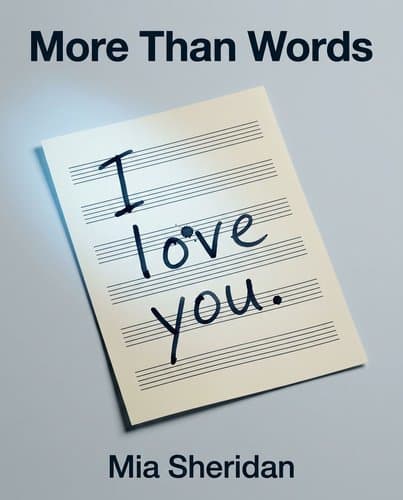
36342145_more-than-words
by Mia Sheridan
When shame convinces a man that he deserves to be abandoned, the woman who accidentally saved him with sheet music must choose whether love can survive someone…
In Brief
When shame convinces a man that he deserves to be abandoned, the woman who accidentally saved him with sheet music must choose whether love can survive someone who keeps pushing rescuers away. A story about how the most transformative gifts arrive unrecognized—and how grace, offered twice across a decade, can outlast a lifetime of being told you're worthless.
Key Ideas
Internalized abuse becomes your own voice
Verbal abuse does its deepest damage not when it's spoken but when the survivor adopts it as their own inner narration — at that point, the abuser doesn't need to be present. The work of recovery isn't silencing someone else's voice; it's recognizing that the voice doing the damage is now yours.
Unexpected gifts reveal hidden transformative power
The most transformative gifts often arrive sideways, in a form neither giver nor receiver recognizes. Jessica handed Callen sheet music thinking she was sharing a hobby. She was handing a dyslexic child the one visual system his brain could hold. You rarely know what you're actually giving.
Fear cannot determine your choices
'Live fiercely and without regret' is not advice about how to feel — it's advice about what to do when you can't know the outcome. Joan of Arc was afraid. Adélaïde ran toward a cave not knowing if Olivier was alive. The lesson is that fear doesn't get to make the decision.
Honest witness is the truest grace
When someone you love is destroying themselves, the most powerful intervention is the most uncomfortable one: naming what they're doing clearly ('at some point you have to stop being a coward') and then stepping back. Grace that refuses to witness the wound honestly isn't grace.
Imperfect effort proves real transformation
The most meaningful proof of inner transformation isn't a dramatic declaration — it's the evidence of quiet, imperfect work done for its own sake. Three blocky sentences with bleeding ink outweigh ten eloquent paragraphs, because they show what it cost.
Who Should Read This
Readers interested in Novels and Contemporary Authors, looking for practical insights they can apply to their own lives.
More Than Words
By Mia Sheridan
11 min read
Why does it matter? Because the man who makes music that breaks people open cannot hear his own — and no amount of fame, alcohol, or anonymous sex has been able to explain why.
He accepts France's most celebrated music award drunk, flashing the practiced smile while blank ledger pages wait back at the hotel. Callen Hayes can silence a concert hall, can drag grief and joy out of an orchestra with a single phrase — and he cannot read a single letter on a page. His father installed a voice early: worthless idiot, retard, disappointment. It outlasted every standing ovation. The answer was waiting in an abandoned California boxcar, where an eleven-year-old girl peered in at a bruised boy hiding alone and said I'm here to save you. She didn't know she was handing him the only visual language his brain could hold.
Awards, Accolades, and a Million Fans — and Still He Hears His Father
The morning after winning France's most prestigious classical composition prize, Callen Hayes sits in a Paris hotel room and flips through a stack of music ledgers. Every page is blank. Not one note in weeks. Not before the ceremony, not through the after-party, not through the rest of the night. He sinks into a chair, elbows on the desk, and hears what he always hears: a voice calling him worthless, saying it's ashamed to claim him. He thinks the voice is right.
The voice belongs to his father — installed early enough to stop feeling like an accusation and start feeling like weather. A small French indie film composition had broken through, then a Hollywood blockbuster, a decade of tabloid notoriety as the reckless bad-boy composer. Awards, sold-out concerts, critical praise. None of it touches the voice, because the voice predates the evidence — and something installed before you had language to argue back doesn't respond to argument. Worse, each new achievement gives it a new surface to colonize. At a charity ball, Callen tells a prominent music critic the new Hollywood score is nearly done. He has written nothing.
What the book layers underneath this, quietly from the first pages, is a woman. On the award night itself, Callen had slipped away from the hollow crowd and onto a closed rooftop terrace, where he found an ordinary-looking American waitress with freckles across her nose and a shyness that unsettled him in ways he couldn't explain. He kissed her. She kissed back with a guileless honesty that cut through whatever numbness had settled over him. Then he said something reflexively crass, his French companion appeared in the doorway calling the girl "the help," and she was gone. Weeks later he returned to that bar to find her. She no longer worked there.
He doesn't leave his name.
The Notes Had Weight. The Letters Never Did.
The sheet music fell out of Jessica's backpack by accident. Callen reached for it before she could explain, studied the page in silence, then pointed at the first symbol and asked what it was. An E, she said. He pointed at another. And another. These are all Es. His pulse was visible in his throat. His eyes had shifted into something past excitement — closer to disbelief.
She answered each one: E, G, B, A. She wanted to explain more — the clef, the key signature — but something made her stop. He wasn't curious the way people are curious. He was moving the way people move when they've been lost and just recognized a road. When she left that afternoon, he stayed with the page in the failing light and named every note on it, pointing at each one and saying it aloud, the way you repeat a new word until it stops feeling foreign.
He asked for more. He asked if she had a keyboard.
She did, barely touched in years. She carried it across the golf course and over the train tracks two days later, and within weeks he was playing things she couldn't have managed after years at a Schimmel baby grand. Partial melodies that trailed off before resolving, as if the music arrived faster than he could hold it.
It's only years later, Callen at a hotel window in France and finally out of places to hide, that he explains what was actually happening that afternoon in the boxcar.
He couldn't read. Not menus, signs, texts. Not his own name. Letters twisted off the page — no weight, no anchor, nothing to fix them. Musical notation was different. Each note was a small specific shape: a filled head, a stem, sitting at one fixed point on the staff, meaning one pitch, always. You didn't have to read it in sequence; you could land anywhere on the page and the note would tell you exactly what it was. He could look at one today and find it exactly as he'd left it yesterday. Nothing rearranged itself between readings.
He'd been diagnosed with a learning disability in childhood, but the diagnosis came packaged with humiliation. His father sat in on every tutoring session and watched. Unable to perform under that surveillance, Callen would act out, and eventually discovered that pushing hard enough would make his father end the lesson and hit him instead. He came to prefer the beatings. Physical pain was cleaner than being called an idiot in front of someone hired to fix you.
So what Jessica handed him wasn't a hobby. It was the only cognitive door that opened, and everything else he became was built behind it. His apparent recklessness, the drinking, the women, the hollow LA life: all of it was a person filling every silence before his father's voice could arrive first. A genius who cannot read his own reviews. A composer who built a cathedral and lives in the parking lot.
At Some Point, It Stops Being His Father's Voice
At some point during Callen's childhood, somewhere between the blurred letters and the backhands and the burning accuracy of words like idiot and retard, the voice stopped needing a body. He'd absorbed the narration completely. His father could have left the country, died, disappeared, and it would have continued without interruption, because it was no longer the father's voice at all. It was Callen's.
At a hotel window, after Callen has told her the truth about the letters, the tutoring sessions, the beatings he came to prefer over humiliation, Jessica listens to him explain that he still hears his father in his head, all the awards in the world bouncing off while that single voice cuts through, and names the thing he can't see: it isn't his father's voice anymore. It's his own. He's the one repeating those words now. He's the one keeping them true. Callen goes quiet, then admits he can't even tell anymore whose voice it is.
The voice isn't trauma echoing from the past: it's active maintenance. Every morning Callen wakes up and re-narrates himself into nothing, using the vocabulary his father left him. The women and the drinking and the noise work as distractions from that narration, not cures for it, which is why none of them ever take. You can't outrun a voice you're generating yourself.
Weeks later, at a launch dinner in Paris, Callen is drunk on a rooftop in a tuxedo, his bow tie already half-undone, calling himself a disgrace. Jessica points out that she didn't say that — his father did. Callen doesn't deny it. His father's word exactly, used on him first, now used by him on himself. She doesn't flinch: he's been carrying on his father's campaign ever since. It's the cruelest kind of inheritance. The book leaves this open: whether naming the wound is enough to break it, or whether it only teaches you what you're still choosing to do to yourself.
She Found Him in That Boxcar Three Times
Were the three meetings (a boxcar in California, a Paris rooftop, a Loire Valley château) just an author stacking coincidences to make a love story work?
After his father's sparse funeral, Callen breaks into his childhood home in Santa Lucinda, now stripped to bare studs and rotting pipes. He ends up in the kitchen — the room where his father would sit him down with an open book and scream at him to read. Something breaks loose. He tears the cabinet doors off their hinges, rips out the plumbing, beats the drywall with the pipes until he's bleeding and the walls are through. Then he collapses on the floor, sobbing: Why couldn't you love me?
Lying in the wreckage, he hears a child's voice say I'm here to save you — Jessica's voice, at eleven, in the boxcar. And the entire structure of his life rearranges. He'd been asking for help his whole life, begging God to let the letters hold still on the page. Something had kept answering. A girl arrived with sheet music his eyes could hold. A friend materialized when he needed one most. An assistant who, without being asked, read his messages aloud. He'd received every one of these as accident, because accepting them as answers would have required believing he deserved to be found.
The Paris rooftop was the cruelest near-miss — she'd used those exact words, meaning the door sign, not knowing she'd already said them to him at eleven in a boxcar and meant them literally.
The question the kitchen forces is simpler and more devastating: can he stop being the one who turns it away.
Joan of Arc Was Terrified Too — She Charged an Army Anyway
The novel runs two timelines. In present-day Paris, an American art historian named Jessica Creswell falls for Callen. Sideways, cautiously, with one foot already halfway out the door. Six centuries back, in medieval France, a young noblewoman named Adélaïde Durand has talked her way into Joan of Arc's inner circle, disguised as a servant boy.
Think of the most intimate letter you've ever received. Now imagine it was written six hundred years before you were born, by a woman who left it in a cave because she believed fate would deliver it to the right person. That's Adélaïde's final diary entry, dated October 1431, addressed to "dear unknown friend." The historian who cracked the medieval French was Jessica. The letter found exactly the person it was written for.
The medieval sections aren't decoration. They're a delivery system: the novel's central instruction, passed from Joan to Adélaïde, left in that cave for six centuries, finally decoded by its intended recipient — live fiercely and without regret.
Joan had explained what the phrase actually required. When Adélaïde asked how she'd gotten past the terror, Joan's answer was that she hadn't. God's voice had come at thirteen, out of nowhere, frightening enough to keep her locked indoors for days. She still trembled before every battle. She rode toward enemy lines anyway. Bravery wasn't a feeling that replaced fear. It was the decision not to let fear make the call.
Before all of it broke, there was a weekend in the Loire Valley that Jessica would spend years trying to un-know. A borrowed château, a peach tree bowing its branches over the kitchen window, Callen reciting something from memory in the garden while she pretended to read. She hadn't meant to be happy. It had happened anyway. That was the part that made everything harder — proof the thing was real before it wasn't.
That phrase lands for Jessica in a tiny inn room on a rain-soaked weekend in France, Callen out finding food. The question she's been circling isn't romantic at its core. Her mother had been brilliant, funny, and catastrophically in love with a man who needed her less than she needed him, and Jessica had watched her spend fifteen years making herself smaller, waiting. She left for graduate school having decided, very clearly, never to let a person become the organizing principle of her life. The choice she faces now is whether that decision still applies. Adélaïde's answer, direct from Joan, left in a cave for six hundred years: you don't wait until you're certain. You go while you're still afraid.
The Letter Wasn't the Payoff. It Was Evidence of the Payoff.
Callen pulls a folded piece of paper from his jacket with a trembling hand and asks Jessica, standing on a rain-soaked Paris sidewalk, not to laugh. She unfolds the page. Inside, in large blocky letters, ink bleeding where he stopped and had to concentrate before continuing, it reads: Dear Jessie, I'm sorry and I love you. Callen.
That's the whole letter. Three sentences. A first-grader could have written it faster.
Jessica calls it the most gorgeous love letter in the history of the earth, and she's right, but not for the obvious reason. The letter isn't moving because love finally arrived. Love arrived long before this. It's moving because of what it took to produce: a man who couldn't hold written language still on a page — who had, as a child, come to prefer his father's beatings over the humiliation of tutoring sessions that went nowhere — sitting down with a tutor named Madame Pelletier, the first person who'd ever sat across from him with patience instead of a stopwatch, and learning, from scratch, to write. Not because a publicist thought it would play well. Because he wanted to reach one specific person, and reaching her this way required doing the thing he'd spent his entire life hiding from.
What he's apologizing for matters. The hotel room ended with Callen looking at Jessica and saying, Turning into your mother already? — cold smile already in place, door closed in her face before she could answer. He'd chosen that line deliberately. People who've been hurt with precision learn the geometry of it; they know which word, at which angle, goes deepest. The wound he gave her was shaped exactly like the one he carried.
The real resolution had come months later, alone, in his childhood kitchen in California, gutted to rotting pipes and crumbling plaster, bank-owned now. Private, ugly work, witnessed by no one. The Paris umbrella, the letter pressed into her hand: none of it held without that.
You can't hand someone your wound as a love letter until you've actually looked at the wound.
Which is what makes those three sentences in their childish letters so precise. I'm sorry requires accepting that the hotel room cruelty — the cold smile, the door closed in her face, the line about her mother designed to land exactly where it did — was his to own. I love you requires believing he's worth loving back. Callen — signed with his own name, written by his own hand — requires everything the book spent twenty-five chapters building toward. The ink bled where his concentration broke. That's not failure. That's what proof looks like when the work has actually been done.
What Three Sentences Can Mean When They Cost Everything
The letter isn't what breaks you. What breaks you is the ink — the places where it bleeds slightly at the edge of a letter, where his hand stopped and gathered itself and started again. Three sentences. His own name at the bottom. That's the whole thing.
He sat down with a tutor in Paris and learned, from scratch, to write. Not for a prize. Not for a press story. For one woman who once dragged a keyboard across a golf course and over a set of train tracks because a boy pointed at a note and asked what is that?
You can build a career from inside the voice that calls you worthless. But you can only learn to write your own name once you've beaten the walls down and cried on the floor and stopped needing your father to answer. He wrote hers next. That's not romance. That's resurrection.
Notable Quotes
“This is for you. I, uh, wrote it for you.”
“I sucked in a breath. A letter.”
“Oh my God. Oh, Callen. He nodded, the expression on his face filled with such raw vulnerability that tears burned in my eyes.”
Frequently Asked Questions
- What does More Than Words teach about verbal abuse and recovery?
- Verbal abuse does its deepest damage not when it's spoken but when the survivor adopts it as their own inner narration. "At that point, the abuser doesn't need to be present. The work of recovery isn't silencing someone else's voice; it's recognizing that the voice doing the damage is now yours." More Than Words illustrates that healing requires acknowledging this internalized abuse and deliberately rebuilding your internal dialogue. Callen's journey shows that genuine recovery is slow, personal, and deeply about reclaiming your mind from an abuser's legacy of self-destruction.
- What role do transformative gifts play in More Than Words?
- More Than Words demonstrates that life's most transformative gifts often arrive unrecognized, in forms neither giver nor receiver understands. "Jessica handed Callen sheet music thinking she was sharing a hobby. She was handing a dyslexic child the one visual system his brain could hold. You rarely know what you're actually giving." The novel emphasizes that profound impact happens sideways, through simple acts of sharing what you love, not grand gestures of rescue. Callen's salvation came from someone unknowingly offering exactly what he needed most, illustrating how we change each other's lives without realizing it.
- What is the meaning of 'live fiercely' in More Than Words?
- "'Live fiercely and without regret' is not advice about how to feel — it's advice about what to do when you can't know the outcome." Fear doesn't disqualify fierce living; it accompanies it. Joan of Arc was afraid. Adélaïde ran toward a cave not knowing if Olivier was alive. More Than Words teaches that meaningful courage means acting despite fear and uncertainty, letting decisions and deeds—not feelings—define your bravery. Fierce living requires moving forward without the guarantee of success, trusting that action matters more than the emotional comfort surrounding it.
- What does More Than Words say about meaningful transformation?
- The most meaningful proof of inner transformation isn't a dramatic declaration—it's evidence of quiet, imperfect work done for its own sake. More Than Words illustrates that true recovery reveals itself through persistent effort rather than eloquent words or grand gestures. "Three blocky sentences with bleeding ink outweigh ten eloquent paragraphs, because they show what it cost." Callen's genuine transformation emerges not from perfect speech but from the grinding daily work of changing his internal dialogue. His proof lies in the visible effort of rebuilding himself, showing the actual labor of healing.
Related Book Summaries

Read the full summary of 36342145_more-than-words on InShort