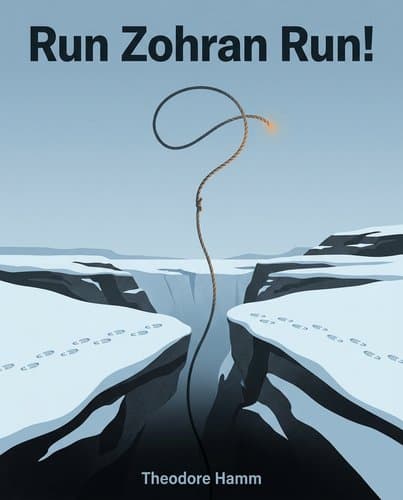
237816855_run-zohran-run
by Theodore Hamm
A drifting loner's stubborn refusal to perform belief in corrupt power structures costs him everything—and earns him the only things worth keeping.
In Brief
A drifting loner's stubborn refusal to perform belief in corrupt power structures costs him everything—and earns him the only things worth keeping. This Western strips away the mythology of rugged self-sufficiency to reveal that survival always runs through the people the powerful assume don't matter.
Key Ideas
Refusing false pretexts: the only dignity
Power structures don't need to be honest about their cruelty — they only need a pretext, and any pretext will do. The Dutch ride is ordered because Bowie 'stole' a horse he intended to return. Recognizing the pretext for what it is doesn't protect you, but refusing to perform belief in it is the only dignity available.
Mercy to the wrong person harms
Mercy extended to the wrong person — the person who will use your protection to do further harm — is not moral neutrality. Bowie's decision to shield Brady from Cyrus's knowledge is framed as compassion; it is structurally the cause of two deaths. The novel doesn't let this rest.
Competence and loyalty calculate separately
Competence and loyalty are not the same thing, and the powerful know it. Cyrus valued Nevers's work and distrusted his character simultaneously. The lesson isn't that competence is worthless — it's that the person you're loyal to is always making a separate calculation about you.
The powerless bear survival's weight
The people most likely to be dismissed or erased — the immigrant widow, the mute girl, the mixed-race ranch hand — are consistently the ones on whom survival actually depends. The novel keeps redistributing agency to whoever the powerful assumed had none.
Philosophy hardens as contradictions accumulate
A man's philosophy about solitude and self-sufficiency tends to harden exactly as the evidence against it accumulates. Cyrus's 'a man alone don't stand a chance' arrives late, costs him everything to learn, and is delivered to someone still young enough to act on it.
Who Should Read This
Readers interested in Novels and Literary Fiction, looking for practical insights they can apply to their own lives.
Run Zohran Run!
By Theodore Hamm
13 min read
Why does it matter? Because the codes men use to justify cruelty always collapse against someone stubborn enough to refuse them.
The Western hero rides alone. That's the myth — self-sufficient, answerable to nobody, stronger for his solitude. Theodore Hamm's Run Zohran Run! spends its entire length dismantling that fantasy one body at a time. Every man in this novel who believes he needs no one ends up either dead or killing to prevent someone else from proving him wrong. The drifter Bowie Candler arrives broke, horseless, and contemptuous of attachment — and what the book slowly forces on him, more painfully than any dragging, is the recognition that Cyrus Trapp was right: a man alone doesn't stand a chance. The violence here isn't spectacle. It's the sound of men destroying others rather than admit dependency. Follow that logic to its end and you'll understand exactly who inherits the earth — and what it actually costs to stop them.
The Law Is Just a Costume Sadism Wears
Bowie Candler is already on his knees in the wet grass, bleeding, when Brady Trapp gives the order. He'd borrowed a horse — a temporary, desperate thing, with the intention of turning the animal loose the moment he spotted a ranch — and Brady knows it. Sully, the half-blood rider in the group, says so plainly: a man carrying his own saddle through a rainstorm and stopping to build a fire isn't running. Brady doesn't care. He drives a rifle butt into Bowie's face without warning, then has Trinidad rope him and drag him across the meadow twice, until Bowie's body is scraped raw and the rope pulls him over his own campfire. The last sensation Bowie registers before he blacks out is a circle of burning pain spreading across his chest.
Horse theft is the costume Brady wears. It gives the whole performance a legal silhouette — a rancher protecting his stock, doing what frontier justice requires. But Sully refuses to participate and rides off, and even Trinidad hesitates. Brady's response to their reluctance is revealing: he doesn't argue the law, he argues appetite. He'd have strung Bowie up from a tree if he could. The dragging isn't punishment; it's what Brady wanted to do the moment he saw someone weaker and alone.
Nevers arrives after the fact and the costume comes apart — not from any legal reckoning, but because Sully is going to tell patriarch Cyrus Trapp what happened, and Nevers wants to be in the room when that story gets told. He brings the battered Bowie in on a makeshift drag, not out of mercy but to get ahead of Sully's account. He says this to Sully directly: they'll trade accounts, each covering the other's position. Nevers is neither villain nor hero; he's a man who has spent fourteen years climbing to the top of someone else's operation and intends to stay there. His honesty about his own motives is almost refreshing. He knows the law is a tool, power is the substance, and the only real question in any given situation is who controls the telling of it afterward.
The characters worth watching — Sully most of all — are the ones who can see the seam.
Every Patriarch Is Already Dying Before His Sons Know It
Cyrus Trapp holds the whole world of Chainlink together — and he's the only one in the room who knows the structure is already coming down. Everyone else is still treating him like a monument.
The crack shows one evening at the supper table, mid-sentence, when Cyrus's elbow slams the wood and he folds over, whispering the same word twice through gritted teeth. Nevers helps haul him upstairs, taking most of the big man's weight on his own shoulder. Cyrus, who built a fifty-square-mile cattle operation with his bare hands and once terrorized an entire town when he'd been drinking, can't find the stairs on his own. Nevers notes the strangeness of it without sentiment — a man he'd thought of as permanent, suddenly as helpless as an infant.
But Cyrus already knew. He'd spent the first two days of roundup in Saltville, not on business as he'd told Adah, but in Doc Rawls's office submitting to tests. Rawls couldn't confirm the diagnosis and sent him to a specialist in Denver. Cyrus had been sitting on that referral ever since. By the time he finally tells someone the truth — standing with Bowie Candler on a rock ledge above Yellow Pass, staring down at his own valley — he frames it with the flat economy of a man who has had time to get used to it: something growing on his brain, pain held in check for now with laudanum and opiates, expects to go hard when the time comes. Maybe he won't wait for it, he adds. No telling what a man will do.
What follows is the more devastating admission. He surveys everything he built — the land, the cattle, the buildings, the money — and tells Bowie it amounts to paper tenancy. The land was there before him. Adah will go back to the city the moment he's gone. His younger son can't take hold. His older son Brady will run it through his fingers like sand. Cyrus knows this about Brady precisely because Brady is already doing it: quietly running up gambling debts at a Saltville casino, debts Cyrus paid off once before under a hard ultimatum, now accumulating again. Nevers knows. He stays silent, calculating it isn't worth his neck to say so.
The patriarch is the last one surprised by any of it — because he isn't surprised at all. Cyrus had been right about that, at least. Bowie is inside the Chainlink orbit now, carrying what he knows, and what comes next will test whether that knowledge is a gift or a weight he can't put down.
Mercy for the Wrong Person Is Its Own Kind of Violence
What does it mean to show mercy to the wrong person? When Bowie catches Brady and Joe-Bob Trapp helping steal their own father's cattle in a hidden valley east of Yellow Pass, he has every justification to bring them in. Brady signed a fraudulent bill of lading to fence the animals at a Craigie stockyard, gambling debts being the motive. The evidence is clean. The witnesses are standing right there. Bowie refuses anyway. His reasoning is simple and genuinely felt — he's not following a rule; he's making a judgment about what Cyrus can survive. Blood feeling runs deep, and it would break the old man to know. So Bowie lets the brothers walk, warns Antrim's surviving men to clear the territory, and rides back to headquarters having resolved nothing except the immediate standoff.
The mercy feels humane in the moment. It looks like restraint, even wisdom — a man choosing the kinder wound. But follow it forward two chapters and the arithmetic turns ugly. Bowie's silence leaves Brady in exactly the position Brady was already in: debt unpaid, exposure still coming, and now the added pressure of knowing two witnesses are somewhere out there. When Searls and Quade eventually get caught robbing a bank in Craigie and start talking to save their own necks, the whole scheme surfaces anyway — the bill of lading, the gambling debts, Lucky Jack Hackett holding Brady's notes. Sheriff Beamis rides through the season's first blizzard to tell Cyrus what his sons did. Cyrus absorbs it, waits for Brady to come home drunk from Saltville, and goes out to the stable in a killing rage.
What happens next is not a murder in any clean sense. Cyrus charges Brady in the stall, Brady grabs a pitchfork in blind panic, and Cyrus runs himself onto the tines with the full weight of his own rush. The wounds alone might not have killed him — something had already been eating his brain for months. But the shock finishes what the illness started, and Cyrus pitches forward in the straw and doesn't move. Brady's first coherent thought is whether anyone witnessed it. His second is the cover story.
Bowie's mercy didn't cause any single one of these events. But it preserved the conditions that made them possible. If Brady had faced consequences in that valley, the chain breaks. Instead, Bowie absorbed the cost of someone else's self-destruction — tried to protect a dying patriarch from pain — and the pain arrived anyway, in a worse form, administered by the person he was trying to protect him from. The kindest decision in the book is also the one that kills Cyrus Trapp.
The People Who Get Erased Are the Ones Who Were Never Supposed to Matter
Sofie Ekstrom leaves her infant son alone for the first time on a gray afternoon in October, reasoning that he is asleep and she will be back in minutes. The visit with Adah Trapp runs a little long. By the time Sofie heads back across the yard, the sleet has turned fierce. She finds the cabin door swinging open in the wind — Jan came home drunk before her and either forgot the latch or didn't bother. Inside, her husband lies face-down and unconscious on the floor. Eric is in his crib in the whipping draft, soaked through, coughing.
The baby dies two days later. Not in Sofie's arms. She has finally been persuaded to sleep — Adah's arguments wearing her down after forty-eight hours of vigil — and Eric goes during those hours while Tula Calder and Adah keep watch. When Sofie wakes and sees Adah's face, she knows before a word is spoken. She finds her way back to the cabin on her own, sits in the cold room staring at the empty crib. She hasn't cried yet. She can't. Then Jan comes through the door — drunk again, face red and bloated — and something in her cracks open all at once. She goes at him with both fists, screaming the same word until he stumbles backward out the door and weaves away across the yard. Then she slides down the inside of the door and the grief finally arrives, in deep wrenching sobs.
Min lille gosse. My little boy. He is all there is. The line wasn't foreshadowing. It was a ledger entry. The only account Sofie had left, and the novel zeros it out with the same quiet efficiency it applies to everything these characters built — all that immigrant endurance, the second uprooting, the unexpected belonging she'd begun to feel at Chainlink — swept away by one drunk man's carelessness with a door latch.
Sully's death in Chapter Fifteen works on the same logic. He figures out faster than anyone that Bowie Candler, if he survived being thrown into a gorge, would have made for the old line camp. He packs food, takes the steeper route to get there first, climbs a treacherous hogback on foot when the horse can't manage it. He reaches the ridgeline, feels the wrongness of something before he can name it, and eases his rifle free. It doesn't save him. A single shot from the pines and he's falling, the darkness arriving before the full sound of the shot does.
The novel distributes its losses this way: to the woman who was never supposed to last, to the man whose loyalty and competence were never going to be enough. The people who absorb the worst of it are the ones the story's power structure treated as marginal all along. Sully was also the one person who might have told Cyrus the truth about what happened — and with him gone, that voice disappears too, leaving Nevers free to run the roundup on his own terms.
A Man Who Calculates Everything Eventually Miscalculates the One Thing That Matters
Sully never saw the hand that moved against him. Faye Nevers saw everything — and it made no difference.
Think of a man who spends years keeping a machine running — oiling every moving part, memorizing every fault, staying late, staying loyal — on the assumption that the owner has noticed. Nevers is that man. He runs Chainlink's fall roundup almost single-handedly: fifty square miles, two hundred riders, fifteen hundred horses divided among six captains. When Cyrus collapses at the supper table and can't find the stairs on his own, it's Nevers who takes the big man's weight and gets him to bed. Cyrus has said it plainly: he couldn't ask for a better foreman. Nevers has earned his place the only way a man without land or name can — through demonstrated indispensability, year after year.
Then Adah delivers the contents of the will, in the hayloft, during the blizzard, while she's still warm from what she imagines is their future. Brady gets full control. Nevers is merely "advised" — a word with no teeth. And Cyrus told Adah why: he saw the ambition in his foreman, feared what would happen if Nevers got the smallest foothold on Chainlink, and chose distrust as his protection. Not a word of this communicated to Nevers himself. Just a clause in a document sitting in a Saltville attorney's office, quiet as a trap.
The miscalculation runs both ways. Nevers assumed competence, faithfully performed, accumulates into something binding — that loyalty earns a ledger entry that eventually gets paid. Cyrus assumed that seeing through a man was the same as neutralizing him. Neither was right. Cyrus's distrust didn't diminish Nevers's ambition; it removed the last reason to suppress it. The moment Adah stops talking, Nevers makes his decision — not in stages, not reluctantly. Cold and instant: both Trapp sons must die, he will have Adah, and through her the ranch. Fourteen years of genuine service collapse into a murder plot in the space of one conversation. Cyrus had been right about what was inside his best employee. He just forgot that knowing it wasn't the same as making it safe.
What a Person Does When They Have Nothing Left to Lose Is Who They Actually Are
The novel's most reliable truth is this: the code that dismisses a person always underestimates them. And Sofie Ekstrom is the clearest proof.
You have watched her absorb loss after loss — the dead infant, the drunk husband, the slow erasure of everything she built when she crossed an ocean and started over. The novel has presented her, patiently and without comment, as a woman to whom things happen. Then Brady Trapp holds her at gunpoint in a high-ridge line camp, rifle leveled at Bowie, and orders her to strip. He expects compliance. What she does instead is think.
Bowie has been feigning worse injury than he feels, maneuvering himself toward a hatchet buried in a chopping block four feet from the fireplace. Brady is watching him. So Sofie gives Brady something better to watch. She rises, chin up, face white, and begins undressing with slow deliberateness — coat, then shoes, one at a time, hair falling forward to curtain her face as she kneels. Not surrender. Timing. She is buying the seconds Bowie needs, and she knows it, and she does it anyway, hands steady, eyes down, giving him nothing to read. Brady's jaw goes slack. His attention narrows. And Bowie throws the hatchet.
The throw misses its mark — deflected at the last instant by Brady twisting his body, the blade opening his shoulder instead of dropping him. What follows is a brutal, grinding fight: Brady hammers Bowie across the back with the rifle barrel, pins him to the floor, presses the weapon down onto his throat with both hands. Bowie's grip is going. And Sofie picks up the hatchet.
She brings the blunt heel of it down on Brady's skull. Hard enough to end the fight. Not hard enough to kill him. When Bowie climbs shakily to his feet, she says only: I could not kill him. She stopped him, and she refused to execute him, and she held both of those things at once — a moral distinction made under the worst possible pressure.
Earlier in the same sequence, she followed Sully Calder into the blizzard on her own judgment, hauling Bowie bodily over a gorge rim after he'd spent a night at the bottom of a sixty-foot drop with frostbite eating his face and blood slicking his shredded palms. Nobody asked her to go. She simply looked out her window, saw Sully ride north, and understood what it meant.
The code that dismissed her — as a widow dependent on Trapp charity, as a woman without standing — never once accounted for what she might do when there was nothing left to calculate. That's always the mistake. She doesn't save Bowie because she's brave in some abstract sense. She saves him because she decided to.
The Dream Was Never the Ranch — It Was the Struggle to Build It
What did Cyrus Trapp actually build? He stands on a rock ledge above Yellow Pass and surveys everything he has to show for fifty years — land, cattle, money, sons — and picks it apart piece by piece. The land existed before him. The paper that proves ownership is just tenancy. Adah will return to the city the moment he's gone. One son can't take hold; the other will let it dissolve through his fingers. The confession isn't false modesty. It's a man who spent a lifetime achieving the wrong thing, arriving at that knowledge too late to do anything but say it out loud to a cowhand he barely knows.
Bowie could only survive long enough to hear it because Sofie acted — and Cyrus, standing on that ledge, had no such person. He tells Bowie that a man alone doesn't stand a chance and means it as wisdom. But hear it against everything he just admitted, and it becomes something harder: a dying man recognizing that he built Chainlink in near-total isolation from any real human bond. His sons were strangers he whipped raw for failing to measure up. His marriage never worked. Even Sully, who is closer to a true son than either Brady or Joe-Bob, is kept at the careful distance of an employee. Cyrus names what he needed and never had. The warning he gives Bowie — don't be alone, don't choose someone with different ways — is an inventory of his own mistakes.
Bowie receives this and then, over the rest of the novel, refuses to repeat it. He walks across an open snow slope toward a leveled rifle in failing light, with nothing but an empty Winchester and the need to keep Brady's version of events from standing. That walk isn't heroism in the monument sense — it's a man who has decided that someone is worth the risk. When it's over and Sofie stands beside him on that frozen mountainside, Bowie thinks three words: where she belonged. Not a declaration. Not a claim. An acknowledgment. The struggle Cyrus described — the thing that was better than everything the struggle produced — is what Bowie has left standing at the end. Not land. Not paper. A person next to him in the cold, and the knowledge that she chose to be there.
What the Gorge at the Bottom of the Ridge Actually Teaches
Here is where the novel finally earns everything it spent. Bowie at the bottom of that gorge — frostbitten, horse dead, sixty feet of frozen rock above him — throws the lariat six times before it catches. Not because he's the kind of man who doesn't quit. Because Sofie is already riding north to find him, and Sully died getting there first, and the only thing worse than the gorge is the gorge meaning nothing. You can build fifty square miles of something and die alone in your own stable, or you can let one person know where you fell. When it's over and she's standing beside him, he doesn't claim her. He just looks at where she is. Then at the rope, still warm from six throws. That's enough.
Notable Quotes
“You killed him. You killed Pa.”
“He killed himself. Shut your goddam mouth. I got to think.”
“Kid. Listen to me. When Pa collared you in the house, was there anyone else about?”
Frequently Asked Questions
- What is Run Zohran Run! by Theodore Hamm about?
- Run Zohran Run! is a 2025 Western novel that uses one man's fight for survival to examine how power operates through pretext, loyalty, and the erasure of the vulnerable. The novel demonstrates that agency consistently resides with those the powerful overlook, and explores what it costs—in lives and hard-won wisdom—to recognize that self-sufficiency is not strength but a liability. Through its Western setting and complex character dynamics, the work interrogates the mechanisms by which power maintains control and who truly holds agency in survival situations.
- What are the key themes in Run Zohran Run!?
- Power structures in Run Zohran Run! operate through pretext rather than honesty; any pretext will serve the powerful's purposes. The Dutch ride is ordered because Bowie 'stole' a horse he intended to return. Recognizing this pretext for what it is offers no protection, but refusing to perform belief in it provides the only available dignity. Additionally, the novel explores how mercy extended to the wrong person—such as Bowie's decision to shield Brady from Cyrus's knowledge—can structurally cause harm rather than prevent it, illustrating that compassion requires moral clarity.
- How does Run Zohran Run! explore the relationship between loyalty and competence?
- In Run Zohran Run!, loyalty and competence are revealed as distinct operations within power structures. Cyrus valued Nevers's work while simultaneously distrusting his character, demonstrating that the powerful understand these are separate calculations. The novel's lesson isn't that competence is worthless—it's that the person you're loyal to is always making a separate calculation about you. This tension underscores a fundamental asymmetry: the loyal employee cannot assume their competence guarantees trust, while those in power maintain the freedom to value work while questioning the worker's loyalty.
- Who holds agency in Run Zohran Run! and why does it matter?
- The people most likely to be dismissed or erased in Run Zohran Run!—the immigrant widow, the mute girl, the mixed-race ranch hand—are consistently the ones on whom survival actually depends. The novel repeatedly redistributes agency to those the powerful assumed had none, subverting conventional power hierarchies. This pattern reveals that survival depends on recognizing capability where social structures have trained us to see only vulnerability or invisibility. Cyrus's ultimate realization that 'a man alone don't stand a chance' arrives late and costs him everything, yet delivers this hard-won wisdom to someone still young enough to act on it.
Related Book Summaries
Read the full summary of 237816855_run-zohran-run on InShort