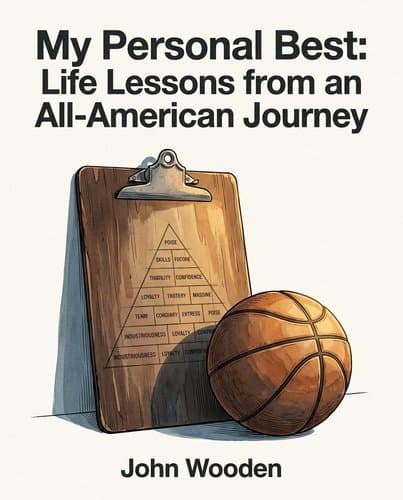
422357_my-personal-best
by John Wooden
Stop waiting for rescue and start making the quesadillas—survival is granular, not strategic. A divorced mother of four reveals how targeted decisions like…
In Brief
Stop waiting for rescue and start making the quesadillas—survival is granular, not strategic. A divorced mother of four reveals how targeted decisions like eliminating your loneliest hours, tracking paid bills on a legal pad, and deliberately building a village transform overwhelming circumstances into consecutive, winnable moments.
Key Ideas
Next action beats master planning
When you're overwhelmed, don't look for a master plan — identify the very next physical action and do only that. Make the quesadillas. Print the data. Scratch the backs. Survival is granular and sequential, not strategic.
Defend against vulnerable time windows
Identify the specific hours when loneliness drives your worst decisions and eliminate them from your day. If that window is 9–11 PM, go to bed at 9. This is not defeat — it's targeted defense.
Visual proof of consecutive wins
Keep a simple running record of bills paid — a legal pad with months across the top and each payment stamped PAID. The visual proof of small, consecutive wins provides more stability than any motivational system.
Trust parental gut without explanation
Trust a gut-level 'no' in parenting even when you cannot explain it to your child or to yourself. You don't owe anyone a logical defense — you owe your children your full attention to what you sense.
Build intentional village for children
Build your village deliberately: identify two or three people who could serve as extended family for your children, and explicitly give them permission to step in — to remind, supervise, coach, and occasionally be the tough voice yours cannot be.
Surface solutions miss soul-level needs
If gallery openings and facials leave you feeling the same emptiness in the car on the way home, the category of solution needs to change. Surface renovation doesn't reach soul-level depletion.
Act independently on deferred dreams
Name one thing you have been holding in reserve for better circumstances and take a concrete step toward it this week. Sign the contract alone. Buy the watch. The act of deciding — without anyone to confirm the decision — is the whole point.
Who Should Read This
Readers interested in Leadership and Mentorship, looking for practical insights they can apply to their own lives.
My Personal Best : Life Lessons from an All-American Journey
By John Wooden & Steve Jamison
9 min read
Why does it matter? Because waiting to be rescued is itself the trap.
Christmas Eve, church packed, candles everywhere — and Angela Thomas is genuinely counting her blessings until she makes the mistake of looking sideways. Every other pew: a man beside a woman, children between them. Whole. Or anyway, whole-looking in candlelight, which is the cruelest light for comparison. The ache lands immediately, the one that says we are obviously not that. She names it clearly and refuses to live inside it — which is not the same thing as not feeling it. Her book isn't a survival guide. It's something more specific: an argument, made in the smell of wet wool, a cancelled flight, and one Italian man's accent in Concourse B, that the real wound isn't a marriage that ended but the waiting: for rescue, for permission, for someone else to hand you back your life. The small acts of deciding turn out to be everything.
Going to Zero Is Not the End — It's the Only Foundation That Doesn't Lie
She's standing in the corner of a jewelry store, waiting, coat pocket holding what's left of her marriage. A man nearby is buying a diamond — three times the size of hers — examining it twice in direct light, talking about color and clarity and how much he loves the woman he's proposing to. She's trying not to watch him. She can't stop watching him.
When the shop owner comes through the back door, their eyes meet and she knows he already knows. She asks if he buys diamonds. He treats the transaction as if she's offered him something magnificent, no pity in his posture, no judgment in his voice, and thirty minutes later hands her a check for $1,400. She drives to the bank, cashes it, walks two doors down to a furniture store, and spends every dollar on children's beds.
That's the moment Angela Thomas marks as the beginning of her surviving.
She'd arrived at zero through divorce: four kids, three months in her parents' basement, hair falling out, thirty pounds gone, the kind of depression that makes taupe walls feel like a life sentence. She hadn't meant for any of this. She held a graduate degree in theology. Her parents had been married forty-five years without a single argument she'd witnessed. Divorce was a word that belonged to other people's lives.
But that's exactly what zero does: it dismantles the plan so thoroughly that the only thing left is what's actually real. And what was real, standing in that jewelry store, was the most clarifying transaction of her life. She had one asset. She liquidated it. She bought beds for her children. The math was that simple, and something in the simplicity cut through months of grief to a bedrock fact: she would do whatever was required. That decision — not the divorce, not the depression, not the months in the basement — was the actual beginning.
What she couldn't have anticipated is how thoroughly arriving at the bottom changes what you can receive. When she moved into the rental house a friend had found, she discovered the previous tenant had left it stocked: sheets in the closet, dishes in the kitchen, a lawn mower in the garage. Any one of those things, arriving in a more comfortable life, would have been a minor convenience. At zero, each one landed as something she could only call grace. She named the house "The Blessing," not ironically, and with no caveats about the mortgage.
Gallery Openings, Facials, New Restaurants: Why None of It Works
The common prescription for a depleted single mother — take a class, try a new restaurant, get out of the house — treats soul-level exhaustion like a scheduling problem. Angela Thomas tried all of it. Trips, facials, gallery openings where she had real conversations with interesting people. She'd drive home afterward and find the emptiness waiting for her in the car. Not reduced. Unchanged.
The problem with all of it was that she was solving for the wrong thing. Loneliness and boredom respond to social stimulation. Soul depletion doesn't. None of it touched what she was carrying, because the real problem wasn't that she was under-filled; she was hiding.
Here's the thing: she already knew where to go. She'd studied theology, taught Bible classes, believed deeply. But when her marriage ended, she decided that God must be disappointed in her, maybe even angry. She'd held herself to a high standard of having it together, and now she had it emphatically not together. So she kept going to gallery openings, because gallery openings don't ask hard questions about your divorce.
What finally broke the cycle wasn't a new strategy. It was a whispered question she'd been terrified to ask: "How could you ever love a woman like me?" The answer was Romans 8: the list of things that can separate her from God's love doesn't include divorce, or consequences, or failure, or any of it.
She describes what followed as a trade. She put her shame and brokenness on one side; mercy and love came back on the other. The exchange didn't require her to get cleaned up first. That was the whole point: she'd been waiting to show up presentable, and she could have waited indefinitely.
She needed to come out of hiding.
Coming out of hiding doesn't happen in a single dramatic moment. Hers started in an airport.
Loneliness Won't Kill You — But the Hours Between 9 and 11 PM Might
Saturday, Valentine's Day, Atlanta's Concourse B. Angela Thomas is dragging a rolling bag through the terminal, soaking wet, smelling like wet wool. The storm had arrived overnight in Mississippi, blowing sideways through every umbrella. She'd spent the entire weekend speaking to women about how God calls them beautiful. Her phone had shown her nothing: no texts from her four kids, no calls from anyone. She was moping toward her gate, praying just to make it to Sunday.
Then she felt a touch on her sleeve.
An elegantly dressed Italian man, somewhere in his mid-seventies, looked at her and said slowly: "You are vaaary beau-tee-ful." Then he turned and walked away.
She knew immediately. She'd said those exact words to a roomful of women all weekend. God had just crossed Concourse B. "The accent," she writes, "that was the bomb."
The story lands because it's honest about what loneliness actually is: not a season you endure until circumstances improve, but just the weather of the life. Angela describes the particular ache of a single mother — not dramatic despair, but the background hum of having no one to share things with. Full house, packed schedule, and still: a weird, ever-present longing for more that shows up even on the best days. Busyness doesn't reach it.
Which is why the hours between nine and eleven at night deserve your attention.
Angela identifies that window as her most morally dangerous — the time when exhaustion meets solitude meets the internet meets bad ideas. She'd seen what happened in those hours: women flying cross-country for a man they'd only met in a chat room, drinking alone in the dark, making purchases that didn't make sense. These women weren't making weak choices; they were choosing from emptiness. And she'd recognized, honestly, that she could become one of them.
Her response is simple: she just cut out those hours. In bed by nine. Her neighbor Lisa delivered the verdict: "Take your integrity and go to bed."
The practical bluntness is the point. Loneliness has specific moral exposure, concentrated in specific hours, and the most effective defense is a bedtime. Not a spiritual discipline or a therapy protocol. A bedtime.
Then God sent an old Italian man in a departure terminal to say the exact right thing. The method is almost funny. But abstract reassurance doesn't reach it; that accent, that sleeve, that moment does.
Survival Is a List, Not a Strategy
The flight had been canceled, the cab driver lost, the hotel never reached. Angela Thomas had slept three hours before a delayed return trip home, walked through her door, and immediately started testing paper towel absorbency with her son Grayson for his science fair. (Buy Viva, for what it's worth.) By seven that evening, her friend Lisa had arrived to help pack for the next four days of travel, the printer ink had run out mid-hypothesis, and the younger kids were circling through the study asking what was for dinner.
She looked at Lisa across the chaos and said what was true: "I don't think I can do this. I'm not going to make it this time."
Lisa said: "Just do the next thing."
What followed was a list, not a plan. She made quesadillas. Drove to the store for ink. Printed the experiment data. Laid out four days of clothes. Ironed the white shirt that goes with everything. Scratched every back, prayed every prayer, tucked everyone in. Brushed her teeth. Skipped the wrinkle cream and went straight to bed.
No arc toward recovery. One task at a time until there were none left.
Rebuilding from zero isn't a vision board. It's a sequence. The items on that list weren't meaningful in themselves. Quesadillas and ink cartridges don't add up to a life. But each one completed meant the next one was possible, and at the end there was a kid tucked in who had a science project to turn in tomorrow. That's enough. That's what enough looks like in the long middle.
She kept the same logic for six years of bill-paying. Bills listed down the left side of a yellow legal pad, months blocked across the top, each cell stamped PAID when something cleared. At the end of one year, she sat looking at a fully marked page and wept — not because anything was finished, the mortgage still had decades on it, but because the evidence was right in front of her: she had done it. At the top of the next year's page she wrote a title — a promise to herself and a note to God: keep watching.
Not a strategy. A record.
When Your Gut Says No, the Answer Is No — Even If You Can't Explain It
She pulls into a driveway in eighth grade — Taylor, her oldest daughter, making new friends — and every alarm inside her fires at once. Not a reasoned concern, not a checklist of risk factors. A presence, dark and unmistakable, felt before she's turned off the engine. She let Taylor go in anyway.
That's the part that matters: she already knew, and she went through with it.
When she returned, the feeling was unchanged. This time she didn't override it. She told Taylor she couldn't name what was wrong, wasn't accusing anyone of anything specific. But Taylor wasn't going back. Ever. The girls were welcome at their house; Taylor was not going to theirs.
What followed were months of social wreckage. Taylor, thirteen, endured it. The friends assumed her mom didn't like them. The mom didn't particularly care what thirteen-year-olds thought of her. She'd made a decision she couldn't defend, against people she couldn't indict, on evidence she couldn't produce. And she held it.
Three months later, at a grocery store, another mom explained exactly what that household involved. Angela had no rational case to make at the time. The danger wasn't visible yet. Her gut saw it anyway.
Solo parenting in the long middle runs on exactly this: not logic, not an argument you could assemble in time, but a readiness to act on what you feel before you can explain it. The price is awkwardness, a hurt kid, accusations of being unreasonable. The alternative is waiting until the danger is explicable, which usually means waiting until it's too late.
The missing co-parent is less a loss of hands than a loss of the person who holds these decisions with you. Angela's answer was concrete: Dave, Mike, and Rick, three married fathers on her street, explicitly invited to treat her children as their own. They remind the boys about the lawn, run safety briefings, take them camping. They're different enough from her to be heard.
She Waited Eight Years for a Man to Buy Her a Watch — Then Bought It Herself
Angela had a broken watch. After her divorce, she didn't replace it. A cell phone told time, and besides, she'd settled privately on the idea that someday a man might love her well enough to buy her one. Not something cheap. Something with the shape she liked, a little indulgent, the kind of gift you give a woman you want to keep. A symbol. So she waited. Eight years passed. The cell phone kept telling time.
On a January trip with her daughter Taylor, she stopped. She walked into a store and bought exactly the watch she'd been saving for someone else to give her: tiny diamonds, stainless-steel band, the precise shape she'd always wanted. She looked at it constantly afterward, not because it was a remarkable watch, but because buying it meant something larger than the object: a decision to stop holding her life in reserve and start living in it.
The paralysis doesn't look dramatic from the outside. A broken watch gets replaced on its own schedule, nobody's business. But internally, the wait had been carrying weight. A placeholder. A held breath. A life perpetually set to pending. And that's the book's final diagnosis. The yellow legal pad, the 9 PM bedtime, the gut-check at the driveway — all of it was deciding now, alone, with what was available. The watch was the same decision, smaller, with tiny diamonds.
She made a larger version of it when a builder asked whether she was certain about the kitchen renovation she'd been sketching on airplane ticket envelopes for two years. She told him she'd never be fully certain; the facts all said build, there was no one to make this decision with her, so they were going to build anyway. The signed contract was on the table when she wrote it down.
"There is no one" is what does the work — not said with bitterness, but as the plain fact that finally clears the way to act. Waiting for someone to confirm the decision, to co-sign the kitchen, to buy the watch, had felt like reasonable caution: facing toward a circumstance that wasn't coming, instead of living in the one that was here.
She bought the watch in January. They poured the footings a few weeks later.
The Ordinary Woman on the Altar
After seven sessions in two days in South Africa, her host Aldyth pulls Angela aside at dinner. She'd been asking God all weekend what drew people to her. The answer: you're so ordinary. Angela calls it the deepest compliment she has ever received.
The woman who sold her ring for children's beds, who goes to bed at nine to guard her integrity, who stamps PAID across a legal pad and weeps at the proof — she didn't become someone worth loving after she got her life sorted. She already was. Ordinary broken material, showing up in daily particular acts. Eight years of waiting ended not with rescue but with tiny diamonds on a stainless-steel band. The contract got signed. The footings got poured. You don't hold your life in reserve for a version of yourself that has it together. That version isn't coming. The ordinary one already is.
Notable Quotes
“I was wondering if you buy diamonds?”
“Just a minute and I'll get the owner,”
“It has all fallen apart, and I cannot possibly keep standing underneath all this heartache!”
Frequently Asked Questions
- What are the key takeaways from My Personal Best by John Wooden?
- My Personal Best distills John Wooden's philosophy of character-driven success into practical wisdom applicable to any field. When overwhelmed, Wooden advises: "identify the very next physical action and do only that. Make the quesadillas. Print the data. Scratch the backs." He teaches addressing loneliness by eliminating vulnerable hours defensively, tracking progress visibly, and trusting parental intuition without logical justification. Wooden advocates deliberately building support networks and recognizing that "Surface renovation doesn't reach soul-level depletion." The book emphasizes taking concrete steps toward reserved dreams independently. Its overarching theme is pursuing excellence through integrity, applicable to any endeavor beyond basketball.
- What is My Personal Best about?
- My Personal Best: Life Lessons from an All-American Journey (2004) draws on legendary UCLA basketball coach John Wooden's nine NCAA championships and decades of mentorship to distill a philosophy of character-driven success. The book offers practical wisdom on preparation, competitive greatness, and living with integrity. Rather than abstract motivation, Wooden provides specific frameworks for handling overwhelm, managing loneliness, tracking progress, building trusted communities, and recognizing when deeper personal needs require more than surface-level solutions. It gives readers actionable strategies for pursuing excellence in any field without sacrificing the values that make achievement meaningful.
- How does John Wooden's philosophy in My Personal Best apply to modern challenges?
- John Wooden's philosophy addresses contemporary struggles through practical, specific guidance. When overwhelmed, he advises completing "the very next physical action and do only that. Make the quesadillas. Print the data. Scratch the backs." To combat loneliness-driven poor decisions, eliminate vulnerable hours defensively. Wooden emphasizes trusting parental instinct, teaching that "you owe your children your full attention to what you sense" rather than logical justification. He advocates deliberately building extended family networks and recognizing when surface solutions fail. His philosophy prioritizes actionable steps and integrity over platitudes, making it especially relevant to today's complexity.
- Is My Personal Best worth reading?
- My Personal Best is worth reading if you seek practical wisdom over motivational clichés. Wooden's advice is refreshingly granular and unglamorous—focused on concrete actions rather than grand transformation narratives. Rather than abstract motivation, the book excels at addressing real vulnerabilities: loneliness, overwhelm, parental doubt, and spiritual emptiness. His teaching that "Name one thing you have been holding in reserve for better circumstances and take a concrete step toward it this week" exemplifies his emphasis on actionable specificity. The book bridges legendary athletic success with everyday struggles, making it relevant whether you coach, parent, or pursue meaningful work. Its strength lies in actionable guidance grounded in decades of mentorship.
Related Book Summaries
Read the full summary of 422357_my-personal-best on InShort