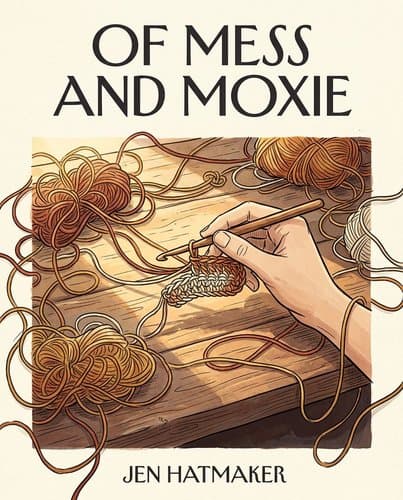
33099371_of-mess-and-moxie
by Jen Hatmaker
The extraordinary life you've been postponing isn't waiting in better circumstances—it's buried in the ordinary mess you're already living.
In Brief
Of Mess and Moxie (Augu) argues that the extraordinary life you're waiting for is already hidden inside the ordinary one you're living now.
Key Ideas
Live fully in your present circumstances
Stop treating your current life as a rough draft. The ordinary categories you're living in right now — not some improved future version — are where the extraordinary life is located.
Begin forgiveness practice with smallest honest prayers
When unforgiveness has you in a loop, start with the smallest honest prayer you can manage for the person ('please don't let them get hit by a car today') and let incrementally larger prayers follow. The practice loosens the anger regardless of how it starts.
Welcome people before your space is perfect
Replace 'my home isn't ready' with 'it's just paint.' Your neighbor wants to belong far more than she wants to be impressed. Nourishment is available today; impressiveness can wait.
Recognize and escape the Someday trap
Before hosting, decorating, or creating, ask whether you're waiting for the 'right conditions' — and notice whether those conditions have been almost-ready for years. That's the Someday trap.
Express kindness immediately or lose the moment
Voice-text every kind thought about a friend before it fades. The delivery rate on compliments you plan to say later is approximately zero.
Replace performative faith with unconditional love
If you recognize fear-driven religion in your past (performing devotion, avoiding 'wrong' people, keeping score), notice that the shift isn't to less seriousness — it's to love without strings. Snip the agenda.
Reweave broken threads instead of starting over
When your children or creative work or community produce something broken, the question isn't 'how do I start over?' but 'which threads can be rewoven?' God never creates a replica. He uses the same material.
Who Should Read This
Readers who connect with first-person stories about Christianity and Self-Improvement and want to see the world through someone else's eyes.
Of Mess and Moxie
By Jen Hatmaker
9 min read
Why does it matter? Because "Someday" is the most expensive lie you believe.
You've been meaning to start your real life. Just as soon as the house stops feeling like an ongoing apology, the marriage gets easier, the creative work gets noticed, the faith stops doing that wobbling thing. Once this season passes, once these particular pieces land, you'll be ready. You know the version of yourself you're waiting to become. You have a whole vision.
Jen Hatmaker would like to gently suggest that you've been conned. That waiting is not a holding pattern — it's a lifestyle decision with real costs. Of Mess and Moxie is Hatmaker's argument that the extraordinary life you're staging for doesn't arrive through better circumstances. It's already hidden inside the ordinary mess you're deferring — and the only way in is through showing up, imperfectly, right now.
The Ordinary Life You're Enduring Is the Extraordinary Life You've Been Waiting For
The life you've been waiting for is already here. Jen Hatmaker means it structurally: the ordinary categories you're currently grinding through — the career that hasn't quite launched, the marriage worn into a familiar groove, the faith that feels more habitual than electric, the parenting that is mostly logistics — those aren't the waiting room. They're the room.
Hatmaker names the alternative "Someday" — that hazy future moment when enough things finally shift and life resembles what you expected. She's blunt about what actually happens when you get there: you don't escape your circumstances, you inherit different ones. The woman waiting to feel like herself once the kids are older trades that problem for an empty nest that feels disorienting. The professional holding out for the promotion gets it and finds a fresh reason to feel behind. Someday is a moving target that resets every time you close in on it.
What replaces it is a reframe, not resignation. Most of life is, by sheer volume, ordinary. Marriage, career, faith, community, loss, and the daily work of being a decent person. That's not the obstacle to a meaningful life; that's where a meaningful life is assembled, day by day, in unremarkable settings, by ordinary people doing their imperfect best. Hatmaker's word for the energy required to do this — to show up fully to the life you have instead of waiting on the one you planned — is "moxie." Pluck. The stubborn refusal to defer.
Fear Dressed Up as Devotion Is Still Just Fear
A youth camp pastor made a throwaway comment — most of you will stop carrying your Bibles to class by October. What he'd done, without knowing it, was issue a challenge to a room of teenagers who competed at everything, including holiness. Jen Hatmaker kept hers on the corner of her desk through May. Fifteen pounds. Prominently displayed.
She tells this story on herself as the clearest possible image of faith operating on fear. She'd built a theology around staying on God's good side — a project she estimated she pulled off for maybe twenty minutes on a good day — and the terror of losing that standing drove everything. The Bible on the desk. The memorized answers. The careful management of which friends she associated with, lest their wrongness become her liability before a God she was already barely managing to appease.
The friend part had its own logic that felt airtight at the time. Proximity to someone's bad choices looked like endorsement, and endorsement was ground she couldn't afford to lose when she was already barely breaking even. Distance wasn't cruelty; it was math.
The whole posture was a Someday faith: someday the certainty would arrive, the ledger would balance, the right behavior would finally produce the approval she was working so hard to earn. She's blunt about the results — not transformation, but exhaustion, and a story nobody wanted to be part of. Including her.
What the actual plan calls for runs entirely in the other direction. Jesus spent his time at the tables nobody wanted to sit at, honored the people the institution had written off, and forgave his executioners while it was still happening. The whole thing reduces to one instruction: love your neighbor. Not as a long game toward changing them. Not as approval contingent on their choices. Just love, as the primary instrument — the kind that isn't quietly trying to fix someone.
And she had been genuinely trying to bring people in the whole time — into that same locked room, the one where God is never quite satisfied and the wrong friends are a liability. She thought she was offering something real. She just didn't know yet what the room was.
Creativity Isn't a Gift Some People Have — It's an Image You Bear
In 1998, Hatmaker was pregnant with her first child and reading A Girlfriend's Guide to Pregnancy — funny, frank, written like a friend in the next chair. She closed the last page with her first fully formed thought about what she wanted to do with her life: this is how I've always wanted to write. Five years later she finished a manuscript on the same subject (faith instead of pregnancy) and titled it, with zero irony, A Girlfriend's Guide to Bible Study. Then came the cease-and-desist from Vicki Iovine's lawyer. Hatmaker's response: she squealed "I GOT A LETTER FROM VICKI."
That reaction is the whole chapter. You don't discover your voice in isolation — you find it by being so lit up by someone else's work that you nearly steal it. Her actual first book, A Modern Girl's Guide to Bible Study, was borrowed tone and original truth. That's how craft develops.
Creating isn't a license issued to the professionally talented. Hatmaker frames it theologically: the Creator made humans in his image, and part of that image is the compulsion to make things. You write, garden, cook, photograph, build. The pressure in your chest demanding release is not vanity. You don't need an audience to justify it, a paycheck to validate it, or a world-saving purpose to earn it. If the only person it reaches is you, that counts.
By her twelfth published book, with a couple on major lists, Hatmaker still sits down every time feeling shaky and unconvinced. The recognition came; her internal weather didn't change. What actually delivers is the moment she stops watching herself and starts writing. The craft, the joy — it was always in the doing. You were never waiting on an audience. You were waiting on yourself.
Your Home Doesn't Need to Be Finished Before You Let People In
Picture walking into a girlfriend's house and stepping over the mountain of shoes at the door. The counters haven't been cleared. Someone pours you wine in a plastic Mardi Gras cup — it's what's clean — and hands you a knife to help chop carrots. Hatmaker calls this one of her favorite memories. Not because the room passed inspection, but because of what it offered: an unguarded welcome where nothing had to be earned first. The feature wall is forgettable. That welcome isn't.
The fear underneath waiting is that guests are auditing your house. They're not. Hatmaker and her husband have hosted crowds in apartments, duplexes, and homes with no dishwasher, no insulation, and no central air. The list of places they've lived that were "ready" by Someday's standards: none. If they'd waited for a finished space, she says, they'd have made their first real friends two years ago.
She's not arguing against beautiful things. Pretty rooms matter to her, and she'd be the first to say so. But beautiful and nourishing aren't the same project, and only one is urgent. You can put on a pot of chili tonight. The crown molding can wait. Your neighbor isn't coming to be impressed; she's coming to belong. Those are different offers with different requirements, and one of them you already have everything for.
Forgiveness Starts Smaller Than You Think — and That's the Point
Jen Hatmaker is standing at the bathroom mirror, practicing a speech. Not a work presentation — a righteous confrontation, body language calibrated for fury and nonchalance simultaneously, somehow also projecting every spiritual virtue she's ever claimed, delivered out loud to her own reflection on behalf of an argument she will never actually have. When her husband Brandon walks in, she dismisses his concern. She was winning that argument, and he couldn't prove otherwise.
This is years after the original injury. Outwardly they'd rebuilt. New city, new work, thriving season. The wound was structurally healed. But forgiveness? Nowhere close. She was still replaying correspondence, sharpening comebacks, privately delighting in any bad news that circulated about that person. All of it felt like standing guard over a real injustice. Someone had to.
The imaginary courtroom was Hatmaker's full-time residence. The person she'd put on the hook was almost certainly sitting in a meeting, buying coffee, maybe returning some shoes to the mall. Completely fine. The only one imprisoned by the unforgiveness was Hatmaker herself, month after month, year after year, deferring her own peace for a verdict that was never coming.
So God told her to pray for this person. Every day. She describes this as the meanest thing He ever said to her. She complied, grudgingly. Her early prayers barely cleared the bar: she asked God to simply not let anything bad happen to the person that day, and called it done. The anger was still stretched too tight for anything more.
But the practice kept going. Something loosened. She began to see the person's own history: the losses, the abandonment, the wounds that had made them volatile. She recognized places where she'd carelessly lit a fuse. Eventually she felt something she hadn't planned on: genuine tenderness. The relationship wasn't repaired. But she was.
That's the path Hatmaker is mapping. Not a decisive moment where you release and you're done, but a long practice aimed in a single direction — starting, if necessary, from the embarrassingly small prayer that's as far as you can honestly go.
The People Already Around You Deserve Your Best Devotion — Not the Leftovers
The school principal is calling the Employee of the Year, drawing out the reveal for effect — and then she names the head custodian: Josie Garza. Garza sprints to the stage with both hands over her face, completely undone. The entire auditorium erupts. Hatmaker, sitting in the audience with the other parents, choked down sobs until she nearly passed out.
She'd been building toward this scene, though she didn't start there. She started at her monthly dinner gathering — four couples, sixteen kids, the kind of night that runs past 1 a.m. — where someone once posed the table question: rich or famous? Hatmaker picked famous. Called it harmless, theoretical, almost fake. She has since changed her answer.
A few years of low-grade Christian celebrity gave her the material. She wrote books nobody read, got introduced as "Jen Hatfield" at small churches where nobody corrected it because nobody knew the right name. Google kept suggesting she'd misspelled "Jean Hatmaker." She misses Jean. But even that modest exposure was enough to name it: the whole system is designed to use you. Celebrity produces leaders polished on the outside and self-serving within, people who eventually turn followers into commodities. Hatmaker includes herself without hedging. Short-tempered, lazy, self-preserving.
Josie Garza had been at that school all year, steady, generous, cheerful through hard daily work, without anyone constructing a platform around her. She wasn't waiting to be discovered. The kids just voted to see what was already in the room.
That's the entire argument, visible in one auditorium. Hatmaker's prescription: devote yourself to Jesus first, then pour your devotion into the specific, named, nearby people in your actual life. The famous already have more than enough. The Josie Garzas in your life are waiting to be seen.
God Doesn't Start Over With Your Broken Life — He Reweaves It
Jen Hatmaker's mother-in-law Jacki once spent four days hunting elk alone on horseback in the Rocky Mountains in winter. Shot one, skinned and quartered it, packed it down the mountain herself. She also hand-stitched her daughter's wedding dress, because of course she did. So when Jen arrived at Jacki's door with a pile of slobbery, shredded yarn — Sydney's crocheted baby blanket, destroyed by the family dog in a single backyard rampage — she'd come to the right person. Jen didn't want a replacement. She wanted the old one put back together. These were the actual threads that had covered her sleeping daughter.
Jacki washed the fragments by hand, sorted through weeks of tangles, and slowly rewove the whole thing: slightly different in structure, same threads throughout, sturdier than before. Machine-washable now.
She was still carrying that image when she went back to a verse she thought she already knew.
Then Hatmaker finds the same word in the Bible.
In Genesis 50, Joseph tells the brothers who sold him into slavery: "You meant evil against me, but God meant it for good." The Hebrew word translated "meant" is actually the word for wove. You wove evil. God rewove it for good. The verse isn't saying God orchestrated the betrayal or that suffering is secretly fine. It's saying He picked up the shredded threads, the hate and abandonment and injustice, and rewove them into something that couldn't have existed without them.
That's her working definition of sovereignty. Not micromanagement of circumstances, but ultimate reclamation capacity. He doesn't throw out the ruined original and start with fresh material. He uses what's there. The exact threads that caused the damage are the ones He works with.
She's careful not to let this become a formula. The Bible doesn't offer one explanation for suffering, which means she refuses to offer you a template. The gap between Joseph being sold into slavery and standing before those same brothers as the second-highest official in Egypt was twenty-two years. Not a quick reweave. The threads take time.
That clears space for presence instead of explanation. You don't need to understand why someone is suffering to sit with them in it. Make the casserole. Weep alongside them. The reweaving isn't yours to manage. That's someone else's department. Yours is to stay in the room.
Still Standing Is the Whole Thing
Here's the thing nobody tells you when you pick up a book like this: you won't finish it fixed. The mirror-speech still escapes you on bad weeks. The dinner party keeps getting postponed. The life you expected by now looks nothing like the one you actually have.
And yet — you are still here. Still pulling up a chair to the table with imperfect hands and half-good intentions. Still trying. That isn't the consolation version of the story. That is the whole story. Hatmaker's word for it is moxie, but you could also just call it Thursday. The mess didn't clear. The ordinary stayed ordinary. And you stayed too. That is not a small thing to say about yourself. That is, in fact, everything.
Notable Quotes
“a wholesome alternative to Def Leppard!”
“If Bo don't know Jesus, then Bo don't know Diddley,”
“most of you will give up by October.”
Frequently Asked Questions
- What is "Of Mess and Moxie" about?
- Of Mess and Moxie argues that the extraordinary life you're waiting for is already hidden inside the ordinary one you're living now. The book challenges readers to stop treating their current life as a rough draft and start inhabiting it fully. Hatmaker provides practical tools for hosting imperfectly, forgiving incrementally, and showing up without ideal conditions. Rather than waiting for someday, the book teaches that the ordinary categories you're living in right now—not some improved future version—are where the extraordinary life is located. It offers actionable strategies to help readers embrace their messy, imperfect lives today.
- What does "Of Mess and Moxie" teach about the Someday trap?
- "Someday" is a trap because it keeps you from living fully today. Hatmaker identifies that many people postpone hosting, creating, or showing up until conditions are "right." Before hosting, decorating, or creating, ask whether you're waiting for the 'right conditions' — and notice whether those conditions have been almost-ready for years. That's the Someday trap. By recognizing this pattern, readers can shift from perpetual postponement to embracing their current circumstances. The book argues that nourishment is available today; impressiveness can wait, freeing you to live now rather than defer.
- How does "Of Mess and Moxie" recommend approaching forgiveness?
- Hatmaker recommends incremental forgiveness to break unforgiveness cycles. When unforgiveness has you in a loop, start with the smallest honest prayer you can manage for the person ('please don't let them get hit by a car today') and let incrementally larger prayers follow. The practice loosens the anger regardless of how it starts. This approach acknowledges that healing doesn't require dramatic transformation but small, honest steps toward releasing resentment. By beginning with minimal, genuine prayers and building from there, readers can gradually soften their hearts without forcing instant forgiveness.
- What does "Of Mess and Moxie" say about hosting and home?
- Your home doesn't need to be perfect to welcome people. Replace 'my home isn't ready' with 'it's just paint.' Your neighbor wants to belong far more than she wants to be impressed. This philosophy shifts the purpose of hospitality from impressing guests to creating genuine connection and nourishment. Rather than waiting for ideal décor or perfect conditions, Hatmaker encourages immediate, authentic hosting with what you have now. By releasing the pressure to impress, you free yourself to offer genuine hospitality that feeds souls rather than egos.
Related Book Summaries



Read the full summary of 33099371_of-mess-and-moxie on InShort