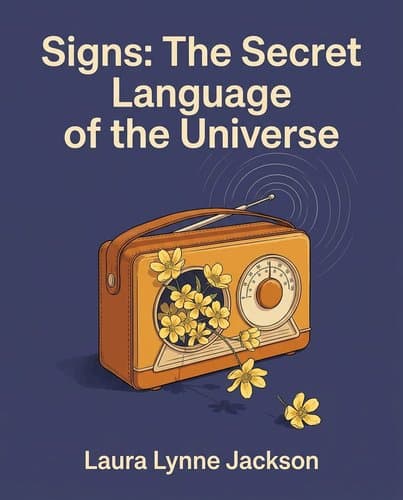
42583943_signs
by Laura Lynne Jackson
Grief feels unbearable because we're still listening for a voice that's changed its language. Laura Lynne Jackson teaches you to decode the signs your loved…
In Brief
Grief feels unbearable because we're still listening for a voice that's changed its language. Laura Lynne Jackson teaches you to decode the signs your loved ones are already sending—through numbers, animals, music, and the uncanny timing of moments that stop you cold.
Key Ideas
Establish Personal Signs With Loved Ones
Establish your own sign language by choosing a specific, mildly challenging symbol connected to a loved one — not impossible, not negative, personal — and asking for it aloud or mentally. Jackson says signs typically arrive within three days; the Other Side works most easily through numbers, animals, music, and electrical anomalies.
Genuine Signs Meet Three Simultaneous Conditions
The strongest signs share three qualities simultaneously: they arrive at emotionally precise moments you didn't manufacture, they contain specific details only the deceased would know, and they appear before you were primed to expect them. Coincidence becomes genuinely harder to argue when all three conditions are met at once.
Intuition Guides Decisions More Than Reasoning
At genuine crossroads moments, physical signs give way to clairaudience (a phrase or thought that enters your mind and isn't yours) and clairsentience (a gut feeling that won't resolve). Jackson's practical suggestion: when you're at a decision point, notice what comes before the reasoning does.
Grief Practice Works Regardless of Belief
Jackson's six-step practice — quiet time, ask for your sign, ask for help, be receptive, say thank you, share what you received — functions as a grief maintenance system regardless of what you believe about its source. The practices are indistinguishable from those that grief research independently validates.
Sharing Signs Creates Collective Family Strength
Sharing signs matters: keeping them private keeps them fragile. Every chapter in which a family adopts a shared sign language shows the same pattern — what begins as a private experience becomes a collective one that sustains an entire family through loss.
Reception Determines Sign Meaning, Not Origin
The framework is explicitly phenomenological: meaning is determined by how a sign is received, not by its causal origin. That's simultaneously its greatest comfort (no proof required) and its most honest limitation (no proof possible). Knowing which side of that line you're standing on before you engage with it is the most useful thing this summary can tell you.
Who Should Read This
People working on personal growth in Spirituality and Mindfulness, especially those tired of generic motivational advice.
Signs: The Secret Language of the Universe
By Laura Lynne Jackson
11 min read
Why does it matter? Because the silence after someone dies might not mean what you think.
The first thing grief does isn't make you cry. It makes the house too quiet. You catch yourself about to say something — just something ordinary, did you eat, it's raining — and the silence that comes back is unlike any silence before it. What Laura Lynne Jackson's Signs is actually about isn't death — it's the communication problem death creates. Her argument is almost painfully simple: the people we lose don't stop trying to reach us. We just stop knowing how to listen. This summary walks you through the framework she builds — the signs, the logic behind them, the stories that are genuinely hard to explain away — and the places where her case rests on something closer to faith than evidence. Both deserve honest attention. You get to decide what you're willing to believe, and why it might matter either way.
When Someone Dies, the Silence Isn't an Absence — It's a Frequency You Haven't Tuned
Imagine your phone loses signal. The broadcast tower isn't gone — it's still transmitting everything it always has. The problem is reception, not transmission.
That's the reframe at the heart of Laura Lynne Jackson's book, and it changes everything about what grief feels like.
Jackson, a psychic medium who has spent decades working with the bereaved, makes a precise and startling claim: the silence after someone dies isn't evidence of absence. It's a reception problem.
The clearest proof she offers comes from a car ride. In 2015, Jackson was being driven to a publisher event in Manhattan by a man named Maximo. She was shut tight — she describes two operating modes, and this was the closed one. Someone pushed through anyway: Virgil, Maximo's stepson who had died in his early twenties. She caught the initial V (phonetically something like "ver") and Maximo knew immediately who it was. Then Virgil showed her something specific and mundane: a bowl of cereal. Maximo confirmed it was Virgil's entire diet. Breakfast, lunch, dinner, every day.
Here's what mattered: none of it was new to Maximo. Before Virgil died, the two had agreed on a signal — Ninja Turtles, Virgil's obsession. Years later, Maximo's young daughter developed a sudden fixation on Ninja Turtles that seemed to come from nowhere. He had already received that sign. He'd dreamed of Virgil alongside his late father. He'd felt Virgil's presence repeatedly. Every message Jackson relayed was something Maximo already knew.
"You don't need me," Jackson told him. "You're already communicating with your son."
Think about what it means to hear that from a stranger. Maximo hadn't received anything new in that car. Jackson confirmed what he'd already been picking up: the Ninja Turtles, the dreams, the feeling of presence he'd probably talked himself out of trusting. He didn't leave with a message he'd never heard. He left with permission to trust what he'd already noticed.
The Wallet Drawing, the Passcode Dream, and the Moment Coincidence Gets Harder to Defend
Tim is lying on his dead son's bed, listening. The medium, Laura Lynne Jackson, has been relaying messages from Caleb for the past hour — Caleb, who was six and a half when he died from anesthesia complications during a routine dental procedure. Then Jackson says something that stops him.
Caleb is saying his father has something in his wallet. Something like a small piece of artwork.
Tim does a quick mental inventory. Cards, receipts. He knows what's in there. He's been the skeptic throughout the reading: careful, measured. He's in pajamas; the wallet isn't even in the room. He offers a necklace he's wearing instead. Jackson says no, specifically the wallet. Tim lets it pass. He's sure there's nothing like that in there.
Later that day, he empties the wallet anyway. Tucked inside what looks like a receipt is a folded piece of paper. He opens it.
A drawing Caleb made: three yellow flowers next to a tree.
What makes this hard to dismiss isn't the drawing itself — a father carrying a child's drawing in his wallet is plausible, and Tim had clearly forgotten it was there. What strains the coincidence is the sequence. Jackson named a specific category before Tim had looked, before Tim believed anything was there. Not "something meaningful," the kind of prompt you could fit to almost anything in retrospect. A small piece of art. Then she told them what to watch for: three yellow flowers and a tree.
The next morning, Eliza notices the kitchen windows. Caleb had covered them with stickers: flowers, butterflies, leaves. Most had fallen off or been scraped away over the years. She moves to peel one of the last ones off and steps back.
Exactly three stickers remain. Each one is a yellow flower.
She calls Tim over. Three flowers, she says, but no tree. He tells her to look through the window, not at it. Framed between the glass and the three remaining stickers is the front yard tree, large and arching and green.
Brandon's story started with a dream.
Bert woke from a dream about a license plate and wrote down the number: 1379. He told Brandon's mother he was certain it was Brandon's phone passcode. Brandon was gone. She had no way to check. So she called his girlfriend, who was overseas, and read her the number. That was the code.
The next day, in a Target parking lot, she found a small piece of white plastic on the ground. Four digits printed on it: 1379.
Thirteen years later, on the anniversary of Brandon's death, she pulled into her garage and glanced at the trip odometer as the car rolled to a stop. It read 137.9.
The parking lot scrap and the odometer are things a skeptic can explain away. The code is different. It was named before it was confirmed, by someone with no access to it, in a dream, then read aloud to someone across an ocean who confirmed it on the spot. What comes after is its own kind of strange.
Jackson's larger argument is that these signals are always being broadcast. The transmission doesn't stop when someone dies. What stops is attention. We notice something, feel its weight, and then quietly argue ourselves back to normal. Tim nearly did. He was certain enough that he almost didn't bother checking the wallet at all.
The drawing had been folded inside his wallet the whole time. He'd just never looked.
The Founder of the Skeptics Society Said 'I Can't Explain This' — Here's Why That's Telling
Michael Shermer has spent nearly three decades professionally dismantling paranormal claims. He founded The Skeptics Society, debates believers in public forums, and has said plainly that he doesn't believe in God. In June 2014, on his wedding day, his new wife's grandfather's transistor radio — broken for decades, forgotten in a desk drawer — began playing music at the exact moment Jennifer said she wished her grandfather were alive to walk her down the aisle.
The radio played through the night. The next day it went silent and never made another sound.
Shermer wrote about it publicly. He acknowledged he would normally reach for statistical explanation: with billions of people having billions of experiences every day, extraordinary coincidences are guaranteed to happen to someone. But he also wrote that this one "rocked me back on my heels and shook my skepticism to its core." When followers asked whether he'd ever encountered something he couldn't explain logically, he said: yes. Now he had.
Shermer didn't convert. But something got to him, and the shape of it matters.
Two features stand out. First, specificity: not a vague feeling but a radio dead for decades, beginning at the precise moment of Jennifer's grief, playing exactly one night. Second, the witness: a man professionally trained to resist this inference, reporting that he couldn't dismiss it anyway. It reached him not because he was looking for a sign, but because of its timing and particularity.
That points to where the framework lives. It operates in felt experience: what happened, when it happened, and how it landed. Not in causal chains or statistical odds. Which is why it can reach a Shermer (who felt something he couldn't explain away) while also being permanently unable to satisfy one. What he ultimately wants is evidence that doesn't depend on how it felt. The book never resolves this tension.
The Medium Who Teaches You Not to Need a Medium Is Always the One in the Room
If the book's promise holds — you don't need a psychic medium — then why does Jackson have to make her own mother turn the car around?
The passage is framed as instruction. Jackson's recently widowed mother asks her late father for a sign: a purple elephant. Within a day she spots one: a large inflatable elephant on a neighbor's lawn. Then the family drives past a new restaurant called The Purple Elephant, complete with an elephant statue out front, and none of them notice. They drive past it again on the way back and still miss it. Jackson is the one who catches it, makes her mother reverse, and points through the windshield.
"Oh wow," her mother says. "How about that?"
The lesson Jackson draws is that we need not just to look, but to see: mindfulness, attentiveness, a slight uptick in perception. What the scene actually shows is that Jackson's mother, primed to look for purple elephants, passed a large one twice. The person who caught it was the medium.
That tension runs through the whole book. In Jackson's opening chapter, she declares you don't need a psychic medium to connect with the Other Side. Maximo already had all his signs before Jackson confirmed them: the dreams, his daughter's sudden Ninja Turtles obsession, the quiet certainty it meant something. Signs arrive. The griever senses something. Jackson confirms it. The sensation becomes a conviction.
That's why the framework can reach a grieving father lying on his dead son's bed. It's also why it can't survive the question: if you choose the symbol yourself and then find it, how would you know the difference?
When Signs Stop Offering Comfort and Start Preventing Murder
The man in the back of the conference room isn't trying to hide his anger. He's big, mustached, wearing a leather vest and motorcycle boots, and his arms are folded so hard across his chest that approaching him feels like a mistake. He keeps his eyes on the floor. Occasionally he looks up to glare. Jackson is leading a grief retreat for families of children who have died — ten sets of parents in a hotel conference room on Long Island — and this man radiates hostility that she reads, correctly, as a shell around tremendous pain.
The Other Side pulls her toward him anyway.
His daughter comes through immediately, and with her comes what Jackson describes as a film clip — a stream of images so vivid it plays like a scene from a movie. The girl shows Jackson the previous day: her father alone in his house, dressing head-to-toe in black camouflage. Rifles laid out on his bed. Loaded into his car. He had spent that day intending to find his daughter's killer — her ex-boyfriend, universally suspected of the murder, never charged — and execute him.
His daughter, Jackson tells him, had been trying to stop him all day.
Not through a bird or a rainbow. Through what Jackson calls clairaudience — a voice in your thoughts that isn't your own voice, a phrase that materializes in your head from somewhere you can't quite locate. The daughter had been sending the same message on repeat: this is not how you show your love for me. He ignored it for hours. He had the rifles. He was going.
Then, at some point, he finally heard her.
"You were going to kill him that night," Jackson tells him in the conference room.
He wipes his eyes. "Yes," he says. "I was."
What separates this from the rest of the book's signs is the nature of the intervention. The signs we've seen so far — the flower stickers, the radio that played one night and went silent — are messages about love and continuity. They reassure the living that death didn't sever the connection. The daughter's repeated message to her father was something different: a correction. A redirection away from an action that would have destroyed his life while doing nothing for hers. He would have killed a man, gone to prison, and lived the rest of his years in a cell. The daughter understood this with a clarity grief had made impossible for him.
Jackson calls this a "shadow life": the version of your future that fear and rage build for you, a lesser path that forecloses everything your actual life could have been.
He had already chosen differently by the time Jackson sat across from him. He was in the room.
You Don't Have to Believe in the Other Side to Benefit from Paying Attention to It
What would you have to believe for this book to be useful to you?
That's the question worth sitting with at the end. Jackson believes the dead transmit, that signs are real interventions, that the people you've lost (what she calls your Team of Light) are actively routing information to you through dreams and flower stickers and the name of a restaurant you drive past. You don't have to share any of that to find the practices in this book doing something real.
What she actually instructs is this: find some daily quiet, ask for what you need, and stay alert. For someone who just lost a child and wakes at 3 a.m. because the house sounds wrong, that stillness might mean sitting in the kitchen with the lights off and asking, out loud or in your head: show me you're still here. Not meditating. Not achieving anything. Just present long enough to notice. Independently of any appeal to the afterlife, these are the core practices of what grief researchers call "continuing bonds" therapy: maintaining a living relationship with someone who died, rather than treating grief as detachment and forgetting. The metaphysics are Jackson's. The structure belongs to anyone.
Rachel is the clearest proof. After two years of paralysis about whether to have a second child — her first son was autistic, the odds were real, the fear was reasonable — she enters an airport bathroom stall, addresses the universe directly, and waits for a sign. Nothing comes. She walks out and tells her friends she's having a baby.
The sign was never coming from outside. Jackson's reading had already told her: this is a free-will choice, and the answer lives inside you. What Rachel did in that stall was finally stop outsourcing the question to something external, stop waiting for permission, and listen to what she already knew. Her daughter Neshama (the name means "soul" in Hebrew) arrived nine months later.
Whether or not the universe was listening in that bathroom, Rachel finally was. The two years of indecision dissolved the moment she stopped requiring proof and started trusting the voice that had been present all along.
That's what the framework delivers, underneath its metaphysics: a structured practice of paying attention to your own inner life, to the physical world, to the people you've lost and what they meant to you. Jackson calls this the secret language of the universe. You can call it whatever you want. The attention is the thing. The relationship kept alive through the attention is the point.
The Question the Book Never Quite Answers — and Why That Might Be the Point
The wallet drawing Tim was certain wasn't there. The flower stickers on Rachel's window. The man who had rifles in his car. These don't explain themselves away easily — coincidence has to work harder the more specific things get. And yet the framework is built so nothing can disprove it. A sign not received just means you weren't ready. That's not a flaw in the argument — it's the load-bearing wall the whole structure rests on.
The better question isn't whether the signs are verifiably real. It's whether living as if the relationship continues — asking, noticing, acknowledging, telling someone — changes something in the person left behind. Grief research, without any appeal to the Other Side, has independently found that it does. Jackson's practices and that research are nearly indistinguishable. You don't have to believe in transmission to benefit from learning to receive.
Notable Quotes
“Listen, God, Team of Light,”
“With all due respect, Ashley does not have bartonella,”
“The HPV vaccine is perfectly safe.”
Frequently Asked Questions
- What is Signs: The Secret Language of the Universe about?
- Signs: The Secret Language of the Universe argues that deceased loved ones continue to communicate through a symbolic language of numbers, animals, music, and electrical phenomena. Laura Lynne Jackson, a psychic medium, contends that grief eases when you learn to recognize these signs. The book provides readers with a practical six-step framework for requesting, identifying, and sharing signs, along with criteria for distinguishing meaningful signals from coincidence. Jackson emphasizes that this symbolic communication system can be learned and accessed by anyone willing to establish their own personal sign language with deceased loved ones.
- How do you request and establish signs from deceased loved ones according to Jackson?
- To establish your own sign language, choose a specific, mildly challenging symbol connected to a loved one — not impossible, not negative, personal — and ask for it aloud or mentally. Jackson says signs typically arrive within three days; the Other Side works most easily through numbers, animals, music, and electrical anomalies. The symbol should be meaningful enough to feel personal but challenging enough to suggest authentic communication. This process creates an intentional connection that Jackson describes as the foundation for all subsequent sign recognition and communication with deceased loved ones.
- What are the key takeaways from Signs: The Secret Language of the Universe?
- The strongest signs share three qualities simultaneously: they arrive at emotionally precise moments you didn't manufacture, they contain specific details only the deceased would know, and they appear before you were primed to expect them. Coincidence becomes genuinely harder to argue when all three conditions are met. Jackson's six-step practice—quiet time, ask for your sign, ask for help, be receptive, say thank you, share what you received—functions as a grief maintenance system. Sharing signs matters: keeping them private keeps them fragile, while collective family adoption of shared sign language sustains families through loss.
- Is Signs: The Secret Language of the Universe worth reading?
- The book's value depends on your approach to its phenomenological framework—meaning is determined by how a sign is received, not by its causal origin. This creates simultaneous comfort (no proof required) and honest limitation (no proof possible). Regardless of belief in the supernatural, Jackson's six-step practice functions as a grief maintenance system that aligns with independently validated grief research. The framework teaches practical receptiveness and symbolic meaning-making during loss. It's worth reading if you're seeking comfort through structure, exploring grief processing, or curious about how meaning-making strengthens families facing bereavement, rather than if you're seeking empirical proof of afterlife communication.
Related Book Summaries



Read the full summary of 42583943_signs on InShort