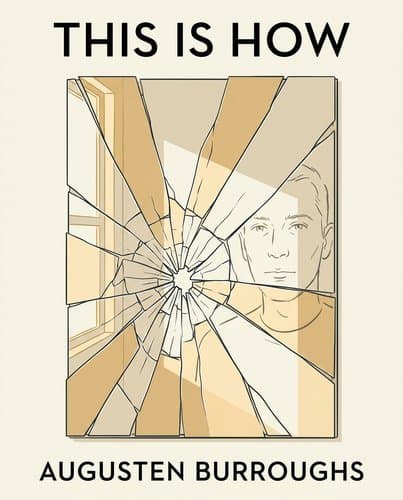
13167087_this-is-how
by Augusten Burroughs
Positive thinking is a lie—radical honesty about exactly what you feel and what's actually true is the only thing that creates real change.
In Brief
Positive thinking is a lie—radical honesty about exactly what you feel and what's actually true is the only thing that creates real change. Augusten Burroughs delivers brutally practical tools for grief, addiction, confidence, and love that work precisely because they demand truth, not comfort.
Key Ideas
Willpower reveals hidden blockers to change
When you need willpower to make a change, treat that as diagnostic information — something is blocking the genuine want from forming into need. Find that blocker before trying again.
Name your actual feeling not affirmation
The next time you catch yourself repeating a positive affirmation, replace it with the accurate statement: name what you actually feel. 'I feel hopeless and stupid' gives you a solid floor to stand on. 'I am powerful and worthy' gives you nothing to push against.
You choose to revisit past emotions
The past does not haunt you; you haunt it. Each time you feel 'haunted' by something, notice the word 'allow' — you are opening the memory and choosing to re-experience the emotion. That choice is available in the other direction.
Confidence comes from outward not inward
Confidence is not an internal state you build through self-talk — it's a reduction of your interest in whether others are thinking about you. The practical method: become so focused on the other person in any interaction that there's no mental bandwidth left for self-monitoring.
Imagined suffering exceeds actual experience
Anticipatory suffering is almost always worse than the thing itself. When dread arrives, notice that you are living inside an imagined future that has not arrived and may not arrive in the form you're imagining.
Discomfort is temporary not permanent pain
Discomfort and pain are not the same thing. Most behavioral change that feels impossible is actually only uncomfortable — and discomfort follows a predictable arc: horrifically uncomfortable, then damn uncomfortable, then not so bad, then gone.
Abusers show remorse not genuine change
If you're in an abusive relationship, know that abusers do not change. The evidence is theatrical remorse, not actual change. The question 'would I think it was mean if he said that to my friend?' is a useful perceptual tool when you've lost your baseline.
Become larger through loss not healed
Healing from catastrophic loss is not the goal — the goal is becoming larger through it. The hole doesn't close. Pleasure, love, and compassion do not leak out of holes of any size.
Who Should Read This
People working on personal growth in Self-Improvement and Mental Health, especially those tired of generic motivational advice.
This Is How
By Augusten Burroughs
13 min read
Why does it matter? Because the self-help advice that's supposed to fix you is often what's keeping you stuck.
The self-help section is built on a single, mostly unexamined premise: that the problem is insufficient optimism. That if you could just believe harder, affirm louder, reframe faster, you'd arrive somewhere better than here. Augusten Burroughs spent decades testing this premise — through addiction, catastrophic grief, an education that ended in third grade when his mother sent him to live with her psychiatrist, and a life strange enough that describing it plainly sounds like fiction. Positive thinking isn't the cure. In most cases, it's the disease. What actually moves people isn't the optimistic story they tell themselves about where they're headed. It's the brutally accurate account of where they actually are. This book is what emerges when someone with nothing to protect and no credentials to preserve decides to tell you the truth about weight, love, sobriety, dying, and the particular way that pursuing happiness tends to guarantee its opposite.
Positive Affirmations Are Psychological Baby Powder on a Turd
Positive thinking is the enemy of actual change. Not a flawed tool, not a well-meaning mistake — an active obstacle, because it substitutes the appearance of progress for the thing itself.
August en Burroughs arrives at this conclusion through a hotel elevator. He's in the wreckage of a relationship that ended without warning, visibly wrecked, and a conference attendee with spiky highlights and drawn-on lips steps in and offers him the following prescription: try on a smile, repeat after her each morning that you are a powerful, positive person, and nothing can get you down. He wants her dead. He's too polite to say so. Then he gets to his room and finds a BBC report on a study out of Canada, published in a psychology journal, which had demonstrated in a clinical setting what he'd suspected from personal experience: for people with low self-esteem — the very people most likely to reach for affirmations — repeating positive statements like "I am a lovable person" made them feel measurably worse than if they were simply allowed to think realistic, dark thoughts.
Burroughs's explanation for why is unsparing. Imagine a woman who has just been raped. She walks in her front door, goes to the bathroom mirror, and recites: I am too strong and independent to be hurt by negativity. I am grateful for the opportunity to learn and triumph. She does this with torn clothing and evidence of the assault still on her body. The image is grotesque. It exposes what positive affirmations ask of anyone in genuine pain: that you lie to yourself at the precise moment you most need to trust yourself.
What actually helps, Burroughs argues, is the opposite: name the ugliness, speak it out loud, work with it. You can't plot a route to California if you don't know what city you're starting from. Feeling better requires first establishing, with complete honesty, how bad things actually are. Without that baseline — that solid floor of reference — any optimism you manufacture is just powder on the carpet. The mess underneath doesn't go anywhere.
Willpower Is a Symptom That Something's Wrong
Imagine you're locked in a sinking car. Water is rising past the dashboard. Somewhere in the back of your head, you know you should roll down the window, but it's electric and the system is shorting out, so you need to find another way — smash the glass, wait for the pressure to equalize, something. Here's what you won't need in that moment: willpower. You won't be white-knuckling your resolve or making a deal with yourself to try harder. You'll have exactly one thing: the biological certainty that you need air. The window will come down or you will die trying to make it come down. That's it.
Burroughs uses this image to diagnose willpower as a symptom rather than a virtue. When you need willpower to do something — to skip dessert, to get up early, to stay off a substance — that strain is informative. It means the genuine want hasn't converted into a need yet. Somewhere in you, something isn't fully committed. Willpower is the evidence of that split, not the solution to it. It holds the way held breath holds: briefly, until it doesn't.
He makes the proof personal. He's known a woman for twenty years who mentions her weight every single time he sees her. She's successful, attractive, has a partner who finds her compelling. By any external measure, she already has what she claims to want. Which means the data is broken. If you pursue a goal for two decades and never close the distance, one of a few things is true: you already have it, you can't get it, or what you're calling the goal is standing in for something else entirely.
The actual work, then, isn't trying harder. It's locating the part of you that's blocking the need from forming — the internal voice that keeps pulling the emergency brake. That voice has a reason. Find it, and you may not need willpower at all. The window rolls down on its own.
The Only Confidence Trick That Actually Works
A teenage Burroughs is so consumed by what other people think of him that if someone stepped on his foot, he was the one who apologized. He can't hold an opinion in conversation — if he admits liking something the other person dislikes, the gap between them feels like abandonment. So one afternoon he rides his bike to a town he's never visited, finds a corner store, and does the one thing that makes him physically ill to imagine: he cuts the line, is confronted, says something offensive, and stays put. His entire point is to stand there and feel the hostility radiating from the people behind him. To remain in the room while being genuinely disliked. He leaves before the clerk rings him up — a small cheat — but the lesson takes anyway. Being despised didn't destroy him. Once you've survived your worst fear, you stop organizing your life around avoiding it.
That story is Burroughs demonstrating, through behavior rather than argument, what confidence actually is — and what it isn't. Most people assume it's an internal reservoir, something you top off with affirmations or references to past wins. Burroughs reverses the causation. Confidence isn't a feeling you have. It's an assessment other people make when they look at you and see someone who isn't busy monitoring themselves. The experience from the inside isn't confidence at all — it's just the unremarkable sensation of being focused on what's in front of you.
His distinction between delay and a natural pause is where this gets surgical. A pause is presence — a beat where you're still in the room. Delay is what happens when your mind bolts sideways to check how it's coming across, and you return half a second late, and that gap is visible. It reads as anxiety regardless of how polished your eventual answer is. Saying the wrong thing on time is more convincing than saying the right thing after a two-second evacuation. The job interview version is identical: the candidate so determined not to look incompetent that every hesitation announces it. Trying, Burroughs writes, orbits the moment. Being is inside it.
You don't build toward this. You just stop going elsewhere.
The Design Flaw in Suicide That a Fourteen-Year-Old Solved
At fourteen, Burroughs is at the bathroom sink, running the hot tap all the way over and lowering his wrist into the stream. Someone had told him this was the preparation — numb yourself first, then the razor. The heat is extraordinary, a sensation so total it barely registers as temperature. Then it becomes warm. Then it becomes cold. His hand goes stiff and strange, something his arm is carrying rather than part of him. He thinks: I can do this.
Then logic arrives. Not a counselor, not a parent — just a design flaw he suddenly sees with perfect clarity. Suicide promises peace, release, an end to everything unbearable. But you would have to still be alive to feel any of that. The promise is structurally broken from the start.
He pushes the thought further. If you cut your wrists in a bathtub, your brain will lock immediately onto the new information: two pulsing openings, blood dispersing into the water. Adrenaline releases. Heart rate climbs. Blood moves faster. The suffering that drove you to the tub is now underneath a layer of horror and panic and the biological scream to survive. What you're left with isn't peace — it's the original pain plus everything else, all of it running simultaneously. That's where you remain for the rest of your life, which is now measured in minutes. You pass into unconsciousness the way you pass from waking into sleep: without knowing the moment it happens.
The mythology of peaceful corpses is a language problem, he decides. We see a body that is absolutely still and we reach for the words we have — calm, at peace — because English hasn't invented the right one yet. Those words describe living states we want for ourselves, projected onto something that isn't experiencing anything at all. He suggests substituting the word "wealthy" instead: she looks so wealthy, lying there. Suddenly it sounds deranged. It's equally deranged the other way.
Here's where the argument turns. Standing at that sink, Burroughs realizes he doesn't actually want to kill himself. He wants to end his life — and those are different things. He makes a list of what he actually wants: punishment for everyone who made him miserable, lifelong guilt radiating outward, something named after him (small, but not a sandwich). Suicide delivers none of it. Ending his life means something else. It means renaming himself — from the monosyllabic Chris Robison to something alphabet-heavy, something with syllables, possibly named after a computing machine. It means a door and a highway. It means the life he's living stops, and a different one begins.
This is what suicide forecloses by making itself the only option visible. Leaving is always there. It's just harder to see.
You Don't Heal From the Death of a Child. You Become Larger.
The pressure to heal from catastrophic loss causes more damage than the grief itself.
Burroughs came to this understanding the hard way. When someone he loved died in a Manhattan hospital, he waited for restoration — for the wound to seal so completely he'd forget which arm had been scratched. He waited several years. The restoration never came because he had confused healing with something it has never been: a return to before.
Heal is a television word. It implies a tunnel. Go in on one side, come out the other. But for the loss of a child, or anyone who occupied that kind of central space in your life, there is no other side. What actually happens is that the hole doesn't close. It becomes surrounded by a constellation of smaller holes — the specific way she smelled like apples in summer, the particular snort he made when something struck him as genuinely funny. One large absence attended by dozens of precise ones. The people around you will eventually see someone who has recovered. What they won't see is that the dead never left the dinner table. The hole just narrowed enough to be concealed by a laugh, or a new child, or an ordinary Tuesday afternoon. And if you've been told to expect more than that — if you've internalized the idea that enough time should eventually fill the space entirely — the gap between expectation and reality becomes its own wound. You start to suspect you're grieving wrong. You worry that still loving the dead so fiercely means betraying whoever came after. The pressure to perform healing does damage that the grief, left alone, would not.
The redefinition Burroughs offers is strange enough to actually help: pleasure, love, and compassion do not leak out of holes. You can be riddled with holes that never closed and still be excited by life, still fall in love, still feel the specific animal satisfaction of a good meal or a funny moment. Loss doesn't subtract from a person. It adds. Carrying that weight expands you — makes the surface area of who you are larger than it was before you had anything to lose.
The hole will always be there. You just learn that wholeness was never about closing it.
The Past Doesn't Haunt You. You Haunt the Past.
What if the project of understanding your past is precisely what keeps you inside it?
Burroughs's answer is blunt: the past doesn't haunt you. You haunt the past. The distinction isn't rhetorical. The past is genuinely gone — as absent from the world as Cinderella, as available for inspection as smoke. What keeps it alive isn't its own momentum but your returning attention. Every time you open a memory, examine it, reach for the feelings that lived inside it, you're not healing. You're visiting.
He makes the structural problem visible with a single image. A driver passes a Mercedes folded nearly in half, hood pressed against the windshield. On the rear shelf: a small girl's doll. The driver concludes the worst and carries that conclusion for years — nightmares, guilt, the imagined dead child. What he didn't know: the Mercedes had crumple zones engineered to protect everyone inside a rigid safety cage. Both people walked away. The doll had been bought at a tag sale for a gift. The man in the driver's seat spent the aftermath on his cell phone, mildly irritated about the paint color. Every detail the driver locked onto — the doll, the silence, the crushed metal — was real. His conclusions from those details were a personal myth, coherent and completely wrong. You cannot understand what happened to you from inside your own perspective. You have half the information at best.
What freed Burroughs wasn't writing six books about his own history — he's explicit that nothing he wrote altered the past or healed anything. It was the sustained attention required to write at all. The present consumed him. Presence, not excavation, is where freedom actually lives. The question is only whether you'll let it.
Anticipatory Suffering Is Always Worse Than the Thing Itself
Burroughs spent years cataloguing the horrors waiting for him. His partner George would eventually need around-the-clock nursing. There would be IV poles and chest tubes and the end of any life that resembled the one they'd built. George, who loved being outside, who walked the dog and drove himself places, would be reduced to someone who couldn't leave a room. Burroughs turned this future over and over until it was polished smooth. He knew exactly how unbearable it would be.
Then the nurse arrived and installed the tubes. George wanted to watch the movie that was on television. So they watched it. George was connected to tubes. The movie was fine. The tubes were fine. Everything Burroughs had spent years dreading turned out to be, in his own words, simply okay — not because the circumstances weren't terrible, but because the circumstances were now the present, and the present has a texture that the imagination cannot replicate. There was no longer a future horror to manage. There was just the room, the screen, the person next to him.
That's what six years of dread actually purchased: the discovery that anticipatory suffering is not preparation. It is its own form of suffering, and it compounds in a way the actual experience never does. The real thing arrives without the weight of surprise. You've already been inside it before you've registered the transition. The imagined version carries the terror of novelty plus the dread of everything it might become. The real version is just what's happening now — and what's happening now is always more manageable than what might be happening later, because now is specific and the future is infinite.
Burroughs phrases the operating principle simply: pay only for what you use. A symptom that hasn't arrived isn't yours yet. Accepting each new development as the updated baseline — not the floor dropping out, just the new floor — is the only posture that lets you remain inside your actual life rather than inside a projected one. The projected life is always worse. The actual life is the one with the movie on.
Discomfort Is Not Pain, and That Distinction Is Everything
Method-shopping is a way to keep failing while appearing to try. Burroughs spent nearly two decades running this particular con on himself — he'd tried everything on the shelf — and the giveaway was in how he talked about it. There was a quiet satisfaction, he noticed, in explaining to a friend exactly why each approach had let him down. The patches hadn't worked. The gum hadn't worked. Everything had failed him. And in that framing — the passive victim of inadequate methods — was the buried acknowledgment he refused to surface: he was the only constant across every failed attempt. He had been the failure, and the parade of methods had given him somewhere else to point.
His two attempts at sobriety make the same point at a different scale. The first was methodologically elaborate — rehab, trigger mapping, relapse prevention plans, a practice of visualizing the alcoholic self as a separate destructive entity lurking in unexamined corners. (Burroughs, characteristically, found the whole architecture a little ridiculous even as he submitted to it.) Eighteen months in, he relapsed when a friend started dying. Not because he lost control. Because he decided to drink, with the same casual ease you'd decide to grab a pack of gum. All that preparation had been aimed at an enemy that turned out not to exist — the irresistible urge — while the real mechanism, a simple conscious decision, went completely unguarded.
The second attempt had no architecture at all. No AA, no therapist, no day-count. What it had was a direction: he needed to write. He needed a specific person. He needed dogs. Sobriety wasn't the goal — it was a condition of the life he was moving toward, which meant he never had to white-knuckle it because he was never choosing between drinking and nothing. He was choosing between drinking and everything.
The actual reason nothing had worked before wasn't physiological, wasn't psychological in any complicated sense. It was this: quitting was uncomfortable. That was the complete list of obstacles. Not impossible, not agonizing in any clinical way — just uncomfortable, and then less uncomfortable, and then fine, and then eventually not even something he missed. Every method he'd tried was, in retrospect, a structure for avoiding the discomfort rather than passing through it. When the structure failed to make the discomfort disappear, he called the method inadequate and lit another cigarette.
Discomfort is not pain. Pain is medically interesting and never boring. Discomfort is just discomfort — survivable, temporary, a gradient. The reason people fail to change isn't willpower or method or support. It's that the life on the other side hasn't become real enough to want more than they want the comfort of staying put.
Even the Most Terrible Loss Doesn't Have to Make You Darker
A woman at a book signing stands up and tells Burroughs her son Sean died alone in his apartment two months earlier, drunk. She had been torturing herself with one specific image: if she had been there, she could have held his hand. The bookstore flyer advertised the event as a hilarious evening. Nobody in the audience wanted to be the one standing at the microphone.
Burroughs had a different account of the same facts. Sean was twenty-five. He had been drinking since he was fourteen. He had never chosen sobriety, not once across eleven years of trying. Those facts she had, but she was looking past them to a different fact: her fact, which was abandonment and loneliness and a death that should have gone differently. What she was missing was Sean's fact. He had spent more than half his life returning to alcohol above everything else the world offered. He died doing the one thing he chose, every single time, over every available alternative. Burroughs, who had nearly died the same way in his own apartment, told her plainly: that kind of oblivion is not loneliness. It is familiar. It is, in its own obliterating way, exactly what the person wanted.
The woman's hands went up to her mouth. Then: I never thought of it like that. I never did.
Reframing has nothing to do with denial. Denial would have been telling her Sean was happy and sober and everything was fine. What Burroughs did was locate the true fact underneath the received narrative — the one that belonged to Sean rather than to her — and say it out loud. Once spoken, it couldn't be unspoken. The mother's grief didn't disappear. But the specific wound, the particular image of her son dying alone and abandoned while she was elsewhere failing him, lost its grip. Because it was built on a false premise. He wasn't waiting for her.
Truth works like this, Burroughs argues — not as opinion or interpretation, but as something more like gravity. Nothing constructed on top of inaccuracy survives the wind. And once a true thing is spoken into the air, the world quietly, permanently, rearranges itself around it. The terrible loss doesn't have to make you darker. If you can find the true fact inside it, it makes you deeper — which is a different direction entirely.
What You're Made Of
Here is something Burroughs drops almost casually, as if he's embarrassed by how large it is: the calcium in your bones was forged inside a star that exploded before the Earth existed. You are, in the most literal sense available, made of dead cosmic material that has been cycling through transformations for billions of years. The identity you've accepted — the damaged one, the limited one, the one your history assembled and handed to you — is a costume. A kidnapped royal driving a UPS truck in Ohio is still royal. The question Burroughs is actually asking, underneath every ugly scene and every uncomfortable reframe, isn't how you fix yourself. It's whether you've been accurately measuring what you contain. The answer, if you're willing to look, is everything. You are made of exploded stars. That was always true. You just had the wrong words for it.
Notable Quotes
“is just a word, like”
“is a phrase. Words and phrases represent things; they are placeholders. When I speak the word”
“Look at her lying there like that. She looks so wealthy.”
Frequently Asked Questions
- What is the main message of 'This Is How' by Augusten Burroughs?
- The book cuts through self-help convention to argue that radical honesty about what is actually true, not positive thinking or affirmations, produces real results. Burroughs advocates replacing positive affirmations with accurate statements about what you actually feel. As he writes, "'I feel hopeless and stupid' gives you a solid floor to stand on. 'I am powerful and worthy' gives you nothing to push against." This honest acknowledgment of emotional reality becomes the foundation for genuine change and healing. The book provides concrete tools for reframing suffering, building actual confidence, and moving forward from loss by rejecting conventional platitudes in favor of brutal truth.
- What does 'This Is How' say about building genuine confidence?
- Burroughs argues that "Confidence is not an internal state you build through self-talk — it's a reduction of your interest in whether others are thinking about you." The practical method he recommends is to "become so focused on the other person in any interaction that there's no mental bandwidth left for self-monitoring." This counterintuitive approach shifts confidence from an internal achievement project into a natural byproduct of genuine engagement with others. By redirecting attention outward rather than obsessing about how you're perceived, real confidence emerges without affirmations or internal coaching strategies.
- How does 'This Is How' approach behavioral change and discomfort?
- Understanding discomfort is key to behavioral change in Burroughs's framework. He explains that "Discomfort and pain are not the same thing. Most behavioral change that feels impossible is actually only uncomfortable — and discomfort follows a predictable arc: horrifically uncomfortable, then damn uncomfortable, then not so bad, then gone." Additionally, "When you need willpower to make a change, treat that as diagnostic information — something is blocking the genuine want from forming into need." This reframing helps you distinguish between genuine obstacles and the natural curve of discomfort, transforming your approach to change.
- What is Burroughs's approach to healing from catastrophic loss in 'This Is How'?
- Burroughs reframes the healing process entirely: "Healing from catastrophic loss is not the goal — the goal is becoming larger through it." Rather than trying to close the wound, he writes, "The hole doesn't close. Pleasure, love, and compassion do not leak out of holes of any size." This insight shifts the approach from repair to expansion—accepting permanent loss while recognizing that grief doesn't diminish your capacity for joy, connection, or kindness. Growth happens alongside grief, not after it, offering tools for expanding yourself through loss rather than returning to your previous state.
Related Book Summaries
Read the full summary of 13167087_this-is-how on InShort