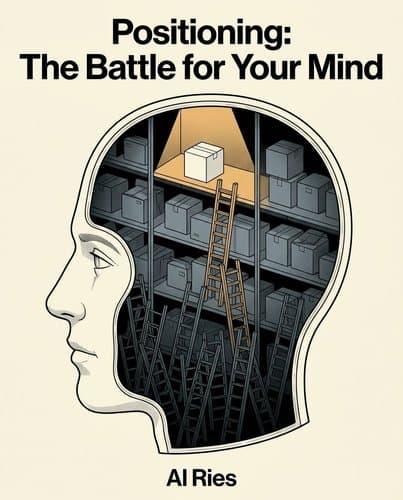
760025_positioning
by Al Ries
Customers don't buy products—they buy mental positions, and most companies actively destroy the one they already own by extending brands, chasing leaders, or…
In Brief
Customers don't buy products—they buy mental positions, and most companies actively destroy the one they already own by extending brands, chasing leaders, or improving features nobody asked for. Learn the counterintuitive rules that decide who wins the real battlefield: the six inches between your prospect's ears.
Key Ideas
Research Prospect Perception Before Strategy
Before any marketing decision, research where your brand already sits in the prospect's mind — not in your own head. That mental position is your real strategic asset, whether you like it or not, and every decision should start from there.
Two Paths When Not Category First
If you are not first in a category, you have two viable paths: find an unclaimed creneau (a gap in the competitive landscape the prospect already has room for), or identify a false belief your competitor depends on and attack it directly. Outspending the leader is not a third path — the data shows it fails even with equal resources.
Names Should Communicate Core Product Claim
When naming a new product, choose a name that does positioning work from the first exposure. 'Head & Shoulders,' 'DieHard,' and 'Intensive Care' communicate the product's core claim without advertising. Coined or initials-based names require the brand to be famous first — which means they only work after you've already won.
Brand Extensions Erode Generic Category Value
Every time you extend a brand name to a new product, you remind customers that the name is arbitrary — not a natural synonym for the product. The closer a brand name is to functioning as a generic category word ('Kleenex,' 'Xerox,' 'Bayer'), the more valuable it is. Extensions erode precisely this property.
Attack Only False Competitor Beliefs
When planning a repositioning attack, first identify whether the competitor's position rests on a false belief. Stolichnaya worked because 'Wolfschmidt sounds Russian' was false. Tylenol worked because 'aspirin is safe for everyone' was false. True beliefs cannot be repositioned away — only false ones create the vacuum a new brand can fill.
Measure Positioning Success in Years
When you find a position that works, measure success in years, not quarters. The Mailgram case is the book's clearest evidence: switching a working strategy for a more logical-sounding one destroys everything the original strategy built, and it happens almost immediately.
Who Should Read This
Business operators, founders, and managers interested in Marketing and Branding who want frameworks they can apply this week.
Positioning: The Battle for Your Mind
By Al Ries & Jack Trout & Philip Kotler
10 min read
Why does it matter? Because the marketing decisions that feel the most logical are the ones most likely to destroy you.
The standard theory of marketing failure is a communication problem: the message wasn't clear enough, the budget wasn't big enough, the creative wasn't strong enough. Fix those, and growth follows. It's a tidy theory — and this book exists to dismantle it. The central argument, first published in 1972, is that communication itself is what's breaking your strategy. The more you say, the less lands. The more you extend your brand, the less of it you actually own. And the harder you push into new categories, the faster you erode the one thing that drove your success: the single word or idea your brand holds in someone else's mind. The battleground isn't your ad spend or your product roadmap. It's inside the prospect's head — and most of what companies do there amounts to friendly fire. The hard part isn't finding that position. It's refusing to abandon it the moment the next agency walks in with a better story.
Your Prospect's Mind Is Already Full — And They're Not Making Room for You
The mind your advertising is trying to reach hit capacity years before you wrote your first brief. Volume is the problem, and more spending just compounds it.
Here's the number that ends the "we just need more reach" argument: George H.W. Bush served four years as Vice President — speeches, state functions, daily headlines — and 44% of supermarket shoppers in a national poll still couldn't identify him. Meanwhile, 93% recognized Mr. Clean, a cartoon genie who hadn't appeared on television in a decade. One of the most prominent officials in the U.S. government lost a recognition test to a fictional character. Bush's career was too complex for the mind to hold. Mr. Clean had one message, one image, one clean slot, and it held for ten years without reinforcement.
The arithmetic makes this structural. Americans receive roughly $376 per capita in advertising each year. A $1 million campaign delivers less than half a cent of that to someone already saturated by everyone else's messages. The ratio doesn't improve with effort. It worsens as every competitor raises spend alongside you.
The mind defends itself against volume by rejecting anything that doesn't slot neatly into what it already believes. Changing those beliefs through advertising is nearly impossible. The solution to a communication problem doesn't live inside your product. It lives inside your prospect.
Whoever Gets There First Doesn't Win the Battle — They Win the War
Imagine a duckling hatching from its egg and seeing a border collie before it ever sees another duck. For the rest of its life, it will follow that dog. The biology is irreversible: the collie arrived first, and that's the entire explanation. Biologists call this imprinting. Ries and Trout use it to describe what happens in the mind of every buyer.
When a brand occupies a category first, the mind doesn't file it away — it installs it as the reference point. Every competitor that follows gets measured against the original, which means every competitor arrives pre-labeled as an imitation. That's what makes first-mover advantage asymmetric rather than merely large: you're not competing for a ranking, you're competing against something the mind has already decided is real.
Columbus reached the Americas first. He also died in jail, still convinced he'd found a new route to Asia. Amerigo Vespucci arrived five years later, technically a follower. But Vespucci didn't win the map by arriving second; he won it by occupying a position Columbus never claimed: the New World as a continent entirely separate from Asia, not a detour to the Indies. He wrote about it obsessively. One letter from his third voyage was translated into 40 languages over 25 years. The continent was named after him, not the man who found it first.
Sperry-Rand built the UNIVAC, the first commercial computer, and delivered it to the Census Bureau in 1951. IBM arrived later. Then, in 1964, IBM launched the System/360 — a compatible family of machines that made "computer" and "IBM" effectively synonymous. Seven competitors, Sperry-Rand among them, were known collectively as the Seven Dwarfs. Sperry-Rand is a footnote. IBM is computing.
The market share data makes this concrete: the first brand into a category commands, on average, twice the long-term share of the second, and twice again of the third. Hertz over Avis. McDonald's over Burger King. The ratios hold across decades and resist correction.
A better product launched second isn't playing catch-up. It's playing a different game entirely, one with structurally worse odds.
Going Head-On Against a Market Leader Is Not a Strategy — It's a Donation
The prediction was already in print when Robert Sarnoff told the world what RCA would accomplish. In 1969, two marketing writers had published a warning in Industrial Marketing: no company could make progress "head-on against the position that IBM has established." The following year, RCA's chairman declared that his company would reach a "firm No. 2 position" in computers by year's end — and three of the country's leading business publications all ran headlines using the same word to describe the strategy: "head-on."
Business Week called it "a broadside at No. 1." Advertising Age called it "a head-on slash at IBM." The press read this as confidence. The prediction said it was a plan to lose.
By September 1971, RCA had absorbed a $250 million loss. IBM controlled 70% of the mainframe computer market. The largest of its competitors held less than 10%. That gap is not a resource problem — it's a position problem, and positions live inside the mind, not inside a product lineup. IBM didn't have a 70% grip on the hardware. It had a 70% grip on the way buyers thought about the entire industry. No amount of executive conviction and no advertising budget can reach inside and rearrange that.
Two General Electric executives illustrate why. Smith ran the GE computer operation with relish and failed. Jones assessed the situation, declared exit the only rational move, and watched the company take his advice. J. Stanford Smith ended up at International Paper — a significantly smaller stage. Reginald Jones became CEO of General Electric. Reading an unwinnable position correctly isn't defeatism. It turns out to be the most consequential call a strategist can make.
There's Always an Open Position — But You Have to Stop Looking at Your Product to Find It
Where do you look when you need a viable position in a crowded market? Most teams look inward: they run formulations, benchmark features, and search for the attribute that justifies the price. The answer is almost never there.
The 7-Up story makes the mechanism explicit. The brand had no distinctive ingredient, no technological edge — just an ordinary lemon-lime soda in a market where roughly two out of every three drinks sold were colas. The mind ranks brands in a category like rungs on a ladder: only the top two or three positions feel real to the buyer, and the rest blur together. Coke and Pepsi already owned the top two. Every competitor below was either fighting for scraps or defining itself against nothing the drinker cared about.
The position didn't come from examining the product. It came from asking what someone reaching for a Coke already believed about everything else in the aisle. The answer — that colas are the default, the reference point, the category itself — exposed a third rung. Not a better cola or a cheaper cola, but the one thing that explicitly isn't cola. 7-Up named that rung and claimed it.
The French call this cherchez le creneau (look for the hole). The discipline requires stopping the internal analysis and mapping what's already occupied in the prospect's mind: what assumption is the market making, what direction has everyone committed to, where has that consensus left a vacancy?
Ford made the opposite mistake with the Edsel. The car filled the gap between the Ford/Mercury lineup at the low end and Lincoln at the top, but that gap existed on the org chart, not in the buyer's mind. Medium-priced cars were already cluttered. The Edsel found a hole in the factory and mistook it for a hole in the market.
The creneau is almost never a product feature. It's an assumption the market forgot to question.
The Fastest Way to Own a Position Is to Clear Someone Else's
A copywriter sits down to write an ad for a pain reliever that trails Anacin, Bayer, Bufferin, and Excedrin. The brief says: beat aspirin. The conventional move is to find the superior claim and lead with it. Instead, the writer does something that looks like a mistake: the first 60 words of the finished ad are entirely about aspirin. Its stomach irritation. Its tendency to trigger asthma and allergic reactions. The small amounts of gastrointestinal bleeding it causes in regular users. Not until word 61 does Tylenol appear by name.
Competitor positions are built on beliefs the prospect has never examined. Attack that belief first and you create a vacuum. People don't resist filling vacuums. The moment aspirin's all-purpose safety assumption collapsed, readers were actively searching for an alternative — and Tylenol was standing right there.
The result was not incremental. Tylenol became the number one analgesic in the country, passing every brand it had trailed. Zero claims about its own superiority. The ad never said "we're better." It said: here's what you missed about the thing you assumed was safe.
The gap between repositioning and comparative advertising is where most competitive budgets get wasted. Comparative advertising says "we're better than Brand X." The prospect thinks: of course you'd say that, you paid for the ad. The belief about Brand X stays intact; only your credibility suffers. Repositioning changes what the prospect thinks about the competitor, not about you. What makes it work isn't aggression — it's sequence. Dislodge first, fill second.
Your Brand's Greatest Threat Is the Logical Growth Decision Your Marketing Team Will Recommend Next Quarter
The most dangerous pitch your marketing team will ever make arrives wrapped in logic: we have an established name, launching under it reduces risk, and the sales projections look sound. Every word is true. The conclusion is suicidal.
Packard was, before the Second World War, the most prestigious automobile in America — more so than Cadillac, more so than almost anything in the world. Heads of state commissioned armored Packards. Franklin Roosevelt rode in one. The company declined to participate in the American auto industry's annual model-change game; Packard considered itself above it. What a Packard signified wasn't transportation. It was arrival.
In the mid-1930s, Packard introduced the Packard Clipper, a significantly cheaper vehicle targeted at middle-class buyers. Record sales. By any short-term measure, the Clipper was the most successful car Packard had ever produced. Then the prestige position dissolved. Buyers who would have saved for a Packard as a status symbol no longer could; the name had become detached from its meaning. The same badge appeared on cars within reach of ordinary buyers. Why spend the premium? By 1954, Studebaker had absorbed the company. Packard disappeared.
Here is the mechanism the Clipper revealed. A brand name's value comes from meaning one specific thing to the buyer. "I want a Packard" once meant one thing. The moment a second kind of Packard existed, the name became a label rather than a synonym, and a label is just ink on metal. Buyers stopped reaching for the word automatically; they had to think about which Packard they meant. That pause is where prestige goes to die.
Procter & Gamble understood this at the company level. They gave every product its own name — Tide, Cheer, Bold — each occupying a single rung in the buyer's mind. Colgate stacked the house name on everything. By keeping each brand name focused on one product, P&G generated twice the revenue and five times the profit of Colgate-Palmolive. The advantage came not from better products, but from names that each still meant one thing.
The logic of extension always sounds like leverage. What it actually does is teach your customer that your brand name is arbitrary: just a corporate label that shows up on whatever the company decided to make this year. Once they learn that lesson, the name stops working as a shortcut. They have to think, and thinking is the last thing you want them doing at the shelf.
The Hard Part Isn't Finding the Right Position. It's Not Abandoning It the Moment Someone Suggests Something Better.
Before settling on the telegram comparison, Western Union had run one of the cleaner controlled experiments in marketing history. Six cities (Boston, Chicago, Houston, Los Angeles, Philadelphia, San Francisco), split into two groups, thirteen weeks. In cities where Mailgram was framed as a high-speed letter, consumer awareness started at 27% and ended at 25%. In cities where it was framed as a low-cost telegram, awareness started at 23% and ended at 47% — more than doubled. Same product. Same budget. The result wasn't difficult to read.
Then Western Union hired a new agency. Instead of "impact of a telegram at a fraction of the cost," the new strategy would lead with next-day delivery. A genuine feature. The kind of brief that produces consensus in a conference room.
Volume immediately fell.
Every company that falls into this runs the same sequence — a position that works, a logical case for updating it, a replacement that sounds like improvement, then a chart turning the wrong direction. The case for reinvention is always available. New management, new agency, new brief, fresh thinking. That pressure originates inside the company and arrives dressed as exactly the kind of strategic rigor that found the position in the first place.
The hard part of positioning isn't the diagnosis. You can test positions, measure awareness, read the data. What most organizations can't do is refuse to improve what's working. Marlboro's cowboys have ridden into the same sunset for decades. Crest has been fighting cavities long enough to reach the children of its original customers. Neither is interesting. Both are still there.
The Position You Already Own
The position you need to protect is almost certainly the one you already have. That's what makes this book genuinely unsettling: it isn't a guide to finding something new. It's a case against most of what your marketing department will propose at next quarter's review. Every slide deck that opens with "it's time to evolve the brand" is the same document — just a different year, a different agency — and the companies that survived ignored it. Ries and Trout spent a quarter century watching companies nod along with this logic and then hire a new agency anyway. The courage the book is actually selling isn't creativity. It's the discipline to keep saying the same thing — same name, same claim, same visual — long after everyone in the room has grown tired of it. Your customers haven't.
Notable Quotes
“The customer is always right.”
“and some money to promote it were all you needed. It was a time when advertising people focused their attention on product features and customer benefits. They looked for, as Rosser Reeves called it, the”
“But in the late fifties, technology started to rear its ugly head. It became more and more difficult to establish that”
Frequently Asked Questions
- What is Positioning: The Battle for Your Mind about?
- Positioning: The Battle for Your Mind argues that marketing success is determined not by products or budgets, but by the position a brand occupies in the prospect's mind. The 1980 book by Ries, Trout, and Kotler provides a strategic framework for claiming, defending, or attacking mental positions in customers' heads. It covers when to extend a brand, when to launch new brands, and how to unseat market leaders by exposing false beliefs their positions depend on. The core insight is that "that mental position is your real strategic asset, whether you like it or not, and every decision should start from there."
- What are the key takeaways from Positioning: The Battle for Your Mind?
- The book's core takeaways: First, research where your brand sits in prospects' minds—"your real strategic asset, whether you like it or not, and every decision should start from there." Second, if not first in a category, find an unclaimed gap or attack a false belief competitors depend on; outspending the leader fails. Third, choose product names that "do positioning work from the first exposure," like 'DieHard' and 'Intensive Care.' Fourth, brand extensions erode a name's value by reminding customers it's arbitrary, especially for names approaching generic status like 'Kleenex' or 'Xerox.' Fifth, repositioning succeeds only by attacking false beliefs. Finally, measure success in years, not quarters—switching strategies destroys the original value.
- What does Positioning recommend about extending a brand versus launching a new one?
- The key principle is that every time you extend a brand name to a new product, you remind customers that "the name is arbitrary — not a natural synonym for the product." Brands functioning as near-generic words like 'Kleenex,' 'Xerox,' and 'Bayer' are most valuable, and extensions erode this value. You should extend a brand name only when it genuinely fits the new product category. Otherwise, launching a new brand with a name that "does positioning work from the first exposure" — like 'DieHard' for batteries or 'Intensive Care' for lotion — is more effective. The name itself should immediately communicate the product's core claim.
- According to Positioning, how do you attack a market leader's position?
- Direct attacks on market leaders succeed only by exposing false beliefs their positions rest on, not through higher spending. For example, "Stolichnaya worked because 'Wolfschmidt sounds Russian' was false" and "Tylenol worked because 'aspirin is safe for everyone' was false." True beliefs cannot be repositioned away — only false ones create the vacuum a new brand can fill. The critical first step is identifying whether the competitor's position actually depends on a false belief. If it does, you can execute a repositioning attack by directly challenging that belief. Outspending the leader, even with equal resources, consistently fails. The Wolfschmidt and Tylenol examples prove this principle.
Related Book Summaries

Read the full summary of 760025_positioning on InShort