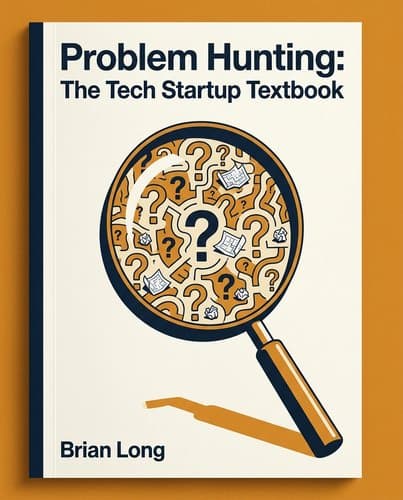
144876823_problem-hunting
by Brian Long
Most startups fail not from bad execution, but from solving problems nobody urgently needs solved. This battle-tested framework teaches founders to validate…
In Brief
Most startups fail not from bad execution, but from solving problems nobody urgently needs solved. This battle-tested framework teaches founders to validate pain points before writing a single line of code, using cheap experiments that reveal the truth investors and customers won't volunteer.
Key Ideas
Validate problem urgency before writing code
Run the Problem Definition Document (PDD) test before writing any code: list specific metrics the problem affects, prior failed solutions, and rate urgency on a 1-10 scale — if it's not a 9 or 10 for buyers, keep hunting
Find budget authority, not accessibility
Identify your buyer by budget authority, not accessibility: HR and Customer Support are 'cost centers' who are easy to reach and never sign checks; CEO, Marketing, and Sales drive revenue and have budget
Strip MVP to core metrics
Cut 50% of your MVP: replace analytics dashboards with Excel sheets emailed manually, replace custom links with Google Analytics — test core metrics in weeks instead of months
Measure product-market fit with four metrics
Use four PMF instruments before scaling: SDD success metrics, NPS score (60+ is best-in-class for software), monthly churn rate below 2%, and 'inability to keep up with demand' as a qualitative signal
Discount sales forecasts by fifty percent
Discount any sales forecast by over 50% automatically: salespeople are rewarded for optimism — track opportunity stages with probability percentages and watch the 'age' and 'last update' of every deal in your CRM
Hire in forty-eight to seventy-two hours
Collapse the hiring process into 48-72 hours: phone screen on day one, in-person committee on day two, references and offer on day three — speed beats brand name and cash when competing with large companies
Lead with buyer's problem, not solution
Lead every sales email with the buyer's problem, not your solution: a subject line with a custom revenue estimate ('Make $24M in incremental revenue for [Brand]') outperforms any product feature claim
Hire top legal counsel from start
Hire a top-tier startup law firm (like Cooley) from day one — they often defer fees, and the cost of messy documentation during Series A due diligence is measured in leverage lost, not just dollars spent
Score investor interest, surface real objections
End every investor pitch with a 1-10 interest score and the follow-up 'what would make this a 10?' — this surfaces the real objection and calibrates your pitch before it reaches your most important targets
Who Should Read This
Business operators, founders, and managers interested in Startups and Business Strategy who want frameworks they can apply this week.
Problem Hunting: The Tech Startup Textbook
By Brian Long
12 min read
Why does it matter? Because the startup advice you've been given is solving the wrong problem.
Most founders believe the startup graveyard is full of people who moved too slowly, doubted themselves too early, or quit before the breakthrough. The real evidence tells a different story. Brian Long sold one company to Twitter in two years and scaled another to a thousand employees and nearly a billion dollars raised — not because he was faster or more confident than the competition, but because he learned, often painfully, that momentum itself is the trap. The founders who flame out spectacularly aren't the ones who hesitated. They're the ones who built with total conviction in exactly the wrong direction. Long's framework, tested across both failures and exits, is a set of checkpoints designed to catch you before that conviction hardens into a liability. What follows is his sequence: when to stop building and talk, when the numbers say keep going, and when to pour fuel.
Most Founders Are Solving Problems Nobody Urgently Has
Brian Long spent months walking the streets of New York collecting paper menus. He and his co-founder photographed hundreds of restaurants, typed the listings into a database, and built a searchable interface they called Hungry4 — all because Long wanted to find the city's best sorbet and no definitive guide existed. When they finally showed the product to real users, the response was indifference. People didn't want to search menus. They wanted a map and a way to get food delivered to their door. Long and his co-founder had answered a question nobody was asking. He later reflected that if they'd talked to users before writing a single line of code, they might have heard exactly what people did want — and possibly built what became DoorDash.
The pattern repeats across thousands of founders Long has spoken with. The instinct is to build — to treat the product as the starting point, then find the customers afterward. It feels like progress. It looks like work. But it skips the one step that determines whether the work matters: finding out whether anyone has a problem urgent enough to pay someone to solve it.
A buyer's problem scores a 9 or 10 out of 10 only when they're already trying to fix it, failing, and feel the cost of that failure in measurable ways — declining revenue, a metric sliding the wrong direction, money spent on workarounds that don't hold. Everything below an 8 is noise. A polite "that sounds interesting" is not signal. It's social grace.
When Long built Franklin, a communication tool for large distributed workforces, he scheduled hundreds of meetings with HR vice presidents. They were friendly, engaged, and almost never said no to a call. The problem: HR departments are cost centers, not budget holders. Long left those hundreds of conversations with warmth and zero paying customers.
The fix isn't pessimism — it's sequence. Talk first, without mentioning your solution, until you find a problem that scores a 9. Then build.
The Cheapest Test Is the One You Run Before You Write a Line of Code
A product is the most expensive hypothesis you can run. Before you write code, you can pitch a slide deck, sketch a mockup, or send manual emails from an engineer's personal account — and if the idea fails, you discard the slides and move on. Once you've built something, you've created an object with weight. It's hard to throw away, and harder still to admit you should.
Long learned this at Attentive, and the lesson came from the build itself. Before launch, he and his co-founder drew up a five-point product plan: a sign-up widget for mobile websites, an analytics dashboard, a web app for composing and sending SMS messages, a custom link-tracking system, and a separate interface to display performance data. Properly built, that's four-plus months of engineering. They had customers who wanted to start immediately, and Long knew anything shipped without customer contact would be built on assumptions. So his co-founder Andrew, who owned the product timeline, started cutting — not trimming, cutting. The analytics dashboard became a spreadsheet emailed to clients by hand. The message-sending app became engineers composing texts via email on the client's behalf. The custom tracking links became standard Google Analytics URLs. A four-month engineering project shipped in weeks. Customers went live, used it, and gave feedback that shaped everything built afterward.
The deeper point isn't that manual workarounds are clever — each one is disposable in a way a finished product isn't. When a customer said the Excel reports were clunky, Long could fix the workflow in an afternoon. If he'd spent four months building a polished reporting interface nobody opened, the pressure to justify that investment would have kept it in the product long past its usefulness.
Before any of this, Long would write down exactly what he was trying to test: the solution, the metrics it had to move, and the minimum features needed to test those metrics and nothing else. At Attentive, that list was short enough to gut five features down to three manual workarounds. Pitch it as slides first. Get a score. If buyers rate the solution below an 8 out of 10, the concept isn't ready. That conversation costs an afternoon. The alternative costs months — and the next question is how you'll know, once you do build, whether you've actually found product-market fit.
Product-Market Fit Is a Number, Not a Feeling
How do you know when your product has actually found its market? Most founders answer that question with a feeling — momentum in sales calls, energy in Slack, a general sense that something has clicked. The feeling is real. It's also unreliable, and building on it before you've checked the numbers is how you staff up, spend the runway, and discover six months too late that you were celebrating noise.
Long breaks product-market fit into four concrete instruments. The first is SDD metrics — the specific numbers you committed to moving before you built anything, now measured against reality. At Attentive, his SMS marketing company, the benchmark was email: roughly 3% of website visitors subscribed to email lists, about 10% of emails got opened, and 3% of links got clicked. For SMS to justify the investment, it needed to beat those numbers convincingly. What Attentive actually saw: more than 5% of visitors subscribed, over 10% clicked through, and each subscriber generated ten times the revenue of an email subscriber. Every metric passed. That result — not a gut feeling — was what triggered the decision to scale.
The second instrument is Net Promoter Score: one survey question asking customers how likely they are to recommend the product, scored zero to ten. Subtract the share who score you low (zero through six) from the share who score you high (nine or ten). The software industry average is around 40. Long's earlier company TapCommerce scored 60, which put it in genuinely rare company.
The third instrument is churn — the rate at which customers stop buying. In any finite market, churn is a countdown. New customers can mask it for a while, but once you've reached most of the addressable buyers, attrition overtakes acquisition and revenue collapses. The fourth is supply overwhelmed by demand: orders you can't fulfill, a waitlist you can't clear, customers pushing you to move faster.
TapCommerce had a 60 NPS and strong retention — clear PMF by every measure — and still had to sell to Twitter within two years of launching. The problem wasn't execution. Long had estimated 10,000 businesses as viable customers. After actually selling to them, the real number turned out to be around 500. The instruments can tell you that your product works. They can't tell you whether the market is worth the fight.
Your First Ten Hires Will Recruit the Next Forty — Choose Archetypes, Not Résumés
Think of your founding team as a mold. Whatever shape it holds, your next forty hires will fill that shape.
At his earlier company, he'd built a team that skewed junior — and watched inexperienced people hire people even less experienced than themselves. At Attentive, he reversed the equation: set a high bar for the first ten, and the first ten set a high bar for everyone who followed.
The type Long hired for wasn't a generalist who believed in the mission; it was a specific personality: someone who prefers making things directly over delegating and overseeing. Builders are frequently poor fits at large companies, where roles are defined and execution is handed down. In a startup, where almost nothing has been defined, they're the only people who move things forward without being asked. The interview question Long uses to find them is deceptively simple: ask a candidate to rate their own performance in the interview on a scale of one to ten. Coachable people score themselves a six or seven and immediately name specific things they'd do differently. People who struggle with self-correction stall at the question, or rate themselves a nine and can't find a flaw. One question, two minutes, and you've learned something a résumé never tells you.
Finding those people requires more pipeline than most founders expect. At Attentive, fourteen of the first twenty hires came from entirely cold LinkedIn outreach — not from Long's network, not from referrals, not from people who already knew the story. He built candidate lists by mapping target companies and adjacent job titles, then sent personalized messages directly from his own account, staking his credibility on a single line: his prior company had sold to Twitter. The reply rate on those messages, with follow-ups, ran between ten and thirty percent. Founders who send one message, hear nothing, and move on are drawing the wrong conclusion — the channel works; they just stopped too early.
Once a strong candidate surfaces, speed is the tiebreaker. Large companies have bigger salaries and more recognizable names, but they can't move fast. Long compressed the entire process at Attentive into three days: phone screen on day one, in-person interviews on day two, references checked and an offer extended on day three. The best candidates are talking to multiple employers at once. Whoever makes a serious offer first usually wins.
Buyers Don't Care About Your Solution. They Care About Their Problem.
Most founders assume marketing is about explaining what your product does as clearly as possible. The real job is the opposite: surface the buyer's problem so precisely that they feel it before you ever mention your solution.
Attentive's early email outreach proved this the hard way. When Long's team led with the solution — subject lines like 'Interested in SMS Marketing for YourBrand' — the emails went nowhere. Buyers didn't care about SMS as a channel. They cared about hitting their annual revenue targets, and every person Long was reaching had one job: find another 20 to 50 percent growth, year after year. When the team rewrote their subject lines around that problem — 'Make $24M in incremental revenue for [Brand], free trial' — response rates jumped. The dollar figure wasn't invented; the team used traffic data from SimilarWeb to build a custom revenue forecast for each brand, so every email arrived with a credible number attached to a familiar company name. The buyer who had deleted the previous message now asked how that number was calculated. That question is the beginning of a sale.
Leading with the problem is also the diagnostic: if buyers engage, you've identified the right pain; if they want to try your product, you may have the right fix. The messaging and the market test are the same motion.
But even after your product works and your messaging lands, you face a different problem: no one has heard of you, and buyers default to known names to avoid career risk. Long's answer was to manufacture legitimacy before scale existed. Attentive launched in spring 2017 and had only a handful of customers by September. Long hosted a customer conference anyway. The event page launched with zero logos; the team populated it by inviting contacts at reputable companies — friends, significant others, anyone with a recognizable employer. They hired a videographer to capture testimonials against a branded backdrop and got clean photos of speakers at the venue. Monthly customer signings went from two or three to more than ten immediately after the event, and for the first time, some prospects mentioned having heard of Attentive before the call.
The Human in the Room Will Outlast the Deck on the Screen
The Attentive sales team ended a call and logged off. What they didn't know was that Gong, their call-recording software, kept running — and the potential customer, still on the line, immediately started debriefing with a colleague. The client was already signed with a competitor and considering switching. After twenty minutes of pitch, the only thing they talked about was the person they'd just met: the CEO looked tired, had gray hair, and had been genuinely, visibly paying attention. That was the whole argument for switching vendors. No feature comparison, no pricing logic, no ROI calculation. They were buying the man in the room.
Long draws a sharp tactical conclusion: buyers forget decks, but they remember how a salesperson made them feel. The tactics he's built around this are deliberately non-technical — camera on, a second person on the call on mute to take notes so you never have to look down, a notepad held up so the buyer can actually see you writing when they speak. The energy you project transfers directly to the person across the call. A nervous presenter makes the buyer uncomfortable. An engaged one makes them want to keep talking.
The most powerful tactic is the one that costs the most discipline. When a buyer finishes speaking, don't respond — pause, write, and wait. In an early Attentive meeting with a large company's marketing leadership, the CMO explained why she'd agreed to the meeting, then stopped. The Attentive team said nothing. She started talking again and kept going for nearly twenty minutes, eventually describing her biggest frustrations with their current vendor and exactly what she needed from a new one. By the time the pitch started, the team already knew which problems to solve. They won the business within weeks.
Fundraising Is a Sales Process, and the Best Deal Comes From the Last Meeting You Almost Skipped
Long was four months into the most exhausting stretch of his career. Fifty-two investor meetings for TapCommerce's Series A, nearly every one a polite decline. Then a real term sheet arrived — low valuation, fair enough — and he was nearly ready to sign. Then someone mentioned an investor in Boston who'd looked at the seed round and passed. The meeting seemed pointless. Long took the train anyway.
The session started with two people in a conference room asking cautious questions. Then more partners filed in. Two hours later, Long walked out with a term sheet at twice the price of the one he'd almost settled for. A half day, a train ticket, one meeting he nearly skipped — it changed the outcome of the entire round.
The lesson isn't that persistence pays off in some vague, motivational sense. Fundraising follows the same logic as any other sales funnel: the best deal rarely comes from the first interested buyer, and the process isn't finished until the money is in the bank. Which is exactly why that Boston meeting — the one he almost skipped — came last. You want the pitch calibrated before the meetings that matter most, and fifty-two reps will do that.
Building the target list is where the process starts. Long used Crunchbase's advanced search to filter by stage, geography, and industry, then looked for funds that had backed companies similar to his — not direct competitors, but adjacent bets that proved the investor understood the category. The key move was going one step further: rather than cold-emailing partners directly, he contacted the founders of those portfolio companies first. Entrepreneurs are motivated to make introductions; a forwarded email from a peer carries far more weight than anything arriving cold. Associates and principals are worth reaching directly when no warm path exists — they're actively hunting for new deals, unlike partners managing existing board seats and LP relationships.
Once the meetings start, the closing technique is borrowed directly from customer discovery — the same one-to-ten scoring system transfers straight into investor pitches. At the end of every meeting, ask for a score from one to ten, then ask what would make it a ten. 'Congratulations on building something great,' with no timeline attached, means the answer is already no. Long's team learned to treat that phrase as a trigger to ask the question directly rather than wait for a follow-up email that never arrives. The score forces investors to name their actual objection. That objection either gets addressed or it sharpens the next pitch.
The Startup Advice Nobody Gives You: Fix the Legal Structure Before You Need To
When do legal problems actually kill a startup? Not during the hard years, when everyone expects trouble. They surface at the exact moment the company finally works — during due diligence for a big funding round, when a serious investor is running a fine-tooth comb through every document you signed in year one.
Long learned this firsthand. His first company incorporated through an online service, then hired a discount law firm to handle the seed round. The paperwork looked fine from the inside. It wasn't. When a Series A investor commissioned proper legal review, the documents were a mess — incomplete, inconsistent, and wrong in ways that required tearing up and redoing entire layers of the foundation. The process triggered personal tax charges. It dragged on for weeks. By the time it was nearly finished, the bank account had almost hit zero. The company needed the round to close or it would run out of money, and the founders knew it — which meant every negotiation in those final weeks happened from a position of pure desperation. Terms they would have pushed back on in any other circumstance, they accepted. That is the actual cost of cheap legal: not the savings you pocket on day one, but the leverage you surrender on the day you can least afford to lose it.
At Attentive, Long hired a specialized startup firm from the start and calls it one of the smoothest decisions he ever made. Attentive worked with Cooley, a firm that specializes in startups and typically charges modest incorporation fees against future work. The math for the founder is obvious once you've lived the alternative.
The same logic applies to equity — cheap defaults there compound just as badly. The standard four-year vesting schedule, Long argues, doesn't match the actual timeline of most startups. Companies often spend years finding their footing before any meaningful growth begins, which means an early employee who leaves in year three walks away with substantial equity even if the company hasn't yet done the thing it set out to do. Attentive moved its early employees to five- and six-year schedules, pairing the longer window with smaller initial grants refreshed through performance-based equity every six months, tied to what each person actually shipped. The employee builds a stake over time, proportional to what they contributed. Fix the structure before anyone is watching, because by the time someone is watching, it's too late to fix it cleanly.
The Only Assumption Worth Testing Is the One You Haven't Questioned Yet
Almost nobody is watching you as closely as you think. The competitor who might copy your idea, the investor who might laugh at your pitch, the customer who might think less of you for asking a dumb question — they're absorbed in their own noise. The scrutiny you dread is mostly imagined. What remains once you accept that is a short, honest list: the things you believe about your market, your buyer, and your product that you haven't actually tested yet. Long's real argument, threaded through every mistake and every framework, is that the moment you start treating your convictions as hypotheses — things to be disproved quickly and cheaply — the stress of building something doesn't disappear. It just stops being the kind that paralyzes you. Not competition, not timing, not access. Untested assumptions dressed up as facts. That's the whole obstacle.
Notable Quotes
“Well what type of books do you like to read? Have you read this book before? Have you heard of it?”
“I hope you are having a nice day,”
“Are there any reasons you wouldn’t try this out?”
Frequently Asked Questions
- What is Problem Hunting: The Tech Startup Textbook about?
- Problem Hunting: The Tech Startup Textbook (2023) argues that most startup failures stem from building before validating the problem. Author Brian Long provides a repeatable framework spanning from the Problem Definition Document through product-market fit signals, hiring, sales, and fundraising. The core thesis is that founders should test cheaply and honestly at every stage before committing significant time and capital. This approach prevents teams from building solutions to non-urgent problems or to problems that customers won't actually pay for, ensuring smarter resource allocation from day one.
- What is the Problem Definition Document framework in Problem Hunting?
- The Problem Definition Document (PDD) test should be run before writing any code. According to the framework, list specific metrics the problem affects, identify prior failed solutions, and rate urgency on a 1-10 scale — "if it's not a 9 or 10 for buyers, keep hunting." This early validation test prevents founders from investing months and capital into products that solve non-urgent problems. By testing problem urgency before development, teams can confidently pursue high-priority customer needs or pivot quickly to hunt for more compelling problems.
- What are the key metrics for product-market fit in Problem Hunting?
- Brian Long identifies four PMF instruments before scaling: SDD success metrics, NPS score (60+ is best-in-class for software), monthly churn rate below 2%, and "inability to keep up with demand" as a qualitative signal. These metrics provide both quantitative and qualitative indicators that confirm customers genuinely need and value the product. By monitoring these four instruments together, founders can objectively determine whether they've achieved product-market fit rather than relying on vanity metrics or subjective impressions of customer interest and engagement.
- What are the best practices for sales emails and investor pitches in Problem Hunting?
- Lead every sales email with the buyer's problem, not your solution — a subject line with a custom revenue estimate ("Make $24M in incremental revenue for [Brand]") outperforms any product feature claim. For investor pitches, end with a 1-10 interest score and ask "what would make this a 10?" to surface the real objection and calibrate your pitch. Additionally, discount sales forecasts by over 50% automatically since salespeople are rewarded for optimism. Track opportunity stages with probability percentages and monitor the "age" and "last update" of every deal.
Related Book Summaries
Read the full summary of 144876823_problem-hunting on InShort