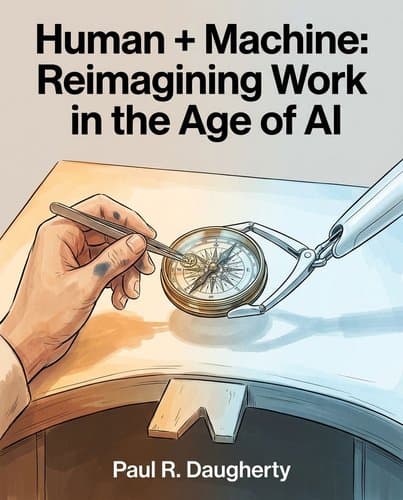
36465763_human-machine
by Paul R. Daugherty
Asking "will AI replace our workers?" is the wrong question—and companies still asking it are already losing. The real edge belongs to organizations that…
In Brief
Human + Machine: Reimagining Work in the Age of AI (2018) argues that the real competitive advantage isn't how much AI a company deploys, but how intelligently it redesigns work around human-machine collaboration.
Key Ideas
Shift from Job Replacement to Task Redesign
Reframe the core question: stop asking 'will AI replace our workers?' and start asking 'which tasks require human judgment, ambiguity resolution, or emotional complexity — and how do we pair those tasks with machines that handle the rest?' The first question leads to defensive posturing; the second leads to process redesign.
Map Human-Machine Work Distribution Gaps
Audit for the missing middle before adding more automation: map your processes to identify where humans are currently doing machine-level work (repetitive analysis, data sorting, routine correspondence) and where machines are being asked to do human-level work (resolving ambiguous complaints, exercising ethical judgment). The gap between those two lists is your optimization target.
Test Collaboration Over Full Automation
Expect counterintuitive optimal ratios: the right level of automation often means *more* human involvement in some areas, not less. Test combinations — Mercedes-Benz found that returning humans to customization-heavy assembly lines outperformed full automation; BMW found human-robot collaboration 85% more productive than either alone.
Build New Roles for AI Deployment
Budget for three new job categories that AI deployment creates: Trainers (teaching machines to handle emotional nuance and edge cases), Explainers (translating algorithmic outputs into decisions that can be audited and justified), and Sustainers (ensuring AI systems don't drift into bias, unsafe behavior, or regulatory violation). If these roles don't exist in your org, the work is happening anyway — badly.
Establish Accountability Before System Deployment
Design accountability before deployment: for every AI system that touches employees or customers, identify in advance who owns the decision when the collaboration produces a bad outcome. Moral crumple zones — where blame compresses onto human participants for system-level failures — are a design flaw, not a legal inevitability.
Develop Intelligent Interrogation as Core Skill
Develop 'intelligent interrogation' as a core team skill: the ability to ask layered, cross-domain questions of AI systems — 'What happens to Tylenol if we raise Advil's price? How confident are you, and what's the cost of being wrong?' — produces insights neither the human nor the machine generates independently. This skill is teachable and more valuable than AI technical literacy for most roles.
Enable Continuous Two-Way Collaborative Learning
Treat human-machine collaboration as a mutual apprenticeship: your workers train the AI on edge cases, values, and context; the AI trains your workers by modeling patterns they couldn't see alone. Build feedback loops in both directions, and resist the temptation to freeze either party's learning once the system is 'deployed.'
Who Should Read This
Business operators, founders, and managers interested in Artificial Intelligence and Management who want frameworks they can apply this week.
Human + Machine: Reimagining Work in the Age of AI
By Paul R. Daugherty & H. James Wilson
10 min read
Why does it matter? Because the companies losing to AI aren't being automated out of existence — they're being out-thought.
Most executives treating AI as a technology decision are already asking the wrong question. They benchmark platforms, measure ROI, and call it transformation. What Daugherty and Wilson found (after surveying 1,500 companies and enough factory floors and back offices to know the difference) is that the organizations pulling ahead aren't the ones with the most powerful algorithms. They're the ones that treated human-machine collaboration as a design problem worth deliberately solving. There's a zone between replacement and augmentation where the real competition is happening, and almost nobody is calling it by name. The firms operating inside it are producing results their competitors genuinely can't explain. The question was never human versus machine. It was always: who figures out the collaboration first — and builds the work around that answer?
The Replacement Debate Is the Wrong Debate — and It's Costing You
Early GPS devices gave you turn-by-turn directions: a fixed route, calculated once, delivered. Waze broke that entirely: a living map, continuously rewritten by millions of drivers reporting accidents and road closures in real time, rerouting you before you feel the delay. The medium didn't just change; the nature of navigation changed.
Most executives thinking about AI are still arguing about the GPS transition. Should we automate this job away? Can we protect it? That debate treats AI as a more powerful version of the industrial machinery that replaced factory workers in the twentieth century — a tool that erases humans, and the question is just how many and how fast. It's the story Hollywood told in Terminator and 2001, and it's the frame that makes a worker at the BMW assembly plant in Dingolfing, Germany feel like she's on the losing side of an inevitable contest.
She isn't. Walk onto that factory floor and you'll hear music playing over a scene that looks nothing like a takeover: a lightweight robot arm picks up a twelve-pound gear while the worker moves on to her next task, then the arm inserts the gear precisely into the casing and swivels away for another. A choreography, not a replacement. Elsewhere on the floor, another robot arm coats small car windows with adhesive while a worker rotates the glass and wipes the nozzle. Two kinds of intelligence, each doing what it handles best, the process faster than either could manage alone.
Among those same 1,500 organizations, 9 percent are already operating this way. Those companies aren't winning because they automated more aggressively. They're winning because they stopped asking who replaces whom and started asking how to design work so that each party, human and machine, extends what the other can do. Every organization still trapped in the replacement debate is competing on the wrong question.
The Highest-Performing Companies Built a Space Nobody Was Watching
A Stitch Fix stylist logs in for her shift and finds the hard part already done. The system started with thousands of clothing items; machine-learning algorithms have already narrowed them by size, brand preference, and purchase history, leaving her a workable shortlist. She doesn't wade through items that would never fit or brands the client would never pick. What she sees is a distillation of millions of previous decisions.
But the algorithm couldn't do what comes next. The client left a note: she's attending her first job interview after a career gap and doesn't want to look like she's trying too hard. There's a Pinterest board with images that gesture at a feeling more than a style. The stylist reads these the way a good friend reads between the lines. She makes her selections, adds a handwritten note, and the box ships. When the client decides what to keep, that signal flows back into the system, making the algorithm a little sharper next time, and the stylist sharper too.
Stitch Fix designed its entire business model around this arrangement, and it couldn't work as pure automation or pure human judgment. The company built what the authors call the "missing middle": a deliberate zone where machines handle pattern recognition across structured datasets and humans handle the rest — ambiguous, emotionally loaded, context-dependent information. The 2,800 stylists aren't what's left after automation hit a ceiling. They're the point.
One detail shows how seriously Stitch Fix engineered this collaboration: the interface is designed to fight the algorithm's own tendency to calcify. The system deliberately varies what information stylists see, testing whether they're falling into recommendation ruts, and if they are, nudging them toward different choices. The machine actively manages the quality of the human judgment it depends on. That's the clearest signal that the human-machine partnership is the core product.
The Most Automated Companies Are Bringing Humans Back
The logical endpoint of AI investment is not a factory with fewer humans. At Mercedes-Benz, where 1,500 tons of steel move through the plant every day and 400,000 vehicles roll off the line each year, engineers spent years maximizing automation. Then they started reversing it. The company is actively removing robots from assembly lines because the variety of customized configurations modern customers demand has exceeded what the machines can handle. Markus Schaefer, head of production at Mercedes: "We're moving away from trying to maximize automation, with people taking a bigger part in industrial processes again."
That decision was a discovery about what optimal actually looks like. The only way to find it was to redesign the process rather than patch the existing one. A factory built around maximum robotics, then adjusted with human workarounds, will never surface that optimum. Mercedes had to ask a different question: for this set of tasks, at this level of product variety, which combination produces the best outcome? What came out of it looked nothing like what they'd been building toward.
An MIT study at BMW puts a number on it. Humans and robots working in coordination were 85 percent more productive than either an all-human or all-robot crew. The gap between the best pure-automation setup and the best hybrid arrangement is enormous, and the way to close it is to redesign the relationship between people and machines, not to improve either side in isolation.
The redesign is where most companies stall. When a robot can handle a task, the instinct is to hand it over — cleaner, measurable, consistent. But the BMW figure suggests that instinct leaves most of the value on the floor. The useful question is what happens to the overall system when you change who does what: how does human judgment combine with machine precision across the full sequence of tasks? That question can only be answered by observing the whole process in motion, and the answer will almost always surprise you.
The most automated companies in the world reached that position by figuring out, often against their own expectations, exactly how many humans to put back in.
AI Didn't Just Change Existing Jobs — It Created Categories That Have Never Existed
What job title do you give the person your AI system most needs?
That question exposes a blind spot in how most organizations plan for AI. The workforce conversation almost always sorts people into two piles: jobs that automation eliminates and jobs that survive. But the authors' study of 1,500+ companies found a third category growing alongside them — roles that couldn't have existed before AI, requiring skills no existing job description captures.
The authors call these workers trainers, explainers, and sustainers.
Koko, an MIT Media Lab spinout, built a machine-learning system to help chatbots respond empathetically to people in distress, and its trainers make the category concrete. The gap between trained and untrained is stark: when someone tells default Alexa they're anxious about an upcoming exam, the device returns a canned phrase. Koko-trained Alexa produces a full paragraph that reframes exam nerves as the body's preparation for action and suggests treating anxiety as a secret weapon. That's not a different algorithm. It's the output of a human trainer who taught the system what good empathy sounds like in that moment.
The trainer role is real, expanding, and surprisingly accessible. Training chatbots for empathy requires recognizing when a response misses the emotional register, not a technical background. The job didn't exist a decade ago; now it does. Meanwhile Fanuc, a leading industrial robot manufacturer, trained 47,000 people to use its equipment over a decade and still faces a projected two-million-person shortage of qualified workers. Training humans to train machines is itself a workforce crisis in manufacturing.
The explainer category has a harder edge. ZestFinance approves small loans, averaging $600, to borrowers with low incomes and spotty credit histories, running thousands of data points through stacked algorithms that score applicants on veracity, stability, and prudence. The company can explain every decision it makes. That capacity is no longer optional: the EU's General Data Protection Regulation established a legal right for consumers to challenge any purely algorithmic decision. Companies without explainers face regulatory exposure, not just reputational risk. Knowing which to use — a high-accuracy but opaque deep-learning model, or a decision tree (which shows its reasoning step by step) at the cost of some accuracy — is now a specialized role. Five years ago, no organization that deployed AI had a title for it.
Sustainers are the least visible of the three. Context designers, ethics compliance managers, and automation ethicists guard against outputs that discriminate, erode trust, or trigger the uncanny-valley rejection that sinks customer adoption. Less than a third of companies surveyed reported high confidence in their AI systems' fairness and auditability. Most are taking it on faith.
Most companies are not staffed for any of this. That's the harder truth the framework surfaces: the missing middle requires people with capabilities that don't yet show up in any talent pipeline.
When the System Fails, the Algorithm Escapes — and a Human Absorbs the Blame
Ethnographer Madeleine Clare Elish hails a ride-share to Miami International Airport. The driver selects the first airport option the app offers: a cargo terminal, twenty minutes from the passenger terminal. Elish dozes off and wakes up on the wrong side of the airport.
Three things failed: the algorithm served a bad address, the driver didn't know Miami well enough to catch it, and Elish wasn't monitoring the route. When she tried to report what happened, the system offered one accountability mechanism: a rating between two humans. The algorithm that initiated the failure was invisible to the entire feedback loop.
Elish and her collaborator Tim Hwang named what they observed: the "moral crumple zone." In automotive engineering, the crumple zone absorbs a crash on behalf of the driver: the car takes the damage so the human doesn't. In AI-managed systems, the structure reverses. When a human-machine process fails, the human operator absorbs the moral and legal impact not because they caused the failure, but because liability frameworks, rating systems, and HR processes were designed for a world where decisions terminate at individuals. The architecture of the system escapes judgment.
That's the accountability trap embedded in the missing middle. Companies designing AI into operations focus on efficiency and output quality, not on where blame lands when the system fails. In most organizations, blame falls on whoever was closest to the customer at the moment of failure (the driver, the nurse, the service rep), regardless of whether the algorithm they were paired with caused the problem.
Elish and Hwang's prescription centers on one structural fix: accountability mechanisms need to reach the algorithm, not just the humans nearest to it. Rating systems, escalation paths, audit loops: these tools exist in most organizations, but they were built for individual decision-makers. The algorithm sits outside all of them. That gap — between who makes the call and who takes the hit — is where trust in AI systems quietly erodes.
Eight Specific Skills Determine Whether a Human Adds Value in an AI-Augmented System
The maintenance worker in the power plant starts her shift with an alert she didn't see coming. A computerized voice — GE's Predix, a digital-twin that mirrors the physical turbine's behavior in real time — announces: "Operator, a change in my mission is causing damage to my turbine rotor." She asks for details. The system walks her through six months of operational data, tells her the damage has quadrupled, and projects the rotor will lose nearly 70 percent of its useful life if nothing changes. Through her AR headset, a red slash marks where the damage is occurring. She asks about options. The system recommends a load-reduction strategy with 95% confidence and estimates it would prevent an outage worth $12 million. Ten minutes later, she tells the system to proceed.
A decade ago, that damage might not have surfaced until the turbine failed. What changed isn't just the technology; it's what the worker's job requires. She didn't need to be an engineer or data scientist. She needed to know how to ask the right questions, read a confidence interval, and make the call. The authors call this intelligent interrogation: the ability to probe a complex AI system across levels of abstraction until you have what you need to decide.
Intelligent interrogation is one of eight "fusion skills" the authors identify as the new grammar of human contribution in AI-augmented work. A second, reciprocal apprenticing, runs in the opposite direction: the human trains the machine by doing the job, and the machine trains the human back. All eight are distinct from the soft-skills platitudes ("be adaptable," "stay creative") that dominate most AI-workforce conversations; each is specific enough to teach, practice, and measure. Three focus on humans helping machines; three involve machines augmenting humans; two span both. The worker who develops them isn't hedging against AI; she's the person the system is built to work with.
IPsoft's AI assistant Amelia escalates questions it can't answer to a human colleague, and while that human resolves the problem, Amelia watches. The human trains the machine by doing the job. Amelia, over time, surfaces patterns no individual accumulates alone. Satya Nadella condensed the imperative: "Don't be a know-it-all. Be a learn-it-all."
The framework the authors build throughout ends on skills because skills are where strategy becomes personal. The GE maintenance worker and the IPsoft customer rep aren't uniquely talented. They're specifically prepared. That's the difference between anxiety and agency: one is a response to a future arriving at you; the other is a vocabulary for meeting it.
The Race Already Started — Most Organizations Don't Know Which Race They're In
The United States puts 0.1% of GDP toward helping workers navigate workplace change — a number that has been shrinking for thirty years, built mostly for displaced miners, not for the automation moment arriving now. The companies that grasp what race they're actually in, redesigning work rather than just deploying software, will build a compounding lead that no late mover can simply purchase at the end of it. The tools to fill the missing middle exist. What remains is the harder and more personal part: developing the specific skills that make you someone a well-designed system is built to work with, not around. The eight fusion skills aren't a guarantee. They're a vocabulary. And a vocabulary is where agency starts.
Notable Quotes
“Operator, a change in my mission is causing damage to my turbine rotor.”
“Twin, how certain are you?”
“Twin, what do you recommend?”
Frequently Asked Questions
- What is the main argument of Human + Machine?
- The book argues that competitive advantage comes not from deploying more AI, but from how intelligently companies redesign work around human-machine collaboration. Daugherty and Wilson present a framework for auditing processes, identifying human-machine mismatches, and building new roles—trainers, explainers, and sustainers—that make AI systems effective, accountable, and safe. Rather than asking whether AI will replace workers, leaders should ask which tasks require human judgment, ambiguity resolution, or emotional complexity, then pair those tasks with machines handling the rest. This reframing shifts thinking from defensive posturing to strategic process redesign.
- What are the three new job categories created by AI deployment according to the book?
- The book identifies three new job categories created by AI deployment: Trainers teach machines to handle emotional nuance and edge cases. Explainers translate algorithmic outputs into decisions that can be audited and justified. Sustainers ensure AI systems don't drift into bias, unsafe behavior, or regulatory violation. According to the authors, 'If these roles don't exist in your org, the work is happening anyway — badly.' Organizations must budget for and intentionally design these roles rather than expecting them to emerge organically, as they're critical for responsible AI deployment.
- What is the 'audit for the missing middle' concept in Human + Machine?
- The missing middle audit identifies mismatches in how tasks are currently allocated between humans and machines. Map your processes to find where humans are doing machine-level work—repetitive analysis, data sorting, routine correspondence—and where machines are being asked to do human-level work like resolving ambiguous complaints or exercising ethical judgment. The gap between these two lists reveals your optimization target. This audit reveals inefficiencies that automation alone won't fix, showing where intentional process redesign can better match tasks to the unique strengths of humans and machines rather than pursuing full automation across the board.
- What does Human + Machine say about optimal levels of automation?
- The book argues that optimal automation levels often require more human involvement, not less. The authors expect 'counterintuitive optimal ratios'—the right mix frequently means humans and machines working together rather than either working alone. Examples include Mercedes-Benz finding that returning humans to customization-heavy assembly lines outperformed full automation, while BMW found human-robot collaboration 85% more productive than either alone. Rather than maximizing automation, leaders should find the optimal combination for each process. The framework treats this as mutual apprenticeship: workers train machines on edge cases and context, while machines reveal patterns workers couldn't see alone.
Related Book Summaries
Read the full summary of 36465763_human-machine on InShort