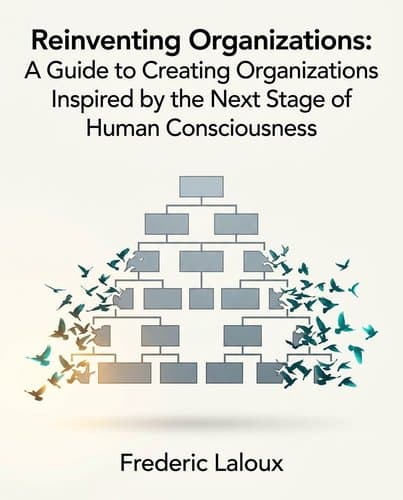
45891610_reinventing-organizations
by Frederic Laloux
Every organizational dysfunction you've accepted as inevitable — the politics, the empty meetings, the quiet suffering — is structural, not human nature.
In Brief
Every organizational dysfunction you've accepted as inevitable — the politics, the empty meetings, the quiet suffering — is structural, not human nature. Laloux proves it by profiling real companies with thousands of employees already running on a radically different model.
Key Ideas
Structures manifest their embedded human assumptions
Before designing any HR process, management layer, or decision rule, ask: what assumption about human nature does this encode? The structure will make that assumption true — Theory X structures produce Theory X behavior, and Theory Y structures produce Theory Y behavior.
Advice process enables distributed authority at scale
The advice process is a specific, scalable alternative to both hierarchy and consensus: anyone can make any decision, as long as they consult those who will be affected and those with expertise. The initiator decides — they are not bound to follow the advice, but they must seek it. This mechanism has operated across organizations ranging from 90 to 40,000 people.
Replace power hierarchies with expertise hierarchies
Self-management doesn't mean flat or equal. It means replacing dominator hierarchies (boss-subordinate power over people) with actualization hierarchies (expertise, scope, and purpose — which are natural and healthy). Teams can be 10 people or 10,000; the key is that roles are granular, fluid, and held by peers rather than imposed by rank.
Full humanity surfaces truth and prevents politics
Wholeness isn't a culture initiative — it's an organizational design question. The suppression of emotion, intuition, and authentic selfhood creates specific failures: political behavior, information hoarding, performative decision-making. Concrete practices (structured peer feedback from care rather than judgment, physical spaces that signal full humanity is welcome) change what information surfaces and what decisions get made.
System cannot exceed leader development level
If you are not the founder or CEO, a Teal experiment inside a non-Teal structure is almost certainly a losing bet. The organizational center of gravity cannot rise above its leadership's stage of development — practices from later stages get quietly neutered, and the hierarchy reasserts itself under pressure. Find or build the right container before expending energy on practices.
Purpose unlocks profits that incentives cannot
Purpose-driven organizations don't ignore financial results — they use them as feedback on whether the purpose is being served. The paradox documented across twelve organizations: the less directly they optimize for profit, the more consistently profitable they become, because purpose unlocks motivation, sensing, and decision-making that no incentive scheme can buy.
Who Should Read This
Business operators, founders, and managers interested in Organizational Behavior and Management who want frameworks they can apply this week.
Reinventing Organizations: A Guide to Creating Organizations Inspired by the Next Stage of Human Consciousness
By Frederic Laloux & José Heuzé
9 min read
Why does it matter? Because the misery inside most organizations isn't a management failure — it's the structural output of a worldview we've already outgrown.
Something is wrong at every floor of the pyramid. Surveys confirm what most of us already sense: work at the bottom runs on dread. But Laloux spent fifteen years consulting at the top, and the view from up there isn't better — just quieter about it. Different vocabulary for the same hollowness.
Here's what he couldn't stop thinking about: what if none of that suffering is inevitable? What if the politics, the performative meetings, the manager who seems to exist mainly to slow things down — what if those aren't bugs in the human condition but the entirely predictable output of a specific design philosophy? One that made sense once, in a different era of human understanding, and has since been quietly superseded?
A dozen real organizations, with thousands of actual employees, are already running on different assumptions. What they found shouldn't be possible by the logic of how organizations are supposed to work. And then it happened at scale.
The Dysfunction Isn't a Bug — It's Baked Into the Architecture
Imagine you're a nineteenth-century anatomist who has just discovered something startling: there's a fully autonomous nervous system in the human gut, capable of independent operation, entirely separate from the brain in the skull. You write it up. Colleagues confirm it. And then — nothing. For a century, medical circles simply forgot it existed.
A physician identified the gut's neural network in the 1860s, and the discovery went unnoticed for over a century before anyone looked again. How do you forget a brain? You don't forget it, exactly. You stop being able to see it. A worldview built around hierarchy (one command center, one boss at the top) has no room for distributed intelligence. The idea of three autonomous nervous systems working in parallel was simply unthinkable, so the evidence went unseen, the way Galileo's contemporaries wouldn't look through the telescope. The worldview wasn't ignorance. It was an architecture that decided in advance what could exist.
Here's the interesting part: the same thing has happened to organizations. The suffering at work isn't random; it has a structure. At the bottom of the pyramid, most people experience their jobs as dread rather than purpose. The Dilbert cartoons became cultural icons because they named something almost universal: the sense that management makes useful work harder. But Laloux spent fifteen years consulting organizational leaders and found the misery doesn't stop at middle management. Behind the confident exteriors, executives describe a quiet emptiness: frantic schedules masking futility, political games that exhaust everybody regardless of rank.
The dysfunction isn't caused by bad people. It's generated by assumptions about human nature baked so thoroughly into org design that they become self-fulfilling: the architecture produces the behavior that confirms the assumption.
Every Organizational Model in History Looked Permanent — Until the Next One Arrived
Every organizational model that has ever existed was invented. Every one of them felt, to the people inside it, like the natural order of things.
Each major shift in human consciousness produced a new way of organizing people. The sequence matters less than this: each model felt inevitable from inside it.
Four models have shaped the last several thousand years. The first ran on raw force: whoever could project power held the group together. Laloux calls this Red, and the metaphor is a wolf pack — the alpha holds position through continuous displays of dominance; the moment power wavers, someone moves to take it. Brutal, yes, but in genuinely hostile conditions like civil wars or failed states, it works. A specific answer to a specific problem.
Then consciousness shifted, and with it came a new answer: the army. Amber organizations (the Catholic Church, colonial trading companies, early industrial factories) introduced something Red could never achieve: stability. Fixed titles, formal hierarchies, written rules. A priest doesn't scheme to topple a weak pope; the robe confers authority, not the personality wearing it. Projects spanning centuries became possible. The assumption underneath, though, was that workers needed direction the way children need parents. Thinking at the top; labor at the bottom.
Orange arrived and called that assumption inefficient rather than unjust. The world isn't an army. It's a machine, and machines can be optimized. Innovation became a competitive advantage, meritocracy replaced fixed caste, and managers measured rather than commanded. Green pushed further: organizations are families, not machines. Servant leadership, stakeholder balance, frontline empowerment.
Here's what Laloux notices: all four models are running simultaneously right now, in the same cities. The Catholic Church operates on Amber logic. Walmart runs on Orange. Southwest Airlines has moved into Green. Each model felt permanent from inside it. None were. The one you're working in today is no different — which means what feels like fixed human nature is actually a specific historical answer to a specific moment. And history keeps moving. If you're in an organization that feels broken in ways you can't quite name, that's not a permanent condition. It's a historical one.
There's a fifth stage in this sequence. Laloux calls it Teal — and unlike the others, we don't have to imagine it. It's already running.
No Managers, 7,000 Nurses, $49 Billion in Potential Savings — Here's the Mechanism
On a Friday in northern France, FIAT calls FAVI's gearbox team with an unusual request: instead of the usual single truck dispatched every Sunday night, could they manage two? Jean-François Zobrist, FAVI's CEO, is traveling. No planning department to consult, no manager to approve overtime. The team gathers, thinks through the logistics, calls for volunteers from neighboring teams. By Sunday night, two trucks roll toward Italy. No one asked for permission. No one filed overtime paperwork — the team would recover the extra time in the weeks ahead. When Zobrist returned and heard the story, one question stuck with him: why would any of this have required a CEO?
That story is the mechanism in action. FAVI, a 500-person French brass foundry, runs with no middle management, no functional departments, no scheduling authority above the shop floor. Teams of 15 to 35 people cluster around specific customers (the Volkswagen team, the Audi team, the Volvo team) and each handles its own hiring, purchasing, planning, and client relationships. The account manager for Volkswagen is embedded in the Volkswagen team. His motivation is feeding work to the colleagues he sees every week.
The standard objection to removing hierarchy: without someone at the top making calls, you get chaos or endless committee deliberations. There's a third option. The advice process, developed by AES, a global energy company with 40,000 employees across 31 countries, lets anyone make any decision, provided they first seek input from affected parties and people with relevant expertise. No consensus required. No permission required. A junior financial analyst at AES used this to create his own role, relocate to Pakistan, and get a $700 million power plant built — against his CEO's skeptical advice, within a framework that gave him the authority to proceed anyway.
The question underneath is about assumptions, not structures. When AES acquired a new plant, Dennis Bakke would ask incoming workers what their previous bosses believed about them. The list (workers are lazy, self-interested, incapable of consequential decisions, interchangeable) was rarely stated aloud. It was encoded in time clocks, approval chains, locked supply closets, and planning departments that decided what workers should do and when. Bakke's point: Theory X (people need control) and Theory Y (people are self-directed) are both self-fulfilling. Build a control architecture and you generate the evasive, clock-watching behavior that seems to justify it. Remove the controls, and something different appears.
Buurtzorg is the proof at scale. A Dutch neighborhood nursing organization founded with ten nurses in 2006, it grew to 7,000 in seven years (two-thirds of all neighborhood nurses in the Netherlands), supported by thirty people at headquarters. Teams of ten to twelve nurses handle their own intake, scheduling, hiring, and patient care, with no managers above them. An Ernst & Young study found that Buurtzorg delivers care in roughly 40 percent fewer hours per patient than traditionally organized nursing, with patients recovering in half the time and hospital admissions down by a third. Extrapolated to the American healthcare system: $49 billion in potential annual savings from home care alone, from an organization that, by every conventional measure, shouldn't work.
What Organizations Actually Lose When They Ask People to Check Themselves at the Door
What does "leaving your personal life at the door" actually cost an organization?
The efficiency numbers point at an outcome. Parker Palmer points at something harder to measure. He describes the soul as a wild animal: hardy and self-sufficient, but impossible to coax into the open. It retreats the moment it senses danger. The everyday sounds of organizational life — a sarcastic remark, an eye-roll, someone dismissed in a meeting — are exactly that kind of crashing through the woods. What disappears isn't atmospheric. It's operational.
What gets lost isn't morale or engagement scores. It's information. Laloux catalogs what suppressing people's emotional and relational dimensions actually produces: feedback loops that tell managers what they want to hear, conflicts that fester underground, decisions stripped of the intuitive pattern-reading experienced people carry but won't voice because voicing it isn't "professional."
The concrete fix comes from Sounds True, a Colorado audio publisher. Once a year, each employee receives feedback from six to twelve colleagues. Before anyone speaks, everyone closes their eyes and holds the person in their heart, releasing judgment. Then each colleague answers two questions: what they most value about working with that person, and one area where they sense the person could grow. Tears of gratitude are common. So is unusually honest, specific feedback that people say they've never received anywhere else.
The same information about someone's impact on their colleagues exists in both traditional and Teal organizations. In traditional settings, it stays unspoken — too risky, too personal, too far outside what work is supposed to be. At Sounds True, a sixty-second ritual changes the emotional conditions enough that it becomes speakable. Wholeness isn't a mood. It's a design choice that determines what information can move through an organization and what gets permanently suppressed.
The Organizations That Ignore Competition Keep Winning — and That's Not a Coincidence
Jos de Blok, who founded Buurtzorg, routinely sat down with the CEOs of companies competing directly against him and walked them through exactly how it worked. He wasn't compensated. He'd already published the details publicly — small autonomous nurse teams, no managers, patients treated as whole people rather than tasks to be completed — so anyone could copy it. His organization was also actively helping patients become independent as fast as possible, which structurally shrank Buurtzorg's own billable hours. Asked about competition, de Blok said something that sounds naïve until you see what happened: "The whole notion of competition is idiotic."
Buurtzorg went from ten nurses to 7,000 in seven years, capturing two-thirds of the Dutch neighborhood nursing market. The organization that stopped thinking about competitive position took the market from everyone who hadn't.
The mechanism underneath is specific. When purpose becomes the actual operating system, when it drives behavior rather than decorates a reception desk, it unlocks something incentive structures can't replicate. Buurtzorg nurses who noticed that elderly patients kept breaking hips didn't file a proposal with a committee. They designed a fall-prevention program with local physiotherapists and ran it. Purpose made the right action obvious. The information was at the edge of the organization, and so was the decision.
The irony: these organizations consistently outperform on exactly the metrics — market share, revenue margins, growth — they've stopped optimizing for. Purpose displaces competitive thinking, and then the competitive results follow anyway.
Laloux doesn't smooth this over. The founders he studied didn't choose purpose-first because they'd calculated it would win. They chose it because running on fear and competitive drive had become impossible to stomach. The winning was something they discovered, not aimed for. And that distinction matters: purpose deployed as a competitive strategy tends to produce exactly the hollow mission statements this book opens by mocking. It only works when it's real.
The One Condition No Program, Consultant, or Initiative Can Substitute For
The entire architecture of a Teal organization (what Laloux calls the next stage of organizational development) rests on one condition that no change initiative or consultant can manufacture: the people at the very top have to actually see the world differently.
AES is the documented case study of what happens when they don't — or think they do until tested. Co-founded in 1982, the company grew from two people to 40,000 employees across thirty countries, all running on radically decentralized, trust-based principles. The board supported this. The stock peaked at $70. The support looked like conviction.
It wasn't. When 9/11 hit, followed by the Enron collapse, AES's stock fell from $70 to $5. The decisions that proved risky in hindsight had been made collectively at board level. The self-management practices had nothing to do with the slide. But fear arrived, and with it came the truth: the board had loved the approach primarily because it pushed the stock price up, not because they believed it was the right way to run an organization. Under pressure, that distinction came to matter completely. Lawyers flooded in. Centralization was demanded. A co-CEO was installed above Bakke, someone with opposite views on nearly every question. Nine months of impossible collaboration followed. Bakke resigned. The board dismantled twenty years of Teal practice in months.
The structures didn't fail on their own. They held through the good years. What dismantled them was a board that, when pressure arrived, reached for the only tools that made sense to them: hierarchy, control, centralized authority. The Teal framework can't defend itself against people who never believed in it.
If the CEO and board don't genuinely hold a Teal worldview — not as a program they've approved, but as how they actually understand the world — the experiment will end. Reliably, under the first serious pressure. Which leaves the question the book never quite resolves: whether that worldview can be developed in a person, or whether it has to already be there.
What It Means That These Organizations Already Exist
Here's the interesting part about those twelve organizations — Buurtzorg, FAVI, AES among them — running experiments on separate continents without ever comparing notes: they converged. Same structures, same practices, same paradoxes resolved the same way. You can call that a blueprint for the future, or you can call it something simpler: evidence that when you take the same set of assumptions about human beings seriously enough to act on them, you tend to build the same kind of place.
These organizations exist. They work at scale. And the worldview that produced them keeps spreading — not because consultants are selling it, but because enough people have quietly stopped believing the old story. The question the book leaves you with isn't theoretical. It's about what you reach for — control or trust — the next time you're the one who gets to decide.
Notable Quotes
“is replaced with a collective”
“Red egocentrism has given way to Amber ethnocentrism. Ken Wilber puts it this way: Care and concern are expanded from me to the group—but no further! If you are a member of the group—a member of … my mythology, my ideology—then you are”
“an opportunity for me to practice holding my breath, so that on weekends I could free-dive deeper to catch the abundant abalone and lobster off the Malibu coast.”
Frequently Asked Questions
- What is Reinventing Organizations about?
- Reinventing Organizations argues that conventional management structures are the output of an outdated worldview and should be fundamentally replaced with models built on self-management, wholeness, and evolutionary purpose. The 2014 book draws on twelve real-world organizations to demonstrate that this new approach proves workable at scale and consistently outperforms traditional hierarchical alternatives. Laloux challenges organizational leaders to carefully examine what assumptions about human nature their structures encode, emphasizing that these structures become self-fulfilling prophecies, shaping both behavior and culture.
- What is the advice process in Reinventing Organizations?
- The advice process is a specific, scalable alternative to both hierarchy and consensus described in Reinventing Organizations. According to the book, 'anyone can make any decision, as long as they consult those who will be affected and those with expertise. The initiator decides — they are not bound to follow the advice, but they must seek it.' This proven mechanism has operated successfully across real organizations ranging from 90 to 40,000 people, enabling truly distributed decision-making without consensus bottlenecks or traditional top-down control.
- What does Reinventing Organizations mean by self-management?
- Self-management in Reinventing Organizations doesn't mean flat or equal organizations. Instead, it means 'replacing dominator hierarchies (boss-subordinate power over people) with actualization hierarchies (expertise, scope, and purpose — which are natural and healthy).' Teams can range from 10 to 10,000 people; the critical key is that roles are granular, fluid, and held by peers rather than imposed by formal rank or organizational position. This distinction clarifies that self-management ultimately isn't about eliminating hierarchy entirely but fundamentally transforming its very source.
- How do purpose-driven organizations perform financially according to Reinventing Organizations?
- Reinventing Organizations documents a striking paradox across twelve real organizations: the less directly they optimize for profit, the more consistently profitable they become over time. Purpose-driven organizations don't ignore financial results; they use them as valuable feedback on whether their core purpose is being served effectively and authentically. According to the book, 'purpose unlocks motivation, sensing, and decision-making that no incentive scheme can buy.' The evidence demonstrates that evolutionary purpose generates the behavioral and cognitive conditions necessary for sustained, superior profitability.
Related Book Summaries
Read the full summary of 45891610_reinventing-organizations on InShort