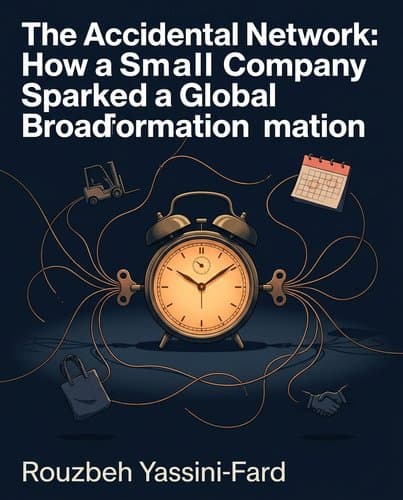
231235422_the-accidental-network
by Rouzbeh Yassini-Fard
Walgreens' distribution center became the company's most efficient operation—not despite employing people with disabilities, but because of it.
In Brief
Walgreens' distribution center became the company's most efficient operation—not despite employing people with disabilities, but because of it. Randy Lewis reveals how asking workers what they need instead of assuming transforms workplaces, and why designing for the most excluded employees makes every system better.
Key Ideas
Inclusive management drives superior performance
The business case for hiring people with disabilities isn't a trade-off — Walgreens' Anderson distribution center became the company's most efficient by cost, quality, and safety metrics, not despite its workforce but because of the management culture that workforce required.
Ask the person, not assumptions
'Ask the person' (ATP) is a concrete methodology: instead of assuming what an employee with a disability can or can't do, ask them. Most accommodations cost under $25 and improve processes for everyone.
Visible distinction undermines true inclusion
Separate inclusion programs that visibly mark workers as 'other' — matching T-shirts, segregated enclaves — preserve the stereotypes they claim to oppose. True inclusion means identical standards, identical pay, and no visible distinction between workers.
Surprising data persuades most powerfully
The finding everyone feared most (deaf forklift drivers) became the finding that proved the case: deaf drivers had substantially fewer accidents than hearing drivers, published in peer-reviewed journals. Let the data that surprises you do the most persuasive work.
Public commitment precedes perfect readiness
Institutional change requires public commitment before you feel ready. The author's single word 'yes' in an unheated Austrian warehouse — answering a lead engineer's blunt question about whether they were intentionally building for the disabled — was more decisive than any strategy document.
Send operators, not engineers
When spreading a model that works, don't send engineers — send operations people who run the place and do the hiring. The success wasn't in the technology; it was in the management culture. Visitors who brought the wrong people missed the lesson.
Bottom-up goals drive execution
Setting a 'clear and elevating' goal means making it specific, deadline-bound, and owned by the people who must execute it — not handed down. The 1,000-by-2010 target worked because the distribution center managers set it themselves after visiting Habitat International.
Who Should Read This
Readers interested in Organizational Behavior and Company Culture, looking for practical insights they can apply to their own lives.
The Accidental Network: How a Small Company Sparked a Global Broadband Transformation
By Rouzbeh Yassini-Fard & Stewart Schley & John Chambers
16 min read
Why does it matter? Because the companies that figured out disability hiring is good business did so because one father was lying awake at night listening to a clock tick.
Most people assume hiring workers with disabilities is a trade-off — you absorb some operational drag in exchange for doing something decent. Walgreens ran the experiment at scale, across millions of square feet of distribution floor, and the data came back exactly backwards: lower turnover, fewer accidents, higher accuracy, better teamwork. The centers built around the workers everyone else declined became the most efficient in the company's history. That inversion — charity that turns out to be competitive advantage, inclusion that turns out to be operational excellence — is the real story. But the reason it happened isn't a business strategy. It's a father lying awake in the dark, listening to a clock he couldn't unhear, asking who would take care of his son after he was gone. What follows is the story of how that question changed a Fortune 50 company — and started changing every company willing to look.
The Clock That Never Stops: What a Diagnosis Teaches You About Time
The doctor didn't smile when he shook their hands. That was the first sign. Randy Lewis and his wife Kay had come expecting reassurance — their son Austin was a little slow with language, maybe, the way boys sometimes are. Instead the doctor walked them through a battery of test results while they sat across his desk, and almost every number showed Austin falling well behind where a child his age should be. Language, motor skills, muscle tone — all of it. Pervasive developmental disorder, the doctor said. Autism, in plain terms. When Randy asked whether Austin might improve as he grew older, the doctor looked up from his papers and said quietly that he might get worse.
Kay sobbed in the car afterward. Randy gripped the steering wheel until his fingers hurt and stared straight ahead. But something else was already happening inside him — a clock had started running. It's the same clock, he would later say, that starts for every parent who receives this kind of news: counting down the years before you die and leave your child without anyone to look after them.
That clock is the real origin of what would become one of the most unusual workforce experiments in American corporate history. Not a diversity initiative dreamed up in a conference room, not a PR strategy, but a father's private reckoning with time. Austin had once used small words — ball, dog, water, daddy, bye-bye, no — and then those words had simply gone. In their place came pointing, pulling, tantrums. The Dag Hammarskjöld prayer Randy soon pinned above his desk — for all that has been, thank you; for all that will be, yes — wasn't optimism. It was the sound of someone deciding to keep moving anyway.
Why Charity Is the Wrong Answer — and the Peruvian Farmer Knew It First
What if the most generous thing you could offer someone was precisely the wrong kind of help? Randy Lewis spent two years in a small Peruvian village as a Peace Corps volunteer, arriving at twenty-one flush with the conviction that he had something valuable to give. Then a farmer, once Randy had learned enough Spanish to actually hold a conversation, asked him a question that stopped everything: why had they sent a person instead of a tractor? The village didn't need goodwill. It needed equipment — something with horsepower and a practical use. Lewis never forgot the question, and years later, watching his son Austin get quietly, repeatedly shut out of the working world, he understood why it had stayed with him.
Austin had done a work-study internship at a pizza parlor during high school. He threw himself into making dough with genuine devotion — his teacher-coach reported that he lived for it. His coworkers liked him. Customers liked him. He was reliable in ways that matter to any employer: never absent, never dishonest, never drama. When the internship ended, his family asked the manager to keep him on. To sweeten the offer, they said Austin would take any shift — the late nights, the weekends, the hours nobody else wanted. The manager said no. They offered to cut his wages. No. They offered to include a full-time job coach, at their own cost, so the manager would effectively get two workers for less than the price of one. No. They offered Austin's labor for free, with the coach included. Still no. The obstacle wasn't cost, or scheduling, or productivity. It was that Austin was, in Lewis's blunt word, weird — different enough that the manager preferred to forgo free labor rather than include him.
That single refusal clarified something Lewis had been circling for years. The impulse to help people with disabilities — the charity drives, the special programs, the enclave arrangements where contracted workers with disabilities labor in matching T-shirts while their sponsors make sure everyone knows which group is which — all of it preserved the very problem it claimed to address. Compassion, Lewis came to believe, removes pain. It doesn't remove the cause. Augustine put it more sharply fourteen centuries earlier: charity is no substitute for justice withheld. As long as employment was framed as something a business graciously extends to people with disabilities, those workers would remain permanent outsiders, recipients of a favor that could be revoked the moment it became inconvenient. What they needed wasn't generosity. They needed what any worker needs: a job offered because their labor is worth having, on the same terms available to everyone else. Lewis had the hiring capacity — his division was bringing on more than six hundred entry-level workers a year, growing toward a thousand. The question was whether he had the imagination to use it differently.
Before Anyone Believed It Could Work, Two Small Companies Already Proved It
The data already existed. No one had bothered to look for it.
When training expert Karen Preston went searching for companies that had already integrated workers with disabilities into mainstream roles at meaningful scale, she found what she needed in Greensboro, North Carolina — a small snack food manufacturer called Carolina Fine Snacks. Before owner Phil Kosak attended a disability employment fair and started hiring, his twenty-person factory was bleeding in the ordinary ways: one in five workers didn't show up on any given day, eight in ten quit within the year, and productivity ran at barely half of what was expected. Six months after Kosak brought on workers with visual impairments, hearing loss, and cognitive disabilities, those numbers had inverted. Annual turnover fell from 80 percent to under 5. Daily absenteeism dropped to the same. Tardiness — previously running at 30 percent — went to zero. Not lower. Zero.
That's not an inspiring anecdote. That's a turnaround. The workers society had deemed least employable had become the most reliable people on the floor.
Lewis and his team weren't looking for inspiration. They were looking for proof of concept — confirmation, as Lewis put it, that they weren't completely crazy. Carolina Fine Snacks provided it. What the data also revealed was a gap: large corporations weren't playing this game at all. A company might hire one or two people with disabilities as something close to a gesture. A real program — equal wages, equal expectations, genuine integration — simply didn't exist at scale in any major corporation.
For Lewis, that absence wasn't a warning. It was an opening. Walgreens had never been interested in chasing what competitors were already doing; the point was to be what competitors would eventually chase. The business case wasn't aspirational anymore. It was waiting to be built from a model that small companies had already quietly stress-tested, in real factories, with real numbers — numbers that happened to be extraordinary.
Chuck Dances for the Purple Totes — and Management Convenes a Meeting
Chuck worked the line at a Walgreens distribution center in Bethlehem, Pennsylvania, moving totes with the focused efficiency of someone who genuinely loved repetitive work. He had Asperger's syndrome. He was fast, accurate, and dependable. Two experienced women flanked him and quietly let it be known that anyone who gave Chuck trouble would answer to them. Nobody tested that. What nobody anticipated was the dancing.
Most totes at the center were a single color, keyed to their home facility. Occasionally a purple tote from another distribution center drifted down the line. When one appeared, Chuck danced. He didn't slow down. He didn't miss a beat. He just danced, and the whole floor knew it, and eventually everyone started watching for the purple totes with something close to anticipation. Management convened meetings. Was dancing allowed? There was no rule against it — the situation had never arisen before — but it wasn't standard procedure. After deliberation, they reached a conclusion: let him dance. Better that than the alternative.
That decision was small and it was enormous. A workplace had bent without breaking — flexibility isn't the same as losing control. Chuck's performance metrics were indistinguishable from anyone else's. His presence had made the floor more cohesive, not less.
When Lewis visited the center, a coworker pulled him aside. The man's son also worked there, another employee with a disability hired after Chuck's success. He asked Lewis one favor: if layoffs ever came, please let his son keep the job. Fire me first. His reasoning was simple — he could find another position somewhere; his son might not ever find one again.
That sentence is the entire argument in ten words. Employment isn't a courtesy. For some people, it's the whole thing.
Dale Thompson's Lie: Why the Right Answer to an Impossible Offer Is 'No Problem'
September 2003, Anderson, South Carolina. Dale Thompson packs his charts and statistics for a meeting with a company he's never heard of — code-named Project Lincoln — and rides over believing he's ready. He isn't. The offer waiting for him is so far outside anything he's experienced that when he hears it, he turns pale. Two hundred and twenty jobs. Full-time. Fourteen dollars an hour to start, with raises, benefits, sick leave, profit sharing, and the same shot at advancement as any other employee. For workers with severe disabilities. All of them.
Dale has spent thirty years in this work. His entire career has been a negotiation for scraps — part-time shifts, sub-minimum wages, the occasional employer willing to look past a wheelchair or a cognitive difference long enough to hand someone a broom. He knows the numbers cold: only 16 percent of people with severe disabilities are employed at all; 27 percent live in poverty. He knows that most of his clients have never held a job of any kind. He knows that Anderson County and its three neighboring counties, combined, might realistically produce ten candidates who could meet the demands of physically grueling, high-speed warehouse work on rotating shifts with zero tolerance for absenteeism.
When Walgreens asks him whether he can supply 220 people ready to do exactly that, Dale does the math instantly. He also recognizes something he has been waiting thirty years to recognize: a moment too large to refuse on logistical grounds. So he looks across the table and says, 'No problem. We can do that.'
Then he goes home and figures out how to make it true.
What followed wasn't resourcefulness as a metaphor — it was resourcefulness as a series of phone calls, lobbying trips, and institutional negotiations that took two years to complete. When Walgreens' own team proposed donating $100,000 to the city for bus routes to the facility, Dale turned it down. Corporate charity, however well-intentioned, would have left the community as a beneficiary rather than a partner. Dale went to the South Carolina legislature instead and came back with $200,000 for new bus lines. He then secured another $300,000 to build a training facility in a vacant building near his office — mock workstations running nearly a year before the distribution center opened. Candidates who might never have another chance like this trained without pay, sometimes for twelve months. Some started exercise programs at home, building the physical endurance the job would require before they were even formally enrolled.
The lie Dale told in that meeting was, in the end, the only honest answer. Saying 'I don't know how' would have been accurate and fatal. Saying yes before he had the means forced everyone — the legislature, the city, the state agencies, the candidates themselves — to become part of making it real. The difference between charity and ownership is exactly that distance: who has skin in the game when things get hard.
The Results Nobody Expected: Deaf Forklift Drivers Had Fewer Accidents Than Hearing Ones
On a September morning in 2003, the finding nobody had predicted turned out to be the one that settled the argument. When outside researchers analyzed hundreds of thousands of hours of operational data from the Anderson distribution center and published their results in peer-reviewed journals, the numbers confirmed what Walgreens had observed internally: workers with disabilities matched their coworkers on productivity, showed up more reliably, stayed longer, and had fewer workplace accidents. Workers' comp costs were lower. Turnover costs, which swallow a significant fraction of any distribution center's budget, were more than offset by accommodations averaging twenty-five dollars apiece. But the specific finding that silenced the room in every presentation was this: the deaf forklift drivers, the workers everyone had worried about most, had substantially fewer accidents than the drivers who could hear. The opposite of what everyone feared. The safety argument against hiring them turned out to be a safety argument for hiring them.
The reason, once you think about it, isn't mysterious. A deaf driver has no ambient noise to filter out, no radio chatter to half-follow, no gradations of attention — just the physical environment and the machine. The accommodation forced onto the operation by necessity turned out to be an advantage hidden inside what looked like a liability. Manager Rico Robinson had solved the horn problem practically: deaf drivers could check whether their horns worked by resting a hand on the horn and feeling the vibration, or — his preferred method — by driving toward an unsuspecting cluster of pedestrians and watching whether anyone jumped. The training video got closed captions. The scratch pad replaced the shouted instruction. None of it cost anything significant. All of it worked.
What the data proved, more broadly, was that Anderson hadn't made a trade-off. The conventional framing of disability hiring — you sacrifice some efficiency to do the right thing — collapsed entirely. Anderson became Walgreens' most efficient distribution center by operating cost, quality, and safety. The workforce built around people the labor market had written off outperformed the centers built around people it had accepted. And when managers who had come to Anderson from other Walgreens facilities were asked to rate teamwork on a ten-point scale, they said Anderson was a ten. Their previous centers, they initially said, had been eights — not a dramatic gap. Then someone asked them to rerate those previous centers now, after working at Anderson. They landed on two. 'We didn't know what teamwork could be until we worked here.' That revision — eight to two — is the real measure of what the experiment produced. Not a slight improvement over a baseline. A discovery that the baseline had been almost nothing.
Designing for the Most Excluded Makes Everything Better for Everyone
Think of a ramp cut into a curb. It was designed for wheelchair users — and now every parent with a stroller, every delivery worker with a dolly, every jogger whose knee aches on impact, uses it without thinking. The people designing it weren't trying to improve the sidewalk for everyone. They were solving a specific problem. The general improvement was a byproduct.
The same thing happened at Anderson. When managers discovered they couldn't rely on a single approach to motivate every worker, they built a culture of individual attention. When communication broke down with workers who couldn't easily articulate what was wrong, managers learned to listen past the words — to ask what was really going on, not just what someone was saying. When assumptions about what a person could or couldn't do turned out to be wrong, they adopted a discipline they called ATP: ask the person. And since you can't turn a management habit on for one group and off for another, it became the way everyone was managed.
Rico Robinson ran the forklift operation. Three of his fifteen drivers were deaf. He switched to scratch pads and text messages for his own instructions, added closed captions to training videos, and let his deaf drivers discover that they could check horn function by resting a hand on the wheel and feeling the vibration — or, as Rico preferred, by driving toward a cluster of unsuspecting pedestrians and watching the reaction. The adaptations cost almost nothing. What they required was a willingness to ask what a person actually needed instead of deciding in advance what they couldn't handle. That question — 'how would you do it?' — turned out to be more valuable than any piece of equipment.
The finding that settled the argument was also the one nobody had predicted. Managers who came to Anderson from other Walgreens facilities had initially rated teamwork at their previous centers as an eight out of ten. Anderson, they said, was a ten. But when asked to rerate those previous centers after working at Anderson, they landed on two. The number eight had been a measure of what they'd thought was possible. Two was the honest score once they knew what a ten actually felt like. Anderson hadn't made a trade-off. The conventional framing of disability hiring — you sacrifice some efficiency to do the right thing — collapsed entirely.
Rico put it plainly: what Anderson had was love. A visiting businessman admitted he'd never heard that word used to describe a workplace before. He meant it as an observation. It was also a diagnosis of what most workplaces are missing.
What Spread: Best Buy Exceeded Walgreens, and a Manager Called From His Car Before Landing
Steve Szilagyi didn't wait to get back to his office. He'd spent a day at a Walgreens distribution center, and somewhere on the drive to the airport his phone was already in his hand. When he reached his Lowe's counterpart at Walgreens, the first words out of his mouth were: 'I get it. And we want it.' Within two years, Lowe's had launched its own disability employment program from scratch and placed more than three hundred workers with disabilities across its distribution centers nationwide. Jeri Swierzewski at Best Buy went further — when she built out a new e-commerce fulfillment center, she didn't match what Walgreens had done; she exceeded it. Half the workforce has a disability. Half. Meijer's logistics chief didn't even bother with a site visit; he'd heard the Walgreens story at a conference, gone home, and started his own program.
Walgreens had spent decades operating by a Midwestern ethic: do good work and let it speak for itself. Once the disability initiative proved out, the company made a conscious decision to change that. The invitation went out to operations leaders across American industry — come spend a day with us, and we won't let you fail. Not engineers. Operations people, the ones responsible for hiring and results. The company called it the 'Yes, Virginia' tour and offered a money-back guarantee. Nobody ever collected.
One thing the visits kept surfacing was how often assumptions collapsed on contact with reality. The discipline the Walgreens team called ATP — ask the person — sounds obvious until you see what assuming gets wrong. One manager had pre-arranged a series of accommodations for a new hire who was deaf. The employee didn't want any of them. What he wanted was to be shown the job and left alone to do it.
The curb cut is the standard image for this: engineers designed it for wheelchairs, and cyclists and parents with strollers turned it into infrastructure everyone uses. Nobody planned that. The improvement for everyone was a byproduct of solving for one group.
Rico Rodriguez, who ran the Anderson facility, put it plainest. He said he didn't just like coming to work anymore. He loved it. That's not a sentiment you typically hear from a distribution center manager. But when the category of 'them' dissolves — when the sign on the wall has that word crossed out inside a circle, because a team member in Waxahachie pointed out that being photographed alongside workers with disabilities still marked them as separate — what you're left with isn't a program. It's just a place where people work.
Austin Works at Walgreens Now. His Calendar Has Two Entries: Payday and Payday.
Every morning Austin Lewis gets up thirty minutes before he needs to and climbs into his car. His parents assumed, when they first noticed, that the extra time meant enthusiasm — a young man eager for work. The real explanation is more specific: Austin maps a route that bypasses the intersections with cameras mounted on traffic signals, the kind that flash and record and apparently do something inside his mind that the regular route doesn't. So he drives the long way. He arrives early anyway.
He works part-time at a Walgreens retail store near his family's home in the Chicago area. To help him track appointments — doctors, dentists, the ordinary machinery of adult life — his parents gave him a calendar. He uses it. Two entries appear every single month: payday, and payday.
That calendar is the whole story. Not a triumph, not a tragedy — just a man with a job, a preference about traffic lights, and a clear sense of what matters. Randy Lewis spent years building a workforce program to prove that people like Austin were worth hiring. He stood in front of hundreds of company managers and wept once — the only time in his professional life — and asked them to make room for people like his son. The program reached a thousand employees, then ten percent of a whole division, then spread to Lowe's and Best Buy and companies that heard about it at conferences and went home to start their own versions. Thirty-five store managers volunteered for one pilot when the team had hoped for ten. Nobody ever collected on the money-back guarantee.
All of that happened. And it lives alongside something simpler: a young man whose high school graduation was met with silence beyond his own family's applause, whose sister told his father she wasn't Austin's best friend but his only one, now clocks in and clocks out and marks the dates that mean something to him. The dream Randy and Kay once whispered — that Austin might someday just be considered a little strange, a little different — has quietly come true. The arc bent. Austin works.
The Arc Bends, But Only If Someone Bends It
The arc doesn't bend on its own. Randy Lewis had a clock ticking in his chest and a hiring budget in his hand, and he used one to do something about the other. The companies that followed him didn't follow because they felt moved — they walked into Anderson, looked at the numbers, and recognized an argument they couldn't dismiss. A father's insomnia and a peer-reviewed journal turned out to be the same case, made two different ways. That's settled. Meanwhile, Austin drives the long way to work, clocks in, and marks the dates that matter. Twice a month. Every month.
Notable Quotes
“Oh, I'm not part of the enclave,”
“I'm one of their sponsors.”
“what if Austin worked for less money?”
Frequently Asked Questions
- What is the business case for hiring people with disabilities?
- The business case for hiring people with disabilities isn't a trade-off — Walgreens' Anderson distribution center became the company's most efficient by cost, quality, and safety metrics, not despite its workforce but because of the management culture that workforce required. The book demonstrates through operational data that inclusive hiring improves measurable performance across productivity, safety, and quality. Rather than presenting disability hiring as corporate social responsibility, the authors show how intentional inclusive management culture delivers competitive advantages, transforming what many perceive as charitable practice into profit-driven business strategy.
- What is the 'Ask the Person' methodology?
- 'Ask the person' (ATP) is a concrete methodology: instead of assuming what an employee with a disability can or can't do, ask them. Most accommodations cost under $25 and improve processes for everyone. This approach removes assumptions and relies on direct employee input about capabilities and needs. The methodology reveals that truly inclusive organizations communicate with rather than for employees with disabilities, discovering that accommodations typically benefit all workers while reducing operational friction and improving overall workplace efficiency and safety.
- What does the book say about visible inclusion programs?
- Separate inclusion programs that visibly mark workers as 'other' — matching T-shirts, segregated enclaves — preserve the stereotypes they claim to oppose. True inclusion means identical standards, identical pay, and no visible distinction between workers. The book argues that well-intentioned programs that segregate disabled employees paradoxically reinforce the marginalization they intend to eliminate. Genuine inclusion requires treating all employees identically in compensation, responsibilities, and workplace visibility. The research demonstrates that visible distinctions undermine the very cultural integration and equal standing that inclusive organizations seek to achieve.
- What evidence does the book provide about deaf drivers?
- The finding everyone feared most (deaf forklift drivers) became the finding that proved the case: deaf drivers had substantially fewer accidents than hearing drivers, published in peer-reviewed journals. This counterintuitive result provided peer-reviewed evidence that challenged assumptions about disability and workplace safety. The book emphasizes that unexpected data becomes the most compelling argument for change. Rather than relying on moral appeals, the authors demonstrate how measurable safety outcomes silence skepticism more effectively than abstract arguments about inclusion, showing that sound and comprehensive data can transform organizational culture more powerfully than rhetoric or good intentions.
Related Book Summaries
Read the full summary of 231235422_the-accidental-network on InShort