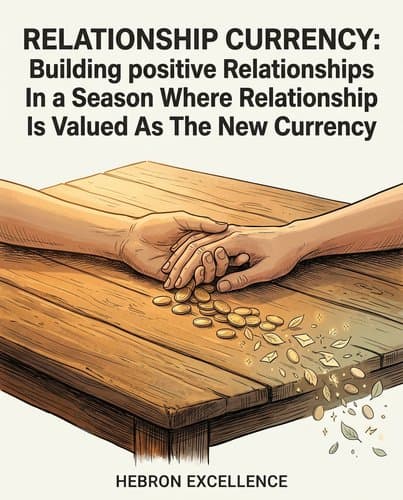
179022092_relationship-currency
by HEBRON EXCELLENCE
Uncover the hidden emotional scripts from childhood and culture that silently control every financial decision you make—because no budget or investment…
In Brief
RELATIONSHIP CURRENCY: Building positive Relationships In a Season Where Relationship Is Valued As The New Currency (2022) argues that financial behavior is driven by emotional scripts inherited from family and culture rather than a lack of knowledge.
Key Ideas
Childhood Money Memory Diagnoses Your Pattern
Start a money memoir with one question: 'What is my first memory of money from childhood?' Don't analyze it yet — just notice what scene surfaces and what feelings it carries. The specificity of that memory is more diagnostic than any budget spreadsheet.
Money Behaviors Carry Messages From Earlier Self
When you notice a recurring money behavior you can't explain rationally (always buying the cheapest option, freezing when bills arrive, giving money you resent giving), treat it as a message from an earlier version of yourself rather than a character flaw. Ask: whose voice does this sound like?
Name the Emotion Before Financial Conversations
Before any significant financial conversation with a partner or family member, name what the money represents emotionally in this context — security, love, power, obligation — because the practical disagreement can't be resolved until the symbolic one is on the table.
Shame's Gap Reveals Your Real Financial Work
Try the two-card exercise: write down a money difficulty you could share with anyone, then write down a money secret causing you real shame. The gap between those two cards is where your actual financial growth lives — and sharing the second card with one trusted person begins to dissolve its power.
Pair Tactical Steps With Emotional Awareness
Build your Money Action Plan in three-month cycles, and include both a tactical step (open the retirement account, call the financial advisor) and an emotional step (journal about why you've been avoiding it, identify whose script you're still running). Neither half works without the other.
Spending Gaps Map Where You Feel Safe
Notice where your 'personal economy' creates inconsistency — the categories where you splurge without guilt versus the ones where you freeze. That inconsistency isn't random; it maps directly onto which areas of your life feel safe to want things in.
Who Should Read This
Readers interested in Relationships and Personal Finance, looking for practical insights they can apply to their own lives.
RELATIONSHIP CURRENCY: Building positive Relationships In a Season Where Relationship Is Valued As The New Currency
By HEBRON EXCELLENCE
13 min read
Why does it matter? Because the financial decisions you think you're making rationally are actually being made by your eight-year-old self.
Here is a confession before we begin: most of us believe our money problems are information problems. We need a better budget, a smarter advisor, the right spreadsheet. So we read the books, download the apps, attend the seminar — and still find ourselves making the same inexplicable choices, feeling the same low hum of dread when the credit card bill arrives. What if the obstacle isn't what you know about money, but what you actually believe about money, underneath the spreadsheets — the emotional script running quietly since childhood, written by a parent who hoarded and counted, or one who gave in secret and called it love, by shame absorbed before you were old enough to earn a single dollar? This book is about relationships — but first, it is about the story underneath every financial decision you have ever made. Read that story, and you'll finally know where to push back.
Your Money Behavior Isn't Irrational — It's Running a Very Old Program
A therapist is walking through her neighborhood on a Tuesday morning, passing houses she has walked by a hundred times. But something has changed. She is calculating. Every driveway, every front porch, every freshly painted fence — she is running the numbers, estimating what each property is worth, tallying what she and her husband lost by selling their home before the market climbed. Some mornings the fantasy slides darker: she imagines herself homeless, wandering these same streets with nowhere to go. She has a roof over her head. She knows this. It offers her no comfort at all.
She had spent years as a practicing psychotherapist asking clients to examine their emotional lives. She had been in her own therapy. And yet applying any of that psychological scrutiny to her own relationship with money had simply never crossed her mind. The script running underneath her behavior was so old, so normalized, that it was invisible — even to someone professionally trained to spot hidden scripts in other people.
What makes that worth noticing: the money behavior she later uncovered wasn't dramatic. She wasn't gambling or drowning in debt. She was buying sale coats she didn't love and discarding them, while the coat she actually wanted stayed on the rack. She was choosing concerts based on price, not interest. Every decision routed through the same quiet filter — what is the cheapest option — and she had filed this under the perfectly respectable label of budgeting. The behavior looked like discipline. It was actually fear, moving through her life in a very orderly disguise.
The program running your money behavior was written long before you were old enough to open a bank account. It was authored by your parents, your culture, every charged moment you witnessed someone gain or lose something over money. What sits underneath the math is a story — and until you read it, it reads you.
The Debt You Can't See on Any Statement: Money as Emotional Currency
Jessie had made up her mind. Six months earlier, she had decided she was done being the family ATM — done cringing every time her phone rang, done watching the money she'd clawed out of poverty disappear into car repairs and overdue rent for siblings who never paid her back. The decision felt clean. Adult. Rational. And then the next call came, and she said yes. And the one after that. Six months of resolve, zero refusals.
The obvious explanation is that Jessie lacked willpower. But when she finally dug into why she couldn't hold the line, she found something more interesting than weakness. The checks she wrote weren't really loans. They were payments on an older debt — a way of buying her family's forgiveness for the crime of leaving. She had escaped their poverty geographically and financially, and some part of her had been quietly terrified ever since that they would never forgive her for it. Every transfer was a peace offering. Every refusal would have been a confession: I chose a different life, and I am keeping it. The money wasn't about the car repair. It was the only language she had found for saying please don't abandon me for succeeding.
Money as emotional currency works like this: the dollar amount is real, but the transaction underneath it is something else entirely. Jessie's was guilt and the need to stay tethered to where she came from. A partner who always insists on picking up the check is buying something too — usually control, or the feeling of being needed, or proof that he can. A parent who writes checks instead of showing up is paying down a different debt. None of them are making financial decisions. They're making emotional ones, in the only language available to them at the time. You can't fix that with a budget. You can't fix it by deciding, more firmly this time, to say no. The behavioral problem is a symptom. What's driving it runs deeper.
That layer is almost always invisible until something forces you to look. A simple exercise: write down every word that surfaces when you think about money — not financial terms, everything — and you'll have a self-portrait most people have never seen. What money means to you, what it's secretly doing in your relationships and your 3 a.m. calculations, is specific to you, written in experiences you may have stopped thinking about years ago. The first move toward changing any of it is simply reading what's already there.
The Childhood Scenes Still Running Your Finances Today
The hidden rules running your finances right now were almost certainly written by a specific scene you haven't thought about in years. Not a general impression of how your family handled money — a particular moment, with particular people, in a particular room.
Amy knew she had a problem. She couldn't buy herself a pair of jeans without standing in the store conducting an internal trial. The jeans were extravagant. They didn't fit quite right. She was being ridiculous. She'd buy them, feel immediately guilty, and spend the next week prosecuting herself for it. This was a woman who thought nothing of buying whatever her children or partner needed — the block was surgical, precise, aimed only at herself.
When she finally looked underneath the behavior, what she found wasn't a spending problem. It was a courtroom she'd been carrying since childhood. Her mother used to hide new clothes for Amy in the back of the closet, letting her wear them only after enough time had passed that they stopped looking new — anything to keep them from registering on her father's radar. When he noticed something new anyway, the fight that followed was seismic. He'd rage about the poorhouse; her mother would end up locked in the bathroom, sobbing. Amy would stand somewhere in the middle of it all.
Her mother had grown up in a family where children were simply never allowed to want anything. When Amy wanted something beautiful and her mother could give it to her, she couldn't stop herself — the refusal would have reopened something too old and too painful. Her father's terror about money came from an entirely different wound. Neither of them was fighting about the dress. But Amy spent her entire childhood watching the dress cause devastation, and somewhere along the way her nervous system drew the obvious conclusion: wanting something for yourself is dangerous. People get hurt.
Decades later, her parents long gone, Amy was still standing in that same doorway every time she reached for something that was just for her. The internal voice — who do you think you are? — wasn't hers. It was the echo of a fight she witnessed at age nine. She had inherited not just her parents' attitudes about money but the specific emotional architecture of their unresolved wounds, and it had been quietly governing her purchases ever since. The rule was precise — it knew exactly which purchases to flag, exactly which alarm to sound — and that precision is what makes it findable.
This Isn't Personal Failure — The Entire Financial System Was Built Without You in Mind
The financial anxiety you carry is not a character flaw. It is the predictable residue of a system that was built, legally and culturally, to exclude you.
Consider how recent the exclusion actually was. Well into the 1970s, a married woman in the United States often could not open a line of credit, sign a contract, or start a business without her husband's signature. This wasn't custom or social pressure — it was law, rooted in a centuries-old doctrine called coverture, which treated husband and wife as a single legal entity and that entity was, without ambiguity, the husband. She could not own what she earned. She could not keep what she inherited. The message encoded into the legal structure was simple: money is not yours to understand or manage, so don't bother learning.
That exclusion wasn't reversed yesterday. Many of the women who raised you came of age inside it. The financial incompetence you may feel — the sense that numbers belong to some other kind of person, that you are always slightly behind, never quite fluent — wasn't born in you. It was produced by a system that actively prevented your mother, and her mother, from developing the skills you were then expected to simply have.
And the system itself reflects a narrow set of values. Think of your aunt who worked thirty years in a school cafeteria, or the woman who cleaned your childhood home — the top one percent of Americans hold forty percent of the nation's financial wealth while the bottom eighty percent share nine percent. That's the result of what I've come to call masculine principles: competition, hierarchy, accumulation, a singular focus on the outcome. Relationship, interdependence, the question of what money actually does for the people it touches — these were sorted into the category of sentiment, not strategy.
That sorting wasn't neutral. A woman who looks at her finances and asks first who gets helped and who gets hurt isn't being naive or soft. She's applying a framework the dominant system simply has no column for — and then absorbing its verdict that something is wrong with her.
That verdict was always more about the system's limitations than yours.
Fear Isn't Your Enemy — But It Becomes One If You Never Look at It
What if your financial fear isn't irrational — what if it's the only honest thing in the room?
Andrea was doing fine. She had a steady income, two kids she was raising on her own, a budget that worked. And yet every unexpected bill — a car repair, a vet visit — sent the same image flooding in: herself, homeless, pushing a shopping cart through the city. She knew it was disproportionate. She had parents who would take her in if the worst happened. She had a safety net she could name. The fear came anyway, with the reliability of a second alarm.
What changed things wasn't a budget revision or a pay raise. It was the moment she stopped treating the fear as noise and started asking it questions. When she held a kind of imaginary conversation with the bag lady haunting her imagination, the answer she got back had nothing to do with money. The voice was her grief over a marriage ending. It was the raw terror of being completely responsible for two small lives with no backup partner. The fear had never been a financial forecast. It was emotional reality dressed in financial clothing — and until she looked directly at it, she couldn't tell the difference.
That distinction is the whole thing. Fear functions as a signal, pointing at something real, but the thing it's pointing at isn't always what it appears to be on the surface. The fear that shows up when you check your bank balance, or open a bill, or watch a coworker get promoted carries information. The work is learning to read that information rather than drowning in it or waving it away.
The alternative is illustrated by Emily, who never felt financial fear at all — because she inherited enough money that its limits simply didn't register for her. When advisors warned her, repeatedly, that she was burning through her fortune, the warnings didn't land. She had no emotional signal calibrated for danger, and by the time she had nothing left, she had nothing left. Fear, for all its discomfort, is a survival system. Its absence isn't peace. It's a gap in your wiring where information should be.
Shame Is the Reason You Can't Talk About Money — And Why That Keeps You Stuck
Here is the architecture worth understanding: shame about money isn't evidence that something is genuinely wrong with you. It is a social mechanism, and it has a design flaw. Shame requires secrecy to function. The moment you bring it into honest company, it begins to lose its grip.
The author discovered this the hard way. She was in the middle of a conversation with a close friend — someone she trusted, someone she'd exchanged real confidences with — and she told her what she'd earned that year. She felt something like pride saying it; it was more than she'd ever made. The friend went quiet for a moment, then said three words: 'Is that all?' She didn't share her own number. She just let those three words settle. Years later, the author can still describe exactly where they were sitting, how the light looked, what she felt — that peculiar combination of having revealed too much and simultaneously not measuring up. The moment lodged in her body the way shame always does when money and vulnerability meet without a safety net.
What that scene reveals isn't something specific to the author's friendship. When we open up about money, we're doing two frightening things at once: breaking a taboo and exposing our actual lives. The exposure can go wrong in an instant, and it usually happens not through cruelty but through the careless competitive impulse that money reliably activates in people who haven't examined their own relationship to it.
So we stop talking. And the silence does exactly what silence always does — it lets us each assume we're the only one struggling, the only one who doesn't know what she's doing, the only one with lawn furniture where the dining room set should be (a detail one workshop participant offered, describing her childhood home). The taboo doesn't protect anyone. It just keeps every person in the room isolated in their shame, too exposed to speak and too hidden to heal.
When Money Speaks for Love, Nobody Actually Gets Either
Jenny was five years old when she fell in love with a harmonica in a music store display case. For six months she asked her parents for that specific instrument, returned to stare at it on every visit, and catalogued it in her mind as the thing she wanted most. Then, on her brother's birthday, her parents gave it to him — and told her she was too young to have it. She carried the wound for years: not that she hadn't gotten the harmonica, but that her parents had given it to him. The gift became evidence, carefully filed, that her brother was loved more. The ledger on which children record their lovability is often denominated in exactly these terms — what was given, what was withheld, and to whom.
Money conflicts in relationships share the same hidden architecture: the dollar amount is real, but the question underneath is almost never about money. It's about whether you are worth caring for. When a parent gives more to one sibling, when a partner refuses to pick up a dinner tab, when a husband insists on splitting every expense exactly down the middle despite a significant income gap — each of these lands not as a financial data point but as a verdict. The person on the receiving end isn't calculating; they're reading. And what they're reading is: how much do I matter to you?
No financial arrangement resolves that question. Until the proxy gets named — until someone can say out loud that the argument about money is actually an argument about lovability — no budget negotiation, no income adjustment, no fair-seeming split will touch what's actually hurting. The ache will just find the next financial surface to press against.
You Don't Need to Fix Your Past — You Need to Read It
Understanding your money psychology is not the same as changing it. Insight that stays inside your head is just a more articulate version of being stuck.
The bridge between seeing clearly and living differently is structure. The author calls this a Money Action Plan — a concrete, time-bounded framework that holds both the emotional work and the practical steps at the same time. A MAP has three elements: a small set of specific actions (usually two or three), a defined time window (typically three months), and at least one step that is purely emotional and at least one that is purely practical. The emotional and practical steps are meant to run simultaneously, because that's what makes them feed each other. The best illustration of how this works comes from a workshop participant who arrived knowing she had emotional work to do but had no idea how to begin. She gave herself three tasks for three months: sit with a 'dream big' exercise and follow whatever feelings surfaced; find a financial advisor; and look honestly at what she was actually earning. Small enough to start, real enough to matter.
What happened next is worth tracking closely. She bought lottery tickets — not because she expected to win, but because she recognized that her relationship to money was strangled by tightness, and she needed a low-stakes way to practice loosening her grip. She asked her yoga teacher to cross-link their websites. When the recession hit, she renegotiated her lease rather than absorbing the loss silently. She picked up contract work that carried her through the lean months and left her with savings. She found the advisor. Eventually she invested in her daughter's business and watched it flourish. What started as a three-month plan to examine her feelings turned into a complete reorganization of how she moved through her financial life — not because she had a revelation, but because she kept taking the next small step.
The point isn't the lottery tickets. The point is that she stopped waiting to feel ready and started acting in a direction, using the emotional insight she had as fuel rather than a destination. The guilt, the tightness, the old story about what she deserved — none of it disappeared. She just stopped letting it make all her decisions.
You don't need to resolve your past before you can act. You need to read it well enough to recognize whose voice is running the show — and then take the next step anyway.
The Script Is Already Running — The Only Question Is Whether You've Read It
Think back to that therapist on her morning walk — educated, self-aware, professionally trained to read hidden patterns in other people, and still helplessly tallying strangers' property values while her own home stood solid behind her. That image isn't a cautionary tale about irrationality. Within the emotional logic she had inherited, every calculation made perfect sense. The script was just older than her awareness of it.
You have a version of that walk. A recurring freeze, a guilty purchase, a conversation you've been avoiding for years. It isn't evidence of weakness — it's evidence of a story still running on equipment installed before you could choose otherwise.
The invitation isn't to achieve some perfect financial clarity. It's simpler and harder than that: read the script clearly enough to recognize whose voice it belongs to, take one honest step this month, and then the next. The story doesn't end there. It just becomes, for the first time, a little more yours.
Notable Quotes
“I resent feeling obligated to be the financial savior for my family,”
Frequently Asked Questions
- What does Relationship Currency teach about financial behavior?
- Financial behavior is driven by emotional scripts inherited from family and culture rather than a lack of knowledge. The book provides practical tools for uncovering hidden patterns — including memory exercises, journaling prompts, and structured money conversations — helping readers align their financial decisions with actual values and goals. The work emphasizes that treating recurring money behaviors as messages from earlier versions of ourselves, rather than character flaws, opens pathways to understanding why we make certain financial choices. When addressing significant financial conversations with partners or family, naming the emotional meaning money represents — security, love, power, obligation — is crucial before resolving practical disagreements.
- What is the money memoir exercise in Relationship Currency?
- Start a money memoir with one question: "What is my first memory of money from childhood?" Don't analyze it yet — just notice what scene surfaces and what feelings it carries. The specificity of that memory is more diagnostic than any budget spreadsheet. This foundational exercise helps you identify the emotional origins of your current money patterns inherited from family and culture. By uncovering these early memories, you begin to see how emotional scripts shape your financial decisions and behaviors, revealing patterns you may have never consciously recognized.
- Why should I name the emotional meaning of money in conversations?
- Before any significant financial conversation with a partner or family member, name what the money represents emotionally in this context — security, love, power, obligation — because the practical disagreement can't be resolved until the symbolic one is on the table. When couples or family members argue about spending, saving, or budgeting, they're often debating surface-level tactics while unspoken emotional needs create the real friction. By identifying and articulating these deeper meanings first, you transform conversations from positions and arguments into shared understanding of what money means to each person.
- What is the two-card exercise in Relationship Currency?
- The two-card exercise involves writing down a money difficulty you could share with anyone, then writing down a money secret causing you real shame. "The gap between those two cards is where your actual financial growth lives — and sharing the second card with one trusted person begins to dissolve its power." This exercise reveals which financial issues carry shame or fear, distinguishing between surface-level problems and deeper emotional barriers. Breaking silence about financial shame is a transformative step toward healing inherited money patterns and achieving authentic financial change aligned with your values.
Related Book Summaries

Read the full summary of 179022092_relationship-currency on InShort