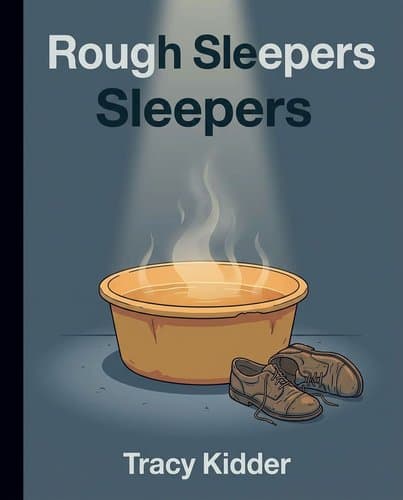
62328661_rough-sleepers
by Tracy Kidder
For thirty-two years, one Boston street doctor proved that relationship—not policy or expertise—is the only medicine that reaches people every institution has…
In Brief
For thirty-two years, one Boston street doctor proved that relationship—not policy or expertise—is the only medicine that reaches people every institution has abandoned. Rough Sleepers reveals what it truly costs to witness the invisible, and why refusing to look away is the most radical act in medicine.
Key Ideas
Clinical expertise yields to relationship first
When someone has been failed by every institution, clinical expertise is an obstacle until you demonstrate willingness to subordinate it to their readiness. The stethoscope goes in the drawer first. Relationship is the mechanism through which any treatment becomes possible — not a preliminary to treatment, but the treatment itself.
Moral obligation independent of economic return
The moral case for any humane intervention — housing, healthcare, community — doesn't depend on whether it saves money. Jim's principle: 'Who would ever say that Mass General exists to save money?' Tying moral obligations to cost-effectiveness is a trap, because the most vulnerable people are rarely cost-effective to serve.
Assuming stranger's worth changes medical reach
'Pre-admiration' — a default assumption that the stranger you haven't met yet will turn out to be likable — is a trainable skill that changes what medicine can reach. The doctor who enters a room curious about a person rather than curious about a diagnosis reaches people the clinical model cannot.
Notice persistence in smallest forward movements
Measure success in the smallest increments that signal someone still wants to go on: a first clean urine sample, a request for button-down shirts, three hours of sleep. The rock rolls back every time. You still notice the push — and so does the patient.
Witness and testimony become the medicine
Loneliness may be the force underneath much of what gets labeled pathology in marginalized populations. When twenty-two homeless people lined up asking Jim to photograph them after he photographed Gretel, they weren't asking for treatment. They were asking to be witnessed — to leave evidence they had passed this way.
Who Should Read This
Readers interested in Social Issues and Mental Health, looking for practical insights they can apply to their own lives.
Rough Sleepers
By Tracy Kidder
9 min read
Why does it matter? Because the most radical act in medicine turns out to be showing up again next Thursday without conditions.
The sensible answer to homelessness involves housing and medicine — get people indoors, give them doctors, measure the outcomes. Tracy Kidder is not writing against that answer. He spent years watching a Boston physician apply it, and found that it was necessary, and, for a specific group of people, not enough. These were patients every institution had already decided against — emergency rooms, shelters, psychiatric wards, housing programs. They weren't hard to treat because they lacked better interventions. They were hard to reach because they had stopped expecting anyone to come back. Jim O'Connell, for thirty-two years, kept coming back. Kidder's book is about what holding that commitment actually costs, and what it reveals about everything medicine pretends not to know about itself.
To Reach a Patient Who Won't Be Reached, First Put the Stethoscope Away
On his first day at the Pine Street Inn shelter clinic, Jim O'Connell — fresh from Mass General's ICU — reached for his stethoscope as he walked through the door. The nurse beside him, Barbara McInnis, shook her head and pointed at a drawer. He put it away.
Then he spent the next month kneeling on the floor.
The task was foot soaking: plastic tubs of antiseptic solution, one per patient. Barbara had told him to stop asking "doctor questions" and learn to listen. The men Jim encountered here were the same ones he'd failed to treat at the emergency room — sullen, refusing medication, whose records documented years of treatment refusals. Here they sat quiet, feet in buckets. Not because of any clinical intervention. Because of the unhurried attention of people who didn't treat them as problems to be solved.
One man, Mr. Carr, had twenty-five years of psychiatric noncompliance on his record and hadn't spoken to Jim once in weeks of visits. Then one evening, looking down at Jim on his knees filling tubs, he said: "Hey, I thought you were s'posed to be a doctor. So what the hell you doin' soakin' feet?"
Jim glanced at Barbara, who was listening nearby. "I do whatever the nurses tell me."
Mr. Carr nodded. "Smart man. That's what I do."
A week later, Carr asked Jim for help sleeping. Within a month, he was taking medications for several conditions — treatments Jim had tried and failed to deliver for years inside the ER.
For people who have spent decades being dismissed by institutions, clinical expertise reads as a threat until you've earned permission to use it. What Barbara had built the clinic around was simpler and more demanding: relationship precedes treatment, and relationship requires the doctor to subordinate their agenda entirely to the patient's readiness. Jim had to learn the corollary in the other direction: the patient's readiness also means not solving problems the patient never asked you to solve.
The Medical Skill Nobody Teaches in Residency: Assuming the Stranger in Front of You Will Be Worth Knowing
Pre-admiration was the word a doctor who worked with Jim used for a quality he'd never encountered so naturally in anyone else: approaching a person who smells of fermentation, lies on the ground, and asks for money, and presuming — before you know a single thing about them — that you're eventually going to like them. Not as a conscious discipline. As a reflex.
The distinction from patience was that it arrived before the evidence did.
When Tony Columbo walked into Jim's exam room in September 2016, the reflex was tested immediately. Tony was six feet four, sweating through withdrawal, several days' beard and an odor of sweat and slightly rotten fruit, twenty years out of prison, now sleeping rough, wanting Suboxone. Jim said he'd need a urine sample before writing the script. Tony's eyes narrowed, his face going dark, and he moved to leave.
"Wait a minute," Jim said. "Sit down for a minute. Talk to me."
Tony sat. Jim looked at the thin medical file and did the math: if he didn't act right now, he would never see this man again. He wrote the prescription.
Then he stayed two more hours — walked Tony to a CVS on Cambridge Street, stood at the counter while a Medicaid error got sorted, went back inside, and slipped a twenty into the bag with a sandwich. He described the twenty as potentially therapeutic: a reason to come back next Thursday.
Tony came back. He kept coming back. Within a year, Jim would describe him as someone "in the middle of that vortex" of street life, a man who knew everyone, looked out for women sleeping rough, and had become Jim's eyes and ears on the street. The presumption of likability, offered in a two-minute standoff over a urine sample, was where that started.
The Moral Case for Housing Homeless People Doesn't Depend on Whether It Works
Does housing homeless people actually work?
The question sounds cynical until you meet Rebecca. She'd been sleeping rough on Boston's waterfront for years, drinking heavily, cycling through emergency rooms. After her street companions died, she went to detox on her own, endured a brutal hepatitis C treatment, and made a decision no Street Team patient had made before: she found an apartment in Dorchester and paid her own rent (no voucher, no assistance). For nine years she kept the place immaculate: framed mirrors, lacy curtains, fresh-baked cookies for Street Team visitors. She housed her boyfriend, became the first Street Team patient to get a driver's license, then saved enough money to buy a car.
Then gentrification reached her block. Developers bought the building and offered her the unit for $245,000. She tried to raise the money and couldn't. Because she had always paid her own way rather than holding a housing voucher, she had no legal protection. The eviction notice arrived while she was dying of lung cancer. When Jim called her back after she paged him, she was crying too hard to talk; her boyfriend delivered the news. She died one week before the eviction date, terrified of losing the home she had built.
Jim's line at the fundraising gala: "She made the mistake of doing everything right."
That line does more work than an entire policy argument. The system's failure here wasn't incompetence or underfunding. Rebecca succeeded at everything the moral case for housing promises, and the market took it away because she had opted out of the protections built for people who need them.
Statistically, Rebecca is the exception. Street Team physician Jill Roncarati's 14-year retrospective on the original 24 Medicaid housing vouchers found that over a decade, 73 people cycled through those slots. Forty-five percent died. Only 12 percent of survivors remained housed. The worst cases — men who had mastered years of outdoor survival and then couldn't figure out how to turn on a television — Jill called "death by housing."
Jim's response to anyone who uses those numbers to argue against housing as policy: "Who would ever say that Mass General exists to save money?"
Jim Learned Not to Raise His Voice at Age Ten, and It Became His Medical Philosophy
Jim was around ten when his father sat down at the kitchen table with the three oldest children. There were six children now; he had to keep working two jobs; they would all have to pitch in. Their mother wasn't coming home. The doctors said she needed medicine and professional care.
Then this man — who had served in the Navy through the war, worked maintenance at the Naval War College, stocked shelves in a liquor store at night, and never made more than ten thousand dollars in a year — began to cry.
What he'd just said also answered the anxious question Jim had carried since early childhood. His mother had severe bipolar depression that came on suddenly and could last for a year. She might be reading aloud to the children one evening and gone the next. Jim and his sisters had concluded that if they behaved better, she wouldn't leave. There had been no fights in the house.
The father's tears were alarming; he was warm but not demonstrative. But what he'd just told them cracked the old explanation open: she had a sickness. She had never wanted to get away from her children.
Jim would tell medical students decades later that the Program he built chose "not to be strident." Building authority through demonstrated expertise, rather than coming through doors screaming, was a calculated tactic. It was.
The cost lives in the people closest to him. One colleague said she never knew where she stood with Jim "because he's so fucking nice." The one time Jim lost his temper at a patient, he jabbed a finger and said it three times: "You stop it. You stop it. You stop it." A nurse who had worked beside him for years was stunned enough to remember it decades later. The aberration was the data point.
'We Don't Judge People on What Led Them Here': Jim's Most Important Principle, Tested
Tony Columbo was the kind of person who made a dark street feel safer, who kept watch while others slept. Then the police report arrived.
Jim's principle — we don't judge what led someone here, only what they do once they're here — sounds like something a reasonable person could agree to without much effort. Tony Columbo tested that.
Tony, the North End charmer who called Jim "the cawnahstone" (cornerstone, in the accent), took it on himself to care for BJ, a double amputee Jim had known for years: lifting him off his wheelchair at night, carrying an Allen wrench in his pocket for small repairs, swabbing a dying man's lips with a damp sponge. He spent eighteen years in prison for an attempted rape. He told Jim and others it had been something else, a drug robbery. A year after Tony died, the actual police report surfaced. In bureaucratic all-caps, it described what had happened in a field behind a school at midnight: a young man taking a shortcut after basketball, Tony calling out from behind, a knife to the neck, repeated threats to kill, an assault that ended only when the victim grabbed Tony and ran.
Jim received this after Tony had been dead for months. He had already delivered his eulogy — not at a formal service, but in the way you deliver one when the formal things don't fit: to a journalist, in a library, going back over what mattered. "We don't judge people on what led them here," Jim said. "It's what they do once they're here. And Tony was nothing but — 99 percent of the time — nothing but gracious and living out his life as best he could." He paused. "His condemnation was to be on the street. But once he got there he really was a protector."
The principle, stripped of comforting vagueness, is demanding and specific: the decision to regard Tony's care for BJ, his vigil over sleeping women, his spontaneous generosity — fifteen Big Macs handed out to people he barely knew — as real, regardless of what coexists in the same person's history. Not instead of it. Alongside it.
Jim knew what had happened to Tony as a child: a priest had abused him badly enough that other boys gave him a cruel nickname, and Tony had carried the secret for decades. He knew Tony had died in an alcove on Blossom Street, a woman holding his cold hands under blankets, and that when she kissed his forehead at dawn he was already gone. He knew all of it: the harm Tony had suffered, the harm Tony had done, and the particular person Tony had managed to be in the years between the prison gate and that concrete alcove.
The principle holds, but not without effort. Jim sees both: the crime is real, the man who emerged from eighteen years in prison is real, and the decision to regard one alongside the other has to be made fresh each time. Not resolved once, not elevated into a motto. Worked at.
The Photograph She Got Dressed Up for Is Waiting for Daughters Who May Never Come
Jim used to find Gretel on the stoop of an abandoned building at night, surrounded by rotten eggs and spoiled milk she'd arranged around herself to keep away predators. She had end-stage cirrhosis. When specialists agreed to consider her for a liver transplant, contingent on six months of documented sobriety, she did it.
A few days before the surgery, she asked Jim to photograph her.
She arrived in a dress, with mascara and lipstick and painted nails. On the table beside her she placed cut flowers in a Styrofoam coffee cup. Jim asked if she was afraid of dying on the table. She laughed at him. She had slept rough for decades — death had been close most nights of that. That wasn't what this was about.
She had two daughters. The last time she'd seen them, one was three and the other six — twenty-five years ago. She was afraid that someday they might go looking for their mother and find nothing a person could be proud of.
Jim took the portrait. He still shows it at lectures, hoping one of those daughters is in the room. The photograph doesn't hang in his gallery outside the office. He's holding it for them, whenever they come — if they come.
The next day, twenty-two other patients came asking to be photographed too. His reading: they wanted proof they had moved through the world.
This is what the work produces when justice doesn't arrive — not a solved problem, but a held record. A woman who dressed up once, for daughters who may never know she did. Someone who was seen.
The Walk Back Down the Hill
Jim once decided he had the Sisyphus myth wrong. Not the push — the reward was the walk back down. Friday nights at Doyle's, a beer with Barbara before Monday came around again. Barbara, who built the clinic, is gone. The walk down doesn't exist in that form anymore.
What remains: a portrait held in a drawer for daughters who may never come looking. A young woman on Cambridge Street who says she heard about Jim from Tony, that Tony was a nice guy, that she misses him. Not victories — something smaller and more durable. Evidence that someone passed this way. That another person noticed. That the noticing wasn't nothing.
The question isn't whether any of this adds up to a solution. It's whether showing up — without power to fix what put people on the street — is itself a kind of medicine. You suspect it is. You suspect we don't have a name for it yet.
Notable Quotes
“I really think we want doctors,”
“But you've been trained all wrong.”
“an injunction against insisting that anyone had to be healed.”
Frequently Asked Questions
- What is Rough Sleepers by Tracy Kidder about?
- Rough Sleepers (2023) chronicles Dr. Jim O'Connell's thirty-two years delivering healthcare to Boston's homeless population. The book demonstrates that unconditional human presence—not policy or clinical expertise—is the core mechanism of care for people abandoned by institutions. Kidder shows how relationship itself becomes the treatment, not a preliminary to it. The work provides a framework for rethinking what medicine, moral obligation, and sustained commitment to the most vulnerable truly require. Through O'Connell's approach, readers learn that "the stethoscope goes in the drawer first" and that clinical expertise can become an obstacle until you demonstrate willingness to subordinate it to a person's readiness.
- What role does relationship play in O'Connell's approach to treating homeless patients?
- In O'Connell's model, relationship is not preliminary to treatment—it is the treatment itself. When someone has been failed by every institution, clinical expertise becomes an obstacle until you demonstrate willingness to subordinate it to their readiness. The approach centers on "unconditional human presence" as the core mechanism of care. O'Connell prioritizes understanding and connection with each person over clinical protocols. This means entering each interaction curious about the person rather than the diagnosis, which allows medicine to reach those the traditional clinical model cannot. The foundation of this work is treating people with what Kidder calls "pre-admiration"—a default assumption that the stranger will turn out to be likable.
- How does Rough Sleepers address cost-effectiveness versus moral obligation in healthcare?
- The book challenges the assumption that moral obligations should be tied to financial outcomes. O'Connell's principle exemplifies this: "Who would ever say that Mass General exists to save money?" The moral case for any humane intervention—housing, healthcare, community—doesn't depend on whether it saves money. In fact, tying moral obligations to cost-effectiveness becomes a trap, because the most vulnerable people are rarely cost-effective to serve. Kidder uses this framework to expose how institutional logic often abandons those least able to advocate for themselves. By documenting O'Connell's thirty-two years of unconditional care, the book argues that institutions like hospitals should exist to heal, not to optimize budgets.
- What does Rough Sleepers reveal about measuring success with homeless populations?
- O'Connell measures success in the smallest increments that signal someone still wants to continue living: a first clean urine sample, a request for button-down shirts, three hours of sleep. As Kidder notes, "The rock rolls back every time. You still notice the push—and so does the patient." This framework recognizes that progress is nonlinear; each small sign of agency matters. Underlying much of what gets labeled pathology in marginalized populations is loneliness. When homeless people lined up asking O'Connell to photograph them after he photographed Gretel, they weren't asking for treatment—they were asking to be witnessed, to leave evidence they had passed this way. These moments reveal the human need for acknowledgment and recognition.
Related Book Summaries

Read the full summary of 62328661_rough-sleepers on InShort