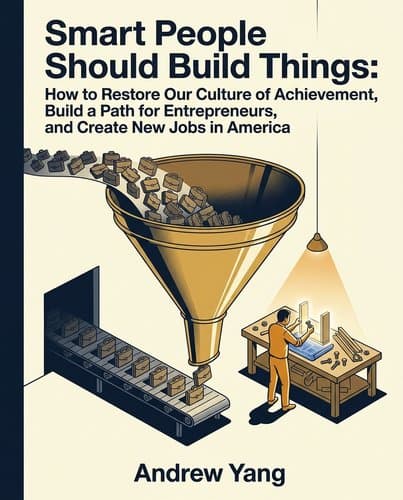
18085527_smart-people-should-build-things
by Andrew Yang
America's smartest graduates aren't lazy or unambitious—they're being funneled into finance and consulting by recruitment infrastructure that startups simply…
In Brief
America's smartest graduates aren't lazy or unambitious—they're being funneled into finance and consulting by recruitment infrastructure that startups simply can't match. Andrew Yang exposes how this talent misallocation is hollowing out American innovation and what structural fixes—not pep talks—can redirect a generation toward building real things.
Key Ideas
Infrastructure inequality shapes prestige pipeline
The prestige pipeline isn't a conspiracy — it's an infrastructure problem. Goldman Sachs and McKinsey recruit on campus a year in advance with open bars and alumni calls. Startups don't. Until the recruitment infrastructure is equalized, talented graduates will keep defaulting to the path that shows up for them.
Valuation training removes entrepreneurial instincts
Professional services training is optimized for analysis, not execution. Learning to value a company is fundamentally different from learning to operate one. Every year you spend producing spreadsheets and recommendations reshapes your judgment away from the risk tolerance and improvisation that building requires.
Self-correction takes longer than careers last
Human capital markets don't self-correct on a useful timescale. The law school data proves it: applications fell 45% while the pipeline kept producing 40,000+ graduates annually for jobs numbering in the thousands. Individual rational choices don't fix structural imbalances — they just make the graduates slightly less talented.
Flat hierarchies enable young leadership
Secondary cities offer a higher impact-to-age ratio than established hubs. The absence of deep hierarchies in Detroit, New Orleans, or Cincinnati means a 22-year-old can carry real responsibility within months. The 'vacuum of people' that makes these cities look unattractive is precisely what makes them worth going to.
Systemic change beats individual motivation
The solution requires structural levers, not motivational speeches: university loan forgiveness for graduates joining early-stage companies, career services offices with dedicated growth-company liaisons, and educational institutions required to publish audited employment and debt-to-income data so students make decisions with real information.
Eighth employee often outpaces founder outcomes
Joining a growth company early is often more valuable — and more realistic — than founding one. The eighth employee at Google had a career-defining experience that most founders never match. The goal isn't to be the visionary; it's to build the habit of building while the organization is still young enough for your contribution to matter.
Who Should Read This
Business operators, founders, and managers interested in Startups and Business Strategy who want frameworks they can apply this week.
Smart People Should Build Things: How to Restore Our Culture of Achievement, Build a Path for Entrepreneurs, and Create New Jobs in America
By Andrew Yang
10 min read
Why does it matter? Because the career path you thought was safe is quietly hollowing out the American economy.
If you went to a good school, you probably watched the same thing happen to everyone around you. The smartest people you knew — the ones who could have done anything — filed quietly into investment banks and consulting firms, pulled along by a current so strong it felt like a personal decision. Maybe you did it too. Maybe you told yourself it was temporary, a launching pad, two years and then something real. Andrew Yang did. He lasted less than a year at a white-shoe law firm before the wheels came off. What he eventually figured out — and what this book argues with uncomfortable precision — is that those individual choices, each one perfectly rational, are collectively catastrophic. Not because ambitious people are sellouts, but because Wall Street built a machine to harvest them and nobody built anything pointing the other way. This book is about building that counter-current — which is how, eventually, you get someone like Chatham or Millar.
The Path of Least Resistance Isn't Chosen — It's Installed
Andrew Yang sat down for his LSAT, scored a 178 out of 180, and the decision was essentially made for him. Not by anyone in particular — just by the logic of the situation. You don't put up a number like that and then go do something else. So he went to Columbia Law School, joined the Law Review, fielded offers from every top firm in New York, and took one. He was twenty-four, making $125,000 plus a bonus, doing work he found completely uninspiring. He describes the moment he realized he had to leave: after just a few months, he noticed his brain rewiring itself. His document-review focus was sharpening. He was getting good at something he didn't want to be good at.
The LSAT score didn't choose law for him — the pipeline did. Every step in Yang's trajectory, from a New England prep school to Brown to Columbia, was a hoop that rewarded jumping without requiring any actual thought about direction. The hoops got jumped. The path revealed itself. That's not a choice in any meaningful sense; it's a sequence that selects for compliance with the sequence.
The same infrastructure now exists at scale for finance and consulting. Bain wasn't founded until 1973, and Wall Street headcount nearly tripled between 1975 and 2008. Over those same decades, these industries built campus recruitment arms that transformed applying for a job into something indistinguishable from applying to college — a defined season, a short list of firms that matter, structured interview rounds, firms coming to you. In 2011, 29 percent of employed Harvard graduates went into finance or consulting, and another 37 percent applied to law or medical school. That's not a generation passionate about derivatives and depositions. That's a generation that found the path of least procedural resistance and walked it — because someone had gone to considerable trouble to pave it.
These Industries Don't Create Wealth — They Circulate It
What does it actually mean to work in a high-value industry? Pay is one answer — but pay measures what a market will bear, not how much new wealth is entering the world.
Yang builds the distinction around a parallel that, once you see it, you can't unsee. Between 1965 and 1998, the OPEC nations — sitting on vast oil reserves — watched their per-capita GDP shrink by 1.3 percent annually, while the rest of the developed world grew by 2.2 percent. The mechanism has a name: the resource curse. When any single industry throws off enormous money, talented people position themselves near the geyser. They get paid handsomely. The geyser keeps producing whether they're there or not. But those minds are no longer inventing things, which is where economies actually expand.
Yang's argument is that American finance and consulting are our geyser. The money is real and large. But much of what happens inside a major investment bank looks, on inspection, like wealth moving from one set of hands to another — not created from scratch. Eight firms controlled the IPO market so completely that between 2012 and 2013 they pocketed two billion dollars in fees from thirty-seven billion dollars of offerings — not because they invented something, but because they held the gate.
Contrast that with what Walker Williams built from a Brown dorm room. When his favorite campus bar shut down in 2011, he and a friend spent five hours putting up a basic website: reserve a custom T-shirt, and if two hundred people commit, they'll print it. Four hundred orders came in. Strangers wanted the same thing for their causes. Within ten months of formally launching as Teespring, they had moved two million dollars in apparel and created twelve jobs in Providence. Those twelve jobs didn't exist before Walker decided not to take the consulting offer in Boston that was almost certainly available to him. If he'd taken it, the firm would have interviewed the next candidate instead.
That's the structural difference Yang keeps pressing on. In industries competing for finite slots, your win is mostly someone else's displacement. When you build something new, you add a slot that didn't exist. The training professional services provide — learning to optimize, analyze, advise within existing structures — is real training. It just points in the wrong direction. You get very good at working within the geyser. That's not nothing. But it's not growth.
Professional Training Makes You Better at Everything Except Building
Professional services training doesn't leave your instincts neutral — it bends them in a specific direction, and the longer you stay, the harder the bend becomes to straighten.
Yang draws a sharp line between what professional services produce and what startups require. At a bank or consulting firm, the output is analytical: a team of six might spend months producing a single valuation or a supply chain recommendation. The question is always some version of 'how much is this worth?' or 'how could this be optimized?' In a small company, that question is irrelevant. The only questions that matter are whether your customer is happy today and whether you got paid. You're not analyzing the operation — you are the operation. One set of skills trains you to examine situations from a careful distance. The other demands you move before you have full information, then adjust. They aren't just different skills; they're opposing reflexes.
The training also comes with a price tag that rises every year you defer the exit. A young professional pulling $150,000 isn't just earning money — they're constructing a life calibrated to that income. The apartment, the wardrobe, the expectations of the people around them. Yang tells the story of a friend who was a genuinely gifted writer, went to law school, made it to a top corporate firm, and then quit to write screenplays. A few months in, with scripts circulating but no traction, the financial pressure won. He went back to a firm 'just to cover the bills.' Years later, he's a senior structured-finance lawyer. The handcuffs didn't snap shut all at once — they tightened one small compromise at a time.
The loss compounds beyond the individual. Yang's point about the PayPal alumni — who between them founded Tesla, LinkedIn, YouTube, and Yelp after the company was acquired in 2002 — is that organizations produce organizations like themselves. Those people built those companies because they'd learned to build inside a company that actually built things. If Musk and Hoffman had gone to McKinsey instead, you'd have more boutique consultancies. You wouldn't have LinkedIn or Tesla.
The Market Won't Fix This — It Never Does
Think of a ship that takes twenty miles to stop. You can cut the engines the moment you spot the iceberg, and the hull will still keep moving.
Yang's starkest proof is the legal industry. Between 2004 and 2013, law school applications fell nearly 45 percent — a collapse that looks, on the surface, like exactly the kind of market correction economists promise. People figured it out. Signal received. Except the students already enrolled kept enrolling, and the schools kept graduating them. Annual output ran between 36,000 and 43,000 new lawyers for a market generating an estimated 2,180 new legal positions per year. Bloomberg projected 176,000 unemployed or underemployed JD holders by 2020. The iceberg got spotted. The ship kept moving.
Why can't individual rational choices fix this? Yang counts five reasons, and they stack. A 22-year-old deciding whether to apply has almost no access to people who graduated recently enough for their experience to be relevant — there's a five- or six-year lag built into the information chain. The graduates who do exist have every incentive to obscure bad outcomes; admitting the degree was a financial mistake is a confession nobody wants to make out loud. Then there's the overconfidence problem: tell a room of ambitious students that only the top 20 percent land good jobs, and roughly 80 percent of them will privately decide they're in that top 20 percent. Add identity — some people simply need to become lawyers the way someone needs to become a chef, and economics doesn't enter the room. Finally, add debt: the average law school graduate now carries around $145,000 in student loans, a number that won't come due for years, which turns a six-figure mistake into an abstract future problem at the exact moment you need to feel the cost.
None of this yields to patience. Somewhere right now there's a 22-year-old refreshing her LSAT scores, absolutely certain she'll be in the top 20 percent, carrying a debt she can't yet feel toward a job that may not exist — and every incentive in her environment is telling her she's right.
Building Something Real Is Harder and Slower Than Anyone Admits
Yang went to sleep the night before the New York Times feature ran genuinely believing his life was about to change. He'd booked celebrities, built a site, landed a CNN appearance with a rock star, and raised $200,000 in a market that briefly rewarded optimism over revenue. The Times piece on Stargiving.com would send thousands of people to the site. Instead it sent dozens — and the ones who showed up clicked around, noticed they weren't moved by anything, and left. The idea had been elegant: sponsors make micro-donations every time someone clicks on a celebrity's charity event, one winner gets to meet the celebrity, everyone feels good at no cost. On a whiteboard it solved multiple problems simultaneously. In the real world, it was a button with a singer's face on it.
Yang's central correction to the mythology of building things: the idea is approximately the easiest part. He compares it to conception — a moment of inspiration that precedes months of unglamorous labor. What the mythology skips is the five months he spent before receiving a single dollar from an investor, taking his pitch to living rooms and boats and office lobbies, burning through $10,000 in savings while paying $2,800 a month in rent and loan payments, eventually moving out of his apartment and onto a friend's couch. He ran out of money before he built the first thing. Fundraising, product development, team assembly, actual customer acquisition — these are the four walls of the problem, and none of them yield quickly. After Stargiving collapsed, Yang deliberately sought out someone further along than him and worked as an apprentice rather than a founder. He spent four years inside that arrangement, absorbing things he couldn't have learned by starting another company at twenty-six.
Rovio made Angry Birds after six years of obscurity. Five Guys spent fifteen years perfecting a handful of Virginia locations before expanding anywhere. We only encounter these companies at the ending, so retrospect turns them into overnight successes. The actual duration is the point.
The Cities That Need You Most Are the Ones No One Considers
Andy Chatham graduated from Cornell and moved to Las Vegas to work for a startup cooperative funded by Tony Hsieh — the CEO of Zappos, who had made a public bet on downtown Las Vegas as an urban-revitalization project. Within weeks — not years, weeks — Chatham found himself at a table with engineers, architects, and project managers twice his age, making real decisions about a vehicle-sharing program that would cover a significant portion of the city. Then Hsieh handed the project down to Chatham's boss, who handed it to Chatham. He spent a month modeling the economics of a company that didn't yet exist, then sat across from Tesla's director of engineering to discuss how it would actually work. The first $3 million in investment transferred into a company where he was the only employee. He was in his early twenties. His Wharton classmates were still learning the org chart.
The math behind Yang's impact-to-age ratio is simple: in New York or San Francisco, every ambitious 22-year-old is competing against thousands of other ambitious 22-year-olds inside organizations with layers of hierarchy built to slow them down. Las Vegas, Detroit, Providence — these cities are hungry. They have problems that need solving and not enough people who showed up to solve them. That vacuum isn't a liability. It's the entire point. In a place where the hierarchy doesn't exist yet, you don't wait a decade to lead something. You lead it next month, because no one else is there to do it, and the city will take what it can get.
Yang's contrast between Cole — the Princeton math graduate earning six figures at a hedge fund before he's risked anything — and Jessica Millar, an MIT math PhD who became chief science officer at a Providence energy startup, is the same argument in slower motion. Millar's work on grid-efficiency algorithms might actually change how electricity moves through the country. Cole's work will make his fund's investors slightly better off than whoever was on the other side of the trade. The city that needed Millar was Providence. The city that needed Chatham was Las Vegas. Neither was on anyone's default list.
The Fix Isn't Inspiration — It's Infrastructure
The solution to talent misallocation isn't a better commencement speech. It's a different set of pipes.
Yang's campus tour made this concrete. At thirty-two universities, he asked students the same question: how many of you want to work at a startup or start your own company? Most hands went up every time. Then he asked why they probably wouldn't. The answers weren't philosophical — they weren't 'I'm too risk-averse' or 'I value security over purpose.' They were logistical: no one recruited them, they didn't know where to look, startups had no money, they didn't know how to start. The demand for an alternative path was enormous and latent. Teach for America received nearly 50,000 applications for 5,800 spots in 2012 — not because teaching is more glamorous than finance, but because TFA made the alternative path feel concrete, prestigious, and structurally supported. Wall Street doesn't win the talent competition because it offers the most meaning. It wins because it shows up.
So Yang's proposals are about showing up in kind. Universities should have dedicated career services staff whose job is reaching out to growth companies the way Goldman Sachs's recruiters reach out to universities. Loan forgiveness should be available for honors graduates who join early-stage firms, the same way law firm signing bonuses defray the cost of the credential those firms required you to get. Schools should publish audited debt-to-income data, signed by the head of the institution, with legal penalties for misrepresentation. And human capital allocation — where talented people actually go — should be tracked as a policy goal alongside STEM graduation rates. What you don't measure, you don't manage. The logic running through all of it is the same: wherever the imbalance between established industries and startups is largest, build a counterweight.
Scott Lowe, an engineering physics major from Oklahoma, got there on his own, but barely. His application essay describes realizing that his trajectory toward quantitative finance meant using sophisticated math to extract value from market inefficiencies rather than create anything new. He didn't need inspiration to change course. He needed a bridge. Venture for America was that bridge. The point Yang keeps returning to is that Scott Lowe exists everywhere, in every graduating class, already oriented toward building things — and that bridge now exists for him to cross.
What It Actually Means to Build Something
You're talented enough to build something. I'd bet on it. The harder question is whether the world around you — the campus liaisons, the loan terms, the published salary numbers, the prestige signals — will make that path feel real before the other path has already made you into someone else.
The prestige pathways aren't the enemy. Goldman didn't trick anyone, and the people inside these institutions aren't living wrong. The problem is simpler and less dramatic: the system was engineered to fill seats efficiently, not to ask whether the person sitting down is pointed in the right direction. It does what it was designed to do. What it was never designed to do is serve your specific interests, or the country's.
Ryan Chatterjee spent his first month in Las Vegas eating gas station sushi and sharing a one-bedroom with two other people from the fellowship cohort. Yang himself worked off a folding table in a borrowed office for longer than the press releases ever mentioned. Neither path looked prestigious from the outside. Both turned out to matter more than the path that did. That's not an argument about infrastructure. That's just what it felt like when the choice was still live.
Notable Quotes
“It’s doing a process that you’ve done a billion times before,”
“What a great idea—why doesn’t that exist already?”
“Wow, I would have one hundred percent done a program like that out of college.”
Frequently Asked Questions
- What is Smart People Should Build Things about?
- Yang argues that America's talent misallocation—not a shortage of capital or ideas—is driving economic stagnation. Elite graduates are systematically funneled into finance and consulting rather than value-creating companies. "The prestige pipeline isn't a conspiracy — it's an infrastructure problem. Goldman Sachs and McKinsey recruit on campus a year in advance with open bars and alumni calls. Startups don't." Until recruitment infrastructure is equalized, talented graduates will default to established paths. This structural issue redirects human capital away from businesses that generate real jobs.
- What solutions does Andrew Yang propose in Smart People Should Build Things?
- Yang recommends structural levers rather than motivational speeches. His solutions include university loan forgiveness for graduates joining early-stage companies, career services offices with dedicated growth-company liaisons, and educational institutions required to publish audited employment and debt-to-income data so students make informed decisions. Additionally, Yang emphasizes that secondary cities offer higher impact-to-age ratios than established hubs, and that joining growth companies as early employees is often more valuable—and more realistic—than founding one.
- What does Andrew Yang say about secondary cities?
- Secondary cities like Detroit, New Orleans, and Cincinnati offer advantages that established hubs don't. "The absence of deep hierarchies in Detroit, New Orleans, or Cincinnati means a 22-year-old can carry real responsibility within months." The apparent disadvantage—the vacuum of talented people—is actually what makes these cities valuable opportunities. A young person can access real responsibility and meaningful impact much faster than in congested hubs where hierarchy is deeper. This translates to a higher impact-to-age ratio early in one's career.
- Should young people found companies or join startups according to Andrew Yang?
- Not necessarily found them, according to Yang. "Joining a growth company early is often more valuable — and more realistic — than founding one." "The eighth employee at Google had a career-defining experience that most founders never match." Rather than chasing founder status, Yang argues the real goal is building the habit of execution while the organization is young enough for your individual contribution to matter measurably. Early-stage employee roles provide this crucial learning opportunity at lower risk.
Related Book Summaries
Read the full summary of 18085527_smart-people-should-build-things on InShort