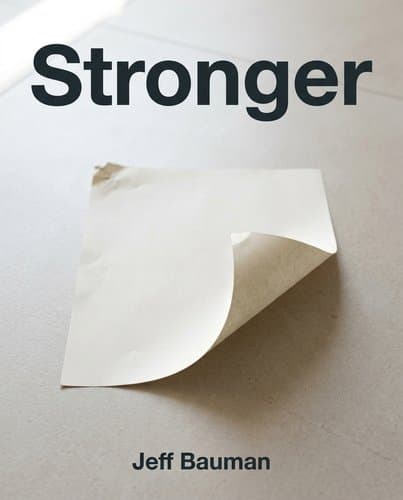
18453268_stronger
by Jeff Bauman
Losing both legs at the Boston Marathon finish line, Jeff Bauman discovered that survival isn't heroic—it's grinding, fraud-filled, and utterly dependent on…
In Brief
Losing both legs at the Boston Marathon finish line, Jeff Bauman discovered that survival isn't heroic—it's grinding, fraud-filled, and utterly dependent on the specific people who stay when the cameras leave. A raw portrait of what resilience actually feels like from the inside.
Key Ideas
Resilience feels different from inside
Resilience is rarely experienced as heroism from the inside — Jeff spent most of his recovery feeling like a fraud performing 'Boston Strong' for a city that needed a symbol, which is a completely different thing from feeling brave.
Witness recovery, don't just hear about it
The gap between believing recovery is possible and seeing it demonstrated by someone who has actually done it is unbridgeable by encouragement alone — find the person who is ten years down your road and already living well.
Guilt haunts the nearly-acted moment
Survivor's guilt often attaches to the smallest counterfactuals — 'what if I'd said something?' — rather than the catastrophe itself; the haunting is proportional to how close you came to acting, not to how responsible you actually were.
Supporters pay invisible emotional costs
The people who sustain you through trauma pay a cost that may not be visible until the crisis has passed; Erin's inner life remained largely inaccessible because she performed the same emotional management for Jeff that he performed for everyone else.
Indifference proves stronger than forgiveness
Refusing to grant the person who hurt you the status of a cause — refusing victimhood not through forgiveness but through indifference to their significance — is a psychologically distinct position that Jeff finds more durable than either anger or absolution.
Milestones demonstrate what reassurance cannot
Recovery milestones matter less as achievements and more as evidence: you don't believe you'll walk again from reassurance, you believe it from watching someone who already has walk into a room like it's nothing special.
Who Should Read This
Readers who connect with first-person stories about Resilience and Memoir and want to see the world through someone else's eyes.
Stronger
By Jeff Bauman & Bret Witter
13 min read
Why does it matter? Because the story you've been told about 'Boston Strong' is the one the city needed — not the one that actually happened.
There's a photograph most people have seen: a man with no legs in a wheelchair, a stranger in a cowboy hat running alongside him, Boylston Street still smoking behind them. It became a symbol almost instantly — of Boston, of resilience, of something the city needed to believe about itself. What the photograph couldn't show was the hospital misspelling his name, his family spending five hours searching the wrong floors, his girlfriend seeing only the cropped version and thinking he was fine. The symbol was clean and immediate. The person inside it was twenty-seven, had dropped out of community college over a $900 debt, and would spend weeks trying to make a piece of typing paper fly across a rehabilitation room.
The Life Before the Bomb Was Ordinary — Which Is Exactly the Point
Jeff Bauman is standing near Mile 18 on Heartbreak Hill, holding a hand-lettered sign that reads GO ERIN GO. He made it himself the night before with a Sharpie and a piece of poster board from CVS.
At this point in his life, Jeff is twenty-seven and owns almost nothing. He works the deli counter at a Costco in Nashua, New Hampshire, slicing turkey and making sandwiches for $11.48 an hour. He has a cell phone, a guitar he barely plays anymore, and a 2002 Passat with a bad transmission. He owes $900 to a community college he attended for one semester before running out of money and motivation in roughly equal measure. He is not unhappy. That's the thing people tend to miss about lives like Jeff's — he is not miserable, not waiting to be rescued, not aware that anything is wrong. He drinks Bud Light with his cousins, watches the Red Sox, shows up to work on time. He is, by any honest accounting, fine.
Erin is his ex-girlfriend, sort of. They broke up, got back together, broke up again. On March 29th, seven weeks before the marathon, they reconciled. He kissed her at Mile 18 during a training run and told her he'd see her at the finish line. That felt like a promise worth keeping, so here he is, sign in hand, in a crowd of strangers, waiting.
The lead runners have already passed. The charity runners and the first-timers are coming through now. Jeff is scanning faces, looking for Erin. It is 2:49 in the afternoon. The sun is out. Someone near him is eating a pretzel.
The Photograph Was Faster Than the Surgeons
The photograph of Jeff Bauman being rushed away from the bombing site in a wheelchair — both legs gone below the knee, a man in a cowboy hat running alongside him — spread faster than the surgeons could work. Before Jeff was even on the operating table at Boston Medical Center, the image was circulating on social media and appearing in news broadcasts. That speed is usually framed as horror. Jeff frames it differently: the photo isn't a record of what the bomb did. It's a record of the people who sprinted toward the smoke.
The way his family found out is its own kind of horror. BMC misspelled Jeff's name on intake, which meant that while his family spent five hours frantically calling hospitals, they were searching for someone the system couldn't locate. What they could find was the photograph — and so they sat with it, staring at his mangled body online, knowing he was somewhere in the city's medical system and unable to confirm he was alive. His cousin Big D saw it during a work break on a road paving crew and, by his own account, couldn't breathe. His stepsister Erika spotted it on the television at the restaurant where she was waitressing. His mother Patty got the news from a Costco coworker who recognized Jeff's face on the break room TV and had to ask whether her son was even alive.
What makes Jeff's defense of the image worth taking seriously is the statistic sitting behind it: of the 260 people injured in the bombing, not one person who reached a hospital died. The man in the cowboy hat — Carlos Arredondo, a bystander who ran toward the blast — helped make that possible for Jeff by getting him out first. The photo captures that act. The carnage is real, but so is the response to it, and the image holds both at once.
The First Thing He Wrote Was a Joke. The Second Thing Caught a Bomber.
Sully is sitting beside Jeff's hospital bed when Jeff wakes up. Jeff can't speak — there's a breathing tube down his throat — so someone hands him a notepad. His first note to his friend: 'Lt. Dan.' Sully laughs out loud. Lt. Dan is the legless Vietnam veteran from Forrest Gump, and Jeff is making that joke two days after losing both legs to a bomb. Sully would later say, 'Only Bauman.' That instinct — to reach for the absurd before the tragic — tells you something about what kind of recovery this was going to be.
The second note was different. Jeff motioned for the paper again and produced a description: dark baseball cap, aviator sunglasses, gray shirt under an open jacket, a JanSport backpack. A man who stood beside him before the blast and didn't belong there — not because of anything dramatic, but because he wasn't enjoying himself. Everyone else at the marathon finish line was festive. This man was somewhere else in his head entirely. Jeff would later put it plainly: 'He was all business.' When Sully walked that note into the hallway, his hands were shaking. The FBI arrived soon after and cross-referenced Jeff's description against thousands of hours of surveillance footage. The description held up. Police told Jeff afterward, 'You got the ball rolling.'
What doesn't make it into that clean narrative is the physical state Jeff was in while producing it. His eardrums were ruptured, leaving a high-pitched drill-whine behind everything, constant and sourceless. The nerves in what remained of his legs fired without warning — not pain so much as detonations, the body insisting on registering what wasn't there anymore. The pain medication cycled every four hours, and even at peak effectiveness it barely blunted things. The bombing footage kept cutting to the wheelchair photograph, so he left the television on whatever it landed on and tried not to look directly at anything. The joke and the description came from the same man — but there were hours between them, and he spent most of those hours just trying to hold on until the next dose.
'Boston Strong' Was a Slogan. The Reality Was a Piece of Typing Paper That Wouldn't Move.
Sometime during his early rehabilitation, Jeff's physical therapist slid a sheet of typing paper beneath the flat end of his leg and explained the motion: a backward kick, the kind you'd need to climb a stair. The paper was the goal — catch the edge of it with the kick, send it flying. Two weeks later, the paper had never moved. Not once. The muscles weren't there yet, or the nerves were still too scrambled from the blast to relay the right signals, or both. Jeff couldn't tell you exactly why. He just knew that he did the motion, and the paper stayed still, and he did the motion again.
This is what 'Boston Strong' actually looked like from the inside. Outside, it was on bus destination signs and the facade of the Museum of Fine Arts. Inside, it was a sheet of typing paper that wouldn't budge. While the city was processing its trauma through a collective story of defiance — flags, speeches, sold-out Fenway Park — Jeff was learning that even the simplest mobility required building something from nothing. The transfer board that bridged his hospital bed to a chair was, embarrassingly, just a sanded plank of wood. The first time he used it, the exertion sent him flat on his back within ten minutes. He practiced until the board chipped and gave him a splinter (he wasn't wearing the new workout shorts yet), and that unglamorous detail is maybe the truest image of early recovery: not triumph, just the same motion repeated until something small gets a little less impossible.
His mother knew some of what was happening behind the door. Some nights she sat outside it with a bottle of Cavit, not wanting to intrude and not able to leave. That's private suffering in its actual form — not dramatic, not photographable, just a woman on the floor in a hallway because she couldn't think of anywhere else to be.
Jeff understood, even then, that the people around him needed the other version. His mother needed 'Bauman' — the joker, the one who wasn't going to go dark. The city needed it too. So he performed it. And he performed it with enough conviction that it stopped being purely performance — more like a role that fit well enough to wear, even if he knew he was wearing it. He knew the difference between what was visible and what was real: the paper on the floor, the board chipping, the long hours between milestone moments when there was nothing to show for the effort at all.
The Man in the Cowboy Hat Was Running From Something Too
A Marine van is parked in a driveway in Florida. Inside it, a man named Carlos Arredondo is soaking himself with gasoline. It's August 24, 2004 — his forty-fourth birthday — and three Marines just knocked on his door to tell him his oldest son, Alex, was killed by a sniper in Iraq. Carlos went somewhere beyond grief. He grabbed a blowtorch. The van exploded, throwing him onto the front lawn, burning. The Marines saved his life. He survived with burns covering more than a quarter of his body and attended his son's funeral on a stretcher, asking to be lifted onto the casket so he could apologize for failing to save Alex.
Carlos spent the years after that in a particular kind of purgatory. He painted Alex's name on the side of his truck, drove the country, showed up at anti-war rallies pulling a flag-draped coffin, and talked to anyone who would listen. His younger son Brian, who had worshipped his brother, descended into depression and addiction under the weight of the loss. On December 19, 2011 — seven years almost to the day after Alex died — Brian committed suicide. Carlos had watched both his sons disappear and felt responsible for both.
Which is why the card matters. When Carlos walked into Jeff's hospital room and introduced himself, he handed over a card that identified him as 'Dad on Fire.' He told Jeff he'd been at the marathon finish line that day to support National Guardsmen marching for military families and suicide awareness — the cause Brian's death had sharpened into something personal. Then the bombs went off, and Carlos jumped the barricade.
What he said to Jeff is the whole thing: 'Something good happened.' The iconic photograph of him running alongside Jeff's wheelchair doesn't just show a bystander's courage. It shows a man who had already burned.
You Don't Believe You'll Walk Again Until You See Someone Who Already Has
Telling someone they'll walk again is one thing. Watching someone who already has is something else entirely. Jeff's family believed in his recovery. His doctors believed in it. His physical therapists had built their careers around exactly this kind of patient. And yet, underneath the effort — the exercises, the group sessions, the showing up — he didn't actually believe any of it. Not in the way that changes how you move through the world.
Then two soldiers from the Wounded Warrior Project walked into the Spaulding rehab gym. Both had lost both legs above the knee in combat — four artificial joints, the same configuration Jeff was looking at. When they came through the door, every medicine ball in the room hit the floor. Literally: people just stopped what they were doing and let go. Because what they saw was two men walking without crutches, without a visible limp, without any sign that it cost them anything. Two people entering a room. Jeff had spent weeks being told this was possible. He had never seen it.
One of the soldiers kept it simple: give it a year of hard work and you'll be walking. Not someday. One year. Jeff did the math alone in his room afterward. One year out landed on the 2014 Boston Marathon — the first anniversary of the attack, on Boston's biggest day, over the same finish line where the bombs went off. He hadn't had a goal before, just effort aimed vaguely at better. Now he had a date. And a reason that went beyond getting his own life back: he wanted to cross that finish line and show, as plainly as possible, what the bombers had managed to take from the city. Which was not a damn thing.
Performing Resilience and Actually Feeling It Can Be the Same Act
When the Bruins invited him to wave a flag on the ice before a playoff game, Jeff refused. His reasons were real: the wheelchair hurt after twenty minutes, he hadn't been outside a hospital since the bombing, and he felt like a target in any crowd. But underneath the practical objections was something simpler: he didn't think he had anything to offer. The hero the city had constructed — the one on the signs, the one in the slogan — felt entirely separate from a man in a wheelchair with no legs who needed help getting dressed. He figured people could believe whatever they wanted about him as long as they didn't have to actually look at him.
Then he got into the arena, and something shifted. He still can't fully explain it. He said he wasn't going on the ice. Then, for reasons he couldn't articulate, he said yes. The lights dropped. Erin wheeled him out across the ice in total darkness. The Jumbotron spelled out his story and then, in enormous letters: BOSTON STRONG. The arena lights came up and Jeff waved that flag — six feet across, tangling in his hands — and the crowd erupted.
He didn't feel like a symbol in that moment. He felt the crowd. The handshakes and backslaps from strangers he had dreaded as intrusions became something else: evidence that the connection was mutual, that his being there was doing something real for people who had also been afraid. The performance of resilience — the flag, the jersey, the Jumbotron entrance — didn't cancel out the genuine experience. Sometimes the act comes before the feeling, and the feeling shows up anyway.
He Refuses to Call Himself the Bomber's Victim — and That Refusal Is His Sharpest Argument
Jeff's position on the bombers is not forgiveness, and it's not the performance of healing that audiences tend to expect from survivors. It's something stranger: a cold-eyed read on a man he refuses to elevate, and a refusal of the one identity the bombing seemed designed to hand him.
He never calls Tamerlan a monster. He calls him small. At the time of the bombing, both men were twenty-seven, each with a nineteen-year-old brother. Jeff knew exactly what that position meant — how much power an older brother holds, how completely a younger one will follow. His own brother Alan would have believed anything Jeff told him. Tamerlan turned that dynamic into a weapon. Jeff turned his into a partnership. The line he draws between them is three words: 'He had a whipping post. I have a partner.' That's the whole argument. Same inputs, two men, opposite results.
His theory of why the bombing happened is even more deflating. Not ideology, not martyrdom, not a considered political act. Jeff's read: Tamerlan's life hadn't worked out, he was afraid to keep trying, and he needed someone else to blame. The bomb was the act of a man too frightened to face his own failure. What you're left with isn't a radical or a monster. It's a coward who found catastrophic leverage.
Which is why anger would be the wrong response. Jeff says so directly: staying angry would make him more like Tamerlan, and it would mean Tamerlan mattered. He didn't. And then, immediately, Jeff refuses the word 'victim.' He won't give that to the man either. Not forgiveness, which would still center Tamerlan, but erasure. To call yourself someone's victim is to let them define you. Jeff declines.
The First Steps on Prosthetics Were Nothing Like the Movie He'd Imagined
Jeff Bauman knew that movie. He'd seen Elysium, where Matt Damon gets cybernetic implants and becomes something close to superhuman. He'd imagined his own version going something like that.
What he got instead was a small examination room in Dorchester, a wheelchair, and a sock he had to roll carefully up to the top of his thigh before he could even begin. The socket — a large thigh-shaped piece of plastic — had to be worked up his leg slowly, the flesh managed so it wouldn't pinch, until the raw end of his residual limb touched the bottom. He chose tie-dye over black or camouflage. A small act of personality in a moment that could have stripped him of it entirely. Then the prosthetist, Mr. Martino, crouched behind him turning screws and adjusting electronics, and they moved to a hallway with grab bars on both walls, and several pairs of hands positioned themselves at Jeff's hips.
When he finally stood, he reached for a word and found one that surprised him: solid. Not triumphant. Not miraculous. Solid — the specific sensation of weight properly distributed, of occupying full height again after months of seeing the world from a seated child's vantage point. Then, without deciding to, he moved his right foot forward. He heard people in the room gasp. He kept going, sweat soaking through his shirt, staring at his new feet, until he looked up and saw Erin's face.
Erin Was His Anchor — Which Meant She Was Drowning While He Stayed Afloat
One afternoon, Jeff starts texting Erin. It's after lunch, that long stretch before she might arrive. 'What time u comin?' Then: 'I need you.' Then, when she doesn't answer: 'My legs hurt.' A dinner invitation. 'I love you.' Her final reply, after all of it: 'OK.' Two letters. The whole dynamic fits inside them.
Erin was emptying his urine cup, giving him leg massages at two and three in the morning when cramping woke them both, managing his media requests, driving him everywhere, and lying awake beside him on a mattress barely meant for one while he thrashed through nightmares. She was doing this on top of a full-time job and a two-hour commute, hauling her clothes back and forth in her backseat because there was no drawer space for her in his mother's five-hundred-square-foot apartment. The version of Erin the public saw — steady, devoted, present at every milestone — was real. What was also real was that she went home to her parents' house and cried. Not occasionally. A lot.
It took her mother, Lori, calling Jeff directly to make that visible. It was the first time she'd ever reached out to him alone, which told him everything about how serious it was. Lori was careful — 'I'm not saying you're doing anything wrong' — but the inventory she delivered was unsparing: exhaustion, guilt, anger, a feeling that her life had slipped out of her control. Jeff's response that night was to ask Erin to move in. He kept asking. When she finally said she didn't want to quit her job, he told her he had money now, he could take care of her. She said: 'I know. That's what I'm worried about.'
Erin had been financially independent since she was twenty years old. She had known who she was before the bombing — that self-possession was part of what Jeff loved about her. By then she had already quit her job, already given up her neighborhood, her social life, her sense of forward motion. Jeff's money wasn't reassurance. It was a door closing.
What 'Like It's No Effort at All' Actually Means
There's a photograph from Game 2 of the 2013 World Series: Jeff standing on the third-base line at Fenway Park, crutches in one hand, not leaning on them — holding them the way you'd hold an umbrella on a clear day, like he brought them along out of habit. He looks like a man who just happened to be standing there. You know better now. You know about the typing paper that sat still for two weeks. The text that came back as two letters. The mother outside a locked door with a bottle of Cavit. The night he crawled up his own front steps on his hands because the sockets had eaten into his legs and walking was no longer an option. The photograph doesn't hide any of that. It's what all of that eventually produces, if you do the work long enough and specific enough and unglamorous enough. The gap between the image and everything it required — that's the whole argument.
Notable Quotes
“I could not even breathe.”
“Dad, Dad, did you see the picture? Jeffrey’s on the news. He’s hurt.”
“No, I haven’t heard from Jeff,”
Frequently Asked Questions
- What is Stronger about?
- Stronger tells the story of Jeff Bauman, who lost both legs in the Boston Marathon bombing, and his journey through recovery. The book examines the unglamorous reality of recovery, showing resilience not as heroism but as sustained private effort. Through Bauman's experience, readers learn about trauma, identity, and the crucial role of people who support survivors. The narrative addresses survivor's guilt, the invisible costs paid by caregivers, and the psychological distance between well-meaning encouragement and genuine recovery progress. Rather than presenting an inspirational story of overcoming, it offers raw insights into what recovery actually feels like and how ordinary people navigate extraordinary challenges.
- What does Stronger teach about resilience?
- Stronger reveals that resilience is rarely experienced as heroism from the inside — Jeff spent most of his recovery feeling like a fraud performing 'Boston Strong' for a city that needed a symbol, which is a completely different thing from feeling brave. This contradiction between public expectations and private experience cuts to the heart of Bauman's insight: survivors navigate an unbridgeable gap between how strength appears to outsiders and how it actually feels internally. Rather than inspiration or willpower, resilience emerges from ungraceful, daily persistence—the choice to continue despite doubt. The book reframes recovery not as heroic achievement but as the unglamorous work of showing up to your rehabilitation when you don't believe it will work.
- What does Stronger say about survivor's guilt?
- Stronger reveals that survivor's guilt often attaches to the smallest counterfactuals — 'what if I'd said something?' — rather than the catastrophe itself; the haunting is proportional to how close you came to acting, not to how responsible you actually were. Bauman's reflection shows that guilt logic doesn't match actual causality—it follows the proximity of near-action, not realistic responsibility. Understanding this distinction matters because it explains why survivors often torture themselves over minor moments of inaction while the actual catastrophe recedes psychologically. Recognizing this pattern can help both survivors and supporters understand why certain regrets linger so persistently.
- How do caregivers experience trauma in Stronger?
- Stronger reveals that caregivers experience invisible costs that emerge only after crisis passes. The book illustrates this through Erin, whose inner life remained largely inaccessible because she performed the same emotional management for Jeff that he performed for everyone else. This creates a paradox—the person closest to the survivor often becomes isolated by their own performance of strength, managing emotions rather than processing them. Bauman's reflection exposes how recovery narratives typically center the survivor, obscuring the caregiver's psychological burden. The book suggests that acknowledging these hidden costs is essential for understanding what truly makes recovery possible.
Related Book Summaries

Read the full summary of 18453268_stronger on InShort