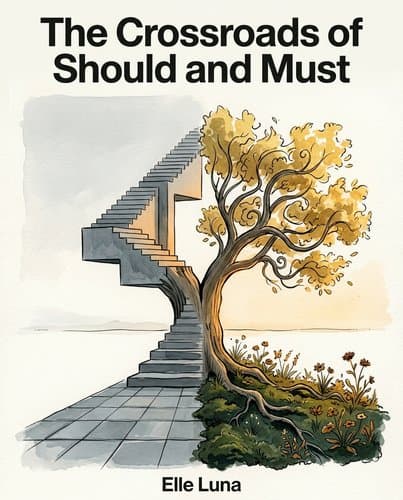
22859551_the-crossroads-of-should-and-must
by Elle Luna
Most people sleepwalk through lives built on other people's expectations—Luna shows you how to identify your 'Must,' the work you were born to do, and take the…
In Brief
The Crossroads of Should and Must (Apri) distinguishes between the life shaped by external expectations and the life driven by your deepest calling. It provides practical tools — from examining inherited beliefs to carving out small daily creative rituals — that help you identify what you truly want and build toward it without abandoning your responsibilities.
Key Ideas
Examine the beliefs shaping your decisions
Ask three questions about any belief that's been shaping your decisions: Where did this Should come from? Is it still true for me today? If I could keep it or let it go, what would I do? You can't shed a skin you haven't examined.
Build momentum through small daily actions
Start with ten minutes, not a life overhaul. Must is built through small daily actions — pick up the pen, write one paragraph, make one list — not through a single dramatic leap.
Separate must-have from nice-to-have spending
Separate Must-Have money (rent, food, obligations) from Nice-to-Have money (everything else). Your day job can be a 'worldly cloister' that funds and protects your Must rather than replacing it.
Create a judgment-free creative space
Create a physical No Judgment Zone — even a sliver of desk marked off with painter's tape counts. The boundary signals to your brain that this space operates by different rules.
Write fears down to manage them
Write out your worst-case fears as a numbered list. Naming them specifically makes them cross-out-able. The fear that lives in the abstract is always larger than the fear that's been written down.
Your unlived must costs others' dreams
Pursuing your Must is not a selfish act. The redwood metaphor makes this concrete: your roots, once extended, intertwine with others. The stranger in the third row who only dreams of playing the piano is the cost of a Must left unlived.
Who Should Read This
People working on personal growth in Purpose and Self-Improvement, especially those tired of generic motivational advice.
The Crossroads of Should and Must
By Elle Luna
9 min read
Why does it matter? Because the life you're living might be someone else's idea of your life.
You already know something is off. Not catastrophically wrong — you haven't lost anything, nobody died, you're fine. But fine is doing a lot of heavy lifting lately, and somewhere underneath it, there's a quieter question you keep not asking. Elle Luna calls it a Should — a life assembled from other people's expectations, internalized so gradually you mistook it for your own. Her book draws a single, unambiguous line between Should and Must, between the life you inherited and the one that keeps tapping you on the shoulder. What's unusual is how she gets there — not through abstract inspiration, but through specific people, specific fears, and remarkably small daily acts. The exit doesn't require burning anything down. It just requires being honest about which door is yours and which one you wandered through.
The Ache Has a Name — and It Has Nothing to Do With Your Circumstances
A CEO sits with his team's morning emails open on one side of his screen and an article on the other. He's just finished reading it — something about the difference between the life you're supposed to want and the life you actually want. His first instinct is protective: if his employees read this, at least a third of them will walk out. His second instinct surprises him. He sends it to everyone anyway, with a note that amounts to: if you don't want to be here, I'd rather know now.
That CEO was one of thousands who wrote to Elle Luna after her essay spread to five million people on Twitter and was read by a quarter-million in a matter of weeks. The responses stopped being surprising only in how consistently they defied every demographic boundary she could name. A high school senior. A widow. A poet who drove a city bus because it paid the rent. Lawyers who wanted to be musicians, and millionaires who felt broke in the only way that counts. The pain wasn't about income or age or geography. It was something more precise — the feeling of being stuck in a life assembled from other people's expectations, with no idea how to begin building one of your own.
Luna has a name for what was doing the assembling: Should. Should is the accumulated weight of other people's expectations — not always coercive, often just quiet enough that you never noticed it steering. The destination can look, from the outside, entirely respectable. That's what makes it so disorienting when the ache arrives anyway.
The ache isn't a sign that something is wrong with you, or with your job, or with the city you live in. It's a sign that you've been living someone else's answer to a question only you can ask.
Should Is Not Sensible Caution — It's a Prison You Built Yourself
Think of a city you've lived in so long that you stop seeing it. The streets feel like facts — the commute, the neighborhood, the apartment you settled into years ago. None of it was inevitable, but it calcified into something that feels as fixed as geography. Elle Luna's central argument is that most of what we experience as the shape of our life works exactly this way: not external reality, but accumulated agreement — a structure built so gradually we forgot we were building it.
She calls that structure Should. Not a single demand from a single person, but the layered residue of a lifetime of expectations absorbed from parents, culture, employers, and a hundred social cues too quiet to notice in the moment. The journey into Should is often smooth, even comfortable — the rewards are legible, the options plentiful, the path well-lit. That's precisely what makes it so effective as a prison. The word prison, Luna notes, has always meant something closer to seized than locked away — and that's the version she means. You don't have to be locked up by force if you've constructed the walls yourself and learned to call them good sense.
Contrasted against Should is Must — not ambition or passion in the motivational-poster sense, but something rawer: what you actually believe, what you'd be drawn toward in a room with no audience and no reward. Must doesn't negotiate. It doesn't accept a version of itself that fits neatly around someone else's expectations.
The hardest part of Luna's argument is this: you cannot find Must by rushing toward it. You find it by first learning your prison's layout. She offers three questions to apply to any belief you've been carrying: Where did this Should come from? Is it still true for me? If I could choose to keep it or release it, what would I actually do? They sound simple. They're not. Answering them honestly requires sitting with the possibility that a belief you've organized years of decisions around might belong entirely to someone else.
Her image for what happens when you don't do this work is a snake that cannot shed its skin. As the animal grows, its outer layer becomes a constraint — the insides literally outgrowing the outsides. The shedding process is painful and disorienting, and during it the snake's coloring sometimes shifts to a strange bluish hue. But if it can't shed, it goes malnourished, then blind, then dies. The creature's growth kills it from the inside. Luna's point isn't gentle: humans who leave their Shoulds unexamined face the same slow foreclosure — not dramatic collapse, but a gradual narrowing of what's possible.
Must Isn't a Dramatic Leap — It's What Van Gogh, Grisham, and a Box of Cereal Have in Common
Choosing Must looks nothing like a cinematic breakthrough. No dramatic resignation letter, no midnight epiphany, no single moment where everything clicks. From the outside, Must is almost indistinguishable from stubbornness — a series of inconvenient daily choices made in rooms where no one is watching. That's what's left when you stop paying the snake's price: not freedom, exactly, but a different kind of obligation.
John Grisham is the clearest illustration. Before he became a bestselling author, he spent three years waking at five in the morning to write stories about crimes and courtroom drama before heading to his job defending actual criminals. Not occasionally. Every morning. The manuscript that came out of that schedule was rejected by publisher after publisher before finally finding a yes. Van Gogh was writing letters to his brother about being utterly invisible in 1882 and kept painting anyway. Nothing about either of those processes felt triumphant while it was happening. Unglamorous, private, easy to quit at any point — and neither of them quit, not because they had certainty about the outcome, but because the work itself was the thing they couldn't put down.
The Airbnb founders, facing a startup running out of money with no traction and no obvious path forward, hot-glued numbered cereal boxes in a California kitchen and sold them for forty dollars apiece at a political convention. None of these people were betting on a sure thing. They were doing the next small, weird, disciplined thing because Must doesn't offer a better option.
The reader who is waiting for the right moment — the one where the leap feels safe, or at least reasonable — is waiting for something that never comes. Must doesn't announce itself with clarity. It announces itself with repetition: the same pull, morning after morning, in the same direction, regardless of whether the world has noticed yet.
The Four Excuses Are Real — Here's What to Do With Each of Them
What if money, time, space, and fear aren't the reasons you haven't started — what if they're just the most socially acceptable way to say 'I'm not ready yet'? Elle Luna isn't unsympathetic to the four obstacles. She just refuses to let them function as permanent deferrals.
Take money first, because it usually wins the argument before the others even get to speak. Philip Glass was one of the most ambitious composers working in America, and as his operas were premiering at the Metropolitan Opera in New York, he was still renewing his plumber's license and keeping his taxi certification current — just in case. Not because he lacked confidence in his work. Because Must doesn't come with a salary guarantee, and he knew the difference between the money he absolutely needed and the money that would simply be nice to have. Luna frames this as a practical distinction with real stakes: must-have money is a fixed floor — food, shelter, your actual obligations. Nice-to-have money is everything above that, and confusing the two is how a temporary day job becomes a permanent identity. T.S. Eliot worked at a bank. Kurt Vonnegut sold cars. The lesson isn't that suffering ennobles the work. It's that financial pragmatism and creative commitment can coexist, and the question worth asking is whether your current arrangement leaves you any energy for Must at all.
Time collapses faster once you accept Luna's provocation: you make time for what you actually want. If Must keeps getting postponed, that might be information about whether you want it as badly as you think. But for the person who genuinely does want it, the intervention is almost embarrassingly small — ten minutes. Waiting for a kettle to boil. Sitting in a carpool lane. The romance of quitting everything and retreating to a cabin to find yourself is exactly that: romance.
Space gets solved with $4.99. A woman named Sharon needed a room of her own and didn't have one, so she ran painter's tape across the floor, up the wall, and over the ceiling — carving out a sliver of her living room that contained nothing but a narrow desk, her tools, and the words 'No Judgment Zone' written along the tape in neat handwriting. The point isn't the tape. It's that the boundary was real enough to work.
Fear is the one that doesn't have a workaround so much as a process. Luna's suggestion is to write your ten worst-case scenarios on a piece of paper, numbered, and then look at them. Fears held entirely in the mind behave like something sticky and ambient — they're everywhere and you can't quite grip them. On paper they become specific. Specific fears can be examined. Examined fears can sometimes be crossed out. The exercise doesn't promise to dissolve the fear. It promises to make it answerable, one line at a time, instead of the invisible architecture you've been designing your whole life around.
Choosing Must Is Not Selfish — It's the Only Way the Roots Hold
Mary Ellen Geist's father spent thirteen years losing himself to Alzheimer's. By the end, he couldn't remember where he lived, what he'd done for work, or how to knot a tie. On the night he opened for the Radio City Music Hall Rockettes in Detroit, stagehands had to lead him to the stage because he couldn't find it on his own. Then he sat down, and he played a perfect set. The music — a lifetime of weekend gigs and late-night rehearsals — had burrowed so deep into his nervous system that no amount of neurological damage could reach it. Must, it turns out, is not stored where the other memories are.
That story does something to the argument that following your deepest calling is self-indulgent. How do you call that selfish? And more to the point: what would have been lost if he'd never played at all? The people in that audience, the family who watched him walk confidently through a door that was otherwise closing — they were the beneficiaries of every hour he'd spent doing the thing that was most fully his.
Luna offers a structural metaphor for exactly this. California redwoods grow to 360 feet tall on roots that barely reach ten feet underground. The math shouldn't work, and it doesn't — not for a single tree standing alone. The secret is lateral: the roots spread outward until they find other redwoods, then intertwine underground, a hidden web of mutual support that no one standing at the base of any individual tree can see. The height is individual. The stability is shared.
Luna herself felt the selfishness accusation when she left design work to paint. Painting felt solitary in a way that design never had — no users, no research, no audience to serve. What she came to understand is that this logic runs backward: the cost of a life unlived is paid by everyone who never gets to experience what you were capable of. The man with his tie unknotted and his band waiting — his Must was the gift, not the distraction from it. The work you do in private, in rooms no one visits, on the particular problem only your life has equipped you to care about — it doesn't isolate you from other people. It grows the roots that reach them.
The Dream Where You Can Play
There's a man sitting in the dark of the San Francisco Symphony, close enough to feel the cello strings pull at something in his chest. Afterward, quietly, almost to himself, he says he can't play a tune — but he dreams that he can. Notice what he didn't say. He didn't say the dream was fading. He didn't say it was foolish. He said it keeps returning. That's not a consolation prize for the life he chose. That's a signal, and it has been patient with him for years. The only thing Elle Luna's book is finally asking is whether you'll take it seriously before the window closes — not because your Must belongs to you alone, but because it never did. The roots you grow from it reach further than you'll ever see from where you're standing. The dream isn't selfish. Leaving it unplanted is.
Notable Quotes
“You should listen to that song,”
“the experience of being alive, so that our life experiences on the purely physical plane will have resonance within our innermost being and reality, so that we actually feel the rapture of being alive.”
“With hope in every bowl,”
Frequently Asked Questions
- What is the difference between Should and Must?
- Should represents external expectations and inherited beliefs that shape your life decisions, while Must is your deepest calling or what you truly want to pursue. The book distinguishes between the life shaped by external expectations and the life driven by your deepest calling. To identify whether a belief is a Should, Luna suggests asking three critical questions: "Where did this Should come from? Is it still true for me today? If I could keep it or let it go, what would I do?" Understanding this distinction helps you examine inherited beliefs, shed what no longer serves you, and move toward authentic choices rather than living on autopilot.
- How do you start building your Must?
- Start small with ten minutes daily rather than planning a complete life overhaul. "Must is built through small daily actions — pick up the pen, write one paragraph, make one list — not through a single dramatic leap." The book emphasizes that you don't need dramatic transformation; consistent small steps accumulate into meaningful progress. These daily rituals provide practical momentum while protecting your Must from becoming overwhelming. By establishing tiny creative practices and honoring them regularly, you create a foundation for pursuing what matters most without abandoning existing responsibilities or making unsustainable commitments.
- How should you handle money and your day job when pursuing your Must?
- Luna separates financial needs into two categories: Must-Have money covers essential expenses like rent and food, while Nice-to-Have money represents everything else. "Your day job can be a 'worldly cloister' that funds and protects your Must rather than replacing it." This reframing allows your job to support your true calling without becoming your identity or consuming all your energy. By intentionally compartmentalizing finances, you can sustain practical responsibilities while protecting mental and creative space for what truly matters. This approach makes pursuing your Must feasible without requiring you to abandon financial stability.
- How can you overcome fears when pursuing your Must?
- Writing out your worst fears as a numbered list makes them manageable and addressable. "The fear that lives in the abstract is always larger than the fear that's been written down." By naming specific fears, they become cross-out-able rather than overwhelming. Additionally, pursuing your Must isn't selfish—it's essential for others. Luna uses the redwood metaphor: "your roots, once extended, intertwine with others. The stranger in the third row who only dreams of playing the piano is the cost of a Must left unlived." This perspective transforms pursuing your calling from guilt-inducing selfishness to necessary fulfillment.
Related Book Summaries

Read the full summary of 22859551_the-crossroads-of-should-and-must on InShort