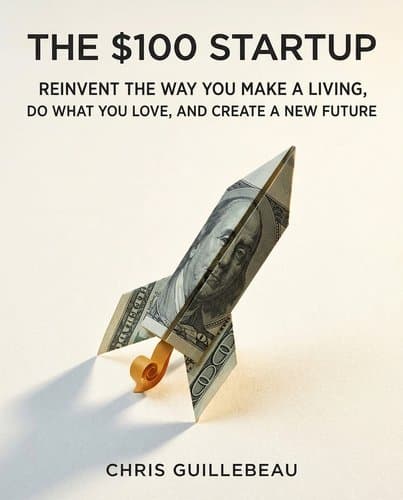
12605157_the-100-startup
by Chris Guillebeau
You don't need funding, a business plan, or even a great idea—just a skill someone will pay for and the courage to offer it. Chris Guillebeau shows how 1,500…
In Brief
You don't need funding, a business plan, or even a great idea—just a skill someone will pay for and the courage to offer it. Chris Guillebeau shows how 1,500 real people built profitable businesses for under $100 by matching their passion to a problem worth solving.
Key Ideas
Three essentials for any business
You need exactly three things to have a business: a product or service, a customer willing to pay, and a way to get paid. Everything else — the LLC, the business plan, the office — is optional and can come later.
Pre-sell to validate customer demand
Test demand before you build. Selling something before it's finished (with a clear delivery date and a refund option) is not deceptive — it's the most efficient way to avoid months of work on something nobody wants.
Match passion with market need
Passion is the starting point, not the destination. The question isn't 'what do I love?' but 'what do I love that other people have a problem I can solve?' Mignon Fogarty loved science and grammar equally — only one of those had a big enough audience with a felt need.
Sell benefits, not product features
Sell the outcome, not the process. Customers don't want to learn to fish — they want the fish. Rewrite your offer around what the customer's life looks like after they buy, not what your product contains.
First sale triggers entrepreneurial psychology
The first sale is a psychological event. It doesn't matter if it's $50. Something shifts when a stranger on the internet hands you money for something you made. Start there.
Raise prices without customer resistance
Raise your prices. Study after study in the book shows that freelancers and consultants undercharge, and that price increases of 25% or more are met with little to no resistance. Higher prices also filter out the customers who generate the most complaints.
Relationship building outperforms paid advertising
Hustle before you pay for ads. Ten hours of active relationship-building — guest posts, journalist outreach, joint ventures — outperformed $10,000 in carefully targeted advertising in Guillebeau's own experiment. Start with people, not platforms.
Launch with narrative and deadline
A launch is a narrative, not a button. Structure your release as a story with a clear opening, a build, and a hard closing date. Without a deadline, you lose the final sales spike that often equals the first two days combined.
Who Should Read This
Business operators, founders, and managers interested in Startups and Business Strategy who want frameworks they can apply this week.
The $100 Startup: Reinvent the Way You Make a Living, Do What You Love, and Create a New Future
By Chris Guillebeau
10 min read
Why does it matter? Because the assumptions you have about what it takes to start a business are almost entirely wrong.
Most people assume starting a business requires money they don't have, credentials they never earned, and a tolerance for risk they're pretty sure isn't in their personality. So they wait — for the right moment, the right idea, the right amount of savings in the account. Meanwhile, someone with a $250 minimum print order and a half-decent eye for design accidentally sells out of 44 travel maps in ten minutes. Someone else turns a PDF about note-taking software into $10,000 in eleven days. A laid-off corporate manager starts delivering mattresses by bicycle and clears six figures. None of them had a business plan. Most of them had under $1,000. What Chris Guillebeau found, after interviewing hundreds of people who quietly built this kind of life, is that the prerequisites you've been waiting to meet were never actually required.
The 9-to-5 Is the Riskier Bet
The 9-to-5 job feels like the responsible choice — steady paycheck, health insurance, someone else worrying about where the revenue comes from. But that story has a flaw: your entire financial life depends on a single decision made by people who have no particular loyalty to you. In a volatile economy, that's not security. That's betting your whole income on one employer's goodwill.
Guillebeau noticed something striking when he interviewed more than a hundred people who'd left traditional employment to run their own small businesses. Many hadn't chosen to leave — they'd been pushed. Laid off, let go, restructured out of existence. And almost universally, once they'd built something of their own, they said the same thing: losing that job was the best thing that ever happened to them. Not because unemployment was fun, but because the push forced them to stop waiting for permission and start building something they actually controlled.
The math underneath this is uncomfortable. A job feels safe because the income is predictable — until it isn't. The moment your employer decides to cut, your income goes to zero overnight, with no warning and no fallback. A small business draws income from multiple customers. Lose one and you're hurt but not finished. A business with ten customers survives losing one. A salary doesn't survive losing one employer.
You Already Have Everything You Need to Start — You Just Haven't Named It Yet
A human resources manager handed Michael Hanna a cardboard box and walked him to his desk. Twenty-five years in sales, and that was how it ended — a box, a slow walk, and an early drive home to figure out what to tell his family. Within months, he was selling closeout mattresses out of a shuttered car dealership, delivering them across Portland on a custom tandem bicycle with a king-size platform on the back. Two years later, he donated the Nordstrom suit he'd worn on his last day to Goodwill, because he had no use for it anymore.
Here's what Michael didn't do: go back to school, get certified in mattress retail, or write a business plan. What he had was two decades of sales instincts — how to read a customer, how to make a room feel welcoming instead of predatory, how to close without pressure. He didn't think of those as transferable skills. They were just things he knew how to do. The mattress business was the vessel those skills poured into. And that combination — sales instincts, a cheap inventory source, a memorable delivery method — turned out to be worth more than expertise in any single piece of it.
Most people misjudge this gap. They look at a business and see the domain — mattresses, PR, software — and assume domain knowledge is the hard part. It usually isn't. The hard part is already behind you: the years you spent learning to communicate clearly, solve problems on the fly, show up reliably, and understand what other people actually want.
The formula is almost embarrassingly simple. You need something to sell, someone willing to buy it, and a way to collect the money. That's the whole architecture. Everything else — the branding, the website, the formal plan — comes later, or never. The skills you already have are the raw material. The only thing missing is the decision to point them at something useful.
Passion Alone Will Sink You — What Saves You Is Finding Who Needs It
What separates a business from an expensive hobby? Passion is the easy answer, and it's also the wrong one.
Mignon Fogarty poured more effort into her science podcast, Absolute Science, than she ever did into the show that made her famous. She loved the material, promoted it relentlessly, and kept at it for nearly a year. The audience liked it too — but there weren't enough of them, and the numbers never worked. Then she launched Grammar Girl, a show about common English usage mistakes, with noticeably less promotional effort. It exploded. Books, media coverage, a network of related programs. The difference wasn't her level of passion. It was the size of the problem she was solving. Millions of people write emails, reports, and documents every day and feel quietly uncertain about whether they're doing it right. Grammar Girl gave them relief. Absolute Science gave a small audience something to enjoy. Both had passion behind them. Only one had a market large enough to sustain a business.
There's a second trap that catches people even after they've found the right audience: confusing the passion itself with what customers are actually paying for. Benny Lewis travels the world learning languages — eight in two years — and will tell you cheerfully that he gets paid to do exactly that. Dig a little further and the real structure emerges. People don't pay him to watch him acquire Czech. They pay him because they believe they can't learn a language and want someone to prove them wrong and show them how. The inspiration is the hook; the helpfulness is the business. Strip out the practical guidance and you have an interesting party guest, not a revenue model. Barbara Varian of the V6 Ranch figured out the same thing from a different angle: guests weren't paying for horse rides, they were paying to briefly become a different version of themselves. The horse is the kitchen. Freedom is what gets delivered to the table.
Passion tells you where to look. Whether there's a business waiting there depends entirely on whether enough other people need what your passion has taught you to provide.
The Right Offer at the Right Moment Beats the Best Product at the Wrong Time
Imagine you've invented the perfect umbrella — lightweight, wind-resistant, a genuine engineering achievement. Now imagine you're selling it in the Sahara. The product hasn't changed. The market has. This is what most first-time business owners miss: the quality of what you're selling is only one variable, and it's rarely the decisive one.
At mile 18 of a marathon, exhausted and mechanically putting one foot in front of the other, Guillebeau spotted a volunteer handing out orange slices on the roadside. He changed his lane, slowed down, and took one with the kind of gratitude people usually reserve for much larger favors. Two miles later, another volunteer was handing out Krispy Kreme donuts — free, same as the orange. Nobody wanted them. The donuts weren't bad. The timing was catastrophic. Three hours into physical depletion, a sugar bomb is an insult, not a gift. The orange solved an immediate, felt need. The donut arrived when no such need existed. Same generosity, opposite outcome.
That's the structure underneath every compelling offer: the right thing to the right person at the moment they actually need it. Scott McMurren's Alaska TourSaver coupon book is a clean example of what that looks like when it works. Visitors arriving in Alaska already know the state is expensive — they've budgeted for it, maybe grimly. McMurren sells them a book for just under a hundred dollars containing over a hundred two-for-one deals on helicopter tours, hotel nights, and excursions that individually cost several times that amount. The pitch isn't clever marketing. It's arithmetic: use one coupon, the book has already paid for itself. What looked like a discretionary purchase becomes a logical one. The offer meets the customer exactly where their anxiety already lives and resolves it.
The lesson isn't that you need deeper discounts or a more elaborate product. The same offer lands differently depending on what the customer is feeling when it arrives. Figure out the felt need first. Then design the offer around that moment.
Sell It Before You Build It — Then Build It Fast
Brett Kelly was working opposite shifts from his wife, handing off childcare with a high-five at the door as she left for her waitressing job and he came home from a software development role he couldn't stand. They were $15,000 in debt and perpetually exhausted. Then Brett noticed something: Evernote, a free note-keeping app with millions of users, had no real English-language guide. No walkthrough, no tutorials, no document that actually showed people how to use the thing properly. He spent months building one — ninety pages of dense, specific content, screenshots included — and put a $25 price tag on the PDF.
Eleven days after it went on sale, his PayPal account crossed $10,000. The next morning, his wife handed in her notice at the restaurant.
The reason this works as an example isn't the outcome — it's the sequence. Brett didn't wait until the guide was flawless. He didn't commission market research or write a business plan. He found a real gap, filled it with genuine effort, and got it in front of people. The $10,000 arrived before he'd done a second round of revisions. The first sale told him something no amount of planning could: that real strangers, with no personal loyalty to him, thought the thing was worth paying for.
That first sale is a breakthrough event more than a financial one. Once money arrives from a stranger, you stop wondering if anyone will ever want what you've made. You know. And knowing changes how seriously you take the next step.
The logic can be pushed even further. Evidence beats planning — a point a friend of Guillebeau's proved by running an ad in a magazine for a $900 specialty guide aimed at high-end car enthusiasts before he'd written a single page. Two people ordered it. Rather than panic, he wrote back to both buyers saying a revised version was coming in thirty days and offered a full refund if they didn't want to wait. Neither asked for one. He spent that month frantically writing the thing, placed another ad, and sold ten more. The product came after the market confirmed it wanted to exist.
It's whether anyone cares enough to pay for it before you've poured your whole life into finding out.
A Launch Is a Story, Not an Announcement
A launch is a story you tell in chapters, not an announcement you make once.
Karol Gajda and Adam Baker borrowed the core idea from a 1923 advertising manual: the fire sale, where everything must go by a fixed deadline. They bundled $1,054 worth of digital products from 23 contributors and priced the whole package at $97, available for exactly 72 hours. No extensions, no exceptions. When they opened the doors, nothing happened for ten minutes — then the orders came in a flood that barely slowed for three days. Final tally: $185,755. The deadline wasn't a gimmick. It was structural. When you track sales over a week-long launch, the pattern is almost universal: a spike at the open, a lull in the middle, then a second spike just before the close. Kill the closing date and you kill that second spike. You've built all that anticipation and then given people no reason to move.
The sequence that produces this looks less like marketing copy and more like a serialized story. It opens with a quiet signal that something is coming — not details, just awareness. Then the case for why it matters, which has to land before anyone will pay attention. After that come the logistics, the final warning, and the open gates. Each message does one thing and moves on. The reason this works at any audience size is that it manufactures the felt urgency that a physical deadline provides naturally. Karol and Adam honored theirs completely — when the 72 hours ended, they turned down every request for an exception. That refusal was itself part of the message: the next launch would be believed too.
The story is the engine.
Price for the Outcome, Not the Hours — Then Offer More Than One
The price you charge doesn't just generate revenue — it tells customers what your work is worth before they've experienced it. Set it too low and you've already lost the argument. Set it based on the benefit it delivers, and you've done something far more powerful than cover your costs.
Gary Leff books first-class international flights for other people. His fee is $250, flat, whether the booking takes a ten-minute phone call or an afternoon of research. Clients don't care which it was — they care that they're sitting in a business-class seat to Tokyo instead of a middle seat in coach. The labor is invisible; the outcome is the product. Price it by the hour and you've made your labor the product, not the outcome. Price it like the latter and you've anchored the transaction to something the customer actually wanted.
Once you've priced for the outcome, there's one more move that almost always increases revenue without adding a single new customer: offer a tiered range. Take a product priced at $87. If you simply present it, the customer's decision is whether to buy or not. But if you add a fuller version at $129 and a premium version at $199, the decision shifts to which one — and the math shifts with it. Run those numbers across twenty sales: the flat-price model produces $1,740. The tiered model, where most buyers land in the middle and a few reach for the top, produces $2,664. The extra $924 came from restructuring the choice, not from finding new customers or improving the product.
The mechanism is an anchor price. When customers see the premium option first, every lower price looks reasonable by comparison. Without an anchor, they're comparing your price to a competitor's. With one, they're comparing it to a version of your own product that costs more. That's a contest you can win.
Fear Is Real, But You're Measuring the Wrong Risk
John T. Unger was standing on top of his Michigan art studio, frantically shoveling snow, when the roof gave way beneath him. The building was a total loss. He spent the rest of that winter shivering through his work, warming himself with an illegal kerosene heater, wondering what came next. Then the bank showed up to assess the damage — and for the first time actually looked at his business rather than dismissing him as another broke artist. They handed him a $10,000 commission. He used it as a down payment on two buildings he'd been trying to buy for years. The disaster unlocked the deal.
The pattern isn't that failure leads to success through some tidy karmic logic. It's that Unger's threshold for what counted as a real risk recalibrated with each setback. The roof collapse felt catastrophic until it became the best deal he'd made. The job loss, the girlfriend, the apartment, even a piece of his thumb — all of it cleared in a single direction: toward the work he'd been doing on the side for ten hours a day anyway. What looks like accumulating ruin from the outside can feel, from inside it, like clarity.
The people most afraid of failure are usually the ones who haven't started yet. Starting doesn't eliminate the fear — it just gives you real information instead of imagined catastrophe. Kyle Hepp, a photographer traveling through Europe after being hit by a car, paid an absurd amount to use hotel internet for ten minutes in Italy and opened an email offering her team a $5,000 wedding booking from a bride on another continent. The money mattered less than what it proved: one stranger who owed her nothing had decided the work was worth it. If there was one, there were more. That's the psychological shift the first sale triggers — not confidence, exactly, but evidence. And evidence beats fear every time.
The actual risk isn't failure. It's the compounding cost of waiting for conditions that never quite arrive.
The Real Question Isn't Whether You Can — It's Whether You'll Start
Every person in this book was, at some point, exactly where you are — convinced the timing was slightly off, that they needed one more thing before they could begin. Rhett, a Cambodian entrepreneur driving his tuk-tuk through Phnom Penh with no formal training and no safety net, skipped that waiting period entirely. No fluent English either. He just started, and in doing so, ran every principle in this book simultaneously. The gap between where you are and where you want to be isn't credentials or capital or some abstract reservoir of courage you haven't accumulated yet. It's one decision: make the first thing, sell it to the first person. That first sale doesn't just pay you — it replaces the imagined catastrophe with something real. Fear doesn't disappear. But it stops being the loudest voice in the room. The regret of never finding out is the real risk. Everything else is just the story you're telling yourself while you wait.
Notable Quotes
“You know, you’d be really good at PR.”
“But look at all these people who like us on Facebook!”
“Wow, $2 million for the latest MacBook is a lot, but hey, the $240,000 model is almost as good.”
Frequently Asked Questions
- What are the three essentials you need to start a business?
- "You need exactly three things to have a business: a product or service, a customer willing to pay, and a way to get paid. Everything else — the LLC, the business plan, the office — is optional and can come later." This framework from The $100 Startup removes barriers that prevent people from starting. You don't need a polished business plan, corporate structure, or expensive office space before launching. Guillebeau emphasizes that formalities should follow after you've proven actual demand, not precede it. This approach enables anyone to start a business with minimal capital. Success depends on validating your core concept first, then adding professional structures later.
- What's the right pricing strategy for startup founders?
- Guillebeau advises: "Raise your prices." Study after study shows that freelancers and consultants undercharge, and that price increases of 25% or more are met with little to no resistance. Higher prices improve your business by increasing revenue without losing customers and filtering out demanding, price-sensitive clients. Rather than competing on cost, focus on value. This positions your business as premium, improves margins, and attracts quality-focused clients. The psychological impact of charging more signals quality to buyers and creates perceived value. Price increases are an often-overlooked but powerful lever for startup success, improving both profitability and customer satisfaction.
- Is passion necessary to start a successful business?
- Passion is necessary but insufficient. "Passion is the starting point, not the destination." The right question is: "What do I love that other people have a problem I can solve?" Guillebeau's example of Mignon Fogarty illustrates this: "Mignon Fogarty loved science and grammar equally — only one of those had a big enough audience with a felt need." Your passion must intersect with genuine market demand. Enthusiasm pushes you through early challenges, but won't sustain a business without customers. The sweet spot is where your passion meets others' problems they'll pay to solve, preventing unprofitable ventures.
- What's more effective than paid advertising for startup growth?
- An experiment in The $100 Startup reveals the power of relationship-building: "Ten hours of active relationship-building — guest posts, journalist outreach, joint ventures — outperformed $10,000 in carefully targeted advertising in Guillebeau's own experiment." The key principle: "Start with people, not platforms." Rather than immediately investing in expensive digital advertising, focus on direct human engagement. Guest posts establish authority, journalist outreach creates credibility, and joint ventures expand reach. These organic growth strategies are particularly effective for early-stage businesses with limited budgets. Personal relationship-building remains the most efficient use of early startup resources.
Related Book Summaries
Read the full summary of 12605157_the-100-startup on InShort