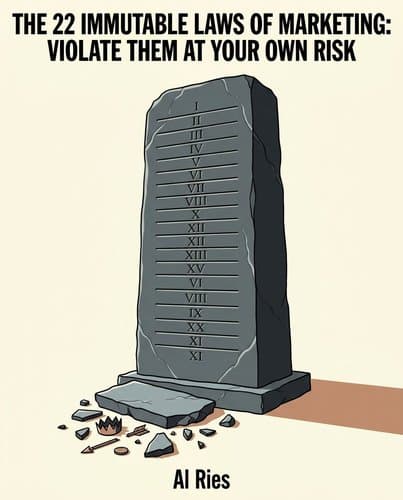
33449_the-22-immutable-laws-of-marketing
by Al Ries
Marketing battles aren't won in stores or ad budgets—they're won inside the prospect's mind, where the first brand to claim a position owns it forever.
In Brief
Marketing battles aren't won in stores or ad budgets—they're won inside the prospect's mind, where the first brand to claim a position owns it forever. Master the 22 laws that explain why superior products lose and why violating these rules turns marketing spend into a gift to your competitors.
Key Ideas
When competitor owns it, market opposite
Before building a campaign around an attribute, map who already owns that attribute in the prospect's mind — if a competitor holds it, advertising it will reinforce them, not you. Find the opposite attribute instead.
Ask 'first what' to pioneer categories
When you can't be first in a category, ask 'First what?' — identify what new category this product could pioneer, then market the category, not the brand. DEC didn't sell DEC minicomputers; it sold prospects on why they needed a minicomputer at all.
New categories need new brand names
When you launch a second product into a genuinely new category, give it a new name. Honda launched Acura with separate dealerships. Volkswagen used the same name across price points and lost 63 percentage points of US market share.
Number two wins through honest positioning
If your brand is #2, build your entire strategy around your relationship to #1 — explicit acknowledgment of your position is more credible than claims of superiority, and relativity makes your differences meaningful.
Extension peaks hide years of damage
Line extension damage takes three to five years to appear, which is why it always looks like it's working. Track original brand volume after any extension launch and watch for the peak — the decline that follows is structural, not cyclical.
Under-supply turns temporary fads into trends
If you're riding something that looks like a fad, deliberately under-supply demand rather than maximizing it. Controlled scarcity stretches a fad into a trend; saturation burns it out.
Own one clear word in minds
Identify the single word or short phrase your brand owns in the prospect's mind. If you can't name it clearly, your brand lacks the focus to defend itself when a well-positioned competitor arrives.
Who Should Read This
Business operators, founders, and managers interested in Marketing and Branding who want frameworks they can apply this week.
The 22 Immutable Laws of Marketing: Violate Them at Your Own Risk
By Al Ries & Jack Trout
9 min read
Why does it matter? Because "build a better product" is not a marketing strategy — it's a prayer.
IBM was bleeding eight million dollars a day. Its leadership kept reinventing the product line, betting that better technology would turn the tide — but the real contest had already moved somewhere else. GM didn't lose ten share points because it built bad cars. Sears didn't implode under the weight of incompetent management. These were the best-resourced, most professionally run organizations on earth — and they executed their strategies brilliantly. The strategies were wrong. Specifically, they were built on an assumption so widely shared that almost no one questioned it: marketing is a battle of products, and the better one wins. It isn't. The real contest takes place in a space you can't visit, can't benchmark, and can't outspend your way into — the prospect's mind. Once you understand how that space actually works, every instinct you currently trust about marketing turns out to be precisely backward.
The Company That Got There First Will Still Be Winning Decades Later — Regardless of Who Makes the Better Product
Whoever enters a prospect's mind first gets filed there — and minds resist revising their own filing systems. Heineken arrived in the US imported beer market after World War II and still commands 30% of a 425-brand field, not because it outperforms rivals in blind taste tests, but because it was first, when the mental slot was open. Every brand that followed inherited a closed door. Most companies assume that's fixable: execute better and loyalty will eventually redistribute. It won't. That asymmetry compounds rather than erodes.
Here's a shortcut that's almost embarrassingly reliable: if you can't remember who was first in a category, substitute the word leading and you'll usually land the same answer. Harvard. Hertz. Coca-Cola. First entry creates the category in the mind, and once created, that real estate belongs to the pioneer — often permanently enough that the brand name becomes the noun. People ask for Kleenex, Xerox copies, Band-Aids. The category disappears into the brand.
Here's where the floor drops: Xerox spent $2 billion over 25 years trying to enter the computer business and got nowhere. Wang poured millions into promoting its PCs and remained, in every customer's mind, a word processor company. These weren't execution failures. They were attempts to overwrite a perception already filed. The mind doesn't accept revisions.
Which leaves the only productive question: what do you do when you're second? Not try harder in the same category — invent a new one. Miller didn't attack Budweiser. It created light beer and owned the slot. Amelia Earhart wasn't the third person to fly the Atlantic; she was the first woman to do so. Category creation is how also-rans become legends.
The Same Product, Sold in Two Countries, Ranks First in One and Third in the Other — Here's Why
Take one product. Ship it to two countries. Watch it rank first in one and third in the other, with no changes to the engineering, the price, or the factory floor. That's not a scenario from a business school puzzle. It's what happened to Honda.
In the United States, Honda is a top-three car brand. In Japan, where those same cars are built, Honda ranks third, moving fewer than a quarter of Toyota's volume. Tell a friend in New York you bought a Honda and they'll ask about the Civic or the Accord. Tell a friend in Tokyo and they'll ask: what kind of motorcycle? Honda built its Japanese reputation on two-wheelers, and that's what the Japanese mind filed. The car is identical on both continents. The mental slot is not — and in marketing, the mental slot is the only one that counts.
The logic, once it lands, reorganizes everything: the product itself is irrelevant to the outcome; only the customer's perception of it matters. The product is static — the same steel and glass whether it rolls off a ship in Los Angeles or out of a showroom in Osaka. Perception is the variable. And once a perception lodges in the mind, it behaves like bedrock, not opinion. It doesn't erode when you present better evidence. It doesn't shift when the product improves.
You can outperform a competitor on every measurable dimension and still lose, because the fight was never happening at the product level. Marketing people who spend careers optimizing the thing itself are confusing the arena. The arena is the customer's mind. That's where every market battle is fought, and it was set up long before your product arrived.
The Only Move That Works Against a Market Leader Is to Become Its Opposite — Not a Better Version
The leader's dominant position doesn't just tell you where they are. It tells you where you should be. Every mental slot a brand locks down simultaneously empties its mirror image. That opposite position is just as strong, and it's sitting there unclaimed.
Pepsi's problem in the 1950s was that Coke had been around for a century. Seven people in Coke's entire history had known the original formula, kept in a vault in Atlanta. That heritage was Coke's strength: permanence, establishment, the original. Pepsi's instinct might have been to match Coke: tout its own recipe, its own history, its own staying power. That would have been a slow funeral. You can't out-legacy a hundred-year institution.
So Pepsi flipped the frame. Coke's century of heritage, the thing that made it unassailable, became evidence that Coke was old. The past was Coke's. The future belonged to Pepsi. "The choice of a new generation" didn't argue that Pepsi tasted better or was made more carefully. It argued that what you drank announced which side of time you were on. Over the following generation, Pepsi closed a 5:1 market gap to within 10% of Coke in US cola sales.
That strategy runs against how most second-place companies think. The instinct is to neutralize the leader's advantage: match their distribution, close the quality gap, out-execute them on their own terms. But the leader's strength is a position to invert, not a deficit to close. The brand that's first becomes the brand of yesterday. The brand for everyone becomes the brand for nobody in particular. And the market has already accepted the leader's claim, which means the opposite claim is equally credible and entirely unoccupied.
Becoming a slightly better version of the leader never works. Prospects have already filed the category; a challenger who runs on the same attributes is just more evidence that the leader belongs on top. The only productive move is to become the thing the leader isn't. That requires understanding the leader precisely enough to step into the negative space they've left behind.
The Word You Sacrifice Everything Else For Is the Only Word That Gives You Any Power
What would you do with a business that's winning, once you've maxed out your core market? Every growth conversation inside a successful company eventually arrives at the same answer: expand. More products, more audiences, more categories. The word for this is "diversification." The experience of Federal Express suggests a different word.
FedEx built its empire on a single, deliberate sacrifice. It shipped small packages overnight, and nothing else. That narrowness was the product. Before FedEx, urgent shipping meant handing it over and hoping. Overnight didn't just name a timeline; it named the end of that anxiety. When the company could put that word in a customer's mind without friction, it owned something no competitor could touch. Emery Air Freight tried to ship everything (any size, any timeline); FedEx, doing one thing, became far larger. The sacrifice wasn't a constraint on growth. It was the mechanism of growth.
Then FedEx decided to grow. It paid $880 million to acquire Tiger International's cargo line and pivoted to worldwide air freight. In 21 months, it lost $1.1 billion on international operations. The money is almost beside the point. The real loss was that overnight — the word FedEx had burned into millions of minds — no longer described what the company was. FedEx became a company that shipped things internationally, by weight, across timelines, on routes that had nothing to do with the promise it had made. It had dissolved its own mental claim.
The earlier logic about how minds resist revision turns out to have a mirror: you can't hold a perception once you stop feeding it. Focus is not just how you win the word. It's how you keep it. The moment FedEx tried to be more than overnight, overnight stopped being FedEx.
The instinct that kills companies (the belief that a strong brand should serve more people) has this backwards. The brand is strong because it doesn't serve more people. Every expansion of what you offer dilutes the specificity of what you mean. The sacrifice isn't the cost of having a word in someone's mind. The sacrifice is what makes the word possible at all.
Line Extension Feels Like Strength — It's Actually How Market Leaders Commit Slow Suicide
Walk into Miller Brewing's strategy meeting in 1979 and everything looks like confirmation. Five years earlier, the company had introduced Miller Lite alongside its flagship, High Life, a bet that sharing the brand name was worth the new market. Now High Life is selling 23.6 million barrels a year, nearly triple its 1974 volume. Both beers growing. The skeptics look foolish. Line extension works.
The bullet had already been fired. No one in the room could see it.
Over the next 13 years, High Life declined without stopping, bottoming at 5.8 million barrels, one-quarter of its peak. Miller Lite followed the same path after Miller Genuine Draft arrived in 1986: five years of coexistence, then its own slide. The extension that had seemed to lift the brand had been hollowing it out the entire time. The growth was real. So was the damage. They just moved on different clocks.
The trap is nearly invisible because the short-term results are genuine. For five full years, every quarterly report confirmed the decision was right. The actual harm was accumulating in the one place quarterly reports don't measure — the customer's mind. "Miller" had once conjured a specific kind of drinker at a specific end-of-day moment. After Lite, after Genuine Draft, it conjures a company. A label, not a signal. Once the word loses that edge, customers drift. No announcement, no drama.
The lag is the whole problem. By the time the decline shows on a balance sheet, the decision is five years old. The executives who made it have been promoted. The quarterly incentives that rewarded it are still in place. And doing it again feels exactly like ambition.
That's the trap's unusual feature: it works before it fails. The first five years reward the decision. The next thirteen punish it. And by then, everything points toward doing it again.
Every Market Eventually Becomes a Two-Horse Race — and Third Place Is Not a Position, It's a Countdown
Every market, given enough time, ends up with two brands. Not three, not four — two. The rest are waiting for the math to finish.
The auto industry got there first. In 1904, sixty companies were assembling 195 different cars. Within ten years, 531 more had formed and 346 had perished. By 1923: 108 makers. By 1927: 44. Today it's Ford and GM, with Chrysler's future in doubt. The cola wars compressed the same process into two decades and left numbers precise enough to trace.
In 1969, Coca-Cola held 60% of the market, Pepsi sat at 25%, and Royal Crown had 6%. Twenty-two years later: Coke at 45%, Pepsi at 40%, Royal Crown at 3%. The redistribution followed one rule: the leader loses share to the challenger, and the third brand erodes toward irrelevance.
What makes this uncomfortable is how invisible it looks from inside third place. Royal Crown didn't go quietly. The company rebuilt its franchise network, brought in fresh executives, retained a high-powered New York agency, and declared publicly it was going after Coke and Pepsi's jugular. The declaration turned out to be self-fulfilling — in the wrong direction. The only brand that got killed was Royal Crown.
Early in any category, buyers don't know who the leaders are, so they sample widely. The third-place brand picks up real sales, real share, real revenue. It looks viable. But as buyers gain experience, they migrate toward whoever's on top, on the logic that market leadership must mean the product is better. That belief is self-reinforcing: once two leaders are established, everything below them becomes slowly uninhabitable.
Third place feels comfortable right up until it doesn't. The law runs on a long clock. The clock doesn't care how much you're spending to stop it.
The Louder the Press Coverage, the More Skeptical You Should Be — Real Revolutions Arrive Unannounced
Heavy press coverage is a symptom, not proof of strength. Companies generating the most noise are rarely the ones with the strongest positions. They're the ones that need to convince you.
IBM, when genuinely dominant, said almost nothing publicly. The press conferences started when the trouble did. New Coke collected over a billion dollars in free publicity (plus hundreds of millions in launch spend) and collapsed in under 60 days. Toyota entered California as "Toyopet," and the papers ran stories about the little cars falling apart on American roads. No coverage of impending industry disruption. The disruption just happened quietly.
The press-coverage signal is useful. There's a harder version of the same failure though: when the disconnection is internal, not external. It's not the press losing touch with the front lines — it's the people who built the company.
Kodak's engineers built a working digital camera in 1975. Management understood exactly what it was and shelved it. They had a billion dollars a year in film profits and the conviction that a company that successful at film must have correctly read where photography was going. It hadn't. By 2012, the company that invented digital photography had filed for bankruptcy.
The gap between the boardroom and the front lines isn't an accident. Strip out investor conferences, keynote speeches, and industry association dinners, and the average CEO has about 20 hours a week to observe what's actually happening. Barely enough time to confirm what they already believe.
The laws in this book aren't hard to understand. Applying them means overriding the confidence that accumulated on the way to the top — which no quarterly report rewards and no promotion encourages. Knowing the law is straightforward. Staying close enough to the customer to use it is the political act.
The Most Expensive Lesson in the Book Is the Last One
The hardest part isn't understanding any of this. You understood most of it before you finished the first chapter. The hard part is saying it in a room where someone senior built their career on the assumption you're about to contradict. Telling your CMO that the line extension is quietly killing the flagship. Telling your CEO that the brand needs to stand for less. Telling the board that you're permanently second and should act accordingly. These are not career-accelerating conversations in most organizations. Ries and Trout are honest about this in a way that's bracing: you'll be doubted, possibly sidelined, and vindicated on a timeline that helps no one in the short term. The market proves you right. Usually after you've already left the company. So here's the question worth sitting with — not abstractly, but about something you're actually working on right now: which one of these laws applies, and what would it genuinely cost you to say so out loud?
Notable Quotes
“How do I make a Xerox copy?”
“FedEx this package to the Coast.”
“Same as the prescription drug Motrin”
Frequently Asked Questions
- What are the 22 Immutable Laws of Marketing about?
- Marketing success is determined not by product quality or ad spend, but by who occupies a position in the prospect's mind first, argues Al Ries and Jack Trout. The book presents 22 laws covering category creation, brand focus, line extension, and competitive positioning. The central insight is that perception beats reality — success comes from working with human psychology rather than against it. The laws reveal why first-to-mind dominates and how to build strategies that align with how prospects actually think.
- Why shouldn't you advertise an attribute your competitor already owns?
- Before building a campaign around an attribute, map who already owns it in the prospect's mind first. If a competitor holds it, advertising it will only reinforce them, not you — so find the opposite attribute and own that instead. The first brand to own a mental position dominates because prospects' minds have limited space. Trying to compete on ground your competitor already controls simply strengthens their position. Strategic differentiation means competing where competitors are weakest by staking out unclaimed mental territory.
- What's the 'First What' strategy for brands that can't be first?
- When you can't be first in a category, ask 'First what?' and identify a new category this product could pioneer, then market the category, not the brand. DEC didn't sell 'DEC minicomputers' — it sold prospects on why they needed a minicomputer at all. By reframing competition, you create a new mental category where your brand becomes first and only. Rather than battling an entrenched leader, you sidestep competition by defining a new playing field where your offering becomes category-defining.
- How does line extension damage a brand?
- Line extension damage typically takes three to five years to appear, which is why it always looks successful in the short term. Track original brand volume after any extension launch and watch for the peak — the decline that follows is structural, not cyclical. When you extend a brand across multiple price points or categories, you dilute the sharp mental position the original brand occupied. By the time damage becomes visible, significant erosion has already occurred, making early detection crucial.
Related Book Summaries

Read the full summary of 33449_the-22-immutable-laws-of-marketing on InShort