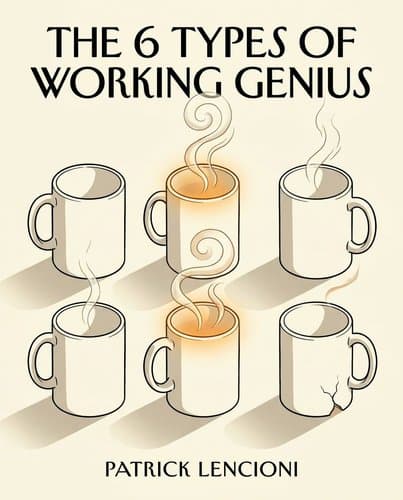
61128912_the-6-types-of-working-genius
by Patrick Lencioni
Working in your frustration zone — not long hours — is the real cause of burnout. Identify your two natural genius types and restructure your work so energy…
In Brief
The 6 Types of Working Genius (2022) introduces a framework for understanding why certain work energizes you and other work drains you.
Key Ideas
Six geniuses organize across three work phases
Every person has exactly two Working Geniuses (activities that energize them almost indefinitely), two Working Competencies (sustainable but eventually depleting), and two Working Frustrations (draining and harmful if prolonged). Tier matters as much as type.
Teams skip Activation, undermining implementation success
The six genius types — Wonder, Invention, Discernment, Galvanizing, Enablement, Tenacity — map onto three work phases: Ideation, Activation, and Implementation. All six are required for any project to succeed; Activation is the phase most teams skip.
Genius mismatch, not motivation, explains struggles
When you or a colleague struggles at a task, ask 'is this a genius mismatch?' before concluding it's a motivation or character problem. The same behavior that looks like laziness or hostility often turns out to be wiring misalignment.
Team maps reveal genius distribution gaps
Draw a Team Map before making personnel decisions. Mismatches between genius distribution and role assignments are usually visible in minutes — and teams diagnose their own problems faster when they can see the map.
Work type, not volume, drives burnout
Burnout is driven by the type of work far more than the volume. Reducing hours doesn't fix burnout caused by working in your frustration zone. The fix is restructuring toward your genius — which usually means someone else needs to pick up what you've been carrying.
Activation phase bridges Ideation and Implementation
The Activation phase (Discernment + Galvanizing) is the most commonly skipped phase in organizations. Without it, good ideas from Ideation reach Implementation without the evaluation and rallying that make execution possible.
Who Should Read This
Business operators, founders, and managers interested in Team Building and Management who want frameworks they can apply this week.
The 6 Types of Working Genius
By Patrick Lencioni
11 min read
Why does it matter? Because the cause of your work frustration probably isn't what you think it is.
Patrick Lencioni spent years surrounded by people he liked, doing work he'd chosen — and still found himself exhausted, snapping at colleagues, staring at his calendar on Sunday nights. Not because the situation was bad. Because he was doing the wrong kind of work for the way he was wired, and he had no vocabulary to name it. So he blamed himself instead.
You've already run the same diagnosis. Wrong boss. Wrong company. Maybe wrong career. And each time the fit improved — new manager, new role, new place — the same low-grade misery came back anyway. That's the part nobody talks about: what happens when the problem follows you.
This book gives you that vocabulary. Six types of work. Three tiers of fit. And a framework precise enough to explain why some tasks fill you up — and why others quietly drain you to nothing.
You've Been Blaming Yourself for the Wrong Thing
Bull Brooks had just finished dressing down two junior employees for typos in a client pitch — not harshly, but with the edge of a man who had been irritated since arriving that morning. Then he turned to Amy, his head of sales, and started riffing on an idea for the next pitch: a family resort in the mountains, something about bringing the memories home. His whole bearing changed. Thirty seconds after the scolding, he was practically buzzing.
Amy watched and asked the question he couldn't answer. "Why are you like this? Thirty seconds ago you were exasperated. Now you're lit up."
Bull had no answer. He had been running his own advertising firm for three years — people he'd hired himself, a shop he'd spent years angling toward — and still he swung between joy and irritability several times a day. His wife had a nickname for the irritable version. His team had learned to wait it out. He had chalked it up to stress, to difficult clients, to the general weight of being the boss. Amy's question cut differently. The problem might not be external at all.
Then she told him something she'd never said out loud. Six months earlier, a competing firm had called her. She had gone in for an interview and seriously considered taking the job. Not because she didn't love the work or the team, but because Bull's mood swings were exhausting to absorb. She came back only because the other firm wouldn't be as interesting. The people closest to you can absorb the cost of your misalignment for a long time before they say anything. And then one day, they almost don't come back.
The pattern predated Bull's company by decades. He had felt the same low-grade Sunday dread at the investment bank where he started out, then at a bank marketing role, then after a corporate acquisition buried him in approval chains and dotted-line management. Each time he had a clean explanation: wrong industry, wrong boss, too much bureaucracy. The explanations changed. The dread kept returning.
What he came to understand, in a whiteboard session that afternoon with Amy and two colleagues, is that the Sunday Blues had never been about the job or the boss. They were a signal. When you spend most of your working hours doing things that drain you (not because you're bad at them, but because they're misaligned with how you're wired), your body starts treating Monday like a threat.
Bull's case is clarifying because the mismatch was invisible even to him. He was competent at the thing draining him. He could rally people, push projects forward, keep momentum alive. But this kind of people-management (what the model would eventually name Galvanizing) cost him something every time. Every hour spent doing it was an hour not spent on what he naturally loved: generating ideas, judging which ones were worth pursuing. He came home depleted. He became difficult to be around.
Most people who feel stuck at work make the same misdiagnosis. They blame the job, the boss, the industry, or, failing a clear culprit, themselves. Bull's team called the look on his face "the face" and started calling him "Lil' Harsh." Those are character explanations — the only kind available when you don't have a better one. What Bull walked out of that whiteboard session with was something more useful: a name for why the Galvanizing hours cost him and the idea-generation hours didn't. He wasn't moody. He was misaligned.
You Have Two Geniuses — And They Explain More Than Any Job Title Ever Could
Think about coffee and how it holds heat. A sealed thermos, the kind you take on a long drive, keeps your drink warm for six, eight hours without effort. A regular mug with a plastic lid stays warm for maybe thirty minutes. A mug with a small crack at the bottom goes cold almost immediately, and you keep picking it up hoping something has changed.
This is the model in a cup.
The model identifies six types of work: Wonder (observing and questioning what could be different), Invention (generating novel solutions from scratch), Discernment (evaluating ideas by instinct rather than domain expertise), Galvanizing (rallying people into action), Enablement (anticipating and meeting others' needs), and Tenacity (pushing a project through to completion). These aren't personality archetypes or job functions. They're categories of activity. Wonder at genius level looks like the person in the planning meeting who keeps pulling the thread: "But have we considered this differently?" Not contrarian. Just powered by the questioning in a way others aren't. Tenacity as a frustration zone looks like finishing a project successfully and feeling hollowed out: the execution grind cost more than it gave back. The question isn't who you are. It's which of these six generates energy when you're doing it, and which ones drain the cup.
Every person has exactly two that act like the sealed thermos. These are your Working Geniuses — the activities that create energy rather than consume it, work you could sustain almost indefinitely. Two more fall in the middle: Working Competencies. You perform them well, sometimes very well, but you're running on borrowed heat. Stay in them long enough and you notice the warmth going out. The last two are your Working Frustrations. The hole in the bottom. Not because you're necessarily bad at them, but because the energy leaves almost as fast as you bring it.
Why exactly two? In assessments Lencioni's team administered across organizations, nearly all participants — ninety-nine out of a hundred — settled on two geniuses when pressed. Even people who initially claimed three or four, asked to separate genuine joy from competence, came back to two. The precision isn't rhetorical. The data kept landing in the same place.
The relief the model provides is specific. Most people who feel depleted at work eventually blame themselves — their attitude, their resilience, their inability to stay motivated. What the model offers instead is a more accurate diagnosis: you may be spending most of your working hours in your Competency or Frustration zones without realizing it. And because you're competent, sometimes excellent, no one, including you, thinks to question what the work is costing.
Lencioni turns the model on himself to make this concrete, and he does it in a way that stings a little. His Working Frustration is Enablement: helping others on their terms. He says confessing this made him feel like he wasn't a kind person. But what he'd discovered was that he doesn't fail at helping. He helps wrong. Every time someone asks for support, his two geniuses (Invention and Discernment) take over. He redesigns the solution rather than executing the request. He evaluates when they just needed someone to carry the box. The frustration isn't indifference. It's a wiring mismatch that doesn't turn off on demand.
That's what the model gives you: somewhere to put the mismatch that doesn't require you to be a worse person for having it. Lencioni said confessing his Enablement frustration made him feel like he wasn't a nice guy. What he'd actually found was that he is — just wired to invent when people needed someone to execute. The flaw he'd been carrying wasn't a flaw. It was a structural thing, sitting in the wrong column.
Your Team Has Blind Spots That Don't Show Up on an Org Chart
Most team dysfunction doesn't show up in performance reviews, org charts, or exit interviews. It shows up as stagnation no one can explain and blame that circulates without landing. The cause is almost always structural: the wrong genius types carrying the wrong work, with no mechanism to make that apparent.
The framework identifies something most organizations don't know they're skipping: a middle phase between generating ideas and executing them. Every team project moves through three stages — questioning and proposing ideas, evaluating and rallying people around them, then getting the work done. Most organizations treat this as two stages. When teams jump from brainstorm directly to implementation, they produce a predictable friction loop: the people who generated the ideas blame the executors for poor follow-through; the executors blame the ideators for impractical proposals. Both sides are diagnosing each other. The real problem is in the missing middle.
That middle phase — Activation — is where Discernment and Galvanizing live. Discernment evaluates an idea before anyone commits to it. Galvanizing enrolls people in moving forward. Without them, good ideas get handed to executors who were never convinced the idea was sound in the first place. The blame loop isn't about attitude. It's about a stage no one named.
The Team Map — a side-by-side visualization of each team member's genius types — makes gaps like this legible. And what tends to happen when a team sees it for the first time is striking: they usually diagnose their own problem before anyone points it out.
Consider a leadership team at a large technology company that had been losing ground to competitors for years, with market share and margins declining without a satisfying explanation. They took the assessment together and saw their collective map. The result was almost comic in its clarity. Not a single member of the leadership team had Wonder as a working genius. For most of them, it was an active frustration. Their only Invention genius — the one person wired to generate novel solutions — was the company lawyer.
A technology company. No one whose energy came naturally from asking what might be different, or what customers might actually need. Just a team that excelled at finishing things, applying enormous Tenacity to a direction no one had seriously questioned in years.
Within minutes of seeing the map, one of the most skeptical executives in the room said what the data had made undeniable: they never stopped to wonder. Every meeting was agendas, numbers, and to-do lists. They were so good at execution that they had never built any mechanism for questioning what was worth executing. He proposed carving out time for Wonder, and everyone agreed.
Then they went further. They rewrote the lawyer's job description on the spot to give him formal responsibility for new technology acquisition. He was energized. The team was relieved. No planning meeting would have surfaced it — but with the map in front of them, it was obvious.
That's what the Team Map offers: a structural picture of what your team is built to do and what it's missing. Once that picture is in front of you — even as a skeptic — the right move tends to name itself.
The Burnout Fix That Treats the Wrong Variable
What if the advice you've been given about burnout is treating the wrong thing entirely?
The standard prescription goes like this: you're burning out because you're doing too much. Take a vacation. Set better boundaries. Find work with fewer demands. This logic is so intuitive that almost no one questions it, and it's almost entirely wrong.
A business owner named Kristal had reached the end of her rope. Already mentally preparing to sell the company she'd built, she described herself as on the verge of burnout — not because she'd lost faith in her people or her work, but because she'd simply stopped being able to sustain it. She took the Working Genius assessment and saw, within fifteen minutes, what had been happening: she'd built her job so that nearly all of her hours were in her frustration zones, the kinds of work that drain faster than they replenish. She had her entire staff take it that same week. They restructured who was doing what. One month later, the question was whether she still planned to sell. "Not a chance," she said. "This is the most fulfilled I've been in years."
She didn't work fewer hours. She changed what the hours were for.
Burnout is caused by type of work far more than volume of work. Someone doing draining work for moderate hours will burn out faster than someone doing energizing work for long hours. The body doesn't keep score the same way. Operating in your genius zones, work replenishes you. Grinding through your frustration zones, even competently, even successfully by every external measure, you leave each day a little more depleted. Enough of that and the deficit becomes structural.
What makes this hard to see is that frustration zones don't always look like struggle from the outside. Competence masks them. Kristal was presumably capable at whatever was draining her — the business survived long enough for her to consider selling. The work was getting done. She just wasn't.
The conventional answer is to do less: reduce hours, take a break, find a less demanding role. That addresses the signal, not the cause. It's quieting the alarm without checking what set it off. Sometimes people do need less. But when the problem is type rather than volume, working fewer hours of draining work is still draining work. The fix that actually works is structural: changing who does what, not how long anyone works. That's what Kristal did. One month later, the company wasn't for sale.
The Question Worth Asking Before You Decide Who's at Fault
It doesn't stay in the conference room.
Consider a husband who spent years reading his wife's reaction to his ideas as quiet hostility. On their wedding anniversary, both took the assessment. He had Invention; she had Discernment. Every response he'd coded as criticism was actually protective evaluation — she was trying to keep him from wasting months on something flawed. He said it was the best anniversary present he'd ever received. Not because anything had changed, but because the same collision that had slowly accumulated into grievance finally had a name that wasn't a character flaw.
Turns out that's mostly what the model gives you. Not a better org chart. Not a more efficient meeting. A question to ask before you reach for blame: whose genius is actually called for here, and are we using it? The answer won't always be comfortable. But it will almost always be more useful than the story you've been telling instead.
Notable Quotes
“That's the problem! I'm so tired of doing Tenacity work but all of it seems to land on my desk!”
“Here is our problem. We never Wonder. We don't contemplate what is going on in the market, what our customers might need, where we're headed. We're all about Tenacity and getting things done.”
“We have to start carving out time to Wonder, and we need to stop making every meeting about agendas and numbers and to-do lists.”
Frequently Asked Questions
- What are the 6 types of working genius?
- The 6 Types of Working Genius identifies six types of work that determine what energizes or drains you: Wonder, Invention, Discernment, Galvanizing, Enablement, and Tenacity. These genius types map onto three work phases — Ideation, Activation, and Implementation — with each phase requiring multiple genius types. Wonder and Invention belong to Ideation; Discernment and Galvanizing to Activation; Enablement and Tenacity to Implementation. Every person has exactly two Working Geniuses (activities that energize them almost indefinitely), two Working Competencies (sustainable but eventually depleting), and two Working Frustrations (draining and harmful if prolonged). All six types are required for any project to succeed.
- How does the working genius framework help reduce burnout?
- Burnout is driven by the type of work far more than the volume, not by hours alone. The Working Genius framework shows that reducing hours doesn't fix burnout caused by working in your frustration zone — the fix is restructuring toward your genius, which usually means someone else needs to pick up what you've been carrying. By identifying your two natural geniuses and two frustrations, you can redesign work to match your wiring. This prevents the harm of prolonged work in frustration zones and helps teams stop attributing struggles to motivation or character problems, recognizing wiring misalignment instead.
- What is the difference between working genius, competency, and frustration?
- The Working Genius framework places every person into three tiers across genius types. Working Geniuses are activities that energize you almost indefinitely, representing natural strength. Working Competencies are tasks you can do sustainably, but they eventually deplete you despite competence. Working Frustrations are draining and harmful if prolonged, representing genuine weakness. Everyone has exactly two in each category. Tier matters as much as type — knowing whether work falls into genius, competency, or frustration zones helps individuals and teams make better role assignments, preventing misreading wiring mismatches as character flaws.
- Why is the activation phase the most commonly skipped in organizations?
- The Activation phase, combining Discernment and Galvanizing, is the most commonly skipped phase in organizations. Without it, good ideas from Ideation reach Implementation without the evaluation and rallying that make execution possible. Discernment evaluates which ideas are viable; Galvanizing rallies people around chosen directions. Teams often jump from generating ideas directly to implementing them, bypassing the critical step of determining which ideas deserve resources. This gap explains why many organizations struggle with execution despite strong ideation. Ensuring all three phases are resourced improves project success and team engagement.
Related Book Summaries

Read the full summary of 61128912_the-6-types-of-working-genius on InShort