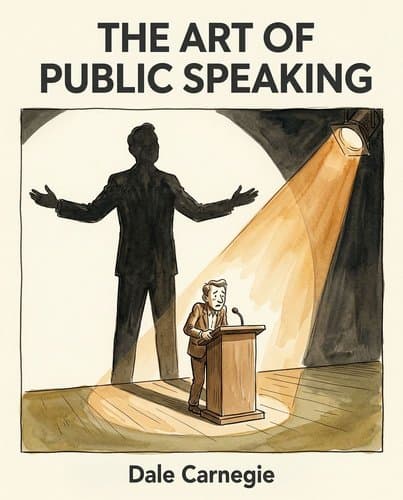
3363618_the-art-of-public-speaking
by Dale Carnegie
Fear—not lack of talent—is the only wall between you and the power to move an audience, and Carnegie shows how genuine preparation, emotional conviction in…
In Brief
The Art of Public Speaking (1915) identifies fear — not lack of talent — as the primary obstacle to effective speaking, and shows how preparation, genuine conviction, and authenticity dissolve it. Drawing on rhetoric, psychology, and practical technique, it equips readers with concrete tools for opening strongly, holding attention, handling hostile audiences, and speaking with natural confidence.
Key Ideas
Conviction beats rehearsal for real confidence
Before your next presentation, develop a genuine conviction — not just facts, but a point of view you'd argue over dinner. Preparation that produces real confidence is about owning a subject emotionally, not rehearsing it verbally.
Craft openings with proven audience hooks
Plan your opening word-for-word in advance. Use a specific story that creates suspense, a fact that touches your audience's self-interest directly, or a question they can't immediately answer. Never open with an apology or a joke you haven't tested live.
Find common ground before resistance solidifies
When facing a skeptical or hostile audience, find what you genuinely share with them and open there. The first 'No' a listener forms — even silently — reorganizes their entire psychology against you and is nearly impossible to reverse.
Make statistics concrete through familiar comparisons
Replace every abstract statistic with a comparison built from your specific audience's frame of reference. 'Eight times the size of Missouri' lands permanently. '590,000 square miles' is gone before the sentence ends.
Channel nervousness into confident physical action
Treat nervousness before speaking as evidence that you're taking the right thing seriously — Cicero called it the mark of all public speaking of real merit. Then redirect it: stand straight, fill your lungs, and act confident until the action becomes the feeling.
Genuine meaning transcends all technique rules
Resist the instinct to follow rules for gestures, pacing, and structure. The only question worth asking before a speech is whether you genuinely mean what you're about to say. If you do, naturalness will follow; if you don't, no technique will compensate.
Who Should Read This
People working on personal growth in Public Speaking and Persuasion, especially those tired of generic motivational advice.
The Art of Public Speaking
By Dale Carnegie
9 min read
Why does it matter? Because stage fright isn't a personality defect — and misunderstanding it is the only thing actually standing between you and an audience.
Carnegie's argument begins with a peculiar observation: virtually every speaker history calls great was physically undone the first time they stood up. Disraeli's maiden speech collapsed into laughter from the floor. Lincoln was barely coherent. The question that follows — what changed? — is what this book spends three hundred pages answering.
Most people carry a quiet conviction that public speaking is a birth lottery, that the room-commanding speaker has something you simply don't. His answer, built over decades of watching ordinary people transform in front of their own eyes, is that this is wrong. The names we remember weren't born comfortable; they were stubborn. Stage fright isn't a verdict on who you are; it's the nearly universal entry fee, paid quietly by almost everyone who ever moved an audience. The question he keeps returning to isn't whether you can learn this. It's whether you want to badly enough to begin.
Disraeli Would Rather Have Led a Cavalry Charge Than Face Parliament — Your Nervousness Is in Good Company
Benjamin Disraeli, who would later become Britain's prime minister, once confessed that standing up in the House of Commons for the first time was so terrifying he would sooner have led a cavalry charge — with all the cannonfire that implied. His maiden speech was a ghastly failure. He sat down humiliated.
He was not alone. So many celebrated English orators bombed their first appearance that Parliament developed a quiet superstition: if a young man's initial speech goes well, something is probably wrong with him. Early success came to feel like a warning sign, as if the serious ones always floundered first.
Carnegie catalogues the afflicted with almost gleeful precision. William Jennings Bryan, considered by many the greatest American orator of his generation, had knees that buckled during his first attempts. Mark Twain stepped up to lecture and felt his mouth go cotton-dry. Ulysses Grant, fresh from taking Vicksburg, trembled at a lectern. Jean Jaurès, later the dominant voice in the French parliament, sat in the Chamber of Deputies for a full year without opening his mouth.
You don't get a list that long by accident. They felt the stakes. That's why Carnegie said he was always glad when a new student showed up shaky — it meant someone who understood that speaking to an audience matters. Cicero made the same point two thousand years earlier: all public speaking of real merit is characterized by nervousness.
The fear you feel is not a verdict on your potential. It is the price of admission — paid, Carnegie notes, by virtually everyone who later spoke well. The question is never whether you'll feel it. The question is what you do with it in the first thirty seconds after you stand up.
Lincoln Was Still Revising on Horseback — Preparation Means Conviction, Not Rehearsal
One afternoon, a woman stooped with age shuffled into Lincoln's Springfield law office. A pension agent had taken two hundred dollars from her — exactly half the pension she was owed for her late husband's service in the Revolutionary War. Lincoln filed suit immediately.
He had a case to prepare. He read a biography of Washington and a history of the Revolutionary War, specifically to stir his own blood before he spoke. When he stood before the jury, he didn't lead with the contract violation. He described Valley Forge: patriots marching through ice and snow on bare, bleeding feet, hungry and half-clothed. Then he turned to the man who had fleeced the widow of one of those heroes out of half what was hers. Several jurors wept. They found for every cent she asked.
His partner discovered the case outline afterward, scrawled on a scrap of paper: Revolutionary war. — Describe Valley Forge privations. — Skin Def't. — Close.
"Skin Def't." was Lincoln's shorthand for skinning the defendant — exposing his conduct before the jury. Four words. The Valley Forge passage got more space. The legal substance sat at the top almost as an afterthought, because the real preparation had been emotional, not verbal. Carnegie's point: what an audience receives is the state the speaker is in. Words are almost incidental. Preparation means arriving at genuine conviction — not rehearsing talking points, but brooding over something until it grips you.
The Gettysburg Address shows the same method run over weeks — Lincoln building emotional possession of the material long before he opened his mouth. He carried a draft in the crown of his stovepipe hat for the entire month before the dedication. The night before the ceremony, he read the speech aloud in his Secretary of State's room for criticism. He revised it again over breakfast the next morning. When the procession finally started, Colonel Carr, riding just behind the president, watched Lincoln's erect posture slowly collapse: arms limp, head bowed, somewhere else entirely. Ten sentences. Still being worked over in the saddle, still being made fully his own, while fifteen thousand people waited.
Build the conviction first. Read the thing that makes the injustice feel real. Watch the documentary. Talk to the person most affected. Arrive already moved. The words follow.
The Technique That Destroys Most Speeches Is Too Much Technique
The surest way to ruin a speech is to study how to give one.
The irony is that you're reading this argument inside a book structured almost entirely as a rulebook: chapters with itemized summaries, pronunciation drills, step-by-step prescriptions. Carnegie knows it. What he's attempting is stranger than it looks: techniques designed to return you to the spontaneous state you occupied before you learned any techniques. The rules are scaffolding meant to come down. The goal is to sound like yourself.
Carnegie's first lesson in public speaking — from a college president in the Midwest — was a gesture drill. He learned the exact arm angle, the precise wrist rotation, the correct order to unfold his fingers: index first, then the second, then the little finger last. When the movement was complete, the arm retraced the same arc. He practiced dutifully. Decades later, he called it hollow as a ventriloquist's dummy going through scripted motions, as recognizably fake as an actor hitting a mark. Not merely useless. Positively harmful. The drill trained him to move as no human being actually moves, severing the link between what a body does and what a person feels.
Compare that to Sherman Rogers, a lumberjack Carnegie heard at the St. Louis Chamber of Commerce. Rogers made grammatical errors, lacked polish, did half a dozen things wrong. But when he talked about men working and dying in the logging camps, men he actually knew, his hands went to the story on their own. He didn't gesture on cue. His body moved because he couldn't keep it still. Carnegie called it one of the best talks he'd ever heard: a raw piece of experience torn out of a real life.
Gesture is like kissing, Carnegie argues, or like seasickness — involuntary, the outward expression of an inward state. Impose a learned sequence on top and the audience sees something they can't name but immediately feel. The arm goes up, the wrist turns, the fingers unfold in practiced order. But the eyes don't match. The timing is a half-beat off. Nobody in the room could explain what's wrong. They just lean back slightly. They're no longer listening to a person; they're watching someone act like a speaker. Nine-tenths of what has been written on gesture, Carnegie concludes, wastes the paper it's printed on.
Your Opening Gets One Chance, and Most Speakers Hand It Back
A prominent government official took the podium at a New York Rotary Club luncheon knowing his subject cold. He knew more about his department's work than he could have used in the time allotted. What he hadn't done was plan. He didn't know where he was going when he started, but he was on his way.
The result was carnage. He served the dessert first, then the soup, then fish and nuts, then something that seemed to be all of it mixed together. When he realized he'd lost the thread, he produced a bundle of notes his secretary had compiled, pages in no apparent order, and shuffled through them fruitlessly while trying to keep talking. Water arrived; his hand shook as he lifted the glass. He repeated himself. Perspiration gathered on his forehead. The audience sat in frozen discomfort — the particular suffering of watching someone capable humiliate themselves in public. When he finally sat down, it was a relief to everyone in the room, including him. He had begun with no idea what he'd say and ended with no idea what he'd said.
Carnegie's diagnosis is clean: a speech is a voyage, and a voyage requires a chart. The official's expertise was never the problem. The problem was treating the opening as the place where you figure out what you're doing. That's exactly when the audience is most alert and most impressionable, the only moment you'll have with minds this fresh. Leave it to chance and you've already lost.
What a planned opening can do instead: a student in Carnegie's course built a mystery around an 82-year-old book. He described friends on a London street asking each other "Have you read it?", a thousand copies sold on publication day, J.P. Morgan purchasing the manuscript for a price never disclosed. By the time he revealed the book was Dickens's A Christmas Carol, the room had been in suspense for three paragraphs and couldn't have walked away if it tried.
Two mistakes cut off most speakers before they've begun. One is the apology — "Unaccustomed as I am to public speaking" tells the audience you didn't think them worth the preparation. The other is the borrowed joke. Ninety-nine speakers will fail with the exact story that made Mark Twain famous; timing can't be borrowed. Plan the opening word for word. It costs almost nothing. Lose the opening and the rest of the speech is spent climbing back.
Nobody Is Persuaded by the Best Argument — They're Persuaded by the Story They Tell Themselves
Southern Illinois, 1858. Lincoln has been announced to speak in the part of the state locals called "Egypt" — rough country where men carried knives and pistols to public gatherings and had already sworn to run this antislavery man out of town before he got three sentences out.
Before he opened his mouth, he asked to be introduced to the ringleaders. He shook their hands.
Then he began: I am one of you. I was born in Kentucky and raised in Illinois, just like most of you, working my way along by hard scratching. He named them, claimed them, placed himself inside their story before they could place him outside it. Those same men cheered when he was done. Several became some of his most ardent supporters when he ran for president.
When a person says "no" — even when they merely form the thought — their entire organism tightens against acceptance. Muscles, glands, posture: everything pulls back. Once that happens, you are not arguing against a position. You are arguing against a person's need to stay consistent with themselves. The psychologist Harry Overstreet put it plainly: the more "yesses" you can induce at the outset, the more the mind moves into open reception rather than braced resistance.
Lincoln's approach wasn't charm. It was architecture. He didn't lead with his case. He found the ground both sides were already standing on. We're all from here. We've all worked hard. We all deserve a fair hearing. From that agreed foundation, he moved the argument only after the audience had already traveled with him. Carnegie calls it "a common ground of agreement," but the mechanism is more precise than that phrase suggests. You're not warming people up before the real pitch. You're keeping them out of the posture of rejection long enough for evidence to reach them.
The extreme version is Mark Antony at Caesar's funeral. Antony never tells the crowd what to conclude. He presents facts — ransoms filling the public treasury, the crown refused three times, the will leaving Caesar's private gardens to ordinary Romans — asks questions, pauses, lets grief do the work. The crowd arrives at fury themselves. They believed it the way you believe something you've figured out on your own, which is the only way belief sticks.
If Your Audience Can't Picture It, It's Gone Before You Finish the Sentence
Why do some explanations land and others evaporate before the speaker sits down?
Carnegie watched a lecturer at a Missouri teachers' college describe Alaska: 590,804 square miles, population 64,356. Numbers delivered, duty discharged. The audience heard them and immediately didn't have them — figures that attach to nothing in the mind and slide off like rain on glass. Carnegie's fix was simple: tell that Warrensburg audience that Alaska is eight times the size of their own state, with barely thirteen times as many people as live right here in town. Same information. Completely different result, because the second version is built from material the audience already owns.
The rule: don't explain what you know, translate it into what your listener already knows. Missionaries in equatorial Africa had to render "white as snow" for people who had never seen snow and had no word for it. A literal translation meant nothing. So they wrote "white as coconut flesh," because those people climbed coconut trees for lunch. Carnegie calls it hard to improve upon. It isn't a flourish. It's the only version that could work for that specific audience.
Both examples carry the same requirement, and it's easy to miss: translation is specific. The coconut answer only works for people who know coconuts. The Missouri comparison only works for people who know Missouri. Before you open your mouth, you have to actually reckon with who is in the room — what they've seen, what they measure things by, what world they return to when the talk is over. Skip that work, and you end up like the Alaska lecturer: accurate, thorough, and immediately forgotten. The audience heard 590,804 square miles and immediately didn't have it. That's where the speech goes when the speaker never asked who they were talking to.
The Skill Doesn't Require a Gift — It Only Asks That You Keep Standing Up
Lincoln had less than a year of schooling across his entire life. He walked thirty miles to hear a good speaker, then practiced his own talks in open fields and before crowds at the country store. He was awkward, shy, and had to be coached toward confidence. That man wrote Gettysburg.
Carnegie's real argument, running beneath all the technique, is simpler than the chapters suggest: the ability to speak well isn't distributed at birth. It accumulates in whoever keeps standing up after it goes badly. He watched it happen in ordinary rooms — people mute with fear in January, speaking fluently by spring. Not because something changed in them. Because they stayed.
What connected Disraeli and Bryan and Twain and Lincoln, so unlike each other in every other way, was that each had something they genuinely needed to say.
The plateau is real. So is what's on the other side of it. You just have to be stubborn enough to find out.
Notable Quotes
“fifteen times in a forenoon”
“have very little attention value. But isn't it easy to listen to the flogging count? The old method of writing a biography was to deal in a lot of generalities, which Aristotle rightly called”
“The new method is to deal with concrete facts that speak for themselves. The old-fashioned biographer said that John Doe was born of”
Frequently Asked Questions
- What is The Art of Public Speaking about?
- The Art of Public Speaking (1915) identifies fear — not lack of talent — as the primary obstacle to effective speaking. The book shows how preparation, genuine conviction, and authenticity dissolve this fear. Drawing on rhetoric, psychology, and practical technique, it equips readers with concrete tools for opening strongly, holding attention, handling hostile audiences, and speaking with natural confidence. Carnegie emphasizes that real confidence comes from owning a subject emotionally, not just rehearsing facts verbally. The book provides actionable strategies across all aspects of public speaking.
- How should you plan your opening in The Art of Public Speaking?
- Plan your opening word-for-word in advance. Use a specific story that creates suspense, a fact that touches your audience's self-interest directly, or a question they can't immediately answer. Never open with an apology or a joke you haven't tested live. This preparation doesn't mean rigid memorization; it means crafting your first moments to immediately capture attention. Carnegie emphasizes that your opening determines whether listeners lean in or tune out, making intentional planning essential to establishing credibility from the start.
- What does The Art of Public Speaking teach about handling hostile audiences?
- When facing a skeptical or hostile audience, find what you genuinely share with them and open there. The first 'No' a listener forms — even silently — reorganizes their entire psychology against you and is nearly impossible to reverse. This reveals why the opening is critical: listeners form rapid judgments that become difficult to change. By identifying common ground first, you create an opening for genuine dialogue. Carnegie treats hostile listeners not as adversaries but as people with whom you share real values worth emphasizing from your first words.
- How does The Art of Public Speaking recommend using statistics?
- Replace every abstract statistic with a comparison built from your specific audience's frame of reference. 'Eight times the size of Missouri' lands permanently. '590,000 square miles' is gone before the sentence ends. This principle reveals how human memory works: audiences retain vivid, relatable comparisons far longer than raw data. By anchoring numbers to your listeners' existing knowledge, you transform forgettable statistics into lasting impressions. Carnegie emphasizes that effective speaking requires translating abstract information into concrete, audience-specific language.
Related Book Summaries
Read the full summary of 3363618_the-art-of-public-speaking on InShort